


The Best Casino in Adelaide in 2026 Is Adelaide Casino — and That Is Almost the Whole Story
 Available in US
The best casino in Adelaide is the one that has held the licence since 1985. Adelaide Casino sits inside the heritage-listed railway station on North Terrace, runs 90 gaming tables and 950 gaming machines under the Casino Act 1997, and will hold its table-game monopoly in South Australia until 30 June 2035. Everything else a reader might be weighing against it is operating in a space the Interactive Gambling Act 2001 prohibits. This page is built around that fact. It describes the venue that is actually licensed to offer casino games in Adelaide, then walks through the offshore market the ACMA has been steadily blocking since November 2019, and the legal and wellbeing framework that puts a wall between the two.

Data current as of 24 September 2026 · Verified against the ACMA’s register of blocked websites and formal warnings
Table of Contents
- Adelaide Casino on North Terrace: the single venue the question can name
- Gaming tables, pokies and the rest of the floor
- The Landscaping of Offshore Sites
- The fundamentals of Adelaide’s casino market
- The prohibition framework and ACMA enforcement
- Wellbeing tools and where Adelaide players get help
- Frequently asked questions
Adelaide Casino on North Terrace: the single venue the question can name
The question “best casino in Adelaide” answers itself the moment a reader stops treating it as a ranking. There is no competition to rank. Adelaide Casino has been the only venue licensed to offer casino games in South Australia for forty years, and its exclusivity was extended through to 30 June 2035 under a licence formalised on 11 October 2013. The building is the Adelaide railway station, heritage-listed, opened on the same site in 1852 and rebuilt after a major 1920s refit. The casino’s gaming floors occupy the western wing of the station and the riverside extension. The address is North Terrace, Adelaide, in the cultural precinct that runs from the railway station past Parliament House to the Adelaide Festival Centre on the River Torrens.
The venue opened on 12 December 1985 under South Australia’s then state-owned Lotteries Commission. SkyCity Entertainment Group, the New Zealand-listed operator, acquired the venue in June 2000, rebranded it SkyCity Adelaide in April 2001, and dropped the SkyCity name in 2009 when its Australian operation reverted to the plain Adelaide Casino. The Riverbank precinct redevelopment, run between 2015 and 2021 at a cost of about A$330 million, added the EOS by SkyCity tower, which opened in 2021 with 120 hotel rooms and the expanded gaming floor that today carries the bulk of the table and machine count.
What a visitor walks into today is a 90-table, 950-machine gaming floor under a single roof, regulated by the South Australian Independent Gambling Authority and the state’s Liquor and Gambling Commissioner. In the 2007-08 financial year the venue paid more than A$41 million in state taxes and charges. That figure sits beside a regulatory carve-out few players notice: Adelaide Casino has no maximum-bet limit, even though the same South Australian statute imposes a A$5.00 maximum bet on gaming machines outside the casino. The exemption is the casino licence’s quietest privilege, and it is the structural reason a high-limit machine player ends up at Adelaide Casino rather than at a pub down the road.
Comparison of Licensed and Offshore Gaming
| Feature | Licensed Venue (Adelaide Casino) | Offshore Casino |
|---|---|---|
| Regulatory Body | SA Independent Gambling Authority | None (in Australia) |
| Recourse for Disputes | SA Gambling Authority / Ombudsman | None / None |
| Player Protection (BetStop) | Yes (for licensed wagering) | No |
| Tax on Winnings | Tax-neutral (recreational) | Tax-neutral (recreational) |
The licence is the part that explains why “best” is a near-tautology. Under the instrument formalised on 11 October 2013, the venue’s table-game monopoly in South Australia was extended to 30 June 2035. The same instrument set the venue’s maximum footprint: up to 200 gaming tables and up to 1,500 gaming machines, both “subject to redevelopment.” The state set the ceiling. Whether SkyCity ever reaches it depends on capital plans that are not visible in the public record. No competitor’s planning application can force the issue, because there is no competitor’s planning application. The licence is exclusive.
Visiting the venue
Practical details for a first-time visitor follow from the building’s location more than from the licence. The casino entrance faces the railway station plaza on North Terrace. Entry requires photo identification and proof of age — the floor is open only to people aged 18 and over. Dress is smart casual; the venue publishes the standards on its own site. Public transport delivers visitors directly: the Adelaide Railway Station is the building, the tram stops on North Terrace, and the city’s free city-loop bus stops within a block. The casino does not operate its own car park. Visitors drive to the nearby UPark facilities on Hindley and Rundle Streets instead.
Hotels within walking distance
Two hotels sit within easy reach on foot. The EOS by SkyCity tower, opened in 2021 as part of the A$330 million redevelopment, has 120 rooms and connects directly into the gaming floor — guests step out of the lift into the venue. The InterContinental Adelaide, on North Terrace roughly 350 metres east, is the next nearest casino-adjacent option, a five-minute walk along the same terrace. The Mayfair Hotel and the Pullman Adelaide sit in the CBD’s east end, both within a ten-minute walk. The Stamford Grand Adelaide, on Moseley Square in Glenelg roughly 9 km southwest, is reachable by a short tram ride rather than by walking, and is more useful for a beach-side stay than for casino convenience.
Restaurants and bars on the floor
The casino floor runs restaurants, bars and a rooftop venue. The heritage building’s bistro and the EOS tower’s higher-end restaurants cover the casual and special-occasion ends of the dining spectrum. The rooftop bar — the venue’s clearest distinguishing amenity in a state where no other casino competes with it — looks over the River Torrens and the Adelaide Oval. A sports bar and a late-night bar run on the gaming floor itself. Outside the venue, Rundle Street and the surrounding East End carry the bulk of Adelaide’s restaurant density, and Gouger Street in the west end runs the city’s Chinatown strip. None of these venues is licensed by the casino; they happen to be nearby.
Gaming tables, pokies and the rest of the floor
Adelaide Casino’s gaming mix sits inside a wider South Australian market the licence governs. The state had 11,672 gaming machines outside Adelaide Casino in 471 venues as of September 2023 — pubs and clubs operating under the same A$5.00 maximum bet and 87.5% minimum return-to-player rate. Adelaide Casino carries 950 of those machines itself and 90 gaming tables in addition. The two halves of the state’s machine market are not equivalent products: the casino’s machines are not subject to the A$5.00 cap, the venue is open later than most pubs, and the floor also runs the table product the licensed pubs and clubs do not.
Table games: blackjack, baccarat, roulette, craps
The table-game floor carries the games Australian readers will recognise from every other casino they may have visited. Blackjack runs at the largest number of tables. The rules follow Australian and New Zealand convention — six or eight decks, dealer stands on soft 17 at most limits, with surrender offered at the higher limit rooms. Baccarat runs as both the standard punto-banco version and a mini-baccarat variant at lower minimums. Roulette runs as both single-zero and double-zero wheels; the double-zero version is closer to the American layout than the European single-zero variant most Adelaide readers will know from Crown Melbourne. Craps is also on the floor, though the venue markets the other three games more aggressively.
Table limits run from a low-stakes entry tier to high-roller rooms in the EOS tower. The casino publishes current limits on its own gaming pages rather than as a static table. Readers planning a specific limit should check before visiting, particularly in the lower-stakes rooms where minimums move with demand. The house edge on each game is the standard published edge — blackjack around half a per cent with basic strategy, baccarat below that on the banker bet, roulette about 2.7% on the single-zero wheel and 5.26% on the double-zero wheel — and the rules are conventional enough that a player who knows the game from any other Australian venue will not be surprised.
Pokies and slot machines
The 950 gaming machines are the volume product. Most sit on the main gaming floor in clusters themed by denomination — one-cent, two-cent and five-cent lines. A standalone area inside the EOS tower carries the higher-limit machines, including the linked progressive jackpots. South Australian statute sets the minimum return-to-player at 87.5%, which the casino honours on every machine on its floor. The practical effect for a player: across the venue’s machines, theoretical returns cluster at or slightly above the floor. That figure is not a prediction. Variance on any single session runs wide, and the long-run return is an average across millions of spins rather than a session outcome. A player who walks in with a budget and a time limit will keep more of either than a player who walks in with neither.
The wider South Australian pokies market
Adelaide Casino’s machines sit inside a much larger non-casino machine market. South Australia’s 11,672 gaming machines outside the casino, in pubs, clubs and hotels across 471 venues as of September 2023, accounted for player losses of about A$0.92 billion in 2022-23 — a per-adult figure of roughly A$497. Adelaide Casino’s machine and table product sits inside the state total but is not separately broken out in the public statistics. What the casino offers that pubs and clubs do not is the table product, the bar and restaurant mix, and exemption from the A$5.00 bet cap. Outside the licence, every other machine in the state runs inside the cap and inside the return-to-player floor.
How the mix compares to nearby states
The broader Australian market puts the South Australian numbers in context. Queensland had 21,122 gaming machines operating in 351 venues as of October 2023 — roughly 1.8× the South Australian non-casino machine count. The ACT was far smaller, with 3,587 gaming machines operating across 46 venues on 1 November 2023 and player losses of A$0.19 billion in 2022-23. Casino Canberra, the only licensed ACT casino, runs no poker machines at all; its licence covers 39 gaming tables for blackjack, roulette, baccarat and a poker lounge — the structural feature of the smallest mainland casino market.
Crown Melbourne, The Star Sydney and Crown Perth are the venues an Adelaide reader would compare to Adelaide Casino on scale. None of them answers the question for an Adelaide resident; the venue on North Terrace is the only one an Adelaide reader does not need to fly to. The Star Brisbane, which opened at the A$3.6 billion Queen’s Wharf precinct on 29 August 2024, is the closest geographic peer in scale, but a flight away. Casino Canberra is a closer option in some respects — same legal regime, smaller venue, no machines — but it sits across the border and answers a different question.
The Landscaping of Offshore Sites
A reader who lands on this page is, with high probability, weighing one or more of the brands below against the licensed venue just described. None of them is licensed in Australia. The Interactive Gambling Act 2001 makes it an offence to provide online casino games to a person physically in Australia, and no state or territory issues the kind of licence that would authorise them. The brands below have nevertheless advertised to and accepted Australian customers, which is why the Australian Communications and Media Authority has issued formal warnings against each. The table summarises the ACMA’s actions; the write-ups below sit with each brand and explain what the warning meant.
| Brand | ACMA action and date | Operator named by the ACMA | Subject support |
|---|---|---|---|
| RocketPlay | Formal warning, March 2026 (Pulsup Ltd); earlier May 2022 (Dama N.V.) | Pulsup Ltd; Dama N.V. | — |
| Level Up Casino | Formal warning, May 2022 | Dama N.V. | Listed in industry directories |
| Woo Casino | Formal warning, March 2025 | Dama N.V. | Listed in industry directories |
| Spirit Casino | Formal warning, May 2025 | Dama N.V. | — |
| National Casino | Formal warning, July 2025 | Consolutetish S.R.L. | Listed in industry directories |
| Bizzo Casino | Formal warning, July 2025 (Consolutetish); 2022 (TechSolutions) | Consolutetish S.R.L.; TechSolutions | — |
| Ignition Casino | Formal warning, July 2025 | Bamboo Media | — |
| Instant Casino | Formal warning, February 2025 | EOD Code SRL | — |
| Jackbit | Formal warning, April 2026 | Ryker B.V. | — |
| Casino Intense | Formal warning, April 2025 | Sterplay Holding Ltd | Listed in industry directories |
| Sky Crown | Formal warning, September 2022 (Hollycorn N.V.) | Hollycorn N.V. | Listed in industry directories |
The “subject support” column follows what industry directories report — some directories still carry pages for these brands — and says nothing about whether the brand itself operates legally in Australia. It does not. The ACMA’s actions are the only authoritative statement on each brand’s status for an Australian reader.
RocketPlay
The ACMA issued a formal warning to Pulsup Ltd over RocketPlay in March 2026. A separate, earlier formal warning had already named Dama N.V. as the operator in May 2022. The progression tells its own story: the ACMA warned Dama N.V. once, the corporate group restructured or rebranded into Pulsup Ltd, and the ACMA warned the new entity. The practical conclusion for an Adelaide reader is unchanged. RocketPlay is prohibited from being offered to people in Australia. Any bonus or payout the marketing surfaces cannot be enforced under Australian consumer law; the offshore licence the brand displays carries no weight on Australian soil.
Level Up Casino
Level Up was named in the same Dama N.V. formal warning in May 2022 that covered four other brands from the same operator group. Some industry directories still list the brand; that is the entire scope of its “subject support.” The ACMA’s position is that the brand has offered prohibited services to Australians and the warning is the formal record. A reader weighing a Level Up offer against a visit to Adelaide Casino is weighing a service the regulator says it should not be offering against the only venue in the state licensed to offer the equivalent product.
Woo Casino
The ACMA issued a separate formal warning to Dama N.V. specifically over Woo Casino in March 2025. Woo is one of the cluster of brands tied to the same operator as Level Up, RocketPlay, Spirit and four others. Industry directories continue to list the brand; the ACMA’s intervention is the only statement that matters under Australian law.
Spirit Casino
Spirit Casino sits with the May 2025 ACMA formal warning to Dama N.V., closing out the second of two 2025 actions against the operator. No “subject support” data is available — Spirit is not carried in the industry directories that list the other Dama brands. The regulatory position is the same as for Woo and RocketPlay, and the same conclusion applies to a reader comparing the brand to the licensed Adelaide venue. The silence in directories does not change the regulator’s view; it just means the marketing footprint is smaller.
National Casino
The ACMA’s July 2025 formal warning named Consolutetish S.R.L. as the operator behind National Casino. Industry directories carry the brand; the ACMA’s position is that National has offered prohibited services to Australians. The corporate structure of Consolutetish is opaque; the ACMA does not list a controlling shareholder, and a reader who looks for one will not find a clean answer. For an Adelaide reader, the warning is what the regulator says it is — and what the regulator says is that the supply is prohibited.
Bizzo Casino
The July 2025 warning to Consolutetish S.R.L. also covered Bizzo Casino, and a 2022 formal warning had already named TechSolutions (CY) Group Limited and TechSolutions Group N.V. as the operator behind it. Bizzo is one of the longest-running ACMA-actioned brands in this list; the 2022 warning makes the 2025 action a second visit. The conclusion for a reader weighing Bizzo against Adelaide Casino is unchanged. A warning issued three years ago is not a warning that was lifted; the second warning is the regulator’s statement that the first one was not enough.
Ignition Casino
The July 2025 warning to Bamboo Media named Ignition Casino. Ignition’s prior Australian exposure is limited; the brand carries an offshore licence rather than any Australian registration. For an Adelaide reader, the warning is the ACMA’s record; the offshore licence is irrelevant for that reader’s purposes. The brand has been marketed into the Australian market through affiliate channels rather than through direct sponsorship, which is the pattern across the brands on this list that do not show up in mainstream affiliate directories.
Instant Casino
The ACMA issued a formal warning to EOD Code SRL over Instant Casino in February 2025. Instant Casino markets aggressively to Australian players and is one of the more visible offshore brands in the Australian market. The warning does not stop an Australian player from visiting the site; it stops an Australian provider from accepting their custom legally. The site can still operate; the legal weight sits with EOD Code SRL, not with the customer. For a reader who has already deposited, the practical position is unchanged by the warning.
Jackbit
The ACMA issued a formal warning to Ryker B.V. over Jackbit in April 2026. Ryker is also the operator behind CasinOK, named in the same warning. Jackbit is one of the brands that lists both sports-betting products and a casino product on the same site, a structure the ACMA has consistently treated as prohibited for the casino product where Australian customers are concerned. The sports-betting product is a different regime under Northern Territory licences; the casino product is not.
Casino Intense
The ACMA issued a formal warning to Sterplay Holding Ltd over Casino Intense in April 2025. Some industry directories carry the brand; the regulatory position is the same as for the rest of this list. A reader weighing a Casino Intense offer against a visit to Adelaide Casino is weighing an offer the regulator has warned against against the only venue licensed to offer the equivalent in South Australia. The licensing footprint shown on the Casino Intense site sits in a jurisdiction that does not cover Australian customers.
Sky Crown
The ACMA issued a formal warning to Hollycorn N.V. over Sky Crown, alongside a sister brand Blue Leo, in September 2022. Sky Crown is one of the earlier names on this list, and its long marketing life in the Australian market explains its continued presence in industry directories. Hollycorn is also behind a string of other brands the ACMA has acted on. For an Adelaide reader, the warning is what the regulator says it is, and the ACMA’s patience with Hollycorn has not been visibly rewarded.
What the pattern means
A reader could be forgiven for asking what a formal warning actually does. It is not a fine. It is not a prosecution. It is the regulator’s recorded statement that the named operator has offered prohibited services to Australians and that further action will follow if the conduct continues. The pattern across these eleven brands is consistent: the ACMA names an operator, the operator restructures or rebrands, and the ACMA warns the new entity. The legal position for an Australian player does not change between iterations. The site on the screen is illegal; the licence it displays is irrelevant for an Adelaide reader.
The follow-on actions the ACMA can take include directing Australian ISPs to block the site, referring the matter to the Australian Federal Police, and publishing the warning on its own register. The cumulative effect is that the brand’s reach into Australia narrows over time even when the underlying corporate entity changes names. That is the design of the regime. Each individual block expires a piece of the marketing funnel rather than dismantling the whole enterprise, but the cumulative effect is what mattered to the brands above. None of them is invisible to the regulator any longer, and several of them have cycled through more than one warning.
The fundamentals of Adelaide’s casino market
The headline of the Adelaide market is its concentration: one licence, one venue, and a regulatory framework that shuts out most of what offshore operators offer. That concentration is what makes “best” a non-question at the venue level and a structural question at the market level. The fundamentals below are the building blocks for the second half of the answer.
Market structure
South Australia’s gaming-machine losses outside Adelaide Casino totalled about A$0.92 billion in 2022-23, a per-adult figure of roughly A$497. Adelaide Casino’s own losses sit inside that total but are not separately broken out in the public statistics; the venue’s 950 machines and 90 tables are a sub-share of the state figure. The pattern repeats in every state — casinos are a minority of total gaming losses by venue count, but a material share by total stake.
The wider picture is the offshore share. H2 Gambling Capital’s 2025 report estimated that Australians lose about A$3.9 billion a year to illegal gambling sites, with the share of gambling going through legal channels falling from 74% in 2021 to 64% by 2025. That ten-percentage-point slide across four years is the structural backdrop the ACMA’s blocking programme is responding to. Each blocked site removes one node from the illegal supply chain; each formal warning — including the March 2025 warning over Woo Casino and the May 2025 warning over Spirit Casino, both naming Dama N.V. as the operator — forces one operator to choose between continuing to take Australian customers and continuing to hold licences in jurisdictions that do not tolerate that conduct.
The single licence and what it allows
Adelaide Casino’s licence is granted under the Casino Act 1997 and regulated by the South Australian Independent Gambling Authority and the state’s Liquor and Gambling Commissioner. The licence makes the venue the only operator in South Australia legally permitted to offer casino table games. The same instrument caps the maximum number of gaming tables at 200 and gaming machines at 1,500, both subject to redevelopment. The venue’s current footprint — 90 tables, 950 machines — sits well inside those ceilings.
The state sets a minimum return-to-player rate of 87.5% on gaming machines outside the casino, and Adelaide Casino applies the same minimum on its floor. Outside the casino, the same statute imposes a A$5.00 maximum bet per spin; the casino is exempt. The carve-out is what allows higher-stakes play on the same machines the venue runs at lower limits. For an Adelaide reader used to pub or club poker machines, the difference is the betting envelope rather than the games.
The credit card and crypto ban
Since 11 June 2024, credit cards, credit-related products and digital currency have been banned as payment for licensed online wagering in Australia, with operator penalties up to $247,500 for breach. Legal deposit routes for licensed wagering are debit card, bank transfer, PayID/Osko and BPAY. An offshore site asking an Australian customer for a credit card or a crypto deposit is operating outside the Australian rules even where wagering is concerned. For casino games, the rule does not formally apply because the casino product itself is prohibited; the credit-card ban is part of the licensed-wagering regime rather than a separate casino prohibition. The structural point is the same: the more “alternative” the deposit method, the further the offer sits from anything the Australian rules contemplate.
The Northern Territory detail
A fact that complicates the headline sits on the betting side of the market, not the casino side. The Northern Territory Racing and Wagering Commission regulates 52 of Australia’s online bookmakers — Sportsbet, Bet365 and Ladbrokes among them — under territory licences taken up for tax reasons. The commission has no full-time staff and meets once a month in Darwin. That is the structure that licences online wagering in Australia: a thin regulator in a small jurisdiction issuing licences to large multinational operators. Casino games are not covered by those licences; the IGA carves them out. The NT structure explains why online sports betting is legal in Australia and online casino is not. The distinction is the one that catches the most Australian readers, because both products are marketed through the same affiliate channels and appear in the same browser tabs.
What changes if you cross to offshore
Both markets charge a house edge and both offer blackjack, roulette and baccarat. The differences are not in the game rules but in what surrounds the game. Adelaide Casino sits under a state regulator with a complaint process and a self-exclusion scheme; an offshore operator sits under none. Adelaide Casino pays state taxes and reinvests on the riverbank; an offshore operator pays whatever its jurisdiction requires. Adelaide Casino’s house edge is the same edge the same game has anywhere; the difference is the recourse when something goes wrong. For a reader weighing a venue visit against an offshore product, that is the variable the maths doesn’t show. A withdrawal refused by Adelaide Casino can be raised with the SA Independent Gambling Authority; a withdrawal refused by an offshore site can be raised with the regulator in whatever jurisdiction the site is nominally licensed in, which usually has no Australian desk.
The prohibition framework and ACMA enforcement
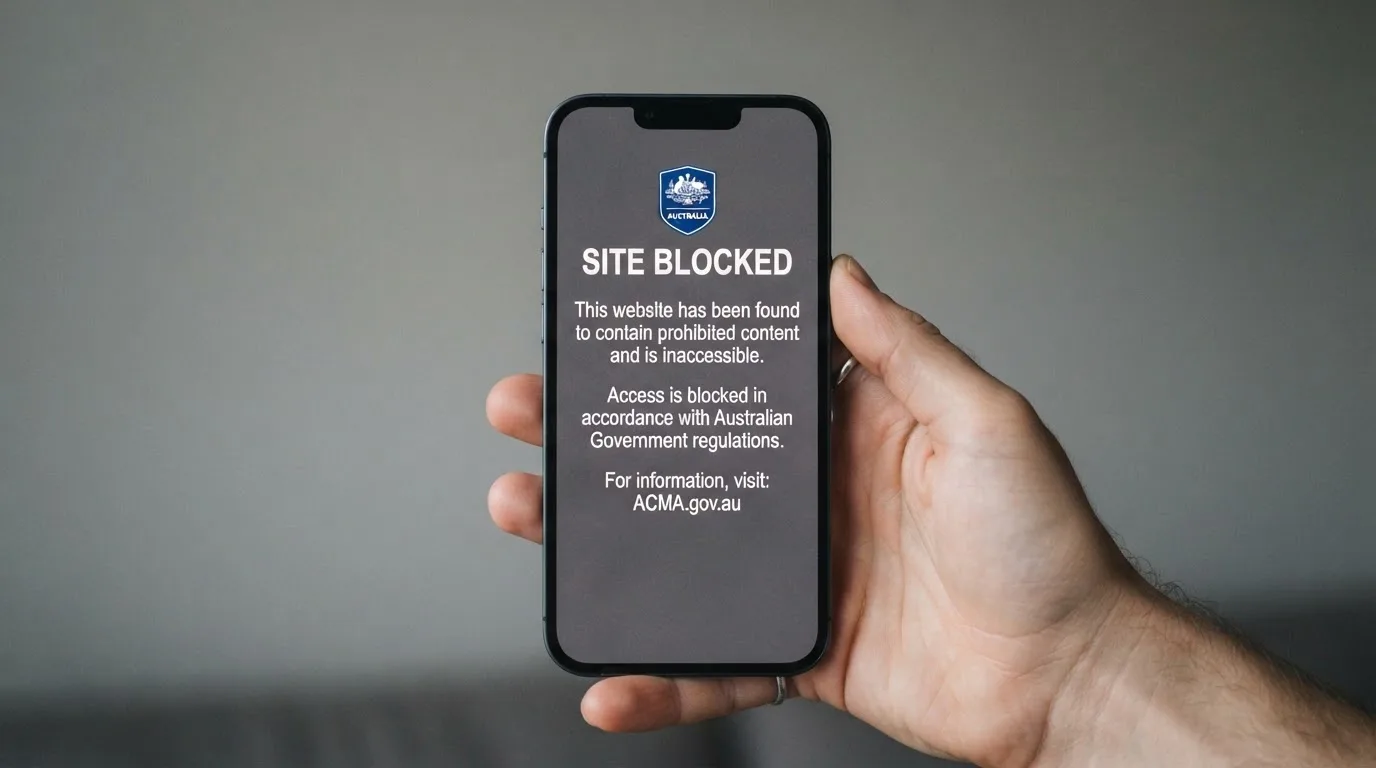
The legal frame around the search for a casino in Adelaide is the Interactive Gambling Act 2001 (IGA), strengthened by the Interactive Gambling Amendment Act 2017. The IGA makes it an offence to provide online casino games, online pokies or in-play betting to a person in Australia. No state or territory issues a licence that would authorise the supply of online casino games; the Northern Territory licences cover sports and race wagering, not casino games. Online lotteries and keno are licensed separately. The minimum age for any form of gambling covered by the regime is 18.
What “prohibited interactive gambling service” covers
The IGA’s central concept is the “prohibited interactive gambling service.” It covers any service supplied to a customer in Australia that involves betting, gaming or lottery activity through internet, telephone or other electronic means, where the activity would otherwise require an Australian licence. Casino games — slots, table games, live dealer — fall squarely inside. The 2017 amendment tightened the definition and added the civil penalty regime that the ACMA now administers. The penalties are aimed at the provider, not the customer; an individual player is not prosecuted for accessing an offshore site. The asymmetry is deliberate: the regime is built to make the supply of prohibited services unattractive rather than to criminalise the demand for them.
The ACMA’s enforcement record
The ACMA investigates suspected breaches, issues formal warnings, and can direct Australian internet service providers to block illegal sites. As reported in June 2026, the ACMA has asked ISPs to block a total of 1,751 illegal gambling and affiliate marketing websites since the first blocking request in November 2019. More than 230 unlicensed gambling services have left the Australian market since the 2017 amendment took effect. The 26 June 2026 round added twelve more: 7Signs, ChromaBet, Donbet, Duospin, Freshbet, Slots Gem, Jacks Club, Lucky Start, Pointsbetz, Spinrise, Vinyl Casino and Wildsino.
The formal warning record tells the same story at the operator level. In July 2025 the ACMA warned Bamboo Media over Ignition Casino and Consolutetish S.R.L. over National Casino and Bizzo Casino — the latter having already been the subject of a 2022 formal warning to TechSolutions. Each warning is a public statement that the regulator has identified the named operator as offering prohibited services and that further action follows if the conduct continues. The ACMA also published formal warnings against Ryker B.V. over Jackbit and CasinOK in April 2026, against Pulsup Ltd over RocketPlay in March 2026, and against Hollycorn N.V. over Sky Crown and Blue Leo back in September 2022. The record has accumulated over a decade and continues to grow.
The blocking rate as a measure of the market
A more useful read of the ACMA’s record sits behind the headline number. The 1,751 sites blocked between the first blocking request in November 2019 and the June 2026 round span 79 months — roughly six and a half years. The rate works out to somewhere between roughly 22 and 23 blocked sites a month, or between about 250 and 270 a year. That band is the speed at which new supply enters the market and the regulator removes it. Each new wave of blocks does not close the supply chain; it prunes one cohort while the next cohort of brands and affiliates replaces it. The blocking programme is a maintenance regime rather than a one-off clean-up.
The condition on that band matters. It is an average over the full 79-month window. Early rounds had fewer sites to block because fewer were operating at scale, and the rate of new entries has shifted with the offshore market itself. The June 2026 round of twelve blocks sits inside the band; the next round may sit outside it. A reader watching the next announcement will see the monthly average move. The 230-plus services that have left the market since 2017 are a separate measure of the same regime’s effect, and the combination — blocks issued plus services exited — is the regulator’s preferred summary statistic.
What the player faces
The IGA targets the provider, not the player. An Australian can technically access an offshore site; the legal risk sits with the operator. The practical risks sit with the player: no Australian consumer protection, no complaints body, no recourse if a withdrawal is refused. Offshore sites can be blocked with a balance still on the customer’s account, and the customer has no Australian regulator to complain to. The ACMA’s formal warnings do not unwind transactions, return balances or arbitrate disputes; they record the regulator’s position and signal the next escalation.
A player who wants to recover funds from an offshore operator that has stopped paying out must pursue the operator in whatever jurisdiction the operator claims to be licensed. In practice, that means initiating a complaint with a regulator that does not have an Australian desk, often in a country whose consumer-protection framework is thinner than Australia’s, and often in a language the player does not speak. The expected recovery rate is low. The expected loss rate is the standard house edge, which the offshore operator keeps the same way Adelaide Casino keeps it.
The 2026 reform
The Interactive Gambling Amendment (Gambling Reform) Bill 2026 passed Parliament on 19 August 2026. Its advertising and inducement measures commence on 1 January 2027 — law with a start date, not yet in force on this page. The reform targets the marketing machinery that reaches Australian players through affiliate sites, inducement offers and “free spin” promotions. The text is final; the enforcement starts in 2026. Readers comparing this page in the first weeks of 2026 will be reading under the new rules; readers reading it now are reading under the regime the 2017 amendment built.
The 2026 reform does not change the underlying prohibition on online casino games. What it changes is the surface area around the prohibition: the affiliate marketing, the inducement bonuses, the in-ad promotions that route Australian players to offshore sites. The legal analysis on this page will not change between 2026 and the year after; the marketing analysis will.
Tax treatment
Gambling winnings of a recreational player are not assessable income in Australia (section 6-5 ITAA 1997), and losses are not deductible — unless the person carries on a business of gambling. That is the standard treatment the ATO applies, and it cuts the same way for Adelaide Casino winnings and for offshore winnings. The recreational carve-out is what makes a casual player’s stake a personal expense rather than a business loss; a professional gambler’s stake is treated on the same basis as any other business expense. The model is general Australian tax law, and a reader with a specific situation should confirm with the ATO or a tax adviser. The general rule, for the vast majority of Adelaide Casino and offshore customers alike, is that recreational gambling is tax-neutral.
Wellbeing tools and where Adelaide players get help
The third shelf in this page’s structure is the smallest in headlines and the largest in consequence. The minimum age to enter Adelaide Casino is 18, the same as for any other form of gambling in South Australia. The safeguards around the venue — and around wagering more broadly — sit on two layers: the venue-level self-exclusion scheme and the national BetStop register.

The age limit and venue identification
The casino enforces an 18-and-over entry policy. Photo identification is required at the door and checked at the entry point. The minimum is the same as for any other form of gambling in South Australia, set by statute and enforced at the venue level by trained floor staff. The same age applies to the licensed pubs and clubs running gaming machines across the rest of the state. There is no exception for tourists; the ID check applies to everyone, regardless of where they travelled from.
BetStop — Australia’s National Self-Exclusion Register
BetStop is the national register, launched by the ACMA on 21 August 2023. It allows a person to register for self-exclusion from Australian-licensed online and telephone wagering services. The registration covers every licensed operator simultaneously, with exclusion periods running from a minimum of three months up to a permanent exclusion. BetStop does not cover in-venue gambling such as Adelaide Casino. An Adelaide reader who wants to self-exclude from the casino must use the venue’s own scheme, not BetStop.
The distinction matters because the bulk of offshore casino marketing reaches Australian players through the channels BetStop does not reach. BetStop is a tool for licensed wagering; it does nothing to stop an offshore casino’s marketing emails, push notifications or affiliate ads. After the ACMA’s February 2025 formal warning to EOD Code SRL over Instant Casino, for instance, the brand continued to operate; the warning did not stop its marketing reaching Australian inboxes. The tools that work for licensed wagering are not the ones the regulator has built for offshore marketing.
The helpline and counselling
The National Gambling Helpline on 1800 858 858 is free and 24/7. It is operated by the ACT Gambling Support Service and funded by the ACT Gambling Harm Prevention and Mitigation Fund. Telephone, online chat and face-to-face gambling and financial counselling are all available. Gambling Help Online runs the chat and online counselling. The service covers problem-gambling support as well as financial counselling; the typical pattern with problem gambling is that the financial damage outpaces the gambling itself, and a counsellor who understands both halves of that equation is more useful than one who understands only the betting.
The helpline is the entry point for the formal support system. It is staffed by professionals who can refer a caller to face-to-face counselling, financial counselling, peer-support groups and, where appropriate, the relevant self-exclusion scheme. Calls are confidential, and the service is funded by a harm-prevention levy rather than by gambling-operator funding, which is the structural reason the helpline can take a call from a player whose losses are mounting without conflict of interest.
Wellbeing inside the venue
Adelaide Casino runs its own responsible-gambling measures: trained staff on the floor, signage, voluntary exclusion, and access to support services. The measures are the standard mix required by the SA Independent Gambling Authority licence. They do not substitute for self-exclusion; they supplement it. A patron who recognises the warning signs in their own play can ask the venue to bar them; the venue has the legal power to honour that request without further proof. The venue’s self-exclusion scheme sits alongside the national register rather than replacing it.
When the offshore market is the problem
The harder case is an Adelaide reader who is playing offshore. The tools that work for licensed wagering — BetStop, the SA self-exclusion scheme — do not reach offshore operators. The ACMA can block an offshore site from being offered to Australians, but it cannot stop a determined customer from accessing it through alternative routes. The helpline still works; financial counselling still works; the underlying protection is the player deciding to stop, supported by professionals. The offshore operator has no Australian obligation to honour a request to self-exclude, and any voluntary exclusion it offers sits on whatever terms its own jurisdiction imposes.
That is the limit of the framework as it currently stands. The 2026 reform package introduces additional advertising and inducement restrictions from 1 January 2027, but the underlying self-exclusion architecture for offshore products is unchanged. The player’s decision is the lever that the regulator cannot move for them. The support system around that decision is the part the framework can deliver.
Frequently asked questions
Which venue is Adelaide’s licensed casino, and where is it?
Adelaide Casino, on North Terrace in the Adelaide CBD. The venue sits inside the heritage-listed Adelaide railway station building, occupies the western wing, and connects to the EOS by SkyCity tower added in 2021. It is the only venue in South Australia licensed to offer casino table games under the Casino Act 1997.
What age do you need to be to enter Adelaide Casino?
Eighteen. Photo identification is required at the door and checked at the entry point. The minimum is the same as for every other form of gambling in South Australia, set by statute and enforced at the venue level by trained floor staff.
Does Adelaide Casino offer blackjack, baccarat, roulette and craps?
Yes. The venue runs 90 gaming tables across blackjack, baccarat, roulette and craps, alongside 950 gaming machines. Table minimums vary by limit; the venue publishes current limits on its own gaming pages rather than as a static schedule.
Where can I stay within walking distance of Adelaide Casino?
The EOS by SkyCity tower connects directly into the gaming floor. The InterContinental Adelaide, on North Terrace roughly 350 metres east, is a five-minute walk. The Mayfair Hotel and the Pullman Adelaide sit in the CBD’s east end, both within a ten-minute walk of the venue.
Can an Australian legally play at an online casino instead?
No. The Interactive Gambling Act 2001 prohibits supplying online casino games to people in Australia, and no state or territory issues a licence that would authorise the product. Offshore operators may still accept Australian customers, but they do so outside Australian law, with no Australian recourse if a withdrawal is refused.
Created by the ”Casino Payout Hub” editorial team.