

Best 7-reel slots Australia in 2026: the format, the blocklist, and the cost
 Available in US
A 7-reel slot sits in an odd corner of the pokies landscape. It is older in spirit than the five-by-three video machine that now dominates pub screens, and simpler in construction than the cascading, expanding, multiplying formats that game studios put out under a dozen feature names. For a player wondering what a 7-reel slot is — and where, if anywhere, an Australian reader can play one — the honest answer splits in two: the format is well-defined and well-documented; the offer of real-money play sits outside Australian law. What follows lays out the format, the regulator’s enforcement record, the offshore brands that have been warned for offering it, and the arithmetic a reader can do with the numbers research has already pinned to the page.
Data current as of 24 September 2026; checks run against the Australian Communications and Media Authority’s published register of blocking requests and formal warnings.
Table of Contents
- A seven-reel format, in plain terms
- Bonuses and free spins on a 7-reel slot, in the abstract
- What a fair comparison of 7-reel slot offers would weigh
- What “ACMA action” means, and what it costs the reader
- The legal frame: why none of this is licensed
- Responsible play, and the help a reader can actually use
- The brands the ACMA has warned, in the regulator’s own order
- What the comparison actually tells a reader
- The arithmetic a reader can run themselves
- Reading the regulator’s record on its own terms
- The shape of the topic, written out
- Frequently asked questions
A seven-reel format, in plain terms
A slot machine is a reels-and-symbols device. Charles Fey’s 1890s machine had three reels with five symbols apiece — horseshoes, diamonds, spades, hearts, and a cracked Liberty Bell — and three bells across one payline paid the top prize of ten nickels. A 7-reel machine stretches the same idea across two more reels. Same symbols per reel, same kind of payline, more positions that have to line up for a prize.

What changes once a reel count climbs from three to seven is not the thrill of a spin; it is the math the reels run. A classic three-reel machine with ten symbols per reel offers roughly a thousand possible three-symbol combinations. A modern video machine running five reels with fifty or more symbols per reel produces top combinations with odds in the hundreds of millions to one. A seven-reel format sits between those extremes, and that is where most of its appeal and most of its confusion comes from. A reader who hears “7-reel” and pictures something exotic is usually picturing a five-reel game with bonus features tacked on. It is its own format, with its own odds profile.
The reel count alone does not settle volatility. Volatility — the spread between long quiet stretches and occasional large payouts — depends on the paytable’s symbol weights, the number of paylines, the size of the top prize, and the size of the smaller prizes. A seven-reel machine can be calibrated by its maker as tightly as any other reel count. The reader should treat reel count as a shape, not a behaviour.
The paytable as the only honest document
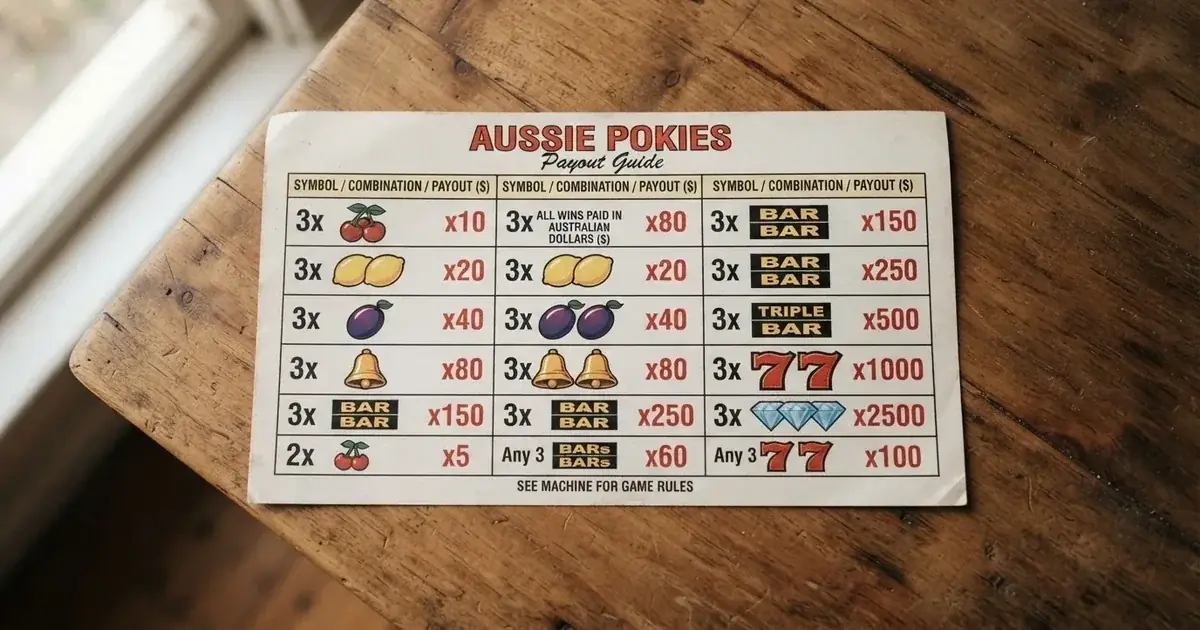
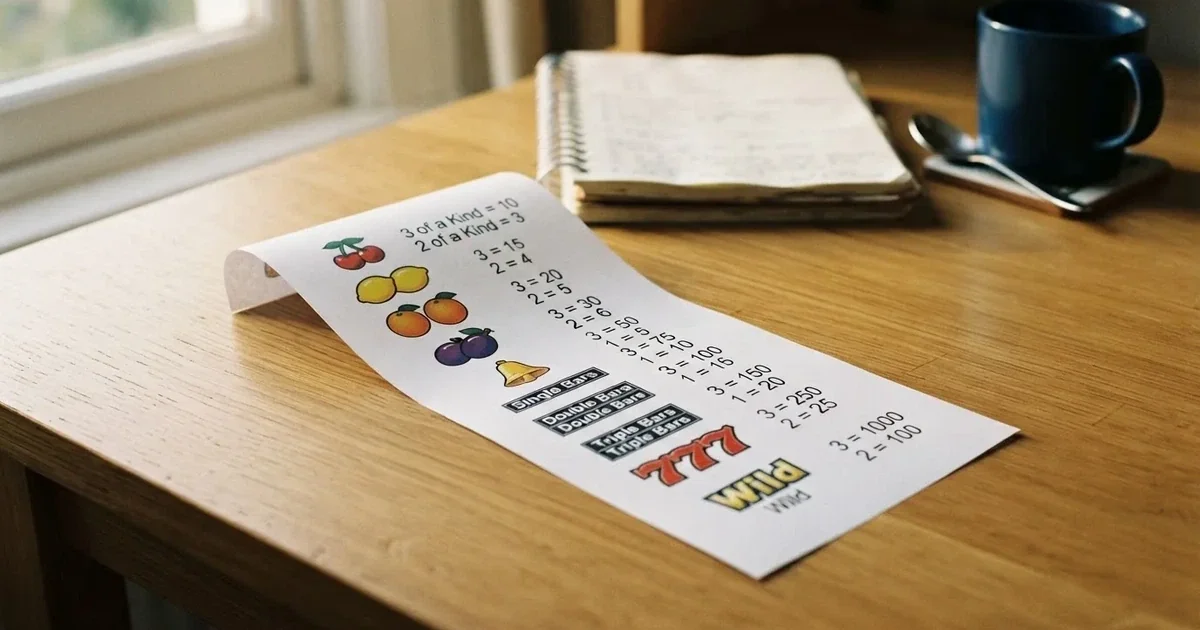
Every slot machine, whatever its reel count, comes with a paytable. The paytable is what tells a player what each symbol pays, how many in a row are required, and which combinations trigger any feature rounds. A printed strip of generic slot symbols and payout numbers laid out on a desk, like a reference chart rather than a live game, is the closest visual the page’s image library gets to that document. Stripped of any operator’s branding, it shows the one thing a slot machine’s marketing never does plainly: the house keeps a long-term edge on every spin, and the paytable is the document that names the size of that edge.

In the United States, state regulation sets minimum payout percentages by jurisdiction — Nevada requires at least 75 percent, Mississippi at least 80 percent, New Jersey at least 83 percent. Australia does not set an equivalent floor for the prohibited online product, and an offshore site is under no obligation to publish a payout percentage at all. The honest move is to assume nothing about an unpublished return rate and to read a published one with the scepticism a marketing figure earns.
A short lineage, for context
The slot machine is more than a century old. Fey’s three-reel Liberty Bell was the first automatic payout mechanism. Bally’s 1963 Money Honey was the first machine with a bottomless hopper, paying out up to 500 coins without an attendant. The first true video slot — no mechanical reels at all, just a screen — was developed in 1976 by Fortune Coin Co. in Kearny Mesa, California. By 2010 Australia operated an estimated 97,103 gaming machines outside casinos, a per-capita density roughly five times that of the United States. That is the domestic environment a reader is comparing an offshore online offer against, and the comparison almost always runs in favour of the local machine.
The domestic installed base still skews to the three-reel and five-reel formats. New South Wales legalised slot machines in 1956; the state counted 87,298 pokies-style machines outside casinos as of June 2023. Victoria recorded 26,380 in 2021–22, Queensland 21,122 in October 2023, South Australia 11,672 in September 2023, and the ACT 3,587 in November 2023. None of these machines is a 7-reel specifically — the seven-reel format has always been a niche — but they are the legal, regulated alternative a reader is weighing against any offshore online offer.
Bonuses and free spins on a 7-reel slot, in the abstract
A bonus offer on a slot machine usually means one of two things. Either the slot’s own feature round — a free-spin mode triggered by a combination of scatter or bonus symbols, paying out at the slot’s own paytable without taking a further stake — or a casino-level promotion, where the operator offers bonus credits or free spins in exchange for a deposit, a registration, or a stake the player has already placed. Both kinds of offer exist for 7-reel slots. Neither kind is available from a licensed Australian operator, because no licensed Australian operator offers 7-reel slots for real money at all.
That is the shape of the bonus shelf for this subject. The mechanics research can talk about: the wagering multiple a casino attaches to a bonus before it can be withdrawn, the maximum-cashout cap that often sits on top of free-spin winnings, the game-weighting table that decides whether 7-reel slots count at 100 percent toward clearing a bonus or at a smaller slice. None of that machinery changes because the game has seven reels instead of five. The cost to the player does not move either; the house edge stays whatever the paytable says it is.
The arithmetic of a bonus is what matters, not the bonus’s headline figure. A bonus that doubles a deposit and carries a forty-times wagering multiple requires A$4,000 of slot turnover to clear a A$100 bonus — the bonus’s actual cost depends on the slot’s house edge across those A$4,000 of spins. A reader who only reads the headline will misread the cost by a factor of ten or more, and the marketing language that surrounds every bonus offer is built to keep that misreading in place.
What a fair comparison of 7-reel slot offers would weigh
A comparison a reader could trust on this subject would carry four pieces of information per operator: the regulator’s published action over the brand, the operator behind the brand, the date of that action, and a clear statement that the operator holds no Australian licence. None of the offshore brands offering 7-reel slots to Australians passes that test. The brands below are the ones the ACMA has acted against for offering prohibited services to Australians, and they appear here in the order the regulator has acted, not in any order of merit. There is no merit to rank; the product itself is unlawful to supply to a person in Australia.
| Brand | ACMA action and date | Operator named by the ACMA |
|---|---|---|
| Casino Intense | Formal warning, April 2025 | Sterplay Holding Ltd |
| Instant Casino | Formal warning, February 2025 | EOD Code SRL |
| Ignition Casino | Formal warning, July 2025 | Bamboo Media |
| National Casino | Formal warning, July 2025 | Consolutetish S.R.L. |
| Bizzo Casino | Formal warning, July 2025; earlier 2022 | Consolutetish S.R.L.; earlier TechSolutions |
| Woo Casino | Formal warning, March 2025 | Dama N.V. |
| Spirit Casino | Formal warning, May 2025 | Dama N.V. |
| Level Up Casino | Formal warning, May 2022 | Dama N.V. |
| Sky Crown | Formal warning, September 2022 | Hollycorn N.V. |
| RocketPlay | Formal warning, March 2026; earlier May 2022 | Pulsup Ltd; earlier Dama N.V. |
| Jackbit | Formal warning, April 2026 | Ryker B.V. |
The pattern in the table is what the ACMA’s own action reveals. Dama N.V. has been warned three times across two and a half years, and its associated brands appear repeatedly. Hollycorn, Consolutetish, Bamboo Media and the smaller operators behind the single-brand sites have each been called out by name, with the date published, in the regulator’s formal warning register. The regulator’s record is the comparison the page is built on. Anything else would be marketing copy with a search box around it.
What the table does not include, on purpose: subject support, in the sense of a 7-reel format confirmation per brand. Research carries no per-brand statement that a specific 7-reel title is hosted at any of these offshore brands. Where a brand’s appearance in another format’s listings is the only thing a source reports, that listing is not the operator’s own statement that it offers the format in question. The honest position is to leave that cell out.
What “ACMA action” means, and what it costs the reader
A formal warning from the ACMA is a published regulatory act. The ACMA names the operator behind the brand, the date, and the legal basis — in every case on this page, the Interactive Gambling Act 2001. Once a warning is published, the ACMA can direct Australian internet service providers to block the brand’s domains at the DNS level. The blocking does not require a court order; the IGA gives the regulator the power to ask, and ISPs comply.
A tidy desk with a laptop open on a plain search-results page, a notebook and a coffee cup beside it, with no screens showing any casino branding, is the visual the page carries for this section. The plainness is the point. The search the ACMA’s blocking action interrupts is the same search a reader is doing when they land on this page; the regulator’s record is what tells them what that search would have led to.
The blocking rate, as a band
Research reports a total of 1,751 illegal gambling and affiliate marketing websites blocked since the first blocking request in November 2019, with the latest reporting round in June 2026. From November 2019 to June 2026 is roughly six and a half years — about 79 months. The arithmetic is straightforward. 1,751 sites over 79 months works out to roughly 22 sites blocked per month on average. The most recent single round asked ISPs to block 12 sites in one announcement, and prior rounds have run larger and smaller.
The honest way to state this is as a band, not a single figure. The blocking rate is sensitive to the window a reader picks: averaged across the full 2019-to-2026 period, the regulator has run at roughly 20 to 25 sites a month; concentrated into a single recent round, the figure can sit above or below that band depending on which round the reader counts. The reader who needs a single number should pick 22 sites per month as the centre of the band, with the caveat that any single month can run higher or lower. The regulator is doing this work continuously, not as a one-off, and the rate has not slowed enough to let any single brand count on staying accessible.
The legal frame: why none of this is licensed
The Interactive Gambling Act 2001, as tightened by the Interactive Gambling Amendment Act 2017, makes it an offence to provide online casino games, online pokies or in-play betting to a person in Australia. No state or territory issues a licence for these products; no operator, Australian or offshore, can lawfully target the Australian public with them. What is licensable under Australian law is wagering on races and sport placed before the event, lotteries and keno.
The Northern Territory Racing and Wagering Commission regulates 52 of Australia’s online bookmakers — including Sportsbet, Bet365 and Ladbrokes — licensed in the Territory for tax reasons. The commission has no full-time staff and meets once a month in Darwin. That is the regulator a licensed Australian wagering customer can point to. It is not the regulator for online casino games or pokies, because those products are not licensable at all.
A red triangular warning sign icon on a laptop screen next to a stack of legal papers, symbolising an official caution rather than any specific website, is the image the page carries for this section. The visual sits on the legal side of the page rather than the marketing side, which is where the formal warnings actually sit.
What an offshore site does not give an Australian reader
An offshore site gives no Australian consumer protection, no complaints body, and no recourse if a withdrawal is refused. The Interactive Gambling Amendment (Gambling Reform) Bill 2026 passed Parliament on 19 August 2026, with its advertising and inducement measures commencing on 1 January 2027 — law on the books, not yet in force. The IGA targets the provider, not the individual player, but the provider can be blocked with a balance still in a player’s account, and the player has no Australian forum to complain to once that happens.
The H2 Gambling Capital 2025 report estimates that Australians lose about A$3.9 billion a year to illegal gambling sites, and that the share of gambling going through legal channels fell from 74 percent in 2021 to 64 percent. That is the magnitude of the harm the offshore sector carries, and it is the reason the regulator’s blocking programme exists at the scale it does.
Payments, and what a banned payment route tells a reader
Credit cards, credit-related products and digital currency are banned as payment for licensed online wagering since 11 June 2024, with penalties of up to A$247,500 for operators who break the rule. The legal deposit routes for licensed wagering are debit card, bank transfer, PayID and Osko, and BPAY. An offshore site asking an Australian player for a credit card or a crypto deposit is signalling that it is operating outside the Australian rules, and the same signal sits in any bonus offer that requires those payment routes to clear.
Responsible play, and the help a reader can actually use
If thinking about 7-reel slot play starts to feel compulsive or stressful, free confidential help is available around the clock. Gambling Help Online runs chat support and a national helpline at 1800 858 858, free from any Australian phone. The National Self-Exclusion Register, BetStop, has been live since August 2023. It binds Australian-licensed online and phone wagering services — and that binding is what makes it useful. An offshore casino is not connected to BetStop, which is one of the clearer reasons an Australian reader would choose a licensed wagering service over an unlicensed casino even when the casino offers a product the licensed market does not.
Tax and the recreational player
Gambling winnings of a recreational player are not assessable income under section 6-5 of the Income Tax Assessment Act 1997, and losses are not deductible. A person who carries on a business of gambling is treated differently, but that is not the situation a casual slot player is in. The model on a reader’s position is “recreational player; not assessable; losses not deductible.” Anything more specific should run past the ATO.
The brands the ACMA has warned, in the regulator’s own order
What follows is not a ranking. It is a sequence, ordered by the date the ACMA first published its formal warning over each brand, and each brand is presented on the same fields: the regulator’s action, the operator behind the brand, and the date the action was published. There is no bonus information to attach, because the only sources for bonus terms were affiliate marketing pages, and that is not a basis on which to write.
RocketPlay
The ACMA issued a formal warning to Pulsup Ltd over RocketPlay in March 2026, with an earlier warning over the same brand issued to Dama N.V. in May 2022. The brand sits on the regulator’s record twice. A reader comparing this brand against the others on the page will note that “warned twice” is a stronger signal than “warned once,” and the regulator’s own publication is what carries the signal.
Level Up Casino
Dama N.V. was warned over Level Up Casino in May 2022 as part of the same action that covered five other Dama N.V. brands. The brand has not been the subject of a more recent ACMA action in the research record, and that is the only honest framing the page can give: an older warning, no newer action to report.
Woo Casino
The ACMA issued a formal warning to Dama N.V. over Woo Casino in March 2025. The brand appeared alongside Spirit Casino in the same Dama N.V. pattern; the regulator’s record places them together.
Spirit Casino
The ACMA issued a formal warning to Dama N.V. over Spirit Casino in May 2025, two months after the Woo Casino warning. The pairing with Woo Casino is the regulator’s own grouping, and a reader can take it as the regulator’s own commentary on Dama N.V.’s compliance pattern.
National Casino
The ACMA issued a formal warning to Consolutetish S.R.L. over National Casino in July 2025, in the same month as a warning over Bizzo Casino. Consolutetish S.R.L. is the operator named on the regulator’s record; the brand is not on its own separate line of enforcement.
Bizzo Casino
The ACMA issued a formal warning to Consolutetish S.R.L. over Bizzo Casino in July 2025. A separate, earlier formal warning had been issued over Bizzo Casino to TechSolutions (CY) Group Limited and TechSolutions Group N.V. in 2022. Two operators, two warnings, one brand — the regulator’s record on this brand is the longest of any on the page.
Ignition Casino
The ACMA issued a formal warning to Bamboo Media over Ignition Casino in July 2025. Ignition Casino appears on its own line of enforcement, with Bamboo Media as the only named operator. The brand has no 2022 warning in the research record.
Instant Casino
The ACMA issued a formal warning to EOD Code SRL over Instant Casino in February 2025, one of the earlier warnings in the regulator’s recent enforcement pattern. The operator is named on the ACMA’s publication; no other operator has been warned over the brand.
Jackbit
The ACMA issued a formal warning to Ryker B.V. over Jackbit and CasinOK in April 2026. The pairing with CasinOK is the regulator’s own grouping in the same action.
Casino Intense
The ACMA issued a formal warning to Sterplay Holding Ltd over Casino Intense in April 2025. The brand appears on its own line of enforcement, with Sterplay Holding Ltd as the named operator.
Sky Crown
The ACMA issued a formal warning to Hollycorn N.V. over Sky Crown and Blue Leo in September 2022, with the formal warning published as a PDF on the ACMA’s website. The pairing with Blue Leo is the regulator’s own grouping in the same action.
What the comparison actually tells a reader
The table above carries the regulator’s action against eleven offshore brands. None of them holds an Australian licence for the product they are offering to Australian readers, because no such licence exists. The honest position a reader can take from the table is that any brand on it has been formally warned by the regulator for offering a product that is unlawful to offer to Australians, and that the warning has been published on the regulator’s own register.
The brands cluster around a small number of operators. Dama N.V. sits behind three of the eleven, and Dama N.V. is the operator that has been warned most often. Hollycorn N.V., Consolutetish S.R.L., and Bamboo Media sit behind another three. The remaining five are each tied to a single operator. The regulator’s own action is what establishes this clustering, and the reader who notices it is reading the regulator’s record correctly.
What the table cannot tell the reader is the order in which any of these brands would be a “good” place to play, because the product itself is unlawful to offer to Australians, and “good” has no meaning inside that frame. A reader who lands on this page looking for a recommendation is looking for something the page cannot honestly provide. A reader who lands on this page looking for a record of what the regulator has done is reading what the page is built to give.
The arithmetic a reader can run themselves
The ACMA’s blocking record, totalling 1,751 sites since November 2019, works out to about 22 sites blocked per month on average, with single rounds ranging higher and lower. A reader who wants a sharper figure should pick a window themselves, count the months in it, and divide. The arithmetic is not complicated, and the inputs are public.
The arithmetic that an offer cannot run, because no offer is licensable: there is no Australian-licensed 7-reel slot product, no Australian regulator that has published an RTP for such a product, and no Australian consumer protection regime that would back any calculation a reader did. The arithmetic of “how much does this bonus cost me” assumes a product the reader cannot lawfully be sold, and the cost is therefore hypothetical.
A reader who wants to do their own arithmetic on a slot’s cost should pick a licensed Australian product — a wagering service with a published return-to-player figure, or a club pokie with a state-issued gaming machine approval. The licensed product is what makes the arithmetic mean anything; the unlicensed product is what makes it hypothetical.
Reading the regulator’s record on its own terms
The ACMA’s register of formal warnings and blocking requests is published on the regulator’s own website. A reader who wants to verify any of the dates or operator names in this page can read the register directly; the register carries the PDF and the date of each formal warning, and the blocking-request announcements carry the list of brands in each round. The register is what the page is built on, and it is what a reader should rely on rather than any single review site or affiliate marketing page.
The June 2026 blocking round asked ISPs to block 12 brands in one announcement: 7Signs, ChromaBet, Donbet, Duospin, Freshbet, Slots Gem, Jacks Club, Lucky Start, PointsBetz, Spinrise, Vinyl Casino and Wildsino. None of those twelve is on this page’s table, because this page’s table is built on the formal warnings, not the blocking rounds. A reader who wants both should read the ACMA’s register, which carries both.
The shape of the topic, written out
A 7-reel slot is a defined format with a defined lineage. It is not a mystery, and it is not exotic; it is a niche inside a broader landscape of slot formats, and the niche exists because game studios and regulators have decided it is worth offering. The honest answer to “where can I play it” is that no Australian-licensed operator offers it, that no Australian-licensed operator can offer it under current law, and that the offshore operators that do offer it have all been the subject of formal warnings from the regulator.
The honest answer to “what does it cost” splits along the same line. A licensed Australian product — a club pokie, a state-regulated machine — has a regulated payout floor, a regulated dispute process, and a regulator the reader can write to. An offshore product offers none of those. The cost of an offshore 7-reel slot to an Australian reader is not just the house edge; it is the absence of any Australian forum to complain to if a withdrawal is refused, the regulator’s blocking programme which can take the site offline with a balance still in the account, and the absence of BetStop binding on the site if the reader wants to self-exclude.
That is the topic, written out in its honest shape. A reader who has read this far has what they need to make the decision themselves, and that is the only thing this page is built to give.
Frequently asked questions
What makes a 7-reel slot different from a standard five-reel video slot?
A 7-reel slot has seven spinning reels instead of the five that dominate modern video formats. The extra reels widen the math of the combinations, with top combinations running to much longer odds than a three-reel classic but shorter odds than a fifty-symbol-per-reel video slot. The format is not exotic; it sits between the original three-reel mechanical machine and the modern video format.
Can 7-reel slot machines be found in licensed Australian pubs and clubs?
The bulk of the licensed Australian pub and club installed base is three-reel and five-reel machines. New South Wales counted 87,298 pokies-style machines outside casinos in June 2023, with smaller bases in Victoria, Queensland, South Australia and the ACT. The 7-reel format has never been a major share of that base.
Do 7-reel slots typically pay out differently than newer five-reel formats?
Payout depends on the paytable, not the reel count. A 7-reel machine can be calibrated as tightly as a five-reel machine, and a five-reel machine can be calibrated as loosely as a 7-reel machine. The honest move is to read the paytable for the specific machine rather than to infer payout from the reel count.
Is a 7-reel slot online the same game as a 7-reel machine on a casino floor?
A licensed Australian casino floor would be regulated by the relevant state or territory casino regulator. An offshore online 7-reel slot is not licensed in any Australian jurisdiction and is not subject to any Australian regulator’s rules. The format can be the same; the regulatory frame around it cannot be more different.
Are 7-reel slots for real money available legally from an Australian-based site?
No Australian-based site is licensed to offer them. The Interactive Gambling Act 2001 prohibits the supply of online casino games and online pokies to a person in Australia, and no state or territory issues a licence for those products. An Australian reader who wants to play a slot legally does so at a licensed Australian venue, with a regulated product on the venue’s floor.
Is reel count still a useful way to compare volatility between older and newer slots?
Reel count is a shape, not a behaviour. Volatility depends on the paytable, the symbol weights, the size of the top prize, and the size of the smaller prizes. Two slots with the same reel count can run at very different volatilities; two slots with different reel counts can run at the same volatility. Reel count tells a reader what the reels look like; it does not tell them how the slot pays out.
Prepared by the Casino Payout Hub editorial staff.