

What 5-Reel Online Slots Cost an Australian Player in 2026
 Available in US
Five reels, a handful of paylines, a coin-in, a coin-out. The format looks simple enough that the marketing copy almost writes itself. In Australia, the page a reader reaches after the search is one on which most of the obvious questions do not have the answers the operator wants them to have. The Interactive Gambling Act 2001 makes it an offence to provide online casino games to a person in Australia. No state or territory issues a licence for them. Every 5-reel slot offered online to an Australian is, by definition, illegal to supply — and illegal to play only in the narrow sense that the law targets the operator, not the customer, which leaves the customer holding every other risk. The rest of this page works through that gap: what an offer costs in turnover, what an offshore site costs in recourse, and which numbers from the ACMA’s enforcement log explain why a “best of” ranking is, in this market, the wrong question to ask.
Data current as of 24 September 2026, verified against the Australian Communications and Media Authority’s published formal-warnings register.
Table of Contents
- Bonus Offers and Free Spins on 5-Reel Slots in Australia
- The 5-Reel Game Itself: Paytables, Symbols and Lines
- Where 5-Reel Online Slots Actually Stand in Australia
- Reading the Format, the Market and the Math Side by Side
- The Legal Position on 5-Reel Online Slots in Australia
- Where Help Is Available If Play Starts to Slip
- Frequently Asked Questions
Bonus Offers and Free Spins on 5-Reel Slots in Australia
The first shelf to clear is the one that does the most damage to a reader who arrives unprepared. Every 5-reel slot promotion aimed at an Australian — a deposit match, a “free spins” package, a “no deposit” credit — sits on top of an offshore site that is not licensed to take the bet. The promotional layer is therefore best read as a description of a market that exists, not as a route into it.

What an offer on a 5-reel slot usually contains
The shape of an online 5-reel promotion is, on the evidence of the ACMA’s enforcement file, almost always the same: a headline number for the deposit match (often expressed as a percentage of the first deposit, with a cap), a parallel number of “free spins” on a named title, and a set of conditions that govern whether any of it becomes withdrawable cash. The exact percentages vary. What does not vary is the chain of qualifiers underneath them: a wagering or play-through multiplier on the bonus, a separate multiplier on free-spin winnings in some sites, a maximum cash-out cap, a list of games that contribute different percentages to clearing, and a clock that runs from the moment the credit lands.
The way to read that chain is to follow the money, not the headline. A 100% match up to A$500 with a 40× bonus wagering requirement means the bonus portion must be turned over 40 times in qualifying bets before any of it withdraws — that is A$20,000 of play on a A$500 bonus before the credit is yours, and that is before the house edge of the games it has to be played on. A free-spin package worth 200 spins at A$0.10 carries a stated win ceiling as often as it carries an honest disclosure, and the ceiling is the figure that decides whether the offer is worth anything at all.
How turnover eats the credit
The promotion is not the price. The price is the play-through. A small example makes the gap obvious. Assume a deposit match that credits a player with A$100 in bonus funds carrying a 35× wagering requirement, played on 5-reel slots at an average stake of A$1 per spin. The required turnover is A$3,500; at one spin every five seconds, that is 4,375 minutes of continuous play, or roughly 73 hours, before a single dollar of the bonus can be withdrawn. If the slots in question return 96% on average, the expected loss during the clearing is A$140 — more than the bonus itself.

Most offers also forbid the games with the highest return-to-player from counting at full weight toward play-through, or exclude them altogether. Read the contribution table first; the headline is the smallest part of the cost.
Why free spins rarely leave as cash
The “free spins” label is the most consistently misleading phrase in this market. A 200-spin bundle at A$0.10 each is A$20 of nominal value, but the win ceiling on those spins is commonly set between A$50 and A$200, sometimes lower. Above the ceiling the winnings vanish. Spin the spins, clear nothing, take whatever the ceiling permits or lose it on the next round — those are the two outcomes the structure actually offers, and the structure is identical across most of the brands the ACMA has had to warn.
Where the slot itself has a low hit frequency or a wide variance, the 200 spins can clear under the ceiling in a single sitting or burn through the credit in two. The expected value of the bundle is whatever the slot’s return-to-player says it is, multiplied by the ceiling ratio — a small number, with a wide confidence interval around it.
The legal overlay on every promotion
A promotion that names an Australian player, accepts an Australian deposit or targets Australian traffic sits, by the ACMA’s published reasoning, inside the prohibition. Formal warnings in the registry name the operator-company, not the brand: Dama N.V. for six brands in 2022, Hollymagn N.V. for two brands that September, Bamboo Media for one brand in July 2025, and so on down a list that grew again on the most recent round reported in April 2026. A reader who has taken up one of these offers is in no sense in legal trouble, because the law targets the provider. The reader is, however, on the wrong side of every other protection an Australian licence would have given them: no Australian complaints body, no AFCA pathway, no BetStop opt-out, no guarantee the balance is reachable when the site is blocked.
That single sentence is the headline for the whole promotion shelf. The offers exist; the offers have real terms; the offers are also the entry point into a market that has no Australian licence, no Australian regulator, and no Australian exit.
The 5-Reel Game Itself: Paytables, Symbols and Lines
The second shelf belongs to the format itself. Five reels, three rows and a paytable is the canonical 5-reel slot, and the parts that change most across games are also the parts worth understanding before any money moves.
Anatomy of a 5-reel slot
A 5-reel slot is a game in which a spin sets five reels, each carrying a vertical strip of symbols, and pays on combinations that land on designated lines across them. The symbols are drawn from a fixed set per game; the number of symbols per reel decides the number of possible combinations. A classic mechanical three-reel machine carries around ten symbols per reel and produces about a thousand possible combinations; a modern 5-reel video slot can carry fifty symbols or more per reel, producing odds against a top combination as long as 300 million to one. That range is not a curiosity — it is the difference between a game that pays often and a game that almost never pays the top prize.
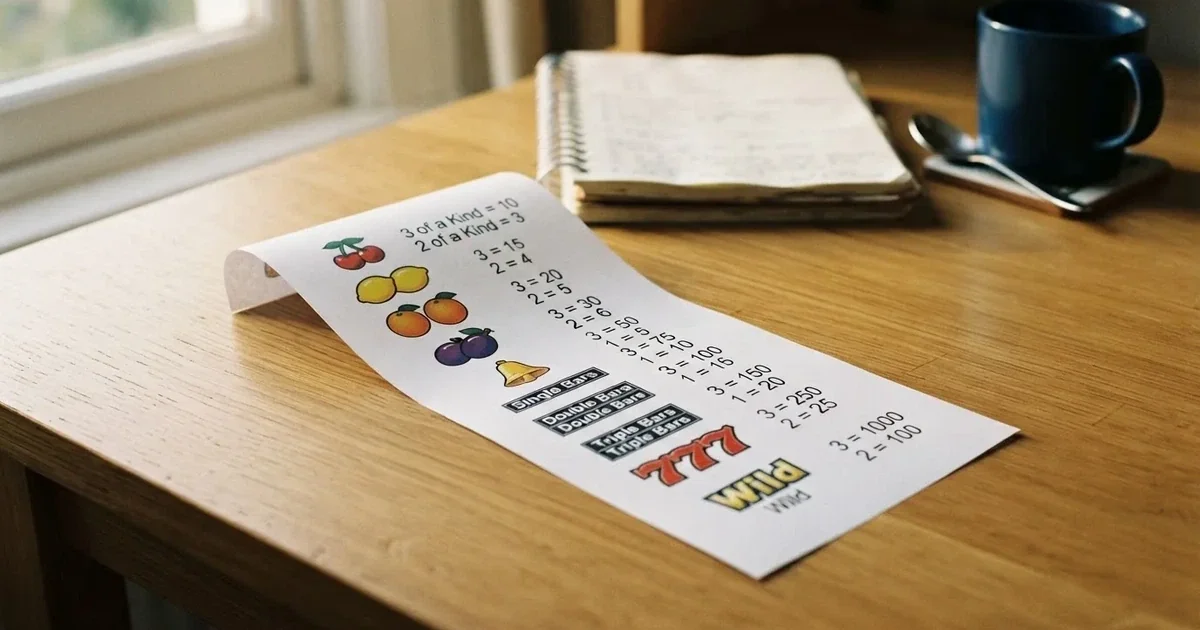
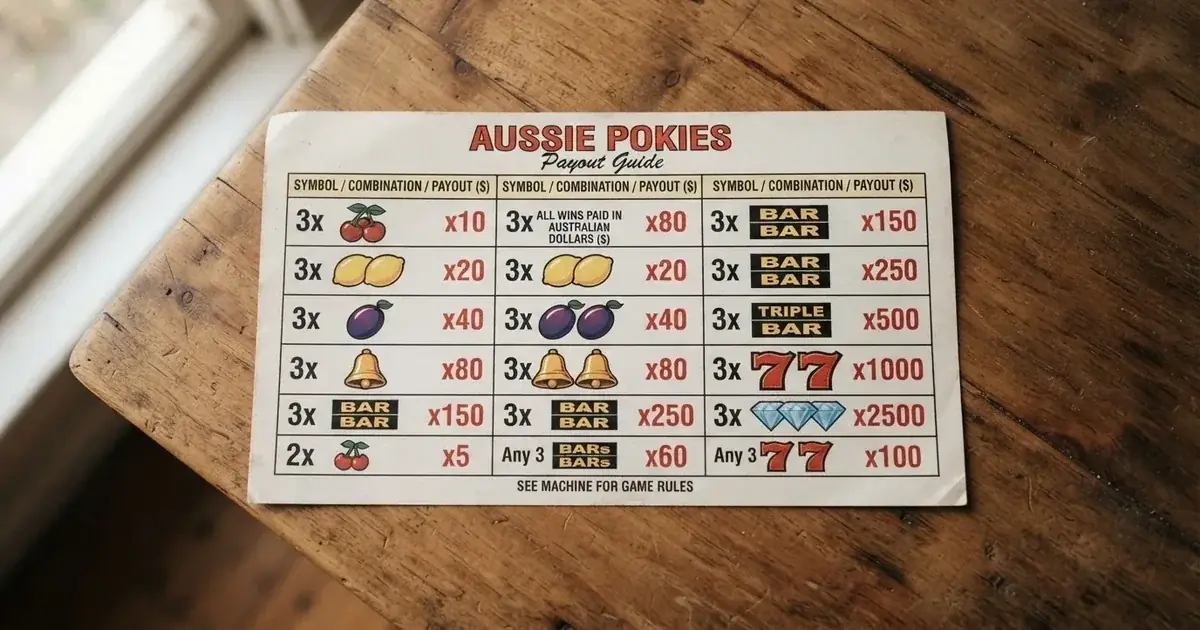
The paytable is the page in the game client that lists each symbol, each winning combination and the credit awarded for each. It also lists which combinations are paid left-to-right only, which pay both ways, and which are scatter or bonus symbols that pay anywhere on the visible grid rather than on a line.
Paylines and ways-to-win
A 5-reel slot will name a number of paylines — fixed or selectable — across the three rows. A 25-line game pays on 25 specific paths across the five reels. A “243 ways-to-win” title drops the lines concept entirely and pays on every adjacent-symbol combination left to right; it is the same reel format, but the matching rule is simpler and the cost per spin is the number of ways multiplied by the coin value. Reading a paytable line for coin-per-line or coin-per-way before spinning is the cheapest habit a player can keep.
Volatility and what it actually does
A paytable does not state volatility, but every game has one. Low volatility means small, frequent wins; high volatility means rare, larger wins, including long stretches of dead spins. The same return-to-player percentage can sit on either end of the volatility spectrum, and the player experience of the two is very different. A high-volatility title can produce a session of nothing followed by a single spin that returns ten times the stake; a low-volatility title pays the same expectation back across hundreds of smaller events. Neither is a better game on the math; they are different rhythms, and reading reviews for the volatility tag is the only way to know which one is being installed.
Where the return-to-player actually lives
A 5-reel online slot typically publishes a return-to-player (RTP) — the long-run percentage of all wagered money the game returns to players. Publicly disclosed RTPs cluster in the 94%–97% range for mainstream video slots; some branded progressive titles run lower because the jackpot feeds a portion of every wager. The house edge is 100 minus the RTP: 96% RTP means a 4% house edge, which is the casino’s long-run cut per dollar wagered. RTP is a long-run average, not a session guarantee; a 96% slot will return A$96 of every A$100 across millions of spins, and a session of 200 spins can land anywhere inside or outside that band. Comparison on RTP between games is the key to understanding value, not the outcome of any single session.
The volatility reading is what tells the player what a session is likely to feel like. A 96% RTP on a low-volatility title pays back in small amounts, often; a 96% RTP on a high-volatility title pays back rarely, sometimes generously. Same expected return, very different distribution.
Where 5-Reel Online Slots Actually Stand in Australia
This is the comparison shelf that the rest of the page leans on, and it is not a ranking. A ranking presumes a competitive set inside a regulated market. Australia has no regulated market for online 5-reel slots; what it has is a regulator that names operators and asks ISPs to block them. The honest comparison is the enforcement log itself.
The comparison the regulator’s file supports
Every brand listed below was the subject of a formal warning published by the ACMA for offering prohibited interactive gambling services to Australians. The list is taken from the ACMA’s register, in the order the regulator’s most recent entries appear, with the operator-company named on each warning rather than the trading brand where those differ.
| Brand | ACMA action and date | Operator named by the ACMA | Subject support |
|---|---|---|---|
| RocketPlay | Formal warning, March 2026 (also 2022 under earlier operator) | Pulsup Ltd (2026); Dama N.V. (2022) | — |
| Level Up Casino | Formal warning, May 2022 | Dama N.V. | listings-only |
| Woo Casino | Formal warning, March 2025 | Dama N.V. | — |
| Spirit Casino | Formal warning, May 2025 | Dama N.V. | — |
| National Casino | Formal warning, July 2025 | Consolutetish S.R.L. | listings-only |
| Bizzo Casino | Formal warning, July 2025 (also 2022 under earlier operator) | Consolutetish S.R.L. (2025); TechSolutions (2022) | — |
| Ignition Casino | Formal warning, July 2025 | Bamboo Media | — |
| Instant Casino | Formal warning, February 2025 | EOD Code SRL | — |
| Jackbit | Formal warning, April 2026 | Ryker B.V. | — |
| Casino Intense | Formal warning, April 2025 | Sterplay Holding Ltd | listings-only |
| Sky Crown | Formal warning, September 2022 | Hollycorn N.V. | — |
The ACMA action column is the only column with the same shape for every row, which is the point. Eleven brands, eleven published warnings, eleven operator-companies named. Each one was offering online casino play to Australians at the time the warning was issued; each one sits on a license (where one exists) issued for a jurisdiction outside Australia, which is not, in Australian law, a license to take an Australian bet.
How the cumulative blocking rate looks
Across the regulator’s enforcement record from November 2019 to the round published on 26 June 2026, a total of 1,751 illegal gambling and affiliate marketing websites had been blocked.
| Metric | Value |
|---|---|
| Total illegal sites blocked (Nov 2019 – June 2026) | 1,751 |
| Unlicensed services exited (since 2017) | 230+ |
Patterns inside the operator list
Two patterns are visible without further arithmetic. First, the same operator-company name recurs: Dama N.V. appears on three of the eleven warnings in this set, across different trading brands. The ACMA names the company behind the site for a reason — closing a brand by formal warning does not, on this record, close the operator, and a rebrand is a real path back into the market. Second, the dates in the table fan across 2022, 2025 and 2026, and the newer entries show no sign of an enforcement slow-down. The comparison is not a snapshot of a market being cleaned up; it is the public face of a continuing enforcement round.
The feature this comparison deliberately lacks
A typical “best 5-reel slots Australia” page ranks operators on bonus size, payout speed and game count, then names a winner. This page does not, because none of the operators in scope is licensed to take an Australian bet. A ranking column would have to score brands on what they offer, which is precisely what the ACMA has asked ISPs to block. The comparison the regulator’s file supports — warnings, dates, operator-companies named — is the only one the material supports.
Reading the Format, the Market and the Math Side by Side
The overview shelf is short by design. Its job is to set out, in one place, what is true about 5-reel online slot play in Australia before the legal and player-protection sections restate any of it.
What the format offers that the marketing never quite says
A 5-reel slot is a three-row, five-reel grid that pays on combinations across paylines, with a return-to-player publicly stated and a volatility rating implied by the symbol distribution and the paytable shape. The house edge sits between the two, in the 3%–6% band for most mainstream 5-reel titles. Every other claim about the format — payouts, jackpots, bonus features — is a feature on top of that structure, not a replacement for it. The format is not new; Charles Fey of San Francisco built the first automatic slot mechanism in the late 19th century, Bally’s “Money Honey” added the bottomless hopper in 1963, and the first video slot was developed in 1976 by Fortune Coin Co. in California. What the 5-reel online slot is, in 2026, is the digital descendant of that lineage.
Why “best” is not the right verb here
In a market that licenses online slot play, “best” compares offerings: payout speed, bonus terms, RTP disclosure. In Australia, the market is the absence of licensing. The ACMA’s enforcement file is the de facto regulator’s report on what is on offer, and what is on offer is, by definition, illegal to supply. A page that ranks the warning list from “best” to “worst” rewards what the regulator is removing and presumes the reader will act on the ranking. The honest read of the file is that the warnings are a list of operators to whom an Australian should not need to be introduced.
The two-tier landscape, plainly stated
Australia’s licensed wagering market — Sportsbet, Bet365, Ladbrokes, the bookmaker set regulated by the Northern Territory Racing and Wagering Commission — does not include online 5-reel slot play. What it licenses is pre-event and race wagering, keno and lotteries. The 5-reel slot the reader searched for sits entirely on the offshore side of that line, alongside the roughly A$3.9 billion a year in estimated Australian losses that H2 Gambling Capital’s 2025 report attributes to illegal sites, with the share of Australian gambling going through legal channels having fallen from 74% in 2021 to 64% by 2025. The two tiers are not in competition; the offshore tier is in breach.
The Legal Position on 5-Reel Online Slots in Australia
The shelf the rest of the page rests on. The Interactive Gambling Act 2001 is the statute, the Interactive Gambling Amendment Act 2017 is what sharpened it, and the ACMA is the regulator that enforces it.
What the Act prohibits
The IGA makes it an offence to provide online casino games — including online pokies and online 5-reel slots — to a person physically in Australia. The 2017 amendments closed the loopholes that had allowed some overseas-licensed operators to continue serving Australian customers. There is no state or territory licence for online casino games in Australia; what is licensable is wagering on races and sport before the event, lotteries and keno. The minimum age for any licensed gambling activity is 18. The Act targets the provider; the individual player is not prosecuted for placing a bet.
What enforcement looks like
The ACMA investigates complaints, publishes formal warnings naming the operator and the trading brand, and asks Australian ISPs to block illegal sites. According to the regulator’s June 2026 reported round, 1,751 illegal gambling and affiliate-marketing websites had been blocked since the first blocking request in November 2019, and more than 230 unlicensed gambling services had left the Australian market since enforcement was strengthened in 2017. A single enforcement round can ask ISPs to block twelve sites in one batch — the round reported on 26 June 2026 named 7Signs, ChromaBet, Donbet, Duospin, Freshbet, Slots Gem, Jacks Club, Lucky Start, Pointsbetz, Spinrise, Vinyl Casino and Wildsino among others. A reader who has an account on any of these at the time of a block cannot log in to withdraw.
Why the offshore licence means nothing here
An offshore site presenting a Curaçao, Malta or Anjouan licence is not in possession of an Australian licence, and there is no Australian licence for it to hold. The licence it does display is real in its own jurisdiction and confers no consumer-protection rights on an Australian customer. There is no Australian complaints body, no AFCA pathway, no local ADR, and no BetStop exit button. If the operator declines a withdrawal, the dispute is heard under the rules of the licence that the operator chose, and the player who chose the operator.
The payments layer
The credit-card and digital-currency ban on licensed online wagering took effect on 11 June 2024, with penalties up to A$247,500 for operators who breach it. The legal deposit routes for licensed wagering are debit card, bank transfer, PayID/Osko and BPAY. A site that asks an Australian customer for a credit card or a crypto deposit is, by definition, not on the licensed side of the line and is operating outside the Australian rules.
What the 2026 reform changes
The Interactive Gambling Amendment (Gambling Reform) Bill 2026 passed Parliament on 19 August 2026. Its advertising and inducement measures commence on 1 January 2027 — a date that matters only because it is not yet in force on a 2026 page. The reform tightens the marketing surface around what is already prohibited; it does not open a licensed online-casket market, and it does not retroactively license any of the operators named in the table above.
A note on tax
Winnings of a recreational Australian player are not assessable income, and losses are not deductible — section 6-5 of the ITAA 1997 and the ATO’s published position sit behind that. A person who carries on a business of gambling is taxed on the business profits, not on the winnings. A reader who reaches this page after a session on an offshore 5-reel slot has, for tax purposes, a non-event to declare.
Where Help Is Available If Play Starts to Slip
The player-protection shelf is short because the Australian protections for the offshore side are essentially absent. What is available, and works, is on the licensed-wagering side and the help-line side.
The BetStop register
BetStop, the National Self-Exclusion Register, has been live since August 2023. A registered exclusion binds every Australian-licensed online and phone wagering service — the bookmaker set under the Northern Territory Racing and Wagering Commission and equivalent bodies in other states. It does not bind offshore casino operators; a self-excluded Australian can still reach an offshore 5-reel slot through a different domain, a different brand, an account that was opened before the exclusion. BetStop is the right tool for the licensed side of the line; it is a partial answer on the other side.
The helpline that does not ask which side of the line
The National Gambling Helpline is 1800 858 858 — free, 24 hours a day, with web chat at Gambling Help Online. The service is confidential and does not require the caller to identify a specific operator. The conversation is with a counsellor trained to help the caller assess what is happening, regardless of whether the play is on a licensed bookmaker, an offshore casino, or a pokie in a suburban club.
What responsible play on an offshore 5-reel slot actually looks like
A reader who chooses to play on an offshore 5-reel slot in spite of the prohibition accepts a set of conditions the licensed market does not impose: no Australian complaints body, no AFCA pathway, no guarantee of withdrawal, and a regulator that may block the domain with a balance on it. The decision is the reader’s; the consequences attach to the decision.
The frame for any responsible play in that context is the same as the licensed side. Decide the budget before the first spin, and stop at it. Do not chase a loss with a deposit the budget did not authorise. Read the bonus terms as a contract, not a gift — the wagering multiple, the contribution table, the win ceiling, the clock. If a session has gone long enough that the budget has become an abstraction rather than a limit, the session is over.
What the law does not change
The statutes and the helpline do not change the experience of a near-miss, the pull of a feature trigger, or the variance that a high-volatility 5-reel slot is built to deliver. They are also not in place to moralise about play; they are in place because a market designed to extract money from its customers will, over a long enough timeline, extract too much from some of them. The helpline is a tool, not a verdict.
Frequently Asked Questions
What makes a 5-reel slot different from a standard five-reel video slot?
In a market context, “5-reel slot” usually names the canonical three-row, five-reel, fixed-payline video format. “Five-reel video slot” is the same format with extra features layered on: bonus rounds, free-spin retriggers, cascading reels, expanding wilds. Reel count does not differentiate them; features and payline structure do.
Can 5-reel slot machines be found in licensed Australian venues?
Yes — pubs and clubs operate pokie-style slot machines under state-level regulation. New South Wales had 87,298 such machines outside casinos as of June 2023, Victoria 26,380 in 2021–22, Queensland 21,122 in October 2023, South Australia 11,672 in September 2023 and the ACT 3,587 in November 2023. The licensed venue is the legal place to play a 5-reel machine in Australia.
Do 5-reel slots typically pay out differently than newer formats?
The math (RTP and house edge) is a property of the individual game, not its reel count. Modern 5-reel video slots can carry more symbols per reel — fifty or more — producing much longer odds against a top combination than a three-reel mechanical machine. The headline effect is fewer top-prize events and more small or mid-sized wins in between, with the same long-run return.
Is a 5-reel slot online the same game as a 5-reel machine on a casino floor?
The format is the same — five reels, three rows, a paytable. Online versions add bonus mechanics the venue machine does not have, run on certified RNG software, and cannot offer the same venue-side compliance and harm-minimisation measures that a state regulator requires of the pub machine. Playing them is governed by entirely different laws.
Are 5-reel slots for real money available legally from an Australian-based site?
No. The Interactive Gambling Act 2001 prohibits the provision of online casino games, including online 5-reel slots, to a person in Australia, and no state or territory issues such a licence. Whatever licence a site displays, it is not an Australian one for this product, and the ACMA names operators that continue to offer this product to Australians.
Does a slot’s reel count change how its paytable and volatility are usually described?
Reel count does affect the number of possible combinations, which a paytable will sometimes disclose in a math sheet or help screen. Volatility is a separate attribute and is typically described in reviews rather than in the game client. Reading a paytable for symbol values, a review for volatility, and a math sheet for the exact RTP and combinations count is what the format asks of the reader.
Written by the editors at Casino Payout Hub.