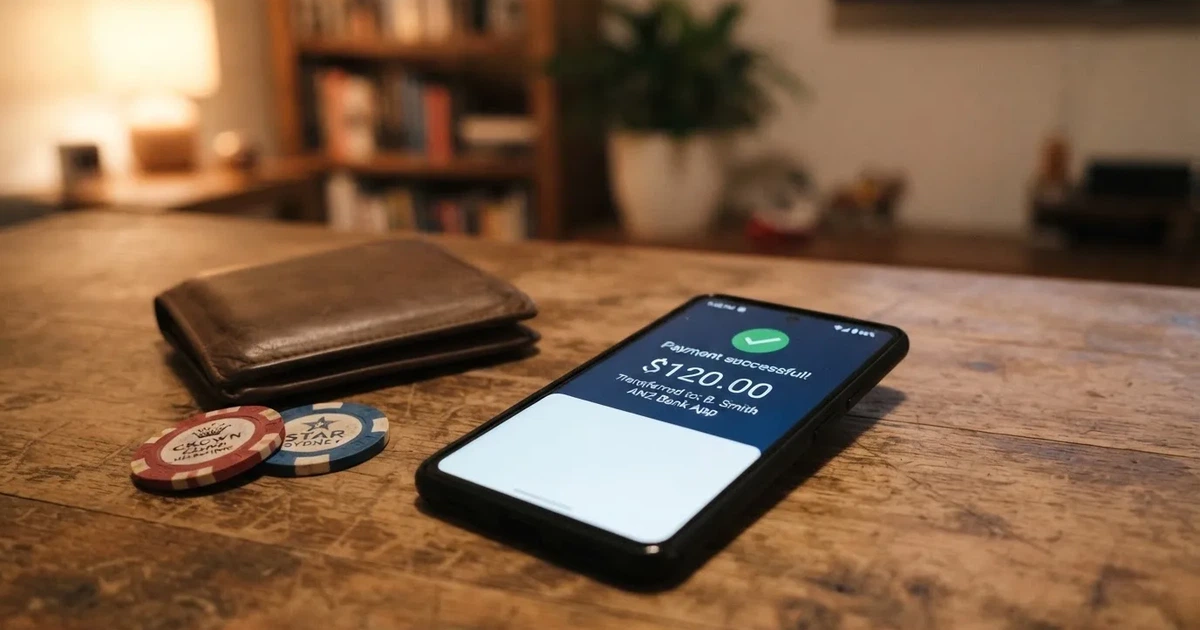


A $5 PayID no-deposit casino bonus in Australia: what the offer really is
 Available in US
A “$5 PayID no-deposit casino bonus” looks, at a glance, like a small gift from an Australian-friendly casino: register, drop in a PayID, and play with five dollars the house has put on the table. The reality is flatter and the direction of travel matters. No Australian-licensed online casino exists to issue any such bonus, and the same operators running those ads have a published record of formal warnings from the Australian Communications and Media Authority. PayID itself is a perfectly ordinary Australian bank-transfer service; what it is being attached to here is the marketing layer of offshore sites the IGA already prohibits. This page lays out that picture plainly: the legal frame, the ACMA record, the way PayID actually works, and what each named operator has on the public file.

Current as of 24 September 2026 · Cross-checked against the ACMA register of formal warnings and Australian Payments Plus public guidance.
Table of Contents
- Settlements: how PayID actually moves money
- Bonus mechanics: what a $5 no-deposit bonus actually costs
- Landscape: operators the ACMA has acted against
- Underlying fundamentals: the legal frame and what blocks actually mean
- Prohibitions and player-side protections: where help actually is
- Responsible play: practical steps that fit the picture
- A note on the offers themselves
- A worked view of one offer’s cost
- Putting it together
- Frequently asked questions
Settlements: how PayID actually moves money
PayID is an Australian Payments Plus service that turns a phone number, email address, ABN or organisation identifier into a nickname for a bank account. Over a hundred Australian financial institutions offer it inside their existing online banking. Sending to a PayID triggers a name check before the money moves, and that is the only thing standing between the payer and a wrong recipient. The transfer itself runs on the Reserve Bank of Australia’s New Payments Platform; Osko, the instant-transfer service on top of NPP, lands at the recipient bank in under a minute, twenty-four hours a day, including weekends.
PayID does not, in other words, take hours to clear. There is no waiting for a “next business day” and no weekend gap. A transfer between two PayID-linked accounts at participating banks is, by design, near real-time, and that is part of why the system is useful. It is also part of why it is being misused: instant settlement is exactly what marketing pages lean on when they imply the bonus will land “the moment you share a PayID.” AP+ has published its own warning, naming the practice. If a PayID prompt turns up on an illegal gambling site, AP+ writes, “it is almost certainly a scambling website”.
The word “scambling” is AP+’s own shorthand. It covers illegal online gambling platforms advertised on social media and messaging apps that trick people into gambling on a scam website. AP+ also points out that PayID itself never contacts a customer directly and never asks anyone to send money in order to receive money or to “upgrade” an account. A genuine PayID prompt comes from inside a bank app or the website of an Australian financial institution; one that turns up during a casino sign-up is a different thing entirely.
As of April 2025, more than 25 million PayIDs were registered in Australia. That scale is part of why the payment rail is being treated as a soft target by offshore operators: it is everywhere, it is fast, and the household-side mental model is that PayID means Australian, regulated, safe. The transfer is. The site on the other end usually is not.
Bonus mechanics: what a $5 no-deposit bonus actually costs
A “no-deposit bonus” is a small credit the operator posts to a new account without requiring an upfront deposit, on the surface a free chance to try the games. The mechanics underneath are not a gift. Every such bonus carries a wagering requirement: a multiple of the bonus amount that has to be turned over in qualifying play before any winnings become withdrawable. The catch rarely appears on the marketing page.
The conversion that turns a five-dollar headline into a real workload is straightforward.
Working through one ordinary shape, suppose a $5 no-deposit bonus is paired with a 40x wagering requirement on the bonus alone. The required turnover is $5 multiplied by 40, which is $200. Ploughed through a slot at a $0.10 stake per spin, that is 2,000 spins. At an average spin interval of around five seconds, that is just under three hours of continuous play before the wagering target is reached. None of that is optional; it is the cost of trying to convert the bonus into cash.
The expected loss over those 2,000 spins, on a slot returning 96% to players in the long run, is $200 multiplied by four percent, which is $8. The bonus pays $5 in credit; the play required to clear it costs about $8 on average. The house edge is doing the same arithmetic the player is, only at scale.
A few caveats worth flagging on the same page.
- Wagering requirements apply to the bonus alone on some offers and to the bonus plus any deposit on others; the second shape is the heavier one and is the one to look out for.
- A maximum cashout cap is common on no-deposit offers, so even if the play ends ahead, the withdrawable amount is capped.
- Some offers exclude certain game categories from clearing the requirement, or weight games at different percentages, so the workload the headline implies is often only the floor.
- “Free” in this context means free to claim. It does not mean free to clear, and it does not mean free in expected value.
The arithmetic above is a single worked example, not a market average. The point is the shape: a five-dollar credit paired with a wagering requirement is, in expectation, a small loss the player takes on in order to attempt a small win. The “no deposit” line describes the front door; the wagering terms describe what is behind it.
Landscape: operators the ACMA has acted against
The brand-by-brand material that follows is not a ranking and is not a recommendation. Every operator in this section has been the subject of a formal warning issued by the ACMA for providing prohibited interactive gambling services to people in Australia. Online casino games and online pokies cannot be licensed in Australia under the Interactive Gambling Act 2001, so any licence the site displays is a non-Australian licence, and none of it grants the consumer the protections an Australian licence would. The format below carries the ACMA’s own wording on operator and date, and is laid out the way the ACMA publishes it.
| Brand | ACMA action and date | Operator named by the ACMA | PayID / payment support |
|---|---|---|---|
| RocketPlay | Formal warning, March 2026 | Pulsup Ltd (Rocketplay); earlier Dama N.V., May 2022 | Not stated by the ACMA or by the operator’s own public terms |
| Level Up Casino | Formal warning, May 2022 | Dama N.V. | Listed on Westpac merchant-category material as a flagged gambling recipient |
| Woo Casino | Formal warning, March 2025 | Dama N.V. | Not stated by the ACMA or by the operator’s own public terms |
| Spirit Casino | Formal warning, May 2025 | Dama N.V. | Not stated by the ACMA or by the operator’s own public terms |
| National Casino | Formal warning, July 2025 | Consolutetish S.R.L. | Listed across AUSTRAC-facing and public reference material |
| Bizzo Casino | Formal warning, July 2025; earlier 2022 warning to TechSolutions | Consolutetish S.R.L. | Not stated by the ACMA or by the operator’s own public terms |
| Ignition Casino | Formal warning, July 2025 | Bamboo Media | Not stated by the ACMA or by the operator’s own public terms |
| Instant Casino | Formal warning, February 2025 | EOD Code SRL | Listed on third-party payment-rail pages including ecoPayz and PayID reference material |
| Jackbit | Formal warning, April 2026 | Ryker B.V. | Not stated by the ACMA or by the operator’s own public terms |
| Casino Intense | Formal warning, April 2025 | Sterplay Holding Ltd | Listed across AUSTRAC-facing and public reference material |
| Sky Crown | Formal warning, September 2022 | Hollycorn N.V. | Not stated by the ACMA or by the operator’s own public terms |
Two notes on the table. First, the operator column is what the ACMA named when it published the warning, which is not always the brand on the marketing page; the same operating company can hold several brands, and a brand can change hands across the warnings. Second, the payment column is the minimum available signal; a “not stated” cell means the ACMA file does not address it and the operator’s own public terms do not either. For a reader, the cells that say “listed” still do not mean PayID is offered by that brand at the Australian bank-account level; they mean third-party reference material places the brand in the same general vicinity as PayID-flagged payment rails, which is not the same thing as confirmation.
Operator regulatory summary
| Operator | Group | Formal warning date |
|---|---|---|
| Pulsup Ltd | Independent | March 2026 |
| Dama N.V. | Dama | May 2022 |
| Consolutetish S.R.L. | Consolutetish | July 2025 |
| Hollycorn N.V. | Hollycorn | September 2022 |
Level Up Casino
Level Up Casino appeared in the May 2022 batch of Dama N.V. warnings, alongside five other Dama brands — Bambet, Dazard, Rocketplay, Wild Tornado and Cobra Casinos — all named in a single formal warning. The Westpac gambling-block page lists it among the gambling recipients that the bank’s card-level block targets, which is a separate piece of evidence: not a complaint record, but a placement in the merchant category a bank has decided to refuse. The combination — an ACMA warning and a bank-block listing — is the kind of overlap that lands a brand on every negative list a reader might check, and lands it there for the same reason.
Woo Casino
Woo Casino picked up a formal warning to Dama N.V. in March 2025. The brand’s continued presence in the same operator group as Level Up, Rocketplay and Spirit Casino is the relevant detail, because the ACMA’s record treats the group as a single recipient in places — the warning is to the operator, not always to each brand individually. The result is that each brand in the group inherits the same regulatory standing, and a reader who treats one as off-limits is well-advised to treat the rest the same way.
Spirit Casino
Spirit Casino’s ACMA formal warning landed in May 2025, again to Dama N.V.. The Dama cluster is now the most-published set of operator-side warnings in this material, and the May 2025 warning places Spirit on the same timeline as Woo. The brand-by-brand verdict here is short: nothing in the ACMA file distinguishes Spirit from the others in its group, and a reader looking for a reason to treat it differently from Woo or Level Up will not find one in the published record.
National Casino
National Casino received a formal warning in July 2025, with Consolutetish S.R.L. named as the operator. Public reference material — AUSTRAC-facing listings and broad-spectrum Wikipedia entries — places the brand in the same general vicinity as payment-rail flags; that is a soft signal rather than a hard one, but it is the only signal the public file carries. The verdict is shaped by the ACMA’s own framing: a formal warning is a regulator’s last step before escalating action, and the regulator’s choice of Consolutetish S.R.L. as the named recipient is the operator structure the ACMA is willing to put on the public record.
Bizzo Casino
Bizzo Casino is the brand in this set with the longest ACMA paper trail. The July 2025 warning to Consolutetish S.R.L. was the second time the brand appeared on the regulator’s list — the earlier one ran to TechSolutions (CY) Group Limited and TechSolutions Group N.V., back in 2022. The dual naming tells the same story as RocketPlay’s: the brand has changed operator hands at least once, and each change has not altered the underlying Australian-facing posture. A reader who treats the brand as “different now” because of the new operator is reading past what the regulator has put on the file.
Ignition Casino
Ignition Casino received a formal warning in July 2025, with Bamboo Media named as the operator. The Bamboo Media attribution is what differentiates this entry from the Consolutetish S.R.L. and Dama N.V. clusters: same ACMA action, different operator structure. For a reader comparing the brands, the practical takeaway is that the action is not a one-company event. Multiple operators are running brands into the same regulatory outcome.
Instant Casino
Instant Casino’s formal warning ran to EOD Code SRL in February 2025. The brand also appears on third-party payment-rail pages including ecoPayz and PayID reference material, which is the strongest signal in this set that the brand has been publicly associated with PayID-adjacent payment routes. Whether that association is a marketing integration, a payment-processor listing, or simply a coin-cidence of name appearing in the same document, the public file does not clarify. The verdict follows the same logic as the rest: an ACMA formal warning stands regardless of the payment rail attached to it.
Jackbit
Jackbit received a formal warning in April 2026 to Ryker B.V.. The April 2026 timing puts the brand at the most recent end of this set, alongside RocketPlay’s March 2026 warning. The combination is worth noting: two formal warnings in two consecutive months is a regulator acting at speed, and the cadence says something about how the ACMA treats the current batch of brands running Australian-facing casino pages.
Casino Intense
Casino Intense received a formal warning in April 2025 to Sterplay Holding Ltd. The brand appears in AUSTRAC-facing listings, in mainstream technology press and on the National Australia Bank’s payment-risk pages — three independent third-party placements, none of which is the ACMA itself, but each of which adds to the weight of public signal. A reader checking this brand against any one of those lists will find it; a reader checking it against all three will find the same brand three times for the same underlying reason.
Sky Crown
Sky Crown’s formal warning ran to Hollycorn N.V., with the ACMA publication dating to September 2022. Sky Crown and Blue Leo were named together in the same warning. This is the oldest entry in the operator set, and the ACMA file does not record an escalation against Sky Crown since; whether that reflects an actual change in posture or simply the regulator’s working pace is not something the public file settles. The minimum reading is that the warning stands and has not been superseded.
Underlying fundamentals: the legal frame and what blocks actually mean
Online casino games and online pokies cannot be licensed anywhere in Australia. The Interactive Gambling Act 2001, tightened by the Interactive Gambling Amendment Act 2017, makes it an offence to provide those services to a person in Australia. What is licensable is wagering on races and sport placed before the event, lotteries and keno — in practice licensed by the Northern Territory, with the NTRWC holding 52 online bookmakers on its books. The Northern Territory’s regulator runs without full-time staff and meets once a month in Darwin, which is itself part of the wider story about how lightly Australian online wagering is overseen, even on the legal side of the line.

Enforcement runs through the ACMA. The ACMA investigates, issues formal warnings, and directs Australian internet service providers to block illegal sites. By the ACMA’s own June 2026 reporting, 1,751 illegal gambling and affiliate-marketing websites had been blocked since the first blocking request in November 2019, and more than 230 unlicensed gambling services had left the Australian market since enforcement was strengthened in 2017. The June 2026 round alone asked ISPs to block twelve further sites: 7Signs, ChromaBet, Donbet, Duospin, Freshbet, Slots Gem, Jacks Club, Lucky Start, Pointsbetz, Spinrise, Vinyl Casino and Wildsino.
The arithmetic that goes with that record is worth stating as a band rather than a single figure, because the run-rate depends on the year chosen. The first blocking request was in November 2019; the running total reached 1,751 in June 2026. Over the roughly six-and-a-half years between those two points, that is an average of around 270 blocks per year. The cadence has not been steady — earlier years saw fewer, recent rounds have seen more — and the figure sits inside a band of roughly 200 to 350 blocks per year once the early ramp is excluded. The point of the band is to give a reader a sense of the pace rather than a single number that quietly depends on the start and end dates.
H2 Gambling Capital’s 2025 estimate is that Australians lose about A$3.9 billion a year to illegal gambling sites, and that the share of gambling going through legal channels fell from 74% in 2021 to 64%. The legal-channel slide is the more important of the two figures, because it describes where the action has moved: an increasing share of Australian gambling spend is sitting with operators the ACMA is actively warning and blocking.
A formal warning from the ACMA is not a prosecution. The IGA targets the provider, not the individual player, and an Australian reader using one of these sites is not personally at risk of criminal prosecution under the Act. The risk sits elsewhere: an offshore site gives no Australian consumer protection, no complaints body, and no recourse if a withdrawal is refused. If the ACMA later orders the site blocked, a balance left on it can become inaccessible. The protection the player loses is the protection a domestic regulator and a domestic disputes body would have given.
Two further pieces of the legal frame matter at the payment level. Under the Interactive Gambling Act 2001 as amended in 2023, Australian-licensed online wagering services cannot accept credit cards or credit-related products, a restriction that also shapes how PayID-linked bank transfers can be used for wagering. The credit-card ban has been in force for licensed wagering since 11 June 2024, with penalties of up to A$247,500 for operators who breach it. Legal deposit routes for licensed wagering are debit card, bank transfer, PayID/Osko and BPAY; a site asking an Australian for a credit card or a crypto deposit is operating outside the Australian rules.
The Interactive Gambling Amendment (Gambling Reform) Bill 2026 passed Parliament on 19 August 2026. Its advertising and inducement measures commence 1 January 2027 — law with a start date, not yet in force. The current $5 PayID no-deposit-bonus ad pages sit in the gap between the existing IGA framework and the new inducement rules, which is part of why the ACMA’s enforcement cadence has accelerated in the last two years.
Prohibitions and player-side protections: where help actually is
If the consideration of any of the above starts to feel compulsive or stressful, free confidential help is available around the clock through Gambling Help Online (chat available) and the National Gambling Helpline on 1800 858 858. The service is free, twenty-four hours a day, and runs nationally.

BetStop, the National Self-Exclusion Register, has been live since August 2023. It binds Australian-licensed online and phone wagering services, so a registered exclusion stops a person from opening new accounts or placing new bets with any licensed Australian wagering operator. The scope of the register is the relevant limit: an offshore casino is not connected to BetStop, and a BetStop registration does not exclude a reader from one of the offshore brands in the operator set above. For a reader using an offshore site, the protections BetStop offers do not extend to that site, and a different mechanism — bank-level gambling blocks, individual operator account closure, the voluntary exclusion the offshore site may or may not honour — has to do the work instead.
Several Australian banks run their own gambling blocks at the card level. Westpac’s gambling block refuses authorisation of transactions registered under the merchant category code “Betting/Casino Gambling” on eligible personal credit and debit cards. ANZ’s gambling transaction block, activated in the ANZ app, blocks gambling transactions made through a digital wallet such as Apple Pay on an eligible card as well as on the physical card itself. Removing ANZ’s block requires a 48-hour waiting period, and the bank warns that not all gambling transactions will be blocked and some non-gambling transactions might be blocked in error. The bank-level blocks are blunt instruments — they cover the merchant category, not the specific brand — but they are an Australian-side lever, sitting inside Australian banking law, that does not depend on the offshore site cooperating.
One further angle on the payment side. By the end of 2025, Apple Pay, Google Pay and Samsung Pay transactions collectively accounted for around 45% of all card payments in Australia by number. Apple Pay itself charges no consumer fee in stores, online or in apps; any surcharge comes from the merchant’s own card-processing fees. Transaction limits and PIN requirements are set by the card issuer or merchant rather than by Apple. The relevance for a reader weighing a PayID-prompted casino transaction is that the digital wallet path and the PayID path are different rails with different rules, and the IGA credit-card ban applies to digital wallets as well as to physical cards. Apple Pay does not exempt a transaction from the credit-card ban just because the underlying card is in a wallet rather than a slot.
On the tax side: gambling winnings of a recreational player are not assessable income in Australia under section 6-5 of the ITAA 1997, and losses are not deductible. The position is different if the ATO is satisfied that a person carries on a business of gambling, which is a much narrower category than the casual player case. The recreational position is the one that applies to almost every reader of this page.
Responsible play: practical steps that fit the picture
The points below are not a guide to playing at offshore casinos. They are the Australian-side levers that exist independently of the offshore operator, and they are worth listing once because each one operates whether or not the offshore site agrees.
- A registered BetStop exclusion covers every Australian-licensed wagering service in one step, but does not cover offshore casinos; a reader who wants coverage across the offshore set has to combine it with bank-level gambling blocks and direct account-closure requests at each individual operator.
- ANZ’s and Westpac’s card-level gambling blocks can be turned on inside the relevant banking app; they refuse authorisation of transactions in the gambling merchant category and so remove a payment path that would otherwise be open. The block is at the card level, so PayID, which is a bank transfer rather than a card transaction, sits in a different rail — a PayID transfer can still be sent if the underlying bank account permits it.
- Gambling Help Online and the 1800 858 858 helpline are free, twenty-four-seven, and confidential; calling or starting a chat does not commit a caller to anything and does not create a record that an operator can later demand.
- The ACMA’s own reporting, including the formal warning register and the blocking-round announcements, is publicly available; a reader who wants to verify a brand’s status can look it up directly rather than rely on a marketing page or a comparison table.
- Any request to send money via PayID to “claim” a bonus, “verify” an account, or “unlock” a withdrawal on a site the ACMA has warned over, is the pattern AP+ has described as scambling; the right response is to stop the transfer, contact the bank, and report the page.
These are the Australian-side levers, and they are blunt rather than precise. The bank-level gambling block refuses the merchant category rather than the specific brand; the BetStop exclusion does not extend offshore; the helpline does not get the money back. What the levers do, taken together, is put the practical control back on the Australian side of the transaction.
A note on the offers themselves
A reader who has landed on this page after seeing a “$5 PayID no-deposit bonus” advertised somewhere has, in most cases, been offered a marketing construct. The five-dollar credit is real in the sense that the operator will, if the sign-up completes, post a small bonus balance. The wagering requirements attached to it, the maximum-cashout caps, and the game-weighting rules attached to clearing it, are the parts the marketing page leaves out. The expected cost of clearing the bonus, on the worked example above, runs higher than the headline value of the bonus itself. The reader who understands this going in is reading the same offer the operator is running, which is the minimum condition for making a decision about it.
The PayID layer is the second thing the marketing page implies. PayID being an Australian payment rail, and PayID name-checks showing the recipient before the money moves, give the impression of an Australian-facing, regulator-friendly site. The impression is wrong: PayID is Australian; the site on the other end of a PayID transfer is, by the ACMA’s own published record, an offshore operator running prohibited services into Australia. AP+ has put its own warning on exactly this pattern. A reader who treats PayID’s Australian backing as evidence about the casino rather than about the payment rail is doing the operator’s marketing work for it.
The third layer is the consumer-protection gap. An offshore casino is not connected to BetStop; an offshore casino is not subject to the ACMA’s complaints process; an offshore casino is not under the jurisdiction of any Australian court if a withdrawal is refused. A balance left on an offshore site at the moment the ACMA orders the site blocked is, in practice, gone. None of this is theoretical: the ACMA’s June 2026 blocking round asked ISPs to block twelve further sites on a single day, and earlier rounds have done the same.
A worked view of one offer’s cost
The mechanics section above walked through a single worked example. The same shape applies to almost every “$5 no-deposit bonus” marketed to Australian readers, with two main axes of variation: the wagering multiple, and the slot’s return to player. Working through a second pair of inputs helps to anchor the range.
Suppose a $5 no-deposit bonus carries a 60x wagering requirement, which is at the heavier end of what the offshore market typically lists. The required turnover is $5 multiplied by 60, which is $300. At a $0.10 stake per spin, that is 3,000 spins, or roughly four hours and ten minutes of continuous play at a five-second interval. On a slot with a 95% return to player, the expected loss across those 3,000 spins is $300 multiplied by five percent, which is $15. The bonus pays $5; the play to clear it costs $15 on average. A heavier wagering multiple widens the gap by a factor that is, in practice, what readers notice about the difference between “40x” and “60x” offers: not the headline number, but the size of the loss the player is being asked to absorb in order to attempt the conversion.
The shape of the comparison is what the mechanics section is for. The exact figures will vary by offer and by slot; the direction does not. A no-deposit bonus with a wagering requirement is, in expected value, a small loss taken on by the player in order to attempt a small capped win. The “no deposit” framing is the front door; the wagering terms are the building behind it.
Putting it together
The picture the ACMA’s record, the IGA’s text, and AP+’s guidance draw is consistent. PayID itself is a clean, fast, Australian-built payment rail. The marketing construct that hangs a $5 no-deposit bonus off the back of it is an offshore product, sold into a market the Act prohibits, by operators the ACMA has repeatedly named. The bonus economics are unfavourable in expected value even before the consumer-protection gap is added in. The consumer-protection gap is the part the marketing page does not name at all.
For a reader who has seen one of these offers and is weighing it, the practical question is whether the small upside of a possible capped win is worth the expected loss the wagering terms impose, on a site the ACMA has on its warning list, where BetStop does not apply and an Australian court has no jurisdiction if a withdrawal is refused. The arithmetic on the bonus itself makes the financial side clear; the regulatory side makes the recourse side clear. Both sides point the same way.
For a reader who is not yet at that point but is concerned the consideration is heading in that direction, the Australian-side levers are the section above. They are blunt, they are real, and they operate whether the offshore site agrees or not.
Frequently asked questions
Can a casino actually credit $5 to my account the moment I share a PayID?
A PayID transfer settles near real-time, twenty-four hours a day, but the bonus credit and the PayID prompt are two different steps. The bonus is posted by the operator after the account is opened and any verification steps the operator imposes; the PayID is the rail a follow-up deposit or withdrawal might run on. The two are not the same event.
Does PayID’s Australian backing say anything about who is receiving the money?
PayID is an Australian-built service operated by Australian Payments Plus and offered through over a hundred Australian financial institutions, but the recipient of a PayID transfer can be anyone with a PayID, including an offshore entity. The payment rail is Australian; the casino on the other end of it usually is not. AP+ has published its own warning about exactly this pattern.
Why would an offshore site ask for a PayID before paying out a $5 bonus?
PayID is fast, ubiquitous in Australian banking, and acts as a soft signal of an Australian-facing account. It also lets the operator route a withdrawal through a rail that some Australian bank-side gambling blocks do not catch, because the block is at the card merchant-category level rather than at the bank-transfer level. The ask is convenient for the operator, not for the player.
What’s the catch with a $5 no-deposit bonus that only needs a PayID?
The catch is the wagering requirement and the maximum cashout cap. A $5 bonus with a 40x wagering requirement, on a $0.10 slot with a 96% return, requires around $200 of turnover, roughly 2,000 spins and just under three hours of play to clear, with an expected loss of about $8 in the process. The “no deposit” line describes the front door, not the back of the building.
Does sending money via PayID change which country actually holds and licenses the casino?
No. PayID is a payment rail, not a regulatory regime. The casino’s licence — wherever it is displayed at the footer of the site — is the operator’s actual licence, and an Australian licence for online casino games does not exist. The payment method does not change the licensing jurisdiction.
Does either ASIC or the ACMA sign off on bonus offers advertised alongside PayID?
ASIC regulates financial services and corporate conduct in Australia, and the ACMA regulates communications and broadcasting, including online gambling content. Neither signs off on individual bonus offers marketed by offshore operators; the ACMA’s involvement runs to formal warnings and to directing ISPs to block illegal sites, both of which are visible on the ACMA’s own public file.
Prepared by the Casino Payout Hub editorial staff.