

Three-reel slot machines: how Australian law and the house edge interact
 Available in US
Three reels, one payline, a handful of symbols. That is the format a reader typing best 3 reel slots australia 2026 is usually picturing, and it is also the one the Australian market has the least room for. Online casino games and online pokies are prohibited here, every offshore brand that takes Australian play runs outside the local regime, and the bonus offers that travel with those brands are written for a market that does not legally exist. This page sets out the format itself, the rules it sits inside, and the cost structure of the offers that arrive with it — so a reader can judge an offer without having to take it.
Current as of 24 September 2026, checked against the ACMA’s published register of formal warnings and blocking actions.
Table of Contents
- Bonus offers on three-reel slots: what the wording usually hides
- Three-reel slots, providers, and what the format actually looks like
- Comparing the brands the ACMA has warned: what the column headings actually mean
- The legal frame: what three-reel slot play looks like under the IGA
- Where three-reel slots actually run in Australia
- Responsible play: where a reader in trouble can go
- What the block rate tells a reader about the market
- A reader’s question, in summary
- Frequently asked questions
Bonus offers on three-reel slots: what the wording usually hides
Most “best 3 reel slots” pages lead with a free-spins package and stop at the headline figure. The package is rarely the cost. The cost is what sits beside it: a wagering requirement, a max-cashout cap, a time limit, and a list of “excluded” or “restricted” games where three-reel titles do not count toward clearing. A punter who reads the headline and skips the small print is paying a price nobody priced in.

For three-reel play specifically, the small print is tighter than for video slots. Many offshore brands weight three-reel titles at a fraction of the wagering contribution given to five-reel video slots — sometimes 0%, sometimes 20% — because the games have a single payline and a flat hit rate that lets a player grind through turnover quickly. A “100% up to A$500” offer with 50x wagering on the bonus looks generous until a punter realises the only games counted toward the playthrough are the very titles the bonus was designed to attract readers to. The edge the marketing puts on the offer is built into the maths the small print applies.
A second layer is the max-cashout rule, almost always present on free-spin packages. A package advertising “100 free spins” will frequently cap the withdrawal from those spins at A$100, A$150, or a small multiple of the spin value. Anything beyond that is forfeit on cashout. For three-reel titles with low per-spin stakes, the cap is often below the gross return of a long session, so a player who clears the wagering can still walk away with less than the headline figure promised.
Then the time limit. Bonuses with 50x wagering and a 7-day window are functionally impossible to clear on three-reel play at minimum stake unless the punter is wagering many hours a day. A “free” bonus that cannot be cleared is a marketing asset, not a customer offer — and the ACMA’s formal warnings over offshore brands repeatedly appear for the same operator names that run such packages.
What a wagering requirement actually asks of a deposit
Wagering is the figure most readers skip past, and it is the figure that decides whether an offer is worth claiming at all. A A$100 bonus with 50x wagering asks for A$5,000 of stake to clear — across the house edge of a three-reel game, that is roughly A$150 of expected loss before the bonus can be withdrawn. The bonus itself is A$100. The punter pays the A$150 to receive the A$100, and the only way the offer makes sense is if the player would have wagered A$5,000 anyway. For most readers, the right answer to a 50x bonus is the same as the answer to a no-bonus offer at the same stake: stake what you planned to stake, take the bonus if it is genuinely free, leave it if it is not.

A 35x requirement trims that expected loss to roughly A$105, and at that level the bonus starts to be worth claiming only by readers who would have wagered A$3,500 anyway — which, for most players, is nobody. The honest reading of a bonus is not the multiplier alone but the multiplier combined with the house edge of the game it attaches to and the contribution table that says which games count.
Free spins on three-reel slots: the small print that decides the payout
Free-spin packages are the offer most often advertised on three-reel play, and they are the offer with the widest gap between marketing and reality. The headline says 100 spins; the terms say each spin is worth A$0.10, the winnings are subject to 40x wagering, and any withdrawal above A$150 is forfeit. Across 100 spins at A$0.10, the gross turnover is A$10; the wagering requirement then asks for another A$400 to clear. A punter who hits anything meaningful on those 100 spins faces a real choice: grind through A$400 of additional wagering, or forfeit the winnings over the cap.
The hidden assumption — that the reader would have wagered that A$400 regardless — is the same assumption the deposit bonus asks, only smaller and quieter. The free-spin package is not cheaper to clear because the headline is friendlier; it is cheaper to clear because the total wagered is smaller, and what looks like a smaller requirement is in fact a smaller offer. A reader comparing packages should ask not “how many spins?” but “what is the cleared value of those spins after the cap and the wagering?”
The bonus offers offshore operators actually run on three-reel titles
The offshore brands that take Australian play package three-reel titles in three shapes: the deposit match with a high wagering multiplier (typically 40x-50x), the free-spin bundle with a tight max-cashout cap, and the “no deposit” starter credit with the heaviest fine print of all — and the ACMA’s enforcement against them treats each one as the same product the law prohibits.
A no-deposit bonus — A$10-A$20 of credit on signup — is functionally a free-spin bundle with a deposit slot reserved. Wagering on no-deposit credit typically runs 60x and above, max cashout sits in the A$50-A$100 band, and the contribution table excludes most three-reel titles entirely. These are the offers a reader encounters first because they cost nothing to take, and they are the offers that pay out least because the brand knows the cost.
What unifies all three shapes is the wagering contribution table. Three-reel games sit low on it because their hit rate is high and their house edge is steady. A reader who wants to clear a bonus on three-reel titles quickly is asking for the one thing the bonus is structured against, and the small print simply says no.
Three-reel slots, providers, and what the format actually looks like
The three-reel format is the original slot machine format: Charles Fey of San Francisco developed the first automatic mechanism in the late 19th century, three reels with five symbols — horseshoes, diamonds, spades, hearts and the Liberty Bell — and three bells in a row paid the top prize of ten nickels. Bally’s Money Honey in 1963 added the bottomless hopper and automatic payout of up to 500 coins; Fortune Coin Co. in Kearny Mesa built the first video slot in 1976. Everything since has been a variation on those two inventions, and the three-reel game is the closer to the original.
A modern three-reel slot keeps the structure but not the mechanism. The reels are no longer mechanical; they are random number generators picking from a virtual reel strip. The symbols are still few — typically cherries, bars, sevens and bells — and the paylines are still few, with most three-reel online titles offering one, three or five paylines across three rows. A classic mechanical three-reel machine with about 10 symbols per reel offers roughly 1,000 possible combinations; a modern video slot can use five or more reels with 50 or more symbols per reel and produce odds as high as 300 million to one against a top combination. The three-reel format sits at the low-volatility end of that range.
What a paytable shows
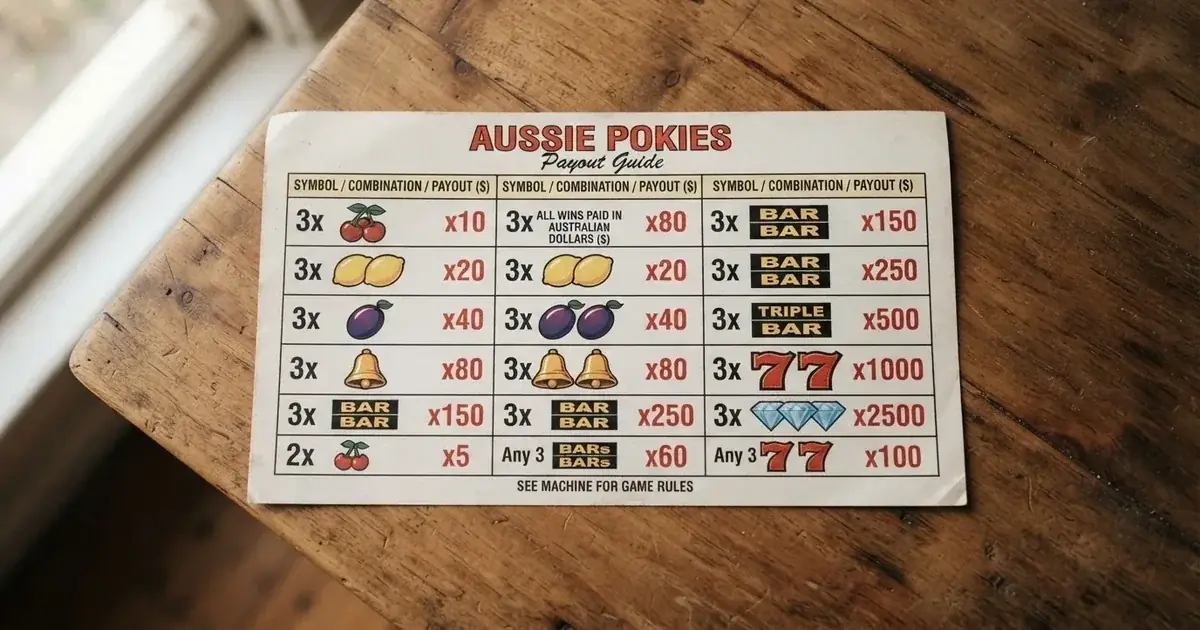
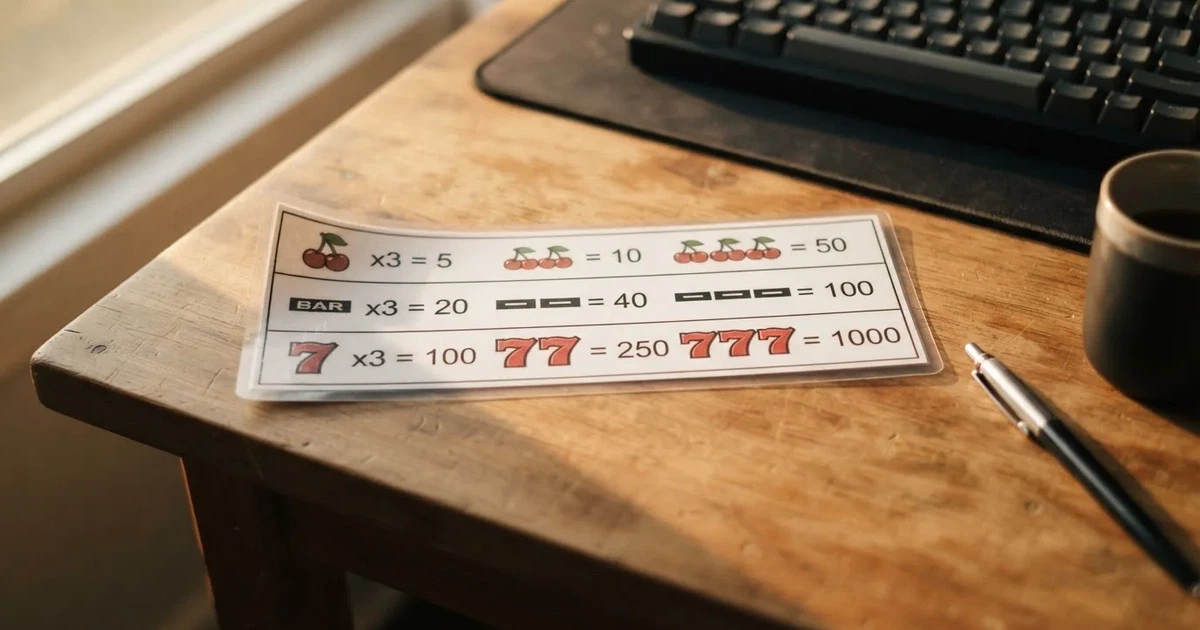
A paytable on a three-reel title is short and readable. Each symbol carries a fixed value; the value scales with the number of matching symbols on a payline; and the top combination pays the highest line value plus often a “max bet” multiplier. A typical three-reel paytable shows three-coin credits per symbol — 1 coin for three cherries, 2 coins for three single bars, 5 coins for three double bars, 10 coins for three triple bars, and the top prize for three of whatever the title’s high symbol is. The multiplier on a max-coin bet is usually 3x, which is the casino’s way of paying for the higher house edge on a smaller stake.
The flat structure is the format’s defining feature. There is no scatter pay, no free-spin round, no cascading reel. The player bets, the line pays, and the result is decided by the table. For readers used to modern video slots with twenty paylines and a bonus screen on every third spin, three-reel play looks spare. It is also closer to what a slot machine was when slot machines were new.
Payline structure and what changes between titles
The single-payline three-reel game is the format most readers picture. Three reels, one horizontal line across the middle, a fixed coin value, and a fixed paytable. Some three-reel titles add three or five paylines by drawing lines across the top, middle and bottom of the reels, or in a V-shape through the centre; a few add diagonal paylines. Each additional payline is paid independently, so a single spin can produce zero, one or multiple wins depending on which symbols land on which lines.
The volatility profile shifts with the payline structure. A single-payline three-reel game with three matching symbols paying the top prize of, say, 1,000 coins on a A$1 bet is a high-variance game by three-reel standards; a five-payline version of the same game at A$0.20 per line is a lower-variance game with more frequent small wins. The house edge on the two games is similar — both run on the same RNG and the same paytable — but the experience of playing them is different.
Symbol values and how the maths is set
The house edge on a three-reel title is set by the gap between the symbol frequencies on the virtual reel strip and the paytable values. A reel strip with low-frequency sevens and a high payout for three sevens creates variance: a long losing run, then a big win. A reel strip with high-frequency cherries and a small payout for three cherries creates smaller, more frequent wins. The maths is the strip; the experience is the paytable.
A punter who wants to understand what a three-reel title is actually paying cannot read it from the paytable alone. The paytable shows what each combination pays; the strip decides how often each combination lands. Two titles with identical paytables and different strips play very differently, and the only honest read of either is the published RTP — return to player percentage — which most licensed regulators require to be disclosed and which most offshore brands do not.
Where three-reel titles sit in the wider library
Three-reel titles are a small share of any modern online casino’s library. A typical offshore lobby carries several hundred video slots and a handful of three-reel classics — often fewer than ten. The format survives because a slice of players prefer it: a smaller, flatter game with no bonus round, no scatter, and no waiting for the feature to land. For the operators, the three-reel titles are a margin product — they hold players between sessions of higher-variance video slots and they keep the library’s “real casino” feel.
The same providers supply both formats. The same RTPs are available in both. The same licences — where they exist at all — cover both. Three-reel titles are not a separate category in any regulatory sense; they are a styling choice within the broader slot product, and the law that prohibits online slots treats them exactly the same.
Comparing the brands the ACMA has warned: what the column headings actually mean
Eleven brands appear in the table below, ordered as research carries them. Each was the subject of a formal warning from the ACMA under the Interactive Gambling Act 2001 for offering prohibited online casino services to Australians. The product — three-reel online slots among others — is the same across every brand, and the warning is the same legal instrument in every row. What differs is the operator behind the warning, the date the warning was issued, and whether any public listing carries the brand’s name.
A reader scanning this table is looking for a license signal. There is none. The Interactive Gambling Act 2001 prohibits online casino games for Australian players regardless of what licence any offshore operator displays; the ACMA’s formal warnings are the regulator’s published record that this prohibition is being enforced against these specific brands. The “ACMA action and date” column is therefore not a recommendation column — it is a record column. The “subject support” column says where, if anywhere, the brand name appears outside the warning; it does not say the brand is suitable to play.
The brands listed below have all been the subject of a formal warning by the ACMA. The table summarizes the operator distribution across these brands.
| Operator | Brand Count |
|---|---|
| Dama N.V. | 3 |
| Consolutetish S.R.L. | 2 |
| Other Entities | 6 |
| Operator | Brand Count |
|---|---|
| Dama N.V. | 3 |
| Consolutetish S.R.L. | 2 |
| Other Entities | 6 |
The brands the ACMA has named
| Brand | ACMA action and date | Operator named by the ACMA | Subject support |
|---|---|---|---|
| RocketPlay | Formal warning, March 2026; earlier Dama N.V., May 2022 | Pulsup Ltd | — |
| Level Up Casino | Formal warning, May 2022 | Dama N.V. | BGaming |
| Woo Casino | Formal warning, March 2025 | Dama N.V. | — |
| Spirit Casino | Formal warning, May 2025 | Dama N.V. | — |
| National Casino | Formal warning, July 2025 | Consolutetish S.R.L. | en.wikipedia.org |
| Bizzo Casino | Formal warning, July 2025; earlier TechSolutions, 2022 | Consolutetish S.R.L. | — |
| Ignition Casino | Formal warning, July 2025 | Bamboo Media | — |
| Instant Casino | Formal warning, February 2025 | EOD Code SRL | — |
| Jackbit | Formal warning, April 2026 | Ryker B.V. | — |
| Casino Intense | Formal warning, April 2025 | Sterplay Holding Ltd | Regulatory records |
| Sky Crown | Formal warning, September 2022 | Hollycorn N.V. | — |
The “subject support” column reflects where research could place the brand name outside the ACMA’s own publication. Most rows carry an em dash because the only public source naming them is the ACMA’s formal warning itself, which is the regulator’s record of breach and not a third-party endorsement. Two rows — Level Up Casino and Casino Intense — pick up listings mentions, and these are listings only: an appearance on a provider’s portfolio page or in a regulatory news piece, not an Australian licence and not a recommendation.
The operator column shows how often the same parent entity appears across multiple brands. Dama N.V. is named on three of the eleven rows — Level Up Casino, Woo Casino and Spirit Casino — and the ACMA’s earlier 2022 action over Dama N.V. covered six brands in total. Consolutetish S.R.L. appears on National Casino and Bizzo Casino; Bizzo Casino’s earlier 2022 warning sits under TechSolutions, illustrating how the same brand can move between operators over time without the warning disappearing from the record. The parent-entity column is therefore a useful trail for a reader who wants to see which offshore groups have been warned repeatedly for the same conduct.
How to read the warnings
A formal warning from the ACMA is the regulator’s first formal step: a written notice to the operator setting out the alleged contravention of the Interactive Gambling Act 2001 and giving the operator an opportunity to respond. A brand that receives one and does not stop offering prohibited services to Australians can expect escalation — referral to the Department of Infrastructure or to the Australian Federal Police, blocking of the website by Australian ISPs, and further publication of the operator’s name on the ACMA’s register. The 1,751 blocking actions reported by the ACMA in June 2026 are the cumulative result of warnings that did not stop the conduct.
For a reader, the warning is information that the brand the table names has been formally told by the Australian regulator that what it offers Australians is illegal. The table’s order is research’s order; the ranking is the ACMA’s order of publication, not a recommendation.
The legal frame: what three-reel slot play looks like under the IGA
Australia’s Interactive Gambling Act 2001 — strengthened by the Interactive Gambling Amendment Act 2017 — makes it an offence to provide online casino games, online pokies or in-play betting to a person in Australia. No state or territory issues a licence for online casino products; the only licensable online gambling products are wagering on races and sport placed before the event, lotteries and keno — in practice licensed by the Northern Territory through the Northern Territory Racing and Wagering Commission, which regulates 52 of Australia’s online bookmakers including Sportsbet, Bet365 and Ladbrokes and meets once a month in Darwin.
The IGA targets the provider, not the individual player. An Australian who plays three-reel slots on an offshore site is not prosecuted; the offshore operator that takes the play is. The consequence for the player is not legal risk but practical risk: an offshore operator offers no Australian consumer protection, no local complaints body, and no recourse if a withdrawal is refused. If the site is blocked by the ACMA, any balance still on the account is functionally stranded, because the offshore operator is outside any jurisdiction that could compel a payout.
What enforcement looks like
The ACMA investigates complaints, issues formal warnings, and can direct Australian internet service providers to block illegal sites. The agency’s June 2026 publication reported 1,751 blocked sites since the first blocking request in November 2019, and more than 230 unlicensed gambling services having left the Australian market since enforcement was strengthened in 2017. The June 2026 blocking round alone covered 12 sites: 7Signs, ChromaBet, Donbet, Duospin, Freshbet, Slots Gem, Jacks Club, Lucky Start, Pointsbetz, Spinrise, Vinyl Casino and Wildsino.
The blocking action is not a one-off. It is cumulative and ongoing. The ACMA’s register of formal warnings — from which every brand in this page’s table is drawn — is updated as new warnings are issued; a brand that has been warned once and continues to take Australian play is a brand that has chosen escalation over compliance.
Payments and what is banned
Credit cards, credit-related products and digital currency are banned as payment for licensed online wagering in Australia since 11 June 2024, with penalties up to A$247,500 for operators that accept them. The legal deposit routes for licensed wagering are debit card, bank transfer, PayID/Osko and BPAY. An offshore site asking an Australian for a credit card or a crypto deposit is operating outside the Australian rules — the credit card ban is on the operator, and the offshore operator that accepts one is in breach of an Australian law it is not licensed under.
The practical reading is simple. A reader who can deposit only by credit card or crypto at an offshore casino is dealing with a brand that has chosen to ignore the Australian credit card ban and, by extension, the wider IGA framework that ban sits inside. The brand’s terms of service may permit it; Australian law does not.
Tax and winnings
Gambling winnings of a recreational player are not assessable income under section 6-5 of the ITAA 1997, and losses are not deductible. A punter who wins A$5,000 on a three-reel spin declares nothing to the ATO; a punter who loses A$5,000 cannot claim it back. The carve-out is professional gambling, which is treated as a business and which the ATO’s guidance treats on a case-by-case basis. The model answer for a recreational reader is “check with the ATO” for any non-recreational position, and “do nothing” for any recreational position.
The 2026 reform
The Interactive Gambling Amendment (Gambling Reform) Bill 2026 passed Parliament on 19 August 2026. Its advertising and inducement measures commence on 1 January 2027. The bill is law with a start date — not yet in force on a page read in 2026, but committed to. The reform’s centre of gravity is the marketing: inducements, sign-up offers, and the bonus packages the cluster above describes are exactly what the bill targets. A reader who treats the current bonus offers as a permanent market feature is reading the market as it was before the reform, not as it will be.
Where three-reel slots actually run in Australia
The product prohibited online is heavily present offline. New South Wales legalised slot machines in 1956, and by 2010 Australia operated an estimated 97,103 gaming machines outside casinos — a per-capita rate about five times that of the United States. By state and territory outside casinos: New South Wales carried 87,298 pokies-style machines in June 2023, Victoria 26,380 across 2021-22, Queensland 21,122 in October 2023, South Australia 11,672 in September 2023 and the ACT 3,587 in November 2023.
The term the venues use is “pokies.” The term the technology uses is “slot machine.” The term this page is built around — “three-reel slot” — refers to the format, which exists across both. The pubs and clubs that house those machines carry three-reel titles among their mix; Crown Melbourne, the only casino operator in Victoria and the largest in the southern hemisphere, runs the full table-game suite alongside its pokies floor under the Victorian Gambling and Casino Control Commission, which replaced the VCGLR as Victoria’s casino regulator on 1 July 2022.
A reader who wants to play three-reel slots in Australia today is, on the law’s terms, pointed at those venues. The IGA does not prohibit the player from playing at a licensed Australian venue, and the venues themselves operate under state and territory gaming laws that predate the IGA’s online prohibition. The legal frame for online three-reel slots is not that the format is banned; it is that the online supply of it is banned, and the licensed offline supply is well established.
The pokies landscape, in numbers
The total of 87,298 NSW machines outside casinos in June 2023 is the single largest concentration of poker-style machines outside casinos anywhere in the world. The 26,380 figure for Victoria is the second-largest state figure, and the 21,122 figure for Queensland is third. The combined total — roughly 150,000 machines across Australia’s largest three states — is the backdrop against which an offshore site’s “100 free spins on three-reel classics” offer is being marketed. The brand is competing for the same dollar the pubs and clubs already hold; the bonus is the bait.
A reader who treats three-reel play as an experience rather than a product will find that experience in the licensed venues. A reader who treats it as an online product will find a product that is prohibited to be supplied to them, and that the brands offering it have been formally warned about by the ACMA.
H2 Gambling Capital’s 2025 estimate
H2 Gambling Capital’s 2025 report estimates that Australians lose about A$3.9 billion a year to illegal gambling sites, and that the share of gambling going through legal channels fell from 74% in 2021 to 64%. The estimate is the most-cited external figure on the size of the offshore market the ACMA is enforcing against, and it carries the qualifier research attaches: an external model estimate, not a regulator-published figure. The fall in the legal share is the trend the 2026 reform targets, and the rise in the illegal share is the trend the ACMA’s blocking actions are aimed at reversing.
Responsible play: where a reader in trouble can go
Three-reel play, like any slot play, is a house-edge product: the house takes a percentage of every wager, and over a long session the player loses. A punter who has stopped playing for fun and started playing to recover a loss, or to maintain a stake they cannot afford, is the punter the responsible-gambling framework was designed for. Australia runs two free, confidential services that are open around the clock.
Gambling Help Online, reachable at Gambling Help Online, offers 24/7 chat and email counselling and a self-assessment tool. The National Gambling Helpline — 1800 858 858 — is free, available around the clock, and staffed by counsellors who can refer a caller to face-to-face support in their state or territory.
BetStop, the National Self-Exclusion Register, has been live since August 2023 and binds every Australian-licensed online and phone wagering service. A punter who registers with BetStop is excluded from every licensed wagering platform in the country for a period of their choosing, and the operator is required to refuse their play and not market to them. BetStop does not bind offshore casino sites — an excluded punter can still reach an offshore site, and the offshore site has no obligation to honour the exclusion. This is the practical limit of the exclusion framework for the products this page is about.
What self-exclusion does and does not do
Self-exclusion is a tool, not a cure. A punter who has registered with BetStop and is still being approached by an offshore casino’s marketing is being approached by a brand outside the framework that produced the exclusion. The practical answer for that punter is to register with BetStop and to recognise that the offshore marketing is exactly what BetStop cannot reach. For readers whose play has moved beyond entertainment, the responsible step is the BetStop registration and the helpline call; the offshore marketing is a separate problem that the exclusion cannot solve.
What to do if a withdrawal stalls
An offshore site has no Australian complaints body to escalate to. A punter whose withdrawal is delayed, capped or refused has, in practical terms, the operator’s own complaints process and whatever recourse the operator’s home jurisdiction provides. The Australian regulator — the ACMA — enforces the IGA against the operator, not against the operator’s treatment of an individual player. A punter who has been refused a payout by an offshore site is, on Australian terms, dealing with a brand that should not have taken the play.
The recovery route is limited. Banks can sometimes recall a card transaction; a chargeback is a possibility for credit card deposits, but credit card deposits are banned under Australian law and an offshore site accepting one is operating outside the law. Crypto deposits have no equivalent recourse. The pragmatic answer for a punter who is about to deposit with an offshore brand is the same as the regulator’s: do not deposit at all.
Limits and what they look like at a licensed venue
A licensed Australian pub or club running poker-style machines operates under state-level harm-minimisation frameworks that include mandatory pre-commitment, time and spend limits, and exclusion provisions. The Crown Melbourne venue operates under the Victorian Gambling and Casino Control Commission’s approved rules, including approved changes to blackjack variants — the “Perfect Pairs” side bet renamed to “Crown Pairs” on 23 December 2024, and the “Free Bet” option with the “Pot of Gold” side bet on 25 March 2024. The same framework applies to slot play. An offshore site has none of this.
The reader-side picture is that three-reel play is well-regulated at licensed Australian venues and not regulated at all on offshore sites. The marketing picture is the opposite: the offshore sites run the advertising and the bonuses because they have to compete harder for the player the law has told them not to take. The bonus is the cost of doing business outside the law.
What the block rate tells a reader about the market
The first blocking request was in November 2019; the cumulative total reported in June 2026 was 1,751 blocked sites. That is the running total and the first date.
Working from those two numbers: the period from November 2019 to the June 2026 publication is roughly 79 months. Over that period, 1,751 sites have been blocked. The average monthly block rate is therefore on the order of 22 sites per month, though the rate is not even — early enforcement actions were sparse, later rounds have grouped larger batches, and the most recent rounds have included a single monthly action of a dozen or more sites.
A more useful framing is to read the cumulative figure against the estimate of A$3.9 billion in annual losses to illegal sites. The block rate of roughly 22 sites per month is the rate at which the ACMA is removing the visible supply; the A$3.9 billion is the demand the remaining sites continue to capture. The gap between the two is the practical measure of how far enforcement has yet to go.
The figure is best read as a band rather than a single number, because the monthly rate is uneven. The reasonable statement for a reader is that the block rate, averaged over the period from the first request in November 2019 to the June 2026 publication, is in the high teens to mid-twenties of sites per month, with single monthly rounds ranging from a handful to roughly a dozen or more. The exact monthly figure for any given month is less important than the trend: blocks are accelerating, and the cumulative total grows faster each year than the year before.
What the trend implies
The 2026 reform — the Interactive Gambling Amendment (Gambling Reform) Bill 2026 — adds advertising and inducement controls from 1 January 2027, which is the regulatory direction the ACMA’s enforcement has been signalling since 2017. The block rate is the existing lever; the advertising and inducement controls are the new one. A reader who treats the current bonus-heavy market as a stable feature is reading it as it was before the new controls come into force, and the right reading is that the current marketing-heavy market is the last of its kind, not the first.
For a reader comparing offshore offers, the calculation that matters is the one the cluster above describes: the cost of clearing a bonus given the house edge of three-reel play, the max-cashout cap, and the time limit. The block rate is the same calculation at the market level — how quickly the supply is being thinned — and the answer there is the same: the visible supply is shrinking, the demand is not, and the gap between them is what an offshore brand’s bonus is being marketed to fill.
A reader’s question, in summary
Three-reel slots are the original slot machine format — three reels, a handful of symbols, a short paytable — and the format has survived because it is closer to what a slot machine was than what a slot machine has become. In Australia the format is well established in licensed pubs and clubs, with roughly 150,000 poker-style machines across NSW, Victoria and Queensland alone, and is prohibited online under the Interactive Gambling Act 2001. The offshore brands that still offer three-reel play to Australians are brands the ACMA has named through formal warnings; the bonus packages that travel with those brands are written for a market that is being thinned by enforcement, not for a market that has settled into stable supply.
For a reader who treats the offer as a marketing exercise rather than a free credit, the cost is plain: a 50x wagering requirement on a A$100 bonus asks for A$5,000 of stake against roughly A$150 of expected loss, and the max-cashout cap on free spins often sits below the gross return of the spin package. For a reader who treats the market as a legal market, the cost is also plain: the ACMA’s block rate of roughly 22 sites per month is the rate at which the visible supply is being removed, and the 1 January 2027 inducement controls are the rate at which the marketing around the supply is being thinned. The two trends point in the same direction.
The most useful thing a reader can take from this page is the format itself, not the offers around it: three reels, one payline, a flat paytable, and a house edge that is steady across the format. Where the format is licensed and regulated, it is well established. Where it is prohibited and offshore, it is being enforced against, and the offers around it are designed for the brief window before the next round of enforcement.
Frequently asked questions
What makes a three-reel slot different from a standard five-reel video slot?
Three-reel slots use three rows of symbols with typically one, three or five paylines and a short paytable built on a handful of classic symbols — cherries, bars, sevens and bells. A standard five-reel video slot uses five rows, often 20 or more paylines, and includes scatter pays, free-spin rounds and bonus features. The three-reel format sits at the low-volatility end of the slot range and the five-reel video format sits at the high-variance end with odds as high as 300 million to one against a top combination. The format is a styling choice within the broader slot product; the law that prohibits online slots treats them the same.
Can three-reel slot machines be found in licensed Australian pubs and clubs?
Yes. Australian venues carry three-reel poker-style machines among their mix, alongside five-reel video titles. By state and territory outside casinos in 2023: NSW had 87,298, Victoria 26,380 (2021-22), Queensland 21,122, South Australia 11,672 and the ACT 3,587. The term the venues use is “pokies.” The format exists in licensed Australian venues, and the IGA’s prohibition is on the online supply, not on the player playing at a licensed venue.
Do three-reel slots typically pay out differently than newer five-reel formats?
Three-reel slots tend to have flatter hit rates, smaller maximum payouts and lower volatility than five-reel video slots. A classic mechanical three-reel machine with about 10 symbols per reel offers roughly 1,000 possible combinations, compared with a modern five-reel title where odds against a top combination can run to 300 million to one. The house edge on a three-reel title is set by the gap between the virtual reel strip and the paytable values, and the published RTP — return to player percentage — is the honest read on what the title pays back over time.
Is a three-reel slot online the same game as a three-reel machine on a casino floor?
The format is the same — three reels, a handful of symbols, a short paytable — but the mechanism is different. A casino-floor three-reel title may still be mechanical or electromechanical; an online three-reel title is a random number generator selecting from a virtual reel strip. The two are functionally equivalent for the player, and the difference is invisible to anyone who has not stood next to a physical machine. The law, however, treats them very differently: a casino-floor title in a licensed Australian venue operates under state and territory gaming laws; an online title is offered through an offshore site and is prohibited for Australian players under the Interactive Gambling Act 2001.
Are three-reel slots for real money available legally from an Australian-based site?
No. Under the Interactive Gambling Act 2001 — strengthened by the Interactive Gambling Amendment Act 2017 — it is an offence to provide online casino games, online pokies or in-play betting to a person in Australia, and no state or territory issues a licence for them. The only licensable online gambling products are wagering on races and sport placed before the event, lotteries and keno — in practice licensed through the Northern Territory. Three-reel online slots for real money are not available legally from an Australian-based site; any site offering them to an Australian player is operating outside Australian law and is subject to ACMA enforcement.
Do reel count and paytable structure affect how a slot’s volatility is described?
Yes. Reel count and paytable structure together define a slot’s volatility profile. A single-payline three-reel game with three matching symbols paying the top prize of 1,000 coins on a A$1 bet is a high-variance three-reel title; a five-payline version of the same game at A$0.20 per line is a lower-variance game with more frequent small wins. The house edge on the two games is similar because both run on the same RNG and the same paytable, but the experience of playing them is different. Volatility is a read on the distribution of outcomes, not on the long-term return.
Created by the ”Casino Payout Hub” editorial team.