

Lightning Link online pokies in Australia: what the hold-and-spin bonus actually costs
A player who searches for Lightning Link online in Australia is usually after one of three things: the bonus round that the cabinet game is famous for, an app that runs the reels on a phone, or a promo code that unlocks free spins. Every one of those searches ends in the same place, because every online casino offering the Lightning Link name to an Australian resident is doing so without an Australian licence. The Interactive Gambling Act 2001 prohibits the supply of online casino games and online pokies to people in Australia. No state or territory issues the licence that would make such a site lawful, and the ACMA has spent the last several years issuing formal warnings to the operators behind them. The cost of playing on any of these sites is therefore not just the expected loss at the reels — it is the absence of the consumer protection that an Australian-licensed wagering service is required to provide, the absence of a working complaints body, and the standing risk that the ACMA will direct local ISPs to block the site with a balance still on it.

The numbers behind that picture are large enough to be worth knowing before anyone spins a reel. In 2020–21 Australians bet almost A$150 billion through gaming machines and lost A$12.18 billion on them, from a country that holds about 3% of the world’s pub and club poker machines with 0.3% of the global population. New South Wales alone runs 87,298 gaming machines outside casinos across 2,195 venues, with player losses of A$8.18 billion in 2022–23. Queensland operates 21,122 machines in 351 venues, and Victoria runs 26,380 outside Crown Casino under a 30,000-machine statewide cap. Those are the legal machines. The illegal online market, into which any Lightning Link site falls, is estimated by H2 Gambling Capital to take about A$3.9 billion a year from Australians — and the share of gambling going through legal Australian channels fell from 74% in 2021 to 64% as that offshore market grew.
This page closes out what an Australian reader actually needs to know about Lightning Link in the online channel: how the hold-and-spin bonus works, what an app on a phone changes about it, how the bonus word on the marketing page translates into required turnover, where the ACMA’s formal warnings line up against the operators that carry the Lightning Link name, and what the regulator’s blocking rate says about how long any of those sites is likely to remain reachable.
Current as of 29 October 2026 against the ACMA register and the published blocking round.
Table of Contents
- The Lightning Link bonus round: how hold-and-spin actually works
- Bonus codes, free spins and what “no deposit” actually demands
- Mobile apps and Lightning Link: the same game in a smaller window
- The 11 sites the ACMA has named over Lightning Link-style casino games
- The blocking record: how fast the ACMA clears the offshore market
- Why no online casino licence exists for Lightning Link in Australia
- What this costs the reader, in concrete terms
- Responsible gambling: what applies, and to whom
- What is changing in 2026 and what changes in 2026 + 1
- Choosing between the legal market and the offshore market
- Reading the ACMA register for yourself
- Frequently asked questions
The Lightning Link bonus round: how hold-and-spin actually works
The Lightning Link cabinet game is built around a feature called Hold & Spin. Six or more coin symbols scattered across the reels trigger it. The triggering coins lock in place, every other position blanks out, and the player receives three re-spins. Each new coin that lands during those re-spins also locks and resets the spin counter to three. The round ends when the re-spins run out without a new coin, at which point every locked coin reveals a credit value or one of three fixed jackpots — Mini, Minor or Major — and the values are added together and paid as a single bonus.
The mechanic is what gives the game its session length. A Hold & Spin round that fills most of the visible positions runs much longer than three spins, because every new coin resets the counter, and the value of the locked coins is only revealed once the round ends. A player chasing the Major jackpot has an incentive to keep the round going as long as a new coin is still appearing. Designers describe the structure as a “retention feature”; the Australian state regulators that approve the cabinet format have written about the same mechanic as one that extends session time well beyond what a standard base-game spin produces.
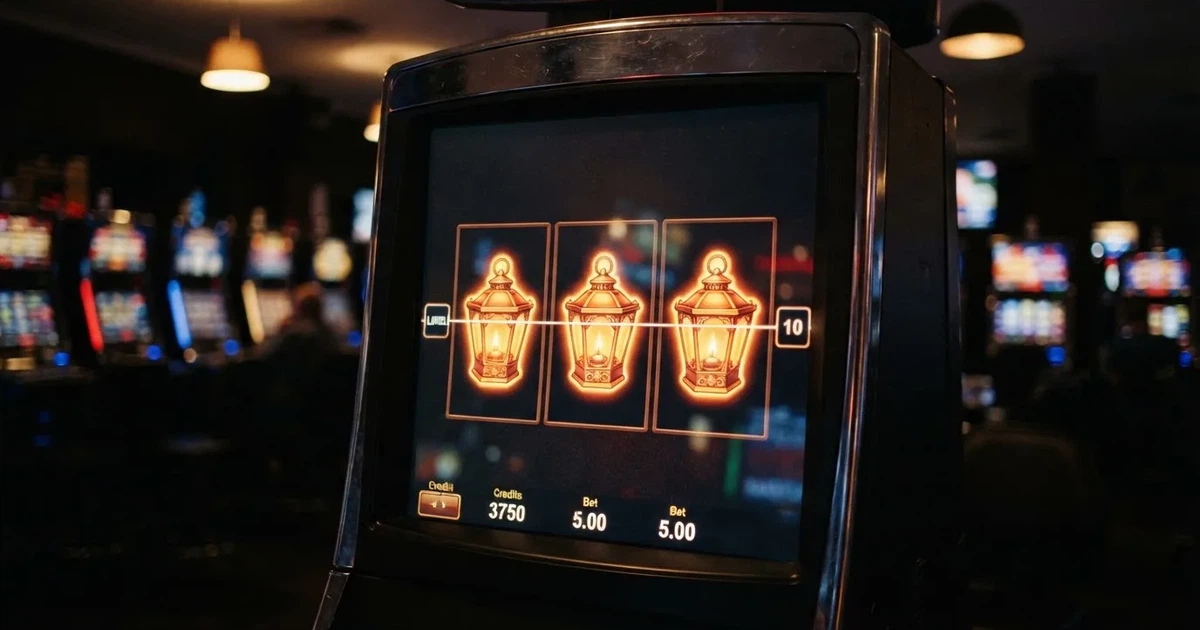
The reel sets that carry the Lightning Link name share the same Hold & Spin engine. They differ in theme and in the symbol set above the bonus — the Happy Lantern cabinet is the version most often photographed for marketing material, with the lantern symbol doubling as one of the higher-paying base-game icons, but the bonus round itself is the same across them. A player who has played one of them at a pub or club has played the bonus mechanic on all of them. The differences between the cabinets show up in the base game and in the size of the fixed jackpot values, not in the structure of the feature.
What the bonus round does not change is the house edge. The minimum return-to-player for poker machines in Australia varies by jurisdiction: 85% in New South Wales, the Northern Territory, Queensland and (generally) Victoria, 87% at Crown Melbourne, 87% in the Australian Capital Territory and Tasmania, 87.5% in South Australia, and 90% in Western Australia. Lightning Link cabinets in Australian venues operate inside those RTP floors. An online version of the same reels, marketed under the Lightning Link name to an Australian resident, is not subject to any of those floors — the RTP shown on the game’s information screen is whatever the operator chooses to publish, and the regulator with the power to enforce it is not the ACMA.
Bonus codes, free spins and what “no deposit” actually demands
The marketing language around Lightning Link online pokies uses the same vocabulary as any other online slot bonus page: a “no deposit bonus,” a stack of “free spins” on signup, a “welcome package” matched to the first deposit, and a “promo code” that unlocks the offer. The vocabulary is identical to the licensed wagering market for the simple reason that the offshore operators running the games borrow the words. The numbers underneath them are not the same as on a Sportsbet or a Ladbrokes welcome offer, and the consumer protections around them are not the same either.
A “no deposit” bonus on an offshore casino is a small credit — typically A$10 to A$25 in bonus funds, or a small number of free spins at a fixed coin value — issued against the player’s signup. It is not a gift. It is a credit that must be turned over a stated number of times before any of it can be withdrawn. The wagering multiple on a no-deposit bonus is heavier than on a deposit bonus, often between 40× and 60× the bonus amount, because no deposit has come in to dilute the operator’s exposure. A$20 of bonus funds at 50× turnover is A$1,000 of required play before withdrawal — a figure that the marketing page calls “free” and the small print calls “playthrough requirement.” The math is what decides whether a player ever sees any of it converted to cash.
A welcome package is a different shape. It is a deposit match — typically 100% on the first deposit up to a stated cap, sometimes with a bundle of free spins attached — and the wagering multiple on the matched amount is usually lower, between 35× and 50×. A$200 deposited with a 100% match at 40× turnover is A$8,000 of required play on the matched A$200 before any of the bonus funds convert. The deposit itself is not subject to playthrough; the bonus on top of it is.
Free-spin bundles add a third layer. A bundle of 100 free spins at A$0.20 per spin on a slot with a 96% RTP produces expected bonus conversion of A$0.80 per spin — A$80 of bonus funds if every spin is taken at face value — and those bonus funds are then subject to the same wagering multiple as the rest of the welcome package. The headline “200 free spins” is not a headline gift of A$200. It is a smaller quantity of bonus funds that must then be turned over the stated multiple of times before withdrawal.
The operator never publishes the expected loss the player takes while working through the turnover. That is the calculation the player has to do. The expected loss on A$1,000 of required playthrough at a 96% RTP is A$40. The expected loss on A$8,000 of required playthrough at 96% is A$320. These are average figures across many spins; no individual session will land on them, and a player can lose more or less than the average in any given sitting. They are the right figures to compare an offer against, because they are what an offer actually costs.
What none of these bonus terms address is the consumer protection that sits behind a licensed Australian wagering service. A Sportsbet bonus that misleads on its terms can be complained about to the relevant state regulator. An offshore casino bonus that refuses to pay out has no Australian complaints body behind it. The ACMA’s enforcement is on the operator, not the player, and the player whose account is closed mid-playthrough has no working route to recover the balance. The “free” in “free spins” is therefore not just a marketing word. It is a word that carries a missing piece of regulation underneath it.
Mobile apps and Lightning Link: the same game in a smaller window
A Lightning Link app on a phone is a packaging choice, not a different game. The reels render in a portrait or landscape window; the spin button is a tap; the Hold & Spin round works the same way it does on a desktop browser. Aristocrat’s Lightning Link cabinets are licensed for land-based venues in Australia, and any app that claims to run Lightning Link on a phone is offering the same unlicensed online casino game as a desktop site. The Australian Communications and Media Authority has been clear about this: a prohibited interactive gambling service is prohibited however it is delivered.
What an app changes is friction. The deposit happens in fewer taps; the session restarts where it left off; push notifications can pull a player back into the app between other tasks. The retention mechanic inside the game — Hold & Spin with its three-spin reset — sits on top of the retention mechanic outside it. That is the design. The state regulators that approved the cabinet version of the game have written about the same pattern as one that extends session time. An app that packages a hold-and-spin feature for a phone does not soften that pattern. It concentrates it.
The legitimate apps a player sees in the Australian app stores — Aristocrat’s own marketing apps, the state lotteries’ apps, the licensed bookmakers’ apps — are not Lightning Link apps. The Aristocrat brand does not publish a real-money Lightning Link app for Australian residents. A search for one turns up unlicensed casino apps that use the Lightning Link name without a licence to do so. The download experience varies: some apps are pulled from the Australian stores quickly, some sit on third-party stores that do not apply Australian distribution rules, and some are wrapped in a web view that loads an offshore casino’s mobile site. Each of those is an unlicensed service.
The credit card and crypto rules for Australian-licensed wagering do not apply on those apps. From 11 June 2024 credit cards, credit-related products and digital currency are banned as payment for licensed online wagering in Australia, with penalties of up to A$247,500 for operators that take them. An offshore casino app asking for a credit card deposit or a Bitcoin transfer is operating outside that regime entirely. The deposit route is part of how a player can tell what kind of service they are on.
The 11 sites the ACMA has named over Lightning Link-style casino games
The brands below are not a ranking. None of them holds an Australian licence to provide online casino games, because no such licence exists. They appear because the ACMA itself has issued a formal warning over each of them for offering prohibited services to Australians. The ACMA register is the authority; the dates and operator names below come from it. The “subject support” column records what independent listings say about whether the brand carries the Lightning Link name or pokies of that style — where no listing carries that subject, the column is left blank, because absence of evidence is not evidence of absence and an operator that does not advertise a subject should not be claimed to carry it.
| Brand | ACMA action and date | Operator named by the ACMA | Subject support |
|---|---|---|---|
| RocketPlay | Formal warning, March 2026 | Pulsup Ltd (RocketPlay); earlier Dama N.V. in May 2022 | — |
| Level Up Casino | Formal warning, May 2022 | Dama N.V. | Listed by third-party game directories as carrying pokies-style content; Lightning Link subject not confirmed |
| Woo Casino | Formal warning, March 2025 | Dama N.V. | — |
| Spirit Casino | Formal warning, May 2025 | Dama N.V. | — |
| National Casino | Formal warning, July 2025 | Consolutetish S.R.L. | Listed by reference works among the brands that market pokies content to Australian-facing traffic |
| Bizzo Casino | Formal warning, July 2025; earlier 2022 | Consolutetish S.R.L.; earlier TechSolutions | — |
| Ignition Casino | Formal warning, July 2025 | Bamboo Media | — |
| Instant Casino | Formal warning, February 2025 | EOD Code SRL | — |
| Jackbit | Formal warning, April 2026 | Ryker B.V. (Jackbit and CasinOK) | — |
| Casino Intense | Formal warning, April 2025 | Sterplay Holding Ltd | Listed by Australian and ACMA sources among brands previously flagged for prohibited service |
| Sky Crown | Formal warning, September 2022 | Hollycorn N.V. (Sky Crown and Blue Leo) | — |
The same operator turns up under more than one name because of how the offshore market is structured. Dama N.V. was warned in May 2022 over six brands at once, then again in March 2025 over Woo Casino and in May 2025 over Spirit Casino. Consolutetish S.R.L. was warned in July 2025 over both National Casino and Bizzo Casino, the latter of which had already been the subject of a 2022 warning to TechSolutions. The brand name on the page is not the legal entity behind it; the legal entity is what the ACMA names in its formal warning.
The pattern of the warnings is also instructive. They do not name Lightning Link specifically. They name the operator for offering prohibited interactive gambling services to Australians — a category that covers any online casino game or online pokies, of which Lightning Link is one title. A reader who came to this page looking for “is brand X licensed to run Lightning Link in Australia” has the same answer for every brand: no Australian licence exists, no state issues one, and the ACMA has already told that brand’s operator the same thing.
RocketPlay
Pulsup Ltd was warned in March 2026 over RocketPlay; Dama N.V. was warned in May 2022 covering Rocketplay among six other brands. RocketPlay is one of the more visible offshore brands in the Australian search results for pokies-style content, and it has been the subject of two ACMA actions across the corporate chain that owns it. The site markets a welcome package and a free-spin bundle, both of which carry the wagering-multiple structure described in the bonus section above; the terms do not change because the ACMA has named the operator. The relevant fact for a reader is that the operator has been told twice.
Level Up Casino
Dama N.V. was warned in May 2022 over Level Up among six brands. Independent game directories list Level Up among the operators whose library covers pokies-style content; the directories do not confirm the Lightning Link subject specifically, and the site should not be claimed to carry it where the listings do not. The five-year interval between the 2022 warning and the present is not evidence that the operator has left the Australian market — the offshore market does not work on visible turnover, and a brand can disappear from search results for a year and re-emerge under a new front domain without changing the corporate entity behind it.
Woo Casino
Dama N.V. was warned in March 2025 over Woo Casino. The Woo Casino brand has been among the more persistent in Australian-facing search results across the period; a second warning to the same operator within three years indicates the ACMA has reason to believe the formal warning was not acted on. The page format is the standard offshore welcome package with a deposit match and a free-spin bundle, and the small print carries the same wagering-multiple structure as every other brand in this list.
Spirit Casino
Dama N.V. was warned in May 2025 over Spirit Casino, two months after the Woo Casino warning to the same operator. The two warnings close to each other are the regulator’s clearest signal that Dama N.V. did not change its Australian-facing operation after the first. Spirit Casino’s marketing vocabulary is identical to the rest of the Dama N.V. portfolio, because the portfolio shares a content engine.
National Casino
Consolutetish S.R.L. was warned in July 2025 over National Casino, in the same enforcement round that named Bizzo Casino. Reference works on the offshore market list National Casino among the brands that market pokies content to Australian-facing traffic, though the Lightning Link subject is not specifically confirmed. The relevant fact is the ACMA’s action against the operator; the marketing of pokies content is the conduct the action addresses.
Bizzo Casino
Consolutetish S.R.L. was warned in July 2025; TechSolutions (CY) Group Limited and TechSolutions Group N.V. were warned in 2022. Two operators across the same brand over three years is the pattern the offshore market produces when a brand is sold or rebranded within a corporate group. The player who arrived at Bizzo Casino via an affiliate link in 2024 and the player who arrives via a different affiliate link in 2026 may be on the same brand and a different legal entity.
Ignition Casino
Bamboo Media was warned in July 2025 over Ignition Casino. Ignition has been a longer-running brand in the offshore market than several of the others in this list, and the formal warning landed in a month when the ACMA also named Consolutetish S.R.L. and Hollycorn N.V. operators in the same round. The volume of warnings in a single month is the regulator’s clearest signal that it treats the prohibited-service market as a continuing enforcement target, not a closed file.
Instant Casino
EOD Code SRL was warned in February 2025 over Instant Casino. The brand’s marketing emphasises speed of withdrawal, which is the marketing word most likely to attract the reader who came to this page looking for a fast payout. The withdrawal speed claim is not enforceable in Australia through any of the channels a Sportsbet player has access to; the relevant fact is that the ACMA named the operator in the formal warning.
Jackbit
Ryker B.V. was warned in April 2026 over Jackbit and CasinOK, named together in the same warning. The pairing is consistent with the ACMA’s habit of grouping related brands into a single warning when they share a corporate chain. Jackbit has been a more visible brand in the cryptocurrency-deposit segment of the offshore market, which is the segment the Australian credit-card and crypto ban does not reach because the ban applies only to licensed wagering.
Casino Intense
Sterplay Holding Ltd was warned in April 2025 over Casino Intense. Australian and ACMA sources have flagged Casino Intense among brands previously identified for prohibited service; the Lightning Link subject is not specifically confirmed by those listings. The warning is the relevant fact.
Sky Crown
Hollycorn N.V. was warned in September 2022 over its Sky Crown and Blue Leo casino services, named together. The 2022 date puts Sky Crown earlier in the warning cycle than most of the other brands on this list. The Hollycorn N.V. portfolio of brands is broader than the two named in the warning, and several of them appear in Australian-facing search results; the warning is to the operator, and the operator’s other brands carry the same risk profile.
The blocking record: how fast the ACMA clears the offshore market
The Australian Communications and Media Authority does not only warn operators. It also directs Australian internet service providers to block illegal sites, and the rate at which it does so is itself information for any reader trying to judge how stable an offshore casino is as a destination for a balance.
The ACMA asked ISPs to block its first batch of illegal sites in November 2019. As reported in June 2026, a total of 1,751 illegal gambling and affiliate marketing websites had been blocked since that first request, and more than 230 unlicensed gambling services had left the Australian market since enforcement was strengthened in 2017. The June 2026 round alone added 12 more sites: 7Signs, ChromaBet, Donbet, Duospin, Freshbet, Slots Gem, Jacks Club, Lucky Start, Pointsbetz, Spinrise, Vinyl Casino and Wildsino.
The blocking rate works out as a band. From November 2019 to the June 2026 report, the running total grew from zero to 1,751 over roughly 79 months — between 22 and 23 sites blocked per month on average, or close to one site every 34 hours. Within that average the pace is uneven: the 230 services that have left the market since 2017 have not left evenly, and a single enforcement round can take out a dozen in one announcement. What the average does say is that the ACMA treats blocking as a continuing operation, not a one-off action.
The relevant fact for a reader is what blocking does to a balance. The ACMA’s enforcement targets the provider, not the player, and an Australian resident who has deposited at an offshore casino that is later blocked does not have a working route to recover the funds. The site is no longer reachable; the operator is offshore; the Australian complaints body has no jurisdiction. A player who plans to leave a balance on an offshore casino for any length of time is planning to leave it on a service whose continued reachability is a question the ACMA answers roughly once a fortnight.
Why no online casino licence exists for Lightning Link in Australia
Australia’s prohibition on online casino games is older than most of the brands in this list. The Interactive Gambling Act 2001 made it an offence to provide online casino games to a person in Australia; the Interactive Gambling Amendment Act 2017 strengthened that prohibition, including the in-play betting rules that closed a major loophole. What is licensable in Australia is wagering on races and sport placed before the event, lotteries and keno. The Northern Territory Racing and Wagering Commission (NTRWC) regulates 52 of Australia’s online bookmakers — including Sportsbet, Bet365 and Ladbrokes — licensed in the Territory for tax reasons; the commission has no full-time staff and meets once a month in Darwin.
The state-by-state regulation of the legal poker machine market runs in parallel. New South Wales approved 87,298 gaming machines outside casinos across 2,195 venues in June 2023, with player losses of A$8.18 billion in 2022–23. Queensland operates 21,122 machines in 351 venues (October 2023); Victoria runs 26,380 outside Crown Casino in 488 venues under a 30,000-machine statewide cap. Western Australia banned poker machines in pubs and clubs when Crown Perth opened in 1985, with Crown Perth’s own machine count growing from about 200 in 1985 to roughly 2,500, all approved by the state’s Gaming and Wagering Commission. Tasmania held the machines under a Federal Group monopoly from 1968 until legislation in November 2021 ended it and moved oversight to the Tasmanian Liquor and Gaming Commission. Tasmania also planned nation-leading mandatory pre-commitment cards for the machines, with implementation delayed until late 2025.
What the legal market does not include is online casino. Registered clubs operated Australia’s first legal poker machines from 1956, in New South Wales. The minimum RTP for those machines varies by jurisdiction as set out above. None of that framework extends to an online casino offering Lightning Link to an Australian resident, because the IGA does not let one be licensed.
The Interactive Gambling Amendment (Gambling Reform) Bill 2026 passed Parliament on 19 August 2026, with its advertising and inducement measures commencing on 1 January 2027. The bill is law with a start date, not yet in force on a 2026 page. Its principal effects on inducement marketing will land in the early months of 2026 + 1; what is in force today is the IGA as amended in 2017.
The cost of an Australian player sitting on an offshore site is therefore not just the cost of the spins. It is the absence of the state-by-state regulatory floor on the machines, the absence of the Australian complaints body, the absence of BetStop coverage (the National Self-Exclusion Register binds only Australian-licensed online and phone wagering services, not offshore casinos), and the absence of the credit-card and crypto ban that applies to licensed wagering. A deposit the player makes by credit card or Bitcoin on an offshore site is a deposit made outside every protection that an Australian-licensed wagering service is required to provide.
What this costs the reader, in concrete terms
A reader who arrived at this page asking “where can I play Lightning Link online in Australia” has three concrete costs to weigh against any answer.
The first is the bonus cost. A A$200 deposit with a 100% match at 40× wagering on the matched amount is A$8,000 of required turnover. At a 96% RTP — typical for an online slot but not the figure any Lightning Link cabinet runs to, since the cabinet RTPs in Australia sit between 85% and 90% — the expected loss on that turnover is A$320. If the RTP is closer to the cabinet floor of 87%, the expected loss on the same turnover is A$480. These are averages, not outcomes; a player can lose more or less than the average in any given sitting. The point is what the average says about the offer.
The second is the payment cost. From 11 June 2024 credit cards, credit-related products and digital currency are banned as payment for licensed online wagering in Australia. An offshore casino asking for a credit card or Bitcoin deposit is operating outside the Australian rules. A deposit the player cannot reverse through the Australian chargeback system is a deposit the player has less recourse over if the site stops paying out.
The third is the blocking cost. The ACMA is blocking sites at a long-run rate of about 22 per month, with the pace uneven and individual rounds much larger. A site a player opens an account on in one month can be on the blocked list the next. The balance at that point is on an unreachable service, with an offshore operator, and no Australian complaints body behind it.
What the figures do not cover is the consumer protection that an Australian-licensed wagering service provides — the complaints body, the responsible-gambling tools, the BetStop registration, the credit-card ban — and which an offshore casino does not. A reader weighing “where do I play Lightning Link” against “what does it cost to play it on an unlicensed site” should weigh the licensed Australian wagering market for what it can offer (sports and race betting, not casino games) and the offshore market for what it cannot. The unlicensed online casino market exists because of a gap between what Australians want to play and what the IGA lets be supplied; it does not exist because of any safety case.
Responsible gambling: what applies, and to whom
The responsible-gambling tools that work in Australia work because they are attached to Australian-licensed services. BetStop, the National Self-Exclusion Register, has been live since August 2023 and binds every Australian-licensed online and phone wagering service. A person registered with BetStop cannot open a new account with a licensed Australian bookmaker, and existing accounts are closed. The register does not extend to offshore casinos. An Australian resident who has self-excluded from licensed wagering is not self-excluded from an offshore casino. The relevant fact for a reader who has registered with BetStop is that the registration does not cover the brand list in this article.
The National Gambling Helpline on 1800 858 858 is free, 24/7 and supports chat at Gambling Help Online. The helpline is the right first contact for a person whose gambling has moved past what they intended, regardless of which channel the gambling happened on. Gambling Help Online extends the same support to web chat.
A hold-and-spin feature like the one Lightning Link runs is built to extend a session. The state regulators that approved the cabinet format have written about that mechanic as one that lengthens play beyond a standard base-game spin. A fixed time limit matters more than any in-game prompt to keep playing. A player who decides on a session length before the session starts and walks away at that length — regardless of whether a bonus round is in progress — is making the decision the regulator’s design did not make for them. That is the responsible-gambling advice that applies to any hold-and-spin game, licensed or otherwise.
What is changing in 2026 and what changes in 2026 + 1
The Interactive Gambling Amendment (Gambling Reform) Bill 2026 passed Parliament on 19 August 2026. Its advertising and inducement measures commence on 1 January 2027. The bill is law with a start date, not yet in force on a 2026 page. What changes on 1 January 2027 is the inducement environment around online wagering — the bonus words, the sign-up offers, the marketing of free bets. What does not change is the underlying prohibition on online casino games. The bill does not legalise online casino; it tightens the inducement rules around the wagering services that are already legal.
A reader comparing the situation today against the situation on 1 January 2027 should treat the date as a boundary on the marketing, not on the legality. The eleven brands in this article’s table are all operating under the IGA as it stands. They will be operating under the same IGA on 1 January 2027, with the inducement rules tightened around the wagering services that are licensed. The expected loss figures in the bonus section above are unchanged by the date.
Choosing between the legal market and the offshore market
A reader who has read this far is in one of three positions. The first is a player who only wants sports or race betting, who can use a licensed Australian bookmaker with the full set of consumer protections, and to whom this article’s brand list does not apply. The second is a player who wants online casino games and has decided that the offshore market is the only channel available, in which case the relevant questions are which offshore operators the ACMA has named, what the bonus terms actually demand in turnover, and how long the site is likely to remain reachable. The third is a player who has not yet decided, and is weighing the cost of the offshore market against what is unavailable in the licensed market.
The cost framework is the same for all three. The expected loss on the turnover is the cost of the spins. The absence of consumer protection is the cost of the channel. The blocking rate is the cost of leaving a balance on the site. None of those costs is hidden in the small print; all of them are in the ACMA’s enforcement record and in the bonus terms on the marketing page. A reader who chooses the offshore market has chosen to pay all three.
Reading the ACMA register for yourself
The ACMA publishes its formal warnings on its website, with the operator name, the brand name and the date. The blocking round reports are published with the list of newly blocked sites. The Australian-licensed wagering and lottery services are listed by state and territory regulator. A reader who wants to check whether a brand is on the ACMA’s list can do so directly, and the licensed wagering register can be checked through the NTRWC and the state regulators.
What the register cannot do is tell a reader whether a brand is a good place to play. It can tell a reader whether a brand is licensed, whether it has been warned, and whether it has been blocked. Those three answers are the only ones a register has, and they are the only ones a player needs to make the cost framework above concrete.
Frequently asked questions
Is it legal to play Lightning Link online pokies for real money in Australia?
No. The Interactive Gambling Act 2001 prohibits the supply of online casino games and online pokies to people in Australia, and no state or territory issues a licence that would let a site offer them lawfully. The ACMA’s enforcement targets the provider, not the player, but an offshore site gives no Australian consumer protection, no working complaints body and no recourse if a withdrawal is refused.
What triggers the hold-and-spin bonus round on a Lightning Link machine?
Six or more coin symbols scattered across the reels trigger the round. The triggering coins lock in place, every other position blanks out, and the player receives three re-spins; each new coin that lands locks and resets the counter to three. The round ends when the re-spins run out, and every locked coin then reveals a credit value or one of three fixed jackpots — Mini, Minor or Major — which are added together and paid as a single bonus.
Is Lightning Link available at regulated land-based venues in Australia?
Yes. Lightning Link cabinets are licensed for Australian pubs, clubs and casinos under each state and territory’s gaming regime, and the minimum return-to-player for those machines ranges from 85% to 90% depending on the jurisdiction. The online channel is a separate product and is not covered by any of those state-based approvals.
Do Lightning Link promo codes work the same way across different cabinet themes?
The hold-and-spin bonus mechanic is the same across the Lightning Link reel sets — the bonus round triggers on six or more coin symbols and pays out the locked coin values at the end of the round. The theme, the base-game symbols and the fixed jackpot values differ between cabinets. A promo code on an offshore site is a marketing device for the site’s welcome package, not a feature of the cabinet game itself.
Does a Lightning Link app on a phone offer a different game to the desktop version?
No. The reels, the bonus round and the RTP are the same on a phone as on a desktop browser. What the app changes is the friction of deposit and session restart, and it concentrates the hold-and-spin retention mechanic onto a device that sits in a pocket. Aristocrat does not publish a real-money Lightning Link app for Australian residents; an app carrying the Lightning Link name is an unlicensed service.
What separates the different Lightning Link reel sets from each other?
The reel sets share the hold-and-spin engine and the three fixed jackpots. They differ in theme, in the base-game symbol set, and in the value of the fixed jackpots. The Happy Lantern cabinet is the version most often used in marketing material, with the lantern symbol as one of the higher-paying base-game icons, but the bonus structure is unchanged across them.