


Best RTP Pokies Australia 2026: Onshore Returns, Offshore Claims, and the Reading Between Them
The highest theoretical return-to-player figure printed on a paytable in Australia sits in a casino at the top end of town, and a reader looking for “best RTP pokies” would be wise to know which one before chasing a number on a banner. This page reads the figure the way the operators, the regulators and the mathematicians read it: as a long-run average, with conditions, and with no Australian online casino inside the comparison — because the product does not legally exist in this country.
Data current as of 8 November 2026 and checked against the Australian Communications and Media Authority register of formal warnings and blocking orders.
Table of Contents
- Pokies with the Highest Theoretical Return: Where the Figure Lives in 2026
- How to Read a Pokies Paytable in Australia
- High-RTP Pokies Mechanics: What Actually Decides the Number
- Best RTP Pokies Australia: Reading the Offshore Sites Already on Your Screen
- Legality and Regulation: What the Interactive Gambling Act Actually Prohibits
- Responsible Gambling Support for Pokies Players in Australia
- Enforcement Record: Brands Named by the ACMA
- Casinos Reviewed by the ACMA: Reading the List as a Record, Not a Recommendation
- Pokies Games Worth Knowing: Reading the Mechanic, Not the Banner
- Frequently Asked Questions
Pokies with the Highest Theoretical Return: Where the Figure Lives in 2026
Australian pokies machines return between roughly 85% and 90% of money wagered to players, depending on the state or territory that licenses the venue. The legal minimum sets the floor; a venue or manufacturer can and does run settings above it, and the highest published figure available to a person in Australia belongs to the Perth casino.

The state-by-state floor reads like this:
| Jurisdiction | Legal minimum RTP |
|---|---|
| Western Australia (Crown Perth only) | 90% |
| South Australia | 87.5% |
| Australian Capital Territory | 87% |
| Tasmania | 87% |
| Victoria (Crown Melbourne) | 87% |
| Victoria (other venues) | 85% |
| New South Wales | 85% |
| Northern Territory | 85% |
| Queensland | 85% |
Western Australia banned poker machines in pubs and clubs when Crown Perth opened in 1985, which is why one casino’s machine count grew from roughly 200 in 1985 to about 2,500 today, every one approved by the state’s Gaming and Wagering Commission, and every one of them running at or near that 90% ceiling. A reader chasing the highest theoretical return is, by definition, chasing a Crown Perth machine, unless they sit down at a Crown Melbourne baccarat table — where the casino’s edge is closer to one percent than fifteen, and the “best return” conversation quietly changes subject.
That last point matters. When readers search for “best RTP pokies,” the answer a mathematician gives is rarely “the pokie in the corner of the gaming floor.” It is whichever game in the building has the smallest house edge, and the building’s lowest house-edge game is almost always baccarat on the Banker bet, at 1.06%. The slot machine by the door keeps a percentage of every dollar that crosses its coin tray that is roughly ten times larger than that. A pokies “best” and a casino “best” can be different words meaning different things.
What a Paytable Number Means Once It Is on the Wall
Return-to-player is a long-run average. It says nothing about the next spin, the next hour, or the next month. A machine stamped 90% keeps 10 cents of every dollar in the long run across millions of spins, but a player sitting in front of it for half an hour can be ahead, behind, or flat, with results that scatter widely around that average. The figure is the machine’s mathematical posture over a sample so large that one punter’s session is rounding error inside it.

The published RTP is also a maximum theoretical figure, not a guaranteed one. Manufacturers build their games to a target return and supply venues with settings that can run below the target. A venue that loads a 90% game at its 87% setting is running the same paytable the regulator approved, but at a different return. Whether a venue actually does that is, in most states, not publicly disclosed on the cabinet itself — the player sees the game title and the paytable, and the cabinet does not always show the live return.
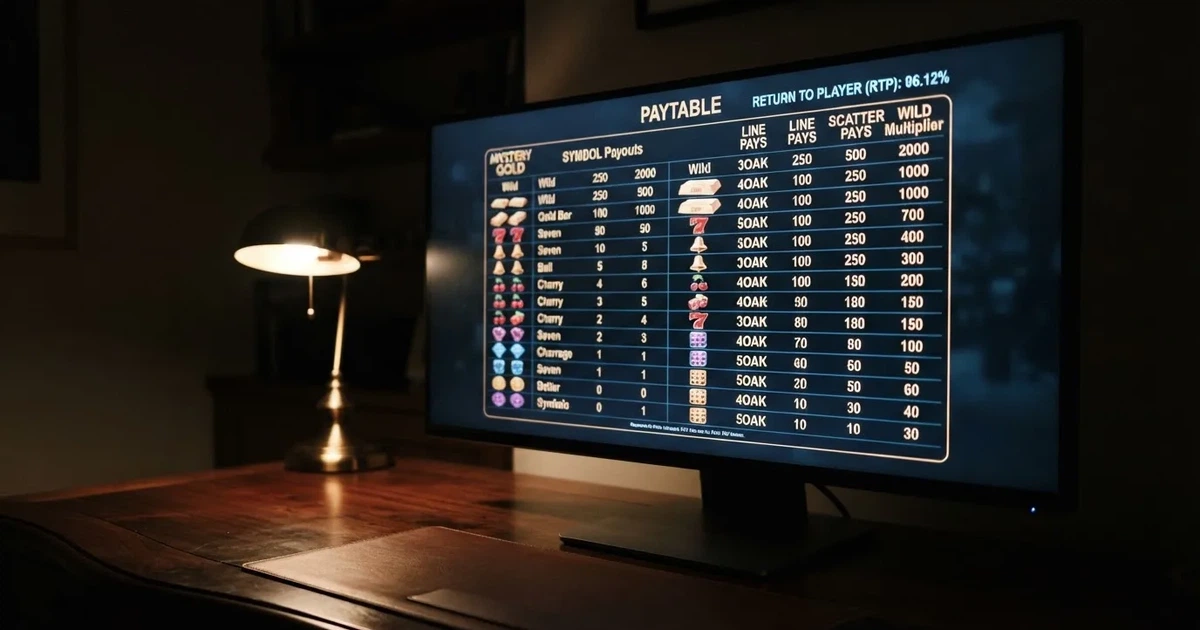
The detail a paytable does carry is the rules of the bonus round, the line combinations that pay, and the maximum theoretical return across the full set of features. That last figure is what gets repeated as “RTP” on marketing copy and is what the regulator certified when the cabinet was approved. It is the right number to read. It is also the number an offshore site can print on a banner without anyone in Australia auditing it.
How to Read a Pokies Paytable in Australia
A paytable lives on the cabinet’s help screen or in the glass at the top of the machine. It lists the symbol values, the bonus triggers, and — on modern Australian machines — a return-to-player figure or range. The figure is shown either as a single percentage (a Class 3 machine in NSW, for instance, is configured to a single approved return) or as a range that the venue can dial within a published band.
The first thing worth knowing is that the figure on a paytable is not the figure the player should plan around on its own. It is the figure the player should pair with the machine’s volatility. A 90% game with high volatility pays out less often and in larger bursts; a 90% game with low volatility pays more often and in smaller bursts. The mathematical return is identical across both, but the experience of playing each is not — and the experience is the part the paytable does not put in writing.
The second thing worth knowing is that the figure does not change from player to player. A$1 spins and A$5 spins on the same machine return the same percentage to the player in the long run, because the math is denominated in money bet, not money kept. A machine that pays 90% of every dollar that crosses the coin tray keeps 10% of turnover regardless of denomination. The punter who bets a dollar per line at one credit per line pays the same house edge per dollar as the punter betting five credits at one line, with the difference showing up only in volatility per spin.
The third thing worth knowing is that the figure has conditions. Some Australian machines offer a higher RTP only when the player wagers the maximum number of lines and credits — a “bet max” condition that turns the paytable’s headline figure into a smaller number for a player who under-bets. The paytable is required to disclose this; the condition is at the bottom of the help screen and is the most-skipped line on the entire machine.
Where RTP Is Legally Required to Be Disclosed
Australian state regulators require an RTP or return-to-player figure to appear on the game’s information screen. The cabinet design standard, the NSQHS Gaming Machine National Standard, requires a “return to player” percentage on the help screen of every gaming machine approved for use in Australia. The figure appears in one of two formats: as a single value (the most common format in NSW, where the regulator approves one setting per game and venue), or as a range (in jurisdictions where the venue can choose its setting within a published band).
The standard applies to machines operated by pubs, clubs and casinos. It does not extend to offshore online slots. A site advertising an RTP of 98% on a pokie game can print any number it likes; there is no Australian regulator auditing the figure, and the player cannot verify it. The reading to take from this is straightforward: an offshore RTP claim and an onshore RTP figure are not the same kind of fact, even when the percentage on the page is the same.
High-RTP Pokies Mechanics: What Actually Decides the Number
A pokie’s theoretical return is built from its symbol distribution, its pay-line structure, and its bonus feature. The mechanic doing the work is the random number generator (RNG) — a piece of software on the machine’s logic board that produces a fresh number for each spin and maps it to a symbol combination on the reels. The RNG is certified by an accredited testing laboratory before the cabinet is approved for use in Australia, and the certified RNG produces the published return across a sufficiently long sample of spins.
Three variables inside that system decide whether a machine lands at the top of its class or the bottom:
- Symbol weighting. Each reel position has a weighted probability of landing on each symbol. Higher-weight positions land on common symbols (low-paying combinations, blanks); lower-weight positions land on rare symbols (high-paying combinations, bonus triggers). The distribution is the machine’s first variable.
- Bonus event frequency and payout. A free-spin bonus that triggers once every 200 spins and pays out an average of 40 credits raises the machine’s overall return by a calculable amount. The cabinet’s information screen usually publishes the bonus frequency and average payout, which is the second variable.
- Bet configuration. Some machines offer a higher return only when the player bets maximum credits on all lines. The “bet max” condition is a third variable that turns the paytable headline into a smaller number for a player who under-bets.
A machine built for a low-volatility profile lands the player on small wins often. A machine built for a high-volatility profile withholds small wins and concentrates the return in rare, large combinations. The paytable’s return figure is identical across both profiles; the bankroll experience of playing them is not.
Where the Math Actually Bites
The house edge on a high-RTP pokies machine is between 10% and 15% of turnover. On a baccarat table at Crown Melbourne, the house edge on the Banker bet is 1.06%. On a blackjack table played with optimal strategy under liberal Las Vegas Strip rules, the house edge is about 0.28%. The pokie’s edge is an order of magnitude larger than the table game’s edge, and that gap is what the “best RTP” framing can quietly hide.
A punter who treats a high-RTP pokies machine as the highest-return game in the building has read the marketing, not the math. A punter who treats a high-RTP pokies machine as the most entertaining way to spend a given amount of money in a venue has read it correctly.
Best RTP Pokies Australia: Reading the Offshore Sites Already on Your Screen
Search results for this term in Australia return offshore casino pages before they return anything onshore. The offshore pages carry slot games with theoretical returns in the high 90s — figures that no onshore pokie matches. They are also offering a product that the Interactive Gambling Act 2001 makes it an offence to provide to a person physically in Australia.
The regulatory record on this is not ambiguous. The ACMA, the regulator that enforces the IGA, has issued formal warnings to operators running offshore casino brands aimed at Australian customers, and has asked Australian internet service providers to block more than 1,700 illegal gambling and affiliate marketing websites since the first blocking request in November 2019. The total number of unlicensed services that have left the Australian market since enforcement was strengthened in 2017 is, by the ACMA’s most recent published count, more than 230.
What this means for a reader looking for “best RTP pokies Australia” is that the figure they find at the top of the search results is not auditable in this country, the operator is not subject to Australian consumer law, and the site can be blocked without warning — leaving a balance on the account the player has no recourse to recover. The reading is mechanical: offshore RTP claims and onshore RTP figures are not the same kind of fact.
The Blocking Rate the ACMA Is On
The arithmetic that puts a number on this is straightforward. The ACMA had asked ISPs to block 1,751 illegal gambling and affiliate marketing websites as of June 2026, with the first blocking request sent in November 2019. That gives a rate of roughly 27 sites per month directed into blocking over the intervening years — though the actual monthly figure is uneven, with some months producing none and other months producing batches of more than ten.
Stated as a band rather than a single figure, and conditional on enforcement continuing at the rate the ACMA has run since 2023: somewhere between 20 and 30 sites a month have been added to blocking lists in recent rounds. The blocking figure is a running total, not a measure of how many sites are currently accessible — some blocked sites come back under new domains, and the ACMA tracks those changes. The point is not the exact count; the point is that the regulator is acting against this product class every month, and any operator offering online pokies to people in Australia is operating inside a window that can close without notice.
Estimated Losses to Offshore Sites
H2 Gambling Capital’s 2025 report puts Australian losses to illegal gambling sites at about A$3.9 billion a year, and the share of gambling going through legal channels has fallen from 74% in 2021 to 64%. The losses figure is an estimate, and the channel share is a trend rather than a single number — but the direction of travel is the part worth reading: legal channels are losing share, and the share being lost is going to sites the IGA prohibits.
For a reader comparing options, the figure to carry is not the offshore RTP but the offshore risk profile: a balance that can be locked behind a blocking order, a payout dispute with no Australian complaints body to escalate to, and a regulatory position the operator has no Australian licence to defend.
Legality and Regulation: What the Interactive Gambling Act Actually Prohibits
The Interactive Gambling Act 2001, strengthened by the Interactive Gambling Amendment Act 2017, makes it an offence to provide online casino games, online pokies or in-play betting to a person in Australia. No state or territory licenses these products. What is licensed is wagering on races and sport placed before the event, lotteries, and keno — in practice licensed through the Northern Territory Racing and Wagering Commission, which regulates 52 of Australia’s online bookmakers including Sportsbet, Bet365 and Ladbrokes, has no full-time staff and meets once a month in Darwin.
The distinction is the one the page keeps coming back to: an offshore site displaying a Curaçao or Malta licence is not licensed in Australia, the licence has no effect on Australian consumer protection, and the operator is not subject to Australian dispute resolution. The licence display is a marketing fact, not a regulatory one.
Enforcement: Formal Warnings and Blocking Orders
The ACMA investigates complaints, issues formal warnings, and directs ISPs to block illegal sites. A formal warning is a public document naming the operator and the brand; a blocking order is a request to every major Australian ISP to make the site’s domain unreachable. The blocking rounds are published as they happen, and the ACMA’s register of actions is the public record the rest of this page works from.
A round reported on 26 June 2026 named 12 sites added to blocking: 7Signs, ChromaBet, Donbet, Duospin, Freshbet, Slots Gem, Jacks Club, Lucky Start, Pointsbetz, Spinrise, Vinyl Casino and Wildsino. The cumulative total at that point was 1,751 blocked sites since November 2019. The running figure is published; the work behind it is the ACMA’s enforcement directorate.
Player Protection: BetStop and Gambling Help Online
BetStop, the National Self-Exclusion Register, has been live since August 2023. It binds every Australian-licensed online and phone wagering service — but only those services. An offshore casino is not connected to BetStop and is not required to honour a BetStop registration. A player who registers with BetStop and then opens an account with an offshore site has self-excluded from one set of operators and not from the other.
The National Gambling Helpline is 1800 858 858, free, 24/7, with chat available at Gambling Help Online. The helpline is the right first call for a player who is concerned about their own gambling or someone else’s, regardless of whether the gambling takes place onshore or offshore.
Payments: Credit Cards, Crypto, and What the Law Says
Credit cards, credit-related products and digital currency are banned as payment for licensed online wagering in Australia since 11 June 2024. Penalties for an operator accepting these run up to A$247,500. Legal deposit routes for licensed wagering are debit card, bank transfer, PayID/Osko and BPAY.
A site asking an Australian player for a credit card or a crypto deposit is, by definition, operating outside the Australian rules. The deposit method is a tell — not a guarantee, but the kind of tell that puts the operator on the wrong side of the IGA.
The Reform Currently Sitting in the Pipeline
The Interactive Gambling Amendment (Gambling Reform) Bill 2026 passed Parliament on 19 August 2026. Its advertising and inducement measures commence on 1 January 2027 — law with a start date, not yet in force on a page published in the current year. The reform tightens inducements and advertising aimed at Australian customers; it does not change the underlying prohibition on online casino games, which remains in force throughout.
Responsible Gambling Support for Pokies Players in Australia
Pokies are the most heavily used form of gambling in Australia, and the support system around them is built for that scale. Gambling Help Online is the national entry point: free, confidential, 24/7, available online and by phone. The National Gambling Helpline on 1800 858 858 routes to the same service.
State-level self-exclusion and pre-commitment schemes sit alongside the federal register. Tasmania’s mandatory pre-commitment card scheme — nation-leading when it was legislated — has been delayed into late 2025, which means a Tasmanian punter who wants a binding limit at the machine has been waiting for the system to come online. New South Wales operates its own pre-commitment and self-exclusion infrastructure through ClubSafe and the Office of Responsible Gambling. Victoria runs the YourPlay pre-commitment system. Western Australia, with poker machines confined to Crown Perth, runs its own arrangements through the Gaming and Wagering Commission.
The one rule that cuts across all of them is the offshore exclusion already named: BetStop does not bind an offshore operator, and an offshore operator does not honour an Australian pre-commitment card. A player who wants the protection of the Australian system has to play inside it.
State-by-State Machine Counts
The number of gaming machines outside casinos in Australia, in the most recent published count for each jurisdiction:
| State / territory | Gaming machines outside casinos | Venues | Notes |
|---|---|---|---|
| New South Wales | 87,298 (June 2023) | 2,195 | Player losses A$8.18 billion in 2022–23 |
| Victoria | 26,380 (2021–22) | 488 | Statewide cap of 30,000 machines |
| Queensland | 21,122 (October 2023) | 351 | — |
| Western Australia | 0 (outside Crown Perth) | — | Pub and club machines banned since 1985; Crown Perth runs roughly 2,500 |
| Tasmania | (under Federal Group until 2021) | — | Monopoly ended November 2021; oversight moved to Tasmanian Liquor and Gaming Commission |
| South Australia | (regulated by Consumer and Business Services) | — | Legal minimum RTP 87.5% |
| Australian Capital Territory | (regulated by ACT Gambling and Racing Commission) | — | Legal minimum RTP 87% |
| Northern Territory | (regulated by NTRWC, mainly licensed venues) | — | Legal minimum RTP 85% |
Australia has roughly 3% of the world’s pub and club poker machines with 0.3% of the global population — a density that turns a state-by-state breakdown into something more than administrative trivia. A$150 billion went through Australian gaming machines in 2020–21, with A$12.18 billion lost on them. The machines are not a sideline of the gambling market; they are the gambling market, and the responsible-gambling infrastructure around them is built to match that scale.
Enforcement Record: Brands Named by the ACMA
The brands listed here are not ranked for play. The product the ACMA has acted against is not licensed in Australia, and a list ordered by quality of service would be a ranking of products that cannot legally be sold to the reader. What this record can do is lay out the brands the ACMA has named, the dates of the formal warnings, and the operators behind them — so a reader who has seen a banner for one of these brands knows what the regulator’s file on it says.
The criteria the comparison rests on are the ones research can support: the ACMA action and the date it was issued; the operator named in the formal warning; and any listing evidence from a third-party source that carries the brand. The criteria do not include bonus terms, RTP figures, payout times or game counts, because the only sources for those figures were affiliate marketing pages, and this page does not draw on those.
The comparison is a record of enforcement, not a buyer’s guide. A reader using it as a buyer’s guide is using it wrong.
Brand-by-Brand Read
RocketPlay. Pulsup Ltd was issued a formal warning by the ACMA over RocketPlay in March 2026, with an earlier warning to Dama N.V. covering the brand in May 2022. The brand sits under two operators in the ACMA’s published register, which is unusual among the brands in this list and worth noting — the brand has cycled through parent companies while continuing to advertise into Australia. A reader seeing a current banner for RocketPlay should know that the regulator has named this domain twice.
Level Up Casino. Dama N.V. was issued a formal warning over Level Up Casino in May 2022, alongside five other brands under the same operator (Bambet, Dazard, Rocketplay, Wild Tornado and Cobra Casinos). The brand’s only listing reference in the public sources the page draws on is a third-party provider directory — a provider directory listing rather than an endorsement. The brand is one of the largest portfolios Dama N.V. has run under the ACMA’s register, and the 2022 warning covers all of them.
Woo Casino. Dama N.V. was issued a further formal warning over Woo Casino in March 2025. The 2025 warning is separate from the 2022 warning over Dama N.V.’s other brands, which suggests the ACMA acted against this specific brand after the earlier action did not produce a sustained change in conduct. A reader comparing Dama N.V. brands should know that the regulator’s most recent action against Woo Casino is dated 2025, not 2022.
Spirit Casino. Dama N.V. was issued a further formal warning over Spirit Casino in May 2025, two months after the Woo Casino warning. The pattern across 2025 — two warnings to Dama N.V. brands in two months — is the kind of enforcement cadence that shows up when an operator is continuing to offer prohibited services despite earlier action. A reader who has seen either brand should treat the recent ACMA dates as the operative ones.
National Casino. Consolutetish S.R.L. was issued a formal warning over National Casino in July 2025, alongside Bizzo Casino under the same operator. The brand’s only listing reference is a third-party page on en.wikipedia.org. The brand shares an operator with Bizzo, and a reader who has seen one of these banners has likely seen the other.
Bizzo Casino. Consolutetish S.R.L. was issued a formal warning over Bizzo Casino in July 2025, with an earlier 2022 warning to TechSolutions (CY) Group Limited and TechSolutions Group N.V. The 2022 warning was issued to a different operator than the 2025 one, which means the brand has cycled through operators at least twice while continuing to advertise into Australia. The reading is the same as RocketPlay’s: a brand with multiple ACMA entries is a brand the regulator has had to come back to.
Ignition Casino. Bamboo Media was issued a formal warning over Ignition Casino in July 2025. The brand has no other ACMA entries in the public register; the 2025 warning is the regulator’s first formal action over this specific brand. A reader comparing brand histories will note that this is a single-entry record rather than a multi-entry one.
Instant Casino. EOD Code SRL was issued a formal warning over Instant Casino in February 2025. The brand is one of the earlier 2025 entries in the ACMA’s published register, and the formal warning was followed by ongoing enforcement against the operator. A reader who saw this brand advertised in early 2025 was seeing a brand already named in an ACMA formal warning.
Jackbit. Ryker B.V. was issued a formal warning over Jackbit and CasinOK in April 2026 — the most recent entry in the ACMA register as of the data this page is checked against. The brand shares an operator with CasinOK, and the April 2026 warning is the first ACMA action against this operator over either brand.
Casino Intense. Sterplay Holding Ltd was issued a formal warning over Casino Intense in April 2025. The brand has a single ACMA entry; the listing reference is to ABC, acma.gov.au and Crown Melbourne, which are regulatory and venue sources rather than affiliate marketing pages.
Sky Crown. Hollycorn N.V. was issued a formal warning over Sky Crown and Blue Leo casino services, in a formal warning published in September 2022. Hollycorn is one of the longest-running operator names in the ACMA’s register, and the Sky Crown warning is the brand with the oldest dated formal action in this list. A reader who has seen a Sky Crown banner in 2026 is looking at a brand whose ACMA entry is now several years old and has not, on the public record, been followed up.
Side-by-Side: Enforcement Record Across the Featured Brands
| Brand | Operator named by the ACMA | ACMA action | Date |
|---|---|---|---|
| RocketPlay | Pulsup Ltd | Formal warning (RocketPlay) | March 2026 |
| RocketPlay (earlier) | Dama N.V. | Formal warning (six brands incl. Rocketplay) | May 2022 |
| Level Up Casino | Dama N.V. | Formal warning | May 2022 |
| Woo Casino | Dama N.V. | Formal warning | March 2025 |
| Spirit Casino | Dama N.V. | Formal warning | May 2025 |
| National Casino | Consolutetish S.R.L. | Formal warning | July 2025 |
| Bizzo Casino | Consolutetish S.R.L. | Formal warning | July 2025 |
| Bizzo Casino (earlier) | TechSolutions (CY) Group Ltd / TechSolutions Group N.V. | Formal warning | 2022 |
| Ignition Casino | Bamboo Media | Formal warning | July 2025 |
| Instant Casino | EOD Code SRL | Formal warning | February 2025 |
| Jackbit | Ryker B.V. | Formal warning | April 2026 |
| CasinOK | Ryker B.V. | Formal warning | April 2026 |
| Casino Intense | Sterplay Holding Ltd | Formal warning | April 2025 |
| Sky Crown | Hollycorn N.V. | Formal warning (Sky Crown, Blue Leo) | September 2022 |
| Blue Leo | Hollycorn N.V. | Formal warning (Sky Crown, Blue Leo) | September 2022 |
The shape of the table is the shape of the regulator’s recent work: Dama N.V. brands account for four entries, Consolutetish S.R.L. and TechSolutions brands account for three, and the remaining seven entries split across five other operators. The brand-level pattern repeats what the regulator has said publicly — that operators continue to advertise prohibited services after earlier warnings, and that brand-cycling across parent companies is a tactic the ACMA is acting against.
Casinos Reviewed by the ACMA: Reading the List as a Record, Not a Recommendation
Eleven brands sit on this page, and a reader who reads them as candidates for play has misread the page. The product each brand offers is prohibited under the IGA, the ACMA has named each brand in a formal warning, and the page’s job is to lay out what the regulator’s record on each one looks like — not to position any of them as worth visiting.
That distinction is the one this page keeps having to make. A reader who lands here from a search for “best RTP pokies Australia” is, by the same search, likely to land on affiliate pages for offshore brands within a click or two. The page’s role is to put the regulator’s record between the reader and that click — not to make the click for them.
A reader who is weighing whether to play at any of these brands at all is asking the wrong question. The right question is whether to play at any offshore online casino from Australia, and the IGA, the ACMA, and the responsible-gambling bodies have already answered it.
Pokies Games Worth Knowing: Reading the Mechanic, Not the Banner
The pokies landscape in Australia is dominated by Aristocrat, with IGT, Bally and Ainsworth as the other major manufacturers operating in pubs, clubs and casinos. The games on a venue floor are largely the same titles that have been on Australian floors for years — Indian Dreaming, 50 Lions, Queen of the Nile, Where’s the Gold, Big Red — with newer Aristocrat titles rotating through as venue contracts refresh.
The mechanic worth reading on these games is the hold percentage, which is the venue’s actual return after the regulator’s minimum is set. A NSW pub machine running at 90% holds 10% of turnover; the same machine running at 85% holds 15% of turnover. The cabinet does not always show which hold percentage is loaded. A venue that loads the floor at the minimum rather than the maximum is keeping more of every dollar that crosses the coin tray, and the difference is the kind of figure a player cannot read off the paytable.
The figure a player can read off the paytable is the maximum theoretical return. It is the right number to start with, and the wrong number to stop with.
Why a Baccarat Table Has a Smaller Edge Than Any Pokies Machine
Crown Melbourne offers three baccarat variants — Traditional Baccarat, Crown Baccarat and 2 to 1 Baccarat — approved as table games by the Victorian Gambling and Casino Control Commission, which replaced the VCGLR as Victoria’s casino regulator on 1 July 2022. The Banker bet in baccarat carries a house edge of 1.06%; the Player bet carries 1.24%; the Tie bet carries 14.36%. The Player bet at a blackjack table played with optimal strategy carries a house edge of about 0.28% under liberal Las Vegas Strip rules.
A pokie with a 90% theoretical return carries a 10% house edge. A baccarat Banker bet carries a 1.06% house edge. The pokie’s edge is roughly ten times the table game’s edge, on a per-dollar-wagered basis. The pokie is more fun than the table game for most players, which is the reason the pokie floor is bigger than the table game floor in every Australian venue — but “fun” and “lowest house edge” are different measurements, and the search term “best RTP pokies” tends to conflate them.
Frequently Asked Questions
What counts as a ‘high’ RTP figure on an Australian pokies machine?
In Australia, the legal minimum return-to-player on a pokie is between 85% and 90% depending on the state or territory licensing the venue. A “high” RTP machine in the Australian context runs at or near the upper end of that range — 87% to 90% in most jurisdictions, with Western Australia’s Crown Perth-only ceiling sitting at 90%. The figure is the long-run average return across millions of spins, not a guarantee on any single session.
Is RTP the same thing as the chance of winning on any single spin?
No. RTP is the percentage of money wagered that a machine returns to players across a very large sample of spins, while the chance of winning on any single spin is determined by the symbol weighting and the random number generator. A 90% RTP machine can pay out on every spin for ten spins in a row and then produce nothing for fifty, because each spin is independent of the last. The RTP is the average the machine reverts to over time, not the outcome of any one play.
Where is a pokies machine’s RTP figure legally required to be disclosed in Australia?
The Return to Player figure is required to appear on the gaming machine’s information screen under the Gaming Machine National Standard. The figure is shown either as a single percentage (where the regulator approves one setting per game) or as a range (where the venue can choose its setting within a published band). The display covers machines in pubs, clubs and casinos, but not offshore online slots — which carry no Australian disclosure obligation.
Can a venue change a machine’s RTP setting after it’s installed?
In most Australian jurisdictions, yes — within the regulator’s approved range. The venue chooses its setting when the machine is commissioned, and a change requires either notification to the regulator or a routine dial within the published band. The cabinet itself does not display which setting it is currently running, and a player asking venue staff for the live setting is unlikely to get a direct answer. The paytable figure is therefore the maximum theoretical return, not the current one.
Does a high RTP figure mean smaller or larger individual wins?
A high RTP figure tells the player the long-run return, not the size of any single payout. The size and frequency of individual wins is determined by the game’s volatility: high-volatility games concentrate returns in rare, larger combinations; low-volatility games spread returns across many smaller combinations. Two games with the same RTP can feel very different to play, and the volatility class is information a player should look for alongside the published return.
Can a Venue Change a Machine’s RTP After Installation?
In most Australian states, yes. Venues are licensed to run a game at a setting within the regulator’s approved band, and changing the setting requires either notification to the regulator (NSW, where a Class 3 game runs at one fixed setting per approval) or a routine dial within a published range (other jurisdictions). The cabinet itself does not advertise which setting it is currently running. A player who asks a venue staff member which setting the machines are loaded at will, in practice, get one of three answers: a direct response (rare), a polite redirect to the regulator (more common), or no useful answer at all.
The implication is that the paytable number on a machine is a maximum, not a contract. A player who wants the published number they were told to expect should look at the regulator’s published list of approved games and their approved settings, not at the cabinet.