


Choosing a pokie machine to play in Australia
Data current as of 8 November 2026 and checked against the Australian Communications and Media Authority’s published blocking and warning registers.
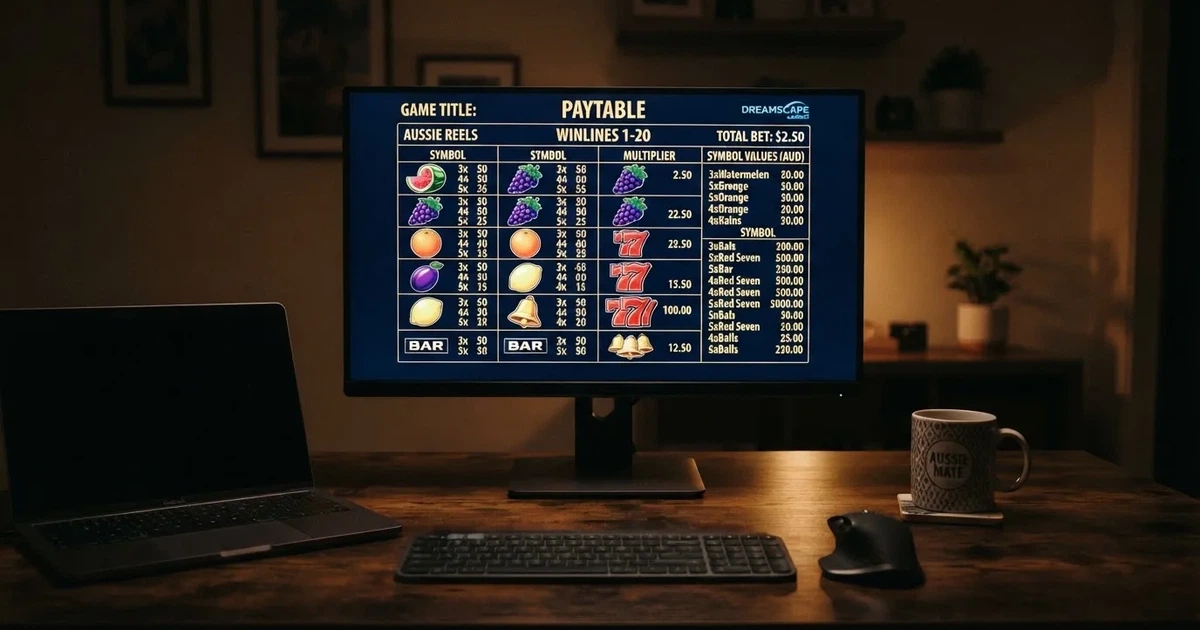
The word “best” does a lot of work in a search box. It sounds like a single answer sits at the bottom of it, waiting to be picked up. Pokie machines do not arrange themselves that way. Two machines side by side in the same venue can pay back quite different shares of what they take, and the gap between a low-volatility game and a high-volatility one is larger than the gap between one branded title and the next. What follows is a way to read a pokie machine on its merits — payout percentage, volatility, bet sizing, the number of lines — and a frank account of where Australians can and cannot legally play one.
There is no “best” machine in any universal sense. There is a best machine for a given budget, a given appetite for long quiet stretches between wins, and a given tolerance for the bet sizes a venue actually lets through the door. The frame for that decision is laid out below, and so are the offshore sites the ACMA has publicly warned for offering the product online to Australians — because the question of what to play cannot be answered honestly without first answering where it can be played.
Table of Contents
- How pokie payouts and withdrawals actually work in Australian venues
- Pokie machine apps and mobile play in Australia
- Paytables, volatility and the games themselves
- How a pokie shortlist gets put together
- The fundamentals of picking a pokie machine to play
- What the Interactive Gambling Act actually prohibits
- Responsible gambling and the limits of what an Australian licence covers
- The offshore brands the ACMA has publicly warned
- The blocking rate, and what it tells a reader
- Frequently asked questions
How pokie payouts and withdrawals actually work in Australian venues
A “pokie” is the Australian name for an electronic gaming machine. The same hardware goes by “slot” elsewhere. In Australia the machines live in licensed venues — pubs, clubs and casinos — and cash moves through them the old-fashioned way. You sit down, you feed notes or a ticket in, the machine credits wins to a printed ticket or to the venue’s cashless card, and you redeem that ticket at the cashier or the kiosk. There is no deposit button, no withdrawal pending, no payment processor to wait on. The transaction is the spin.

That changes the practical shape of “payments and payout speed” in this market. A punter is not waiting on a wallet or a crypto confirmation; they are waiting on the machine and on the venue’s cage. A ticket prints within seconds of a win. A cashless card balance moves on the same machine-to-machine protocol the venue uses. The payout percentage — the share of money taken in that the machine is programmed to return over its lifetime — runs the way the regulator sets it, not the way the cashier feels that day.
Inside the casino the picture is the same, scaled up. Crown Melbourne and Crown Perth operate as the only casino venues in their respective states and run their own cage systems; the bet range, the denominations, and the ticket-redemption rules are the casino’s, within the state regulator’s frame. A Crown-branded loyalty card links play across the property and credits points on a fixed ratio the casino publishes. None of this is fast or slow in the sense a banking payout is fast or slow. It is a closed loop running on the venue’s own rails.
The offshore pitch is built on a different metaphor. An “instant withdrawal” headline, a “crypto payout in ten minutes” claim, a “PayID deposit” button on the cashier page — these promise a speed that is structurally impossible under Australian law, because the product they sell is not licensed to be sold to an Australian at all. The mechanics themselves are real on a licensed Curaçao or Anjouan site, but the offering is illegal here. A reader who treats “fast payout” as the main criterion has already answered the wrong question.
What this section is actually about, then, is what a payout looks like where it is legal. The land-based machine prints. The cashier redeems. The cashless card transfers to another machine in the same venue. That is the entire chain, and it is the only chain with an Australian regulator on the end of it.
Pokie machine apps and mobile play in Australia
There is no licensed Australian pokie-machine app. The Interactive Gambling Act 2001, as tightened in 2017, makes it an offence to provide online casino games — which the regulator treats as including online pokies — to a person physically in Australia. An app on a phone, a browser-based mobile casino, a “real money pokie” on a tablet: each of these is offering the prohibited product, and none of the well-known app stores carry them for an Australian Apple or Google account. The brands that surface in app searches for an Australian IP are operating offshore, unlicensed for this market, and the ACMA has acted against most of them.
Mobile play in the legal sense is a different thing. Crown Melbourne publishes a mobile app that links to the casino’s account system and shows loyalty points, restaurant bookings, event tickets and responsible-gambling limits. It does not let a punto banco player sit at a virtual baccarat table from a tram. Crown Perth does the same. The land-based machines in pubs and clubs have no mobile component at all — there is nothing to download, and nothing the venue could let you download that would not breach the IGA. The screen on the machine is the screen.
A punter who wants to play a pokie on a phone has, in practical terms, three honest options. They can drive to a club and play on the machine in front of them. They can play a free-to-play social-casino app — these carry no real-money wagering, the in-app purchases are for cosmetic credits, and the IGA does not catch them. Or they can use an offshore site and accept that the product is unlicensed for Australia, that winnings have no Australian enforcement behind them, and that the site may be blocked without notice. The mobile experience on the third option is genuinely smooth — that is what offshore operators spend on — but the smoothness is irrelevant to whether the play is lawful.
There is also the question of what “pokie machine app” means in casual speech. A venue’s own app, the social-casino game, the offshore real-money app and the browser-based mobile casino are four different things, and only the first two are legal here. Anyone comparing them on the basis of load time or touch responsiveness is comparing apples to offshore apples to a parking meter.
Paytables, volatility and the games themselves
A paytable is the screen a pokie shows for the rules it plays by: how many lines it has, what each symbol pays, what the bonus feature triggers, and the published return-to-player. The screen on the machine — and the equivalent page in a help menu on a video pokie — is the contract between the machine and the player. Reading it takes a minute, and that minute does more work than any amount of marketing.
Return-to-player, or RTP, is the share of money the machine returns over its full working life. The legal minimum RTP in Australian jurisdictions runs from 85 per cent to 90 per cent. New South Wales, the Northern Territory, Queensland and (generally) Victoria set the floor at 85 per cent, with Crown Melbourne at 87 per cent. The Australian Capital Territory and Tasmania set 87 per cent. South Australia sets 87.5 per cent. Western Australia sets 90 per cent, and applies that floor only inside Crown Perth, because Western Australia banned poker machines in pubs and clubs in 1985 when the casino opened. None of these floors is a guarantee for a single session; they are long-run averages across the machine’s lifetime, often billions of spins.
Volatility is the shape of the payout distribution, not its average. A low-volatility pokie pays smaller amounts more often. The bankroll moves in small steps; the session feels busy. A high-volatility pokie pays less often, and when it pays, the win tends to be larger. The bankroll can go flat for an hour and then move sharply. A punter who values long sessions and predictable movement will prefer the low-volatility end. A punter chasing a feature-game payout that lands once every few hundred spins will prefer the high-volatility end. Neither is “better” than the other on RTP alone, because two machines at the same RTP can sit at opposite ends of the volatility scale.
Bet size does not change the odds on the machine itself. A $1 spin and a $5 spin on the same machine have the same expected return as a share of money in. What bet size changes is which paylines are active, whether the maximum bet is required for the top jackpot, and how quickly the bankroll is consumed. A machine that requires max bet for the jackpot line punishes a small-wager punter not by changing the odds but by locking the best pay out of reach. Reading the paytable for that line is worth the minute it takes.
Multi-line machines are not “more likely to pay out” than single-line ones. They spread the wager across more lines and pay smaller amounts more often on each. The total return, on a per-dollar basis, sits where the machine’s RTP says it sits. The number of lines is a structure for the bet, not a probability dial. A 25-line machine at one cent per line is a 25-cent bet; a one-line machine at 25 cents is the same 25-cent bet with a different shape.
The games themselves in an Australian venue depend on the venue. Pub and club machines are predominantly video pokies, leased from manufacturers — Aristocrat and IGT (formerly IGT’s Australian operations, now part of a wider reshuffle) are the names that come up most often on the floor, alongside Konami and Ainsworth. Casinos run the same machines plus the higher-denomination three-reel games, the linked progressives, and the table games. None of this is “online” in the offshore sense; the machines sit in the room and the punter sits in front of them.
The mechanical lineage runs back further than most players realise. The English game vingt-un became blackjack after the Klondike Gold Rush, with the modern name attached around 1899. Baccarat’s history is older and more disputed — some accounts place it in 19th-century France, others in 15th-century Italy under King Charles VIII, with the modern punto banco variant developed in Havana in the 1940s and dealt from a six- or eight-deck shoe. None of that history changes the house edge, which sits at 1.06 per cent on the Banker bet in baccarat and at roughly 0.28 per cent in blackjack under liberal Strip rules with optimal play. A punter at a pokie machine is paying a steeper edge than that, and the machine will not improve the odds on a streak.
How a pokie shortlist gets put together
A ranking of pokie machines can be assembled in two honest ways and a number of dishonest ones. The dishonest version sorts by which manufacturer pays the affiliate the most, dresses the result up as “top 10” and ships it. The honest versions are these.
The first honest version ranks by RTP and volatility against a stated bankroll. A $100 bankroll, a $1 bet size, a low-volatility preference produces one shortlist; a $500 bankroll, a $5 bet, a high-volatility preference produces another. The two shortlists share few titles, and neither is wrong. A reader who treats one shortlist as universal has skipped the question the shortlist was supposed to answer.
The second honest version ranks by regulatory footprint — where the machine is licensed, which state regulator approved it, what the venue’s own responsible-gambling infrastructure looks like. A machine in a NSW club with a printed self-exclusion form and a venue manager trained on harm minimisation is not the same product as a machine in a comparable venue without those, even when the cabinets are identical and the software is the same build.
The dishonest versions blur those lines. They invent RTP figures the manufacturer never published. They quote volatility classes (“medium-high”) that the game’s own paytable does not use. They declare one machine “the best pokie in Australia” on the basis of a screenshot and a bonus offer. None of that survives a look at the paytable.
What follows below is a different kind of list. It is not a ranking. It is the set of offshore brands the ACMA has publicly named for offering online casino games to Australians, with the date and the operator the warning was issued to. A reader searching for the “best pokie machine” needs to know that none of these brands can lawfully offer that product to them, and that a “best” claim attached to any of them is a claim the regulator has already contradicted.
The fundamentals of picking a pokie machine to play
A useful framework for choosing a pokie machine has four parts, and each one is something a punter can check on the spot.
The first is the RTP, and it is on the paytable or in the help menu of every video pokie a venue installs. A 90 per cent machine is a 10 per cent house edge; an 87 per cent machine is a 13 per cent house edge. On a $1 average bet over an hour, the gap is real money. The second is volatility, and the paytable hints at it without naming it — a game whose biggest line pay is hundreds of times the line bet, with a bonus feature that retriggers, is high-volatility; a game whose line pays top out at tens of times the line bet is low-volatility. The third is bet sizing, and the question is not “how much can I bet” but “what does the paytable require for the top prize.” The fourth is session length, which is a function of bankroll, bet size and volatility, and which the punter sets before sitting down.
None of these is a tip. They are the spec sheet of the machine in front of the punter, written by the manufacturer and approved by the state regulator. The work of “choosing the best pokie” is reading the spec, not collecting opinions.
Two further points belong here, and both are about what the spec does not say. The spec does not say the machine is “due” for a payout — every spin is independent, the previous spin does not weight the next, and the term “hot machine” has no mechanical meaning. And the spec does not promise a session outcome. A 90 per cent RTP machine can take a $200 bankroll in twenty minutes; that is not a malfunction, that is the long-run average working through a short run.
What the Interactive Gambling Act actually prohibits
The Interactive Gambling Act 2001, as amended in 2017, makes it an offence to provide certain interactive gambling services to a person physically in Australia. The list of prohibited services is specific: online casino games, online pokies and in-play betting on sport. Lotteries, keno and pre-event wagering on races and sport are licensable, and the licensing is done state by state — in practice, the Northern Territory Racing and Wagering Commission issues most of those licences, covering 52 of Australia’s online bookmakers, including the well-known brands like Sportsbet, Bet365 and Ladbrokes. The commission runs with no full-time staff and meets once a month in Darwin.
The enforcement sits with the Australian Communications and Media Authority. The ACMA investigates complaints, issues formal warnings, and can direct Australian internet service providers to block offending sites. As of the round reported on 26 June 2026, the ACMA had asked ISPs to block 1,751 illegal gambling and affiliate marketing websites since the first blocking request in November 2019, and more than 230 unlicensed gambling services had left the Australian market since enforcement was strengthened in 2017. The latest published round added twelve more sites to the block list: 7Signs, ChromaBet, Donbet, Duospin, Freshbet, Slots Gem, Jacks Club, Lucky Start, Pointsbetz, Spinrise, Vinyl Casino and Wildsino.
A formal warning is not a prosecution. The IGA targets the provider, not the individual player. A punter who opens an account on an offshore site is not committing an offence under the Act. What the punter is doing is using a service that has no Australian regulator behind it. If the site refuses a withdrawal, the punter has no Australian complaints body to escalate to. If the site disappears with the balance, the punter has no recourse. If the site is blocked mid-session, the punter’s balance is on a platform the ACMA has already determined should not be available here. None of those outcomes is theoretical.
On 19 August 2026 Parliament passed the Interactive Gambling Amendment (Gambling Reform) Bill 2026. Its advertising and inducement measures commence on 1 January 2027. The bill is law with a start date, not yet in force at the time of writing, and its practical effect on operators will become visible in the new year.
H2 Gambling Capital’s 2025 report estimates that Australians lose about A$3.9 billion a year to illegal gambling sites, and that the share of gambling going through legal channels fell from 74 per cent in 2021 to 64 per cent. The dollar figure is the size of the unregulated market. The fall in the legal share is what the ACMA’s enforcement work is trying to reverse.
The payment rules tell the same story from a different angle. Since 11 June 2024, credit cards, credit-related products and digital currency are banned as payment for licensed online wagering in Australia, with penalties of up to A$247,500 for operators that breach. Legal deposit routes for a licensed wagering account are debit card, bank transfer, PayID and Osko, and BPAY. An offshore casino asking an Australian customer for a credit card or a crypto deposit is operating outside the Australian rules from the moment the deposit screen loads.
There is no path to a “licensed online pokie in Australia.” The Interactive Gambling Act does not allow one to be issued. A licence displayed on an offshore site — Curaçao, Anjouan, the Malta Gaming Authority — is a licence to operate in the jurisdiction that issued it. It is not a licence to offer the product to a person in Australia. The two are routinely conflated by affiliate marketing, and they should not be.
Responsible gambling and the limits of what an Australian licence covers
The land-based pokie machine sits inside a harm-minimisation frame that has been built over decades. State regulators require printed information on the machine, mandatory break reminders, cashless card systems that let a venue enforce pre-commitment limits, and trained staff who can intervene. New South Wales had 87,298 gaming machines outside casinos across 2,195 venues in June 2023, with player losses of A$8.18 billion in 2022-23. Queensland had 21,122 machines in 351 venues in October 2023. Victoria had 26,380 machines outside Crown Casino in 488 venues in 2021-22, sitting under a 30,000-machine statewide cap. Tasmania ended the Federal Group’s monopoly on poker machines in November 2021, and planned mandatory pre-commitment cards were pushed back to late 2025 for implementation.
The principal national self-exclusion tool is BetStop, the National Self-Exclusion Register, live since August 2023. A punter registers with BetStop and is barred from every Australian-licensed online and phone wagering service for the period they nominate. BetStop covers the licensed product. An offshore casino is not connected to it. Registering with BetStop and then opening an offshore account does not produce the protection the punter was registering for. The 24/7 National Gambling Helpline is 1800 858 858, free, with chat support at Gambling Help Online. Both services cover the punter regardless of where they have been playing.
Two caveats belong beside any responsible-gambling passage on this page. The first is that a self-exclusion tool is only as wide as the licences that bind to it; offshore play falls outside it. The second is that harm minimisation is not a marketing feature. A venue that offers pre-commitment cards and a help-line poster is not “safer than the competition”; it is meeting the regulator’s minimum. A punter comparing venues should treat the floor as the floor and not as a differentiator.
For tax: gambling winnings of a recreational player are not assessable income in Australia, under section 6-5 of the ITAA 1997, and losses are not deductible. The exception is a punter who carries on a business of gambling, which is a different matter entirely and a conversation to have with the ATO, not with this page.
The offshore brands the ACMA has publicly warned
The table below lists the offshore brands the ACMA has named in formal warnings for offering prohibited interactive gambling services to Australians. Each row gives the brand as published by the ACMA, the date of the warning, the operator the warning was issued to, and what the ACMA’s own page says about subject support for the brand’s offering.
None of these brands is licensed to offer online casino games to Australians. The Interactive Gambling Act 2001 does not allow such a licence to be issued. A licence displayed on the brand’s site — Curaçao, Anjouan, or otherwise — is a licence to operate elsewhere, and it does not change the position under Australian law.
| Brand | ACMA action and date | Operator named by the ACMA | What the licence on the site actually covers |
|---|---|---|---|
| RocketPlay | Formal warning, March 2026; earlier warning to Dama N.V., May 2022 | Pulsup Ltd (Rocketplay); earlier Dama N.V. | Not an Australian casino licence |
| Level Up Casino | Formal warning, May 2022 | Dama N.V. | Not an Australian casino licence |
| Woo Casino | Formal warning, March 2025 | Dama N.V. | Not an Australian casino licence |
| Spirit Casino | Formal warning, May 2025 | Dama N.V. | Not an Australian casino licence |
| National Casino | Formal warning, July 2025 | Consolutetish S.R.L. | Not an Australian casino licence |
| Bizzo Casino | Formal warning, July 2025; earlier warning, 2022 | Consolutetish S.R.L.; earlier TechSolutions | Not an Australian casino licence |
| Ignition Casino | Formal warning, July 2025 | Bamboo Media | Not an Australian casino licence |
| Instant Casino | Formal warning, February 2025 | EOD Code SRL | Not an Australian casino licence |
| Jackbit | Formal warning, April 2026 | Ryker B.V. (Jackbit and CasinOK) | Not an Australian casino licence |
| Casino Intense | Formal warning, April 2025 | Sterplay Holding Ltd | Not an Australian casino licence |
| Sky Crown | Formal warning, September 2022 | Hollycorn N.V. (Sky Crown and Blue Leo) | Not an Australian casino licence |
The notes that follow are not reviews. They describe what the ACMA has on file and what that means for a reader comparing one of these brands to a licensed Australian venue.
RocketPlay
The ACMA issued a formal warning over Rocketplay to Pulsup Ltd in March 2026. The same brand was caught up in the broader Dama N.V. warning of May 2022, which covered six casino brands at once. The site publishes a Curaçao licence on its footer; that licence authorises the operator to offer its product in the jurisdiction that issued it, not in Australia. A punter who opens an account does so without the protection of any Australian regulator, and any balance is exposed to a block order the ACMA can issue at any time. For a reader who treats the ACMA warning as a serious signal — which the regulator’s own enforcement record suggests it should be — RocketPlay is not a candidate.
Level Up Casino
Level Up was named in the Dama N.V. warning of May 2022, alongside Bambet, Dazard, Rocketplay, Wild Tornado and Cobra Casinos. The brand carries a Curaçao registration on listings pages. None of the listings data overrides the ACMA’s published position that the offering to Australians is prohibited. For a reader who needs a real-money pokie machine to play in Australia, this is not on the lawful side of the line.
Woo Casino
Woo Casino drew a further ACMA warning to Dama N.V. in March 2025. The brand was not named in the earlier 2022 round. A punter who arrived at the brand after the 2022 warning and found no further action would have been wrong: the regulator’s follow-up was on the record six months before this page was written. The site displays an offshore licence. The product is not licensed to be sold to an Australian.
Spirit Casino
Spirit Casino received its formal warning from the ACMA in May 2025, again to Dama N.V. The pattern across the Dama brands — repeated warnings, new brand names, the same operator on the other side of the warning letter — is the ACMA telling the same operator, repeatedly, that the conduct has not changed. Spirit is the latest name on that list.
National Casino
National Casino was named in the ACMA’s July 2025 warning to Consolutetish S.R.L., alongside Bizzo Casino. The brand’s own offshore licence does not reach into Australia. For a reader weighing a National Casino account against a licensed Australian venue, the ACMA warning is the dispositive fact.
Bizzo Casino
Bizzo Casino was named twice. The 2022 warning went to TechSolutions (CY) Group Limited and TechSolutions Group N.V.; the July 2025 warning went to Consolutetish S.R.L. The site has carried two different offshore operators under the same brand name at different points, and the ACMA has acted under both. A punter reading the brand as the same business across time has read it correctly; the regulator has been treating it that way too.
Ignition Casino
The ACMA issued a formal warning to Bamboo Media over Ignition Casino in July 2025. Ignition is one of the better-known offshore brands in the Australian search results, and that name recognition is part of the problem the ACMA’s enforcement is built around — a familiar brand surfaces in searches and gets clicked through without the punter registering that the regulator has named it on a warning register.
Instant Casino
Instant Casino received a formal warning in February 2025, with EOD Code SRL as the operator named. The brand is one of several the ACMA has acted against under EOD Code SRL’s corporate envelope. The offshore licence on the site is not an Australian licence.
Jackbit
The ACMA issued a formal warning to Ryker B.V. in April 2026, covering both Jackbit and CasinOK. Two brands under one warning letter is a common shape for the ACMA’s enforcement work — the operator is the unit, and the brand is a label on top of it.
Casino Intense
Casino Intense drew a formal warning in April 2025, with Sterplay Holding Ltd as the named operator. The brand surfaces in listings pages that group it with Australian-facing casino content, and those listings do not affect the regulator’s published position.
Sky Crown
Hollycorn N.V. is the operator on the ACMA’s formal warning covering Sky Crown and Blue Leo Casino, dated September 2022. Hollycorn operates a stable of brands under the same corporate envelope, and the ACMA has named it across several warnings over the years. The brand’s offshore licence does not authorise an offering to Australians.
The blocking rate, and what it tells a reader
The ACMA’s first blocking request to Australian internet service providers went out in November 2019. The 26 June 2026 ACMA round reported a cumulative total of 1,751 illegal gambling and affiliate marketing websites blocked since that first request — a span of roughly six and a half years. The headline figure, taken at face value, is about 22 sites blocked per month, or roughly 266 per year, across the full period.
That headline is an average, and the average hides two facts a reader should hold onto. First, the ACMA’s enforcement tempo has not been steady. The November 2019 starting point was a single request, the early rounds added a handful of sites each, and the larger rounds — 12 sites in the June 2026 batch alone — sit at the recent end of the curve. Second, the 1,751 figure counts affiliate marketing sites alongside the operator sites, and an affiliate page is not the same as a casino. The blocking rate the ACMA reports is the rate at which the regulator is willing to ask ISPs to act, and it has risen over time.
For a reader, the number is a band rather than a single figure. The band runs from roughly 20 to 30 sites per month over the full enforcement period, with the recent end closer to the higher number. The fact that sits beside the band is the second figure the regulator publishes: more than 230 unlicensed gambling services have left the Australian market entirely since 2017. The exit rate is the regulator’s other lever. A site that does not leave after a warning can be blocked; a site that does leave is also a win for the ACMA’s enforcement record. The two figures together describe a regime that is acting at scale, not a regime that has only just started.
Frequently asked questions
Is a low-volatility pokie machine better than a high-volatility one?
Neither is better in the abstract. Low volatility pays smaller amounts more often and suits a longer session on a smaller bankroll. High volatility pays less often but pays larger amounts when it does, and suits a punter who has the bankroll to absorb the quiet stretches. The choice is about the shape of the session, not the size of the expected return.
Does raising my bet size change the odds on the machine?
No. The odds on any individual spin are set by the machine’s software and the regulator’s approval, and they do not change with the size of the bet. What changes is whether the maximum-bet line is required for the top prize, how many paylines are active, and how quickly the bankroll is consumed. Read the paytable before changing the bet.
Are the pokie apps on my phone the same product as the machines in a pub or club?
No. A licensed Australian pub or club pokie is a physical machine in a regulated venue. An app on an Australian phone that offers real-money pokies is an offshore product, unlicensed for Australia, and the ACMA has issued formal warnings over several of the well-known brands. A venue’s own app, where one exists, is a loyalty and account tool, not a way to play.
How do I find the payout percentage of a specific pokie before playing?
Read the paytable. The return-to-player is published on the machine’s help screen on every video pokie a venue installs, and the venue’s gaming manager can confirm the figure on request. The published minimum RTP in Australian jurisdictions runs from 85 per cent (NSW, NT, Queensland, generally Victoria) to 90 per cent (Western Australia, inside Crown Perth). Higher figures on individual titles are manufacturer-published.
Are multi-line pokies more likely to pay out than single-line ones?
No. The number of lines changes how a bet is spread across the machine, not the probability of any individual outcome. The total return, per dollar bet, is the RTP. A multi-line game at a low per-line stake is the same bet as a single-line game at a higher stake, with a different distribution of wins.
Who audits the pokies in a licensed Australian venue?
State and territory regulators approve the games and audit the machines in operation. The relevant bodies are Liquor & Gaming NSW, the Victorian Gambling and Casino Control Commission (which replaced the VCGLR on 1 July 2022), the Queensland Office of Liquor and Gaming Regulation, the South Australian Liquor and Gambling Commissioner, the Tasmanian Liquor and Gaming Commission, the Western Australian Department of Local Government, Sport and Cultural Industries, the ACT Gambling and Racing Commission and the Northern Territory Racing and Wagering Commission. Each regulator publishes the rules it enforces.