

Understanding casino promo codes in Australia
Anyone searching for a casino promo code in Australia in 2026 is being aimed at offshore sites, not at any Australian-licensed product. The Interactive Gambling Act 2001, as amended in 2017, prohibits the supply of online casino games and online pokies to a person in Australia, so no state or territory issues a licence for the product the code unlocks. The marketing that surrounds a “promo code” is therefore an inducement to use a service that is itself unlawful to provide locally, and the string of small-print rules attached to it is best read as the cost of crossing that line. This page walks through what those codes normally look like, why the protections Australians expect at a regulated venue are missing, and what a player gives up by entering one.
Data current as of 29 October 2026; licence claims and ACMA actions cross-checked against the Australian Communications and Media Authority’s published register.
Table of Contents
- The way a casino promo code is actually framed
- How an offshore promo code lands at an Australian player
- The price of the bonus: turnover, time and expected loss
- What “max bet” and “max cashout” actually mean
- Payments and payout speed on offshore promo sites
- Card networks, digital wallets and the Australian gambling block
- Surcharging and the card networks themselves
- The legal frame around an offshore promo code
- What the licensed half of the Australian market actually offers
- Responsible-gambling supports that apply on this side of the line
- The blocking-rate of the ACMA’s enforcement, put in context
- The eleven brands the ACMA has formally warned
- What an Australian player is actually choosing between
- Summary of ACMA formal warnings
- Frequently asked questions
The way a casino promo code is actually framed
A casino promo code is a short string — letters, numbers, or both — that an offshore operator asks a player to type at sign-up, deposit, or in a cashier field. In marketing terms it is an inducement, the hook that converts a casual visitor into a depositing account. In legal terms, applied to an online casino product offered to someone in Australia, it is the front end of a service the provider is not allowed to supply.

That is the single fact that shapes every other paragraph on this page. A promo code from a brand the ACMA has named in a formal warning is not a discount; it is the entry point to a product the regulator has decided Australians should not be offered at all. The bonus value advertised next to the code is the operator’s price for that entry, and the wagering requirements, max-bet caps, max-cashout rules and expiry windows attached to it are the price the player pays for taking it.
The mechanics, though, are worth knowing in their own right. Reading a promo-code terms page well is one of the few defences a player has against an operator that is not subject to Australian consumer law.
See also Casino VIP programs in Australia in 2026.
How an offshore promo code lands at an Australian player
The path a code travels is short and largely automated. An affiliate site — usually one of the brand names that appear in a Google search for this topic — carries a tracked link. The link drops a cookie, then forwards to the casino’s sign-up page. The code itself is either pre-filled in a “bonus code” field, or it has to be pasted into the cashier before the first deposit. From the player’s side, the whole sequence takes about a minute; from the regulator’s side, it is the act the Interactive Gambling Act 2001 prohibits.
Two things follow from that path, both relevant to anyone considering using a code.
The first is that the affiliate page is part of the inducement, and is treated as such by the ACMA. The Authority has, on several occasions, blocked affiliate marketing websites alongside the casinos themselves, on the basis that an inducement to use a prohibited service is itself part of the prohibited conduct.
The second is that the “promo code” is functionally identical to the standard welcome offer every offshore casino runs. A code looks like a special deal because it is wrapped in a string the player has to enter; in practice, it is the same matched-deposit package, the same free-spin bundle, or the same no-deposit freebie that the same site offers to anyone who signs up without entering anything. The codes that turn up in search results are usually a tracking mechanism for the affiliate, not a special price for the player.
The price of the bonus: turnover, time and expected loss
The most consequential figure on any promo-code terms page is rarely the headline bonus amount. It is the wagering multiple — how many times the bonus (or the bonus plus deposit) has to be turned over before any winnings can be withdrawn.
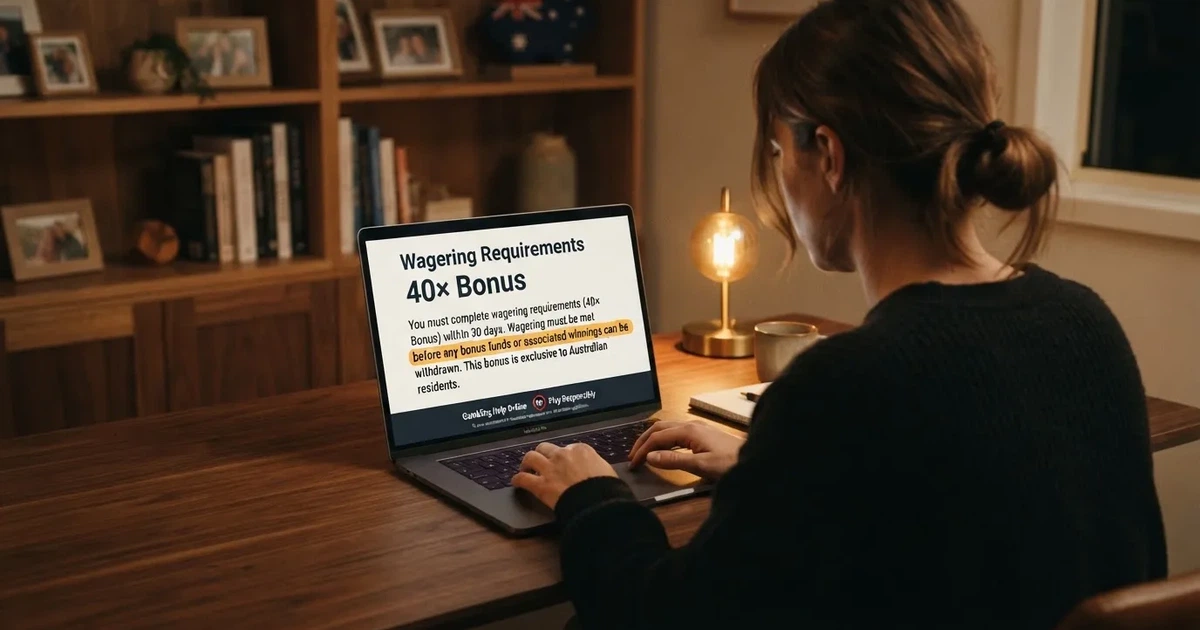
A typical structure in this offshore market is a matched deposit at 100%, with a wagering requirement of around 40 times the bonus. A$100 in bonus money therefore means A$4,000 of required turnover. At a slot stake of A$1 per spin, that is 4,000 spins. At a five-second spin interval, that is about 5.6 hours of continuous play to clear the bonus alone — and that is before any contribution weighting, any max-bet cap, or any game restriction cuts in.
The expected cost of that play is what the marketing page never states. Slots commonly sit in the 94–96% return-to-player band, so the house edge on A$4,000 of turnover is somewhere around A$160 to A$240. That is the price of a “free” A$100 bonus, before any cashout cap, before any time limit, before the next deposit required to keep playing. It is not a loss a player can avoid by playing well; it is the statistical cost of the bonus itself, averaged across enough spins to smooth out variance.
A short-window expiry — the typical 7-day or 14-day clock — pushes the same turnover into a smaller number of sessions, which in practice means larger stakes or longer hours. Either direction costs the player something the headline bonus never mentions.
What “max bet” and “max cashout” actually mean
Two clauses do most of the work in any offshore promo terms page, and both are worth reading twice.
The first is the maximum-bet rule, almost always present when a bonus is active. A common ceiling is A$5 per spin or hand. Above that ceiling, the bonus is voided, the winnings are confiscated, or both. The point of the rule is to stop a player from clearing turnover with a handful of large-stake spins; the cost is that the player has no way to vary their stake around the size of their bankroll, which is one of the few levers a slot player actually holds.
The second is the maximum-cashout cap, which applies most often to no-deposit bonuses and free-spin bundles. A free-spin win of A$200 from a “no deposit” promo, for instance, may be capped at A$50 of withdrawable cash, with the rest written off. Read the rule before spinning, because the difference between A$50 withdrawable and A$200 withdrawable is the entire reason the no-deposit offer was framed as a freebie.
Neither rule is unusual in this market. Both are standard. They are standard because they work in the operator’s favour, and because there is no Australian regulator on the other side of the table reading the small print for the player.
Payments and payout speed on offshore promo sites
The payment side of an offshore promo site is where the gap with a regulated venue becomes hardest to ignore.
A licensed Australian online wagering operator takes debit cards, bank transfer, PayID, Osko and BPAY. Credit cards and credit-related products are banned under the Interactive Gambling Act for any licensed wagering service. An offshore casino, by contrast, is asking the player to fund an account at a service that does not meet the licensed-wagering rules at all, and the funding rails it accepts reflect that. Visa and Mastercard debit may be declined by an Australian issuer; credit cards are barred by the legislation even when an issuer would otherwise allow them; crypto deposits are common because they sit outside the Australian payments perimeter altogether.
On the way out, payout speed is one of the marketing claims operators lean on hardest. The honest reading is that a fast payout on a first withdrawal is the most reliably honoured transaction an offshore casino will ever do; it is the cost of acquiring the player. The second and third withdrawals are where processing delays, additional “verification” requests for source-of-funds documents, and reversed payouts start to appear. There is no Australian external dispute resolution body to escalate a refused withdrawal to, and the ACMA’s enforcement levers are about blocking the site, not about making a single player whole.
A practical defence is to test a small withdrawal before any bonus is taken, because that is the moment a site is most likely to behave as its marketing claims. After a bonus is active, the same site’s behaviour on payouts tends to track its small print, not its homepage.
Card networks, digital wallets and the Australian gambling block
A second layer sits between the player and any offshore casino: the Australian bank’s own gambling block.
Westpac runs a gambling block that operates at the card level, refusing authorisation of transactions that fall under the merchant category code “Betting/Casino Gambling” on eligible personal credit and debit cards. ANZ offers the same kind of block, and its block also extends to gambling transactions routed through a digital wallet such as Apple Pay when the underlying card is an eligible one. Commonwealth Bank lets customers apply a gambling lock to eligible cards through its app, with the same caveat that the lock cannot guarantee every gambling-related purchase is stopped. Removing the ANZ block once it has been turned on requires a 48-hour waiting period, which is itself a friction designed to slow the path back into a session.
The point of these blocks is not to second-guess the player’s decision in the moment. It is to put a deliberate delay between the impulse and the deposit, exactly the kind of friction the ACMA’s enforcement machinery cannot provide. A player who has turned a bank block off is in roughly the same position as a player who has never turned one on; a player who is considering turning one off has at least asked the question that the block is built to surface.
Surcharging and the card networks themselves
The Reserve Bank of Australia’s July 2025 review of merchant card payment costs and surcharging proposes removing surcharges on eftpos, Mastercard and Visa transactions, and explicitly leaves American Express outside the scope of the proposed ban. The proposal matters to this page only at the margin, because the card networks through which an offshore casino accepts payment are mostly the ones the review is about — but the Amex carve-out is worth noting. Amex operates a three-party scheme, issuing cards and processing transactions itself rather than running the four-party network that Visa and Mastercard use, and the review treats that structure as different enough to leave alone for now.
For a player looking at an offshore site that advertises Amex deposits, the practical implication is that the surcharge regime on that card sits outside the proposed changes — so any surcharge passed through to the player by the merchant is the merchant’s own fee, not a regulated pass-through. None of that changes the fact that the merchant is asking for payment at a service that is unlawful to supply in Australia; it only changes the price shape of the payment.
The legal frame around an offshore promo code
The relevant statute is the Interactive Gambling Act 2001, as amended by the Interactive Gambling Amendment Act 2017. The amended Act makes it an offence to provide online casino games, online pokies, or in-play betting to a person physically in Australia. The offence targets the provider, not the individual player, so an Australian punter is not personally at risk of prosecution for using an offshore code. What the player gives up is the consumer protection that would apply at a licensed venue: no Australian complaints body, no recourse to an Australian court, no guarantee that a balance held at the site can be withdrawn at all.
Enforcement sits with the ACMA. The Authority’s two main tools are formal warnings, which are published on its website and which name the operator and the brand, and directions to Australian internet service providers to block specific domains. According to the ACMA as reported in June 2026, 1,751 illegal gambling and affiliate marketing websites had been blocked since the first blocking request in November 2019, and more than 230 unlicensed gambling services had left the Australian market since enforcement was strengthened in 2017. A round reported on 26 June 2026 added 12 more domains to that list — 7Signs, ChromaBet, Donbet, Duospin, Freshbet, Slots Gem, Jacks Club, Lucky Start, Pointsbetz, Spinrise, Vinyl Casino and Wildsino.
The blocking mechanism is upstream of the player but downstream of the marketing. A site can be live on a Tuesday and blocked by an Australian ISP on a Wednesday, with the balance a player left on it still sitting in the account and now unreachable. That outcome is not theoretical; it is the steady state of this market, and the ACMA’s published numbers describe the pace at which it happens.
The Interactive Gambling Amendment (Gambling Reform) Bill 2026 passed Parliament on 19 August 2026. Its advertising and inducement measures commence on 1 January 2027 — law with a start date, not yet in force on a 2026 page. A reader looking at a promo code today is reading against the regime as it stood before those inducement measures begin, not the one they will live under from next year.
Understanding casino promo codes in Australia — More on this topic at casino payout.
What the licensed half of the Australian market actually offers
The licensable product in Australia is wagering on races and sport placed before the event, lotteries and keno. Wagering is regulated federally, and in practice most online wagering operators are licensed in the Northern Territory, where the Northern Territory Racing and Wagering Commission supervises 52 of the country’s online bookmakers — Sportsbet, Bet365 and Ladbrokes among them. The Commission’s own resourcing is modest; it has no full-time staff and meets once a month in Darwin. The Territory licence is in significant part a tax-location decision, not a regulatory one.
None of those licensed operators offer online casino games or online pokies to Australian customers. A punter at a regulated Australian wagering site can bet on a Saturday football match, or place a bet before a horse race, but cannot spin a slot or sit at a live-dealer blackjack table. The promotional codes that turn up on the same affiliate pages as the offshore casino codes are typically tracking links to those licensed bookmakers — different product, different rules, and subject to the credit-card ban that took effect on 11 June 2024 for licensed wagering.
The boundary between the two halves of the market is therefore not a marketing line; it is the line drawn by the Act. Crossing it is what a casino promo code is for.
Responsible-gambling supports that apply on this side of the line
The Australian support infrastructure is built around the licensed product, which is why it does not reach across to the offshore half.
BetStop, the National Self-Exclusion Register, has been live since August 2023 and binds Australian-licensed online and phone wagering services. A person who has registered with BetStop cannot open an account with a licensed Australian bookmaker, deposit with one, or be marketed to by one. An offshore casino is not connected to BetStop, and a self-exclusion on the Australian side does not extend to it. The register is the right tool for a punter who wants to step away from the licensed wagering market, and it is the wrong tool for someone trying to keep themselves off an offshore casino.
The National Gambling Helpline is 1800 858 858, free and available 24/7, with web chat at Gambling Help Online. The Helpline is staffed by counsellors who can take a call about any gambling harm, including harms that began with an offshore site, and who can route a caller into state-specific face-to-face services. A punter who is in the middle of a session at an offshore casino and is trying to talk themselves out of the next deposit has somewhere to call; the call is free, the line is open, and the counsellors do not require the caller to be playing at a licensed venue.
The gambling blocks run by the major Australian banks sit alongside these supports rather than above them. A Westpac card block, an ANZ card block, or a CommBank gambling lock is a friction mechanism, not a treatment. Each is worth turning on for the delay it adds between impulse and action; none of them addresses the underlying decision a player is making about whether to use an offshore code at all.
The blocking-rate of the ACMA’s enforcement, put in context
The calculation in this section — the numbers from this data — is a band, not a single figure.
Since the first blocking request in November 2019 and as of June 2026, the ACMA had directed the blocking of 1,751 illegal gambling and affiliate marketing websites. Spread across roughly 79 months, that is an average of about 22 sites blocked per month over the life of the regime, with the rate varying sharply from year to year as new enforcement rounds cluster around specific operators. The June 2026 round alone added 12 more domains in a single direction, which on its own represents more than half of a typical month’s blocking volume.
Read as a band rather than a point, the rate is somewhere in the low-twenties per month across the full life of the regime, and materially higher when measured over the most recent enforcement rounds. A reader who treats “around 20 to 25 sites blocked per month” as the working figure is reading the ACMA’s published numbers faithfully; a reader who treats any single month as the steady state is reading the wrong month.
The same numbers carry a second reading. More than 230 unlicensed gambling services had left the Australian market since 2017, which means the blocking register is not the only signal of operator behaviour; voluntary exit is the other. A service that decides the ACMA’s pressure is not worth operating against has the option to stop taking Australian customers without being blocked. Both routes end in the same outcome for an Australian player with a balance on the site: the service is no longer reachable.
The eleven brands the ACMA has formally warned
The brands below are not a ranking and not a recommendation. Each is listed because the ACMA itself issued a formal warning over it for offering prohibited services to Australians. The pattern that runs through the list — different company names, the same product, the same regulator’s response — is the point of reading it as a group.
| Brand | ACMA action and date | Operator named by the ACMA | Subject support |
|---|---|---|---|
| RocketPlay | Formal warning, March 2026 (Pulsup Ltd); earlier warning to Dama N.V., May 2022 | Pulsup Ltd / Dama N.V. | — |
| Level Up Casino | Formal warning, May 2022 | Dama N.V. | — |
| Woo Casino | Formal warning, March 2025 | Dama N.V. | — |
| Spirit Casino | Formal warning, May 2025 | Dama N.V. | — |
| National Casino | Formal warning, July 2025 | Consolutetish S.R.L. | listings only (ACMA, AUSTRAC, BetStop) |
| Bizzo Casino | Formal warning, July 2025 (Consolutetish S.R.L.); earlier warning to TechSolutions, 2022 | Consolutetish S.R.L. / TechSolutions | listings only |
| Ignition Casino | Formal warning, July 2025 | Bamboo Media | — |
| Instant Casino | Formal warning, February 2025 | EOD Code SRL | listings only (ecopayz, PayID) |
| Jackbit | Formal warning, April 2026 | Ryker B.V. | — |
| Casino Intense | Formal warning, April 2025 | Sterplay Holding Ltd | listings only (AUSTRAC, BetStop, Gambling Insider) |
| Sky Crown | Formal warning, September 2022 | Hollycorn N.V. | — |
A few things stand out from the table. Six of the eleven brands sit with Dama N.V. or its associated entities — the same operator, repeatedly named, under different brand labels. Two sit with Consolutetish S.R.L. The pattern is what the ACMA’s enforcement data describes: a relatively small number of operating companies run a long tail of brand names, so a brand shutting down or rebranding does not change the underlying operator’s exposure. Several of these brands had been warned more than once; RocketPlay and Bizzo Casino both sit on the table with two ACMA actions against them.
The “Subject support” column lists the third-party sources where each brand appears outside the ACMA’s own register, where the research inputs carry any. A dash is the no-data marker — the brand was not found in any of the consulted third-party sources for the subject of this page, and the absence is left unannounced. The listings-only entries are exactly that: the brand is mentioned on those sites, but not as anything the operator itself warrants.
RocketPlay
The ACMA’s March 2026 formal warning to Pulsup Ltd covers RocketPlay. An earlier warning to Dama N.V. in May 2022 had already named the brand, which puts RocketPlay on the ACMA’s register twice, under two different operating companies. The site’s standard welcome structure at most offshore casinos in this market is a matched deposit with a wagering requirement well above the threshold at which a bonus becomes statistical cost rather than promotional value; specific terms are not carried by the regulator and are not reproduced here. A punter considering the brand is looking at a service the ACMA has now warned twice in four years.
Level Up Casino
The May 2022 ACMA warning to Dama N.V. covered Level Up Casino alongside five other brands under the same operator umbrella. The brand has not appeared on a more recent ACMA action in the data this page is built on, but the same operating company has — Dama N.V. is named again in the Woo Casino and Spirit Casino warnings of March and May 2025. For a player, the implication is that the company behind the brand is one the regulator returns to rather than one-off.
Woo Casino
Dama N.V. was the named operator again in the ACMA’s March 2025 formal warning over Woo Casino. The brand sits in the same operating-company group as Level Up Casino and Spirit Casino, and the ACMA’s most recent action against that group was the May 2025 warning over Spirit Casino. A reader comparing these three brands is essentially comparing three labels for one operator, and the choice between them is not a meaningful one.
Spirit Casino
The May 2025 warning over Spirit Casino was the ACMA’s second action against a Dama N.V. brand in 2025, after Woo Casino in March. The same points apply as for Woo Casino: the brand is one of a group, the operator is a returning one, and the regulator has put the cost of that return in published warnings rather than private correspondence.
National Casino
The ACMA’s July 2025 warning to Consolutetish S.R.L. covered National Casino and Bizzo Casino together. National Casino is the older of the two brand labels and had been on the affiliate-marketing side of this market for some time before the warning. BetStop, AUSTRAC and the ACMA’s own register all carry the brand name as a reference point, which is what “listings only” amounts to in this column — a brand name that exists in the regulatory and payments perimeter, but not as anything an Australian-licensed product can be offered against.
Bizzo Casino
Consolutetish S.R.L. was the named operator in the July 2025 warning. An earlier 2022 warning had been issued to TechSolutions (CY) Group Limited and TechSolutions Group N.V. over the same brand, which makes Bizzo Casino the second brand on this table (alongside RocketPlay) with two ACMA actions against it. The repetition is the headline here; the brand has been on the regulator’s list across two operators and roughly three years.
Ignition Casino
The ACMA’s July 2025 warning named Bamboo Media as the operator behind Ignition Casino. The brand label is one a reader may already know from the US-facing online casino market; the ACMA’s warning places it on the Australian prohibited list. There is no second operator entry on the research record for the brand, which makes this a single-warning case rather than a returning-operator case.
Instant Casino
The February 2025 warning to EOD Code SRL over Instant Casino sits earlier in 2025 than several other warnings on this table. The brand is mentioned in third-party listings alongside EcoPayz and PayID, neither of which makes the brand any more available to an Australian player — EcoPayz is an e-wallet that does not convert an offshore casino into a licensed venue, and PayID is an Australian payment rail that the licensed product sits on, not the offshore product. A reader who sees the PayID reference and reads it as a sign of Australian legitimacy is reading past the point of the warning.
Jackbit
Ryker B.V. was named in the ACMA’s April 2026 warning covering Jackbit and CasinOK together. The brand is one of the more recent entries on the regulator’s register. There is no earlier warning against the same brand in the data this page is built on, so the operator profile is a single-warning one for now; whether that stays that way depends on what the ACMA’s next enforcement round shows.
Casino Intense
Sterplay Holding Ltd was named in the ACMA’s April 2025 warning over Casino Intense. The brand appears in third-party listings through AUSTRAC, BetStop and Gambling Insider, which puts it in the same “named in the regulatory perimeter, not licensed within it” position as several other brands on this table.
Sky Crown
Hollycorn N.V. was the operator named in the ACMA’s warning over Sky Crown and Blue Leo, published in September 2022. Sky Crown is the older of the two warning entries on the table, and the brand sits without a third-party listing entry in the data this page is built on. The same operator also ran Blue Leo, which appeared alongside Sky Crown in the same formal warning.
What an Australian player is actually choosing between
Stated flatly, the choice the marketing sets up is not a choice at all.
A player who wants to spin a slot or sit at a live-dealer table from Australia in 2026 has, in practical terms, two routes. One is to use an Australian-licensed wagering product — which is racing and sport, not casino, and is therefore not the product the promo code is offering. The other is to use an offshore casino, which means an unlicensed, unregulated, and increasingly blocked service whose consumer protections sit somewhere between zero and whatever the operator’s terms page feels like honouring on the day. A promo code from any of the eleven brands above is the entry point to the second route, with the small print attached.
The arithmetic on the bonus, the legal exposure on the provider side, the bank’s gambling block on the funding side, and the regulator’s blocking register on the access side are not four separate considerations. They are four angles on the same underlying fact — that the product the code unlocks is not a product Australians are supposed to be offered — and each one tightens the constraint on what a player is actually doing when they enter the code.
The honest read of a casino promo code in Australia is therefore the same at the start of this page as it is at the end: a marketing string attached to a service the regulator has decided Australians should not be using, with the small-print cost of using it sitting exactly where the operator wants it — out of the headline, inside the terms.
Summary of ACMA formal warnings
| Brand | ACMA action and date | Operator named by the ACMA | Subject support |
|---|---|---|---|
| RocketPlay | Formal warning, March 2026 | Pulsup Ltd | — |
| Level Up Casino | Formal warning, May 2022 | Dama N.V. | — |
| Woo Casino | Formal warning, March 2025 | Dama N.V. | — |
| Spirit Casino | Formal warning, May 2025 | Dama N.V. | — |
| National Casino | Formal warning, July 2025 | Consolutetish S.R.L. | listings only |
| Bizzo Casino | Formal warning, July 2025 | Consolutetish S.R.L. | listings only |
| Ignition Casino | Formal warning, July 2025 | Bamboo Media | — |
| Instant Casino | Formal warning, February 2025 | EOD Code SRL | listings only |
| Jackbit | Formal warning, April 2026 | Ryker B.V. | — |
| Casino Intense | Formal warning, April 2025 | Sterplay Holding Ltd | listings only |
| Sky Crown | Formal warning, September 2022 | Hollycorn N.V. | — |
Frequently asked questions
How does a casino promo code differ from a permanent welcome offer?
A casino promo code is functionally the same as the standard welcome bonus on the same offshore site — typically a matched deposit plus free spins. The code is usually an affiliate-tracking string rather than a special price; the player without the code gets the same offer, and the code’s job is to attribute the signup to the affiliate that supplied it.
Are promo-code offers from offshore casino sites subject to any Australian consumer protection?
No. The Interactive Gambling Act 2001 prohibits the supply of online casino games and pokies to a person in Australia, so offshore sites offering these products sit outside Australian consumer law, the Australian Financial Complaints Authority, and any state-based gambling complaints body. There is no Australian recourse if a withdrawal is refused.
What’s a common maximum-bet restriction attached to promo-code winnings?
Most offshore casinos apply a per-spin or per-hand cap, often around A$5, while a bonus is active. Bets above the cap typically void the bonus and any winnings earned under it. The rule exists to prevent turnover being cleared with a few large-stake wagers, and it removes one of the few levers a slot player normally holds.
Can a promo code be combined with another offer at the same offshore site?
Almost never. Standard terms exclude bonus stacking, and entering a second code while a first bonus is active usually voids the first. The cleaner reading is that each brand runs one welcome package per account, and the code is just the route into that package rather than an additive discount.
Why do promo codes often carry a short expiry window?
A short expiry — commonly seven or fourteen days — concentrates the wagering requirement into fewer sessions, which in practice means either longer hours or larger stakes. The clock is part of the cost of the bonus, not a customer-service feature, and it is one of the clauses worth checking before depositing.
What should an Australian do before entering any personal details on an offshore promo page?
At minimum: read the wagering multiple, the max-bet cap, the max-cashout cap, and the bonus expiry; check the brand against the ACMA’s published formal-warning register; and turn on a bank-level gambling block on the card being used so that the friction between impulse and deposit is deliberate. None of these steps change the legal position; they change how exposed the player is to it.