


Plinko Casino Australia: Costs, Legality, and Offshore Realities
Data current as of 8 November 2026 · Verified against the ACMA’s published formal warnings and the Interactive Gambling Act 2001
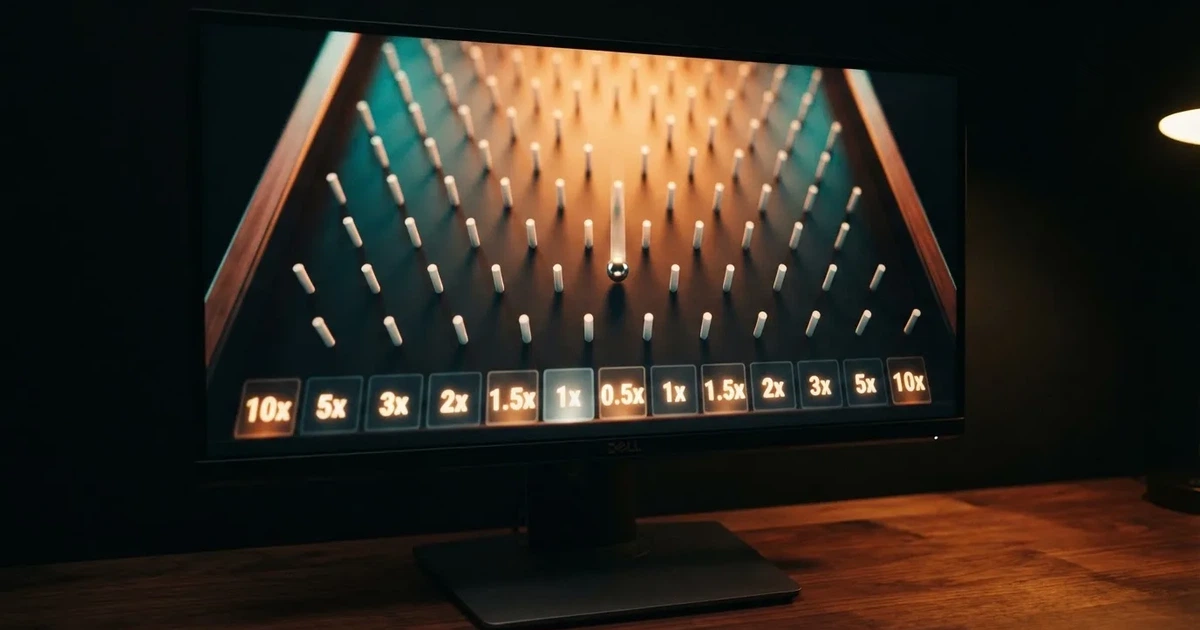
Plinko looks harmless. A ball drops through a pegboard, lands in a slot, multiplies your stake. The offshore casino sites offering it for real money to Australians lean on that simplicity hard — a quick round between emails, nothing like the spin-every-few-seconds grind of a pokie. The mechanics are genuinely simple. The cost is not what the marketing claims, and the legal position of anyone in Australia who opens an account is exactly what the ACMA has spent the last several years trying to spell out. This page walks through what the game is, what it returns, why paying with cryptocurrency does not change any of that, and what an ACMA formal warning actually means for a brand you might find advertised.
Table of Contents
- Crypto and Anonymity: What Crypto Deposits Don’t Do for Australians
- Payments and Payout Speed: What the Background Claims Don’t Cover
- The Plinko Game Itself: Paytable Detail and What the Numbers Mean
- The Brands: Side-by-Side on ACMA Action
- How the ACMA’s Enforcement Has Built Up
- What the Game Looks Like to an Australian Player
- The Legal Position: What the Interactive Gambling Act 2001 Actually Says
- Responsible Gaming: Where to Get Help, and What BetStop Does and Doesn’t Cover
- Frequently Asked Questions
Crypto and Anonymity: What Crypto Deposits Don’t Do for Australians
The advertising around crypto-first Plinko casinos leans heavily on two ideas — that Bitcoin or Ethereum deposits are private, and that on-chain play is somehow outside any country’s rules. Neither holds up under scrutiny, and the distinction matters because the cluster of “plinko crypto casino” and “crypto casino plinko” searches is the one where Australian players most often reach for an offshore site thinking the transaction gives them cover.

Crypto deposits are pseudonymous, not anonymous. Every Bitcoin transaction sits on a public ledger indefinitely. Chainalysis and similar forensic tools have been used in civil asset recovery and criminal cases for years; Australian law enforcement agencies have used blockchain analytics in fraud matters. The wallet address an Australian player funds a casino account from is not a name, but it is a permanent, traceable identifier that links to the exchange or peer-to-peer counterparty where the coins were originally acquired. A Know Your Customer check on the exchange side ties the wallet to a verified identity. The ledger does not forget.
Paying with crypto does not make an offshore casino Australian-licensed. The Interactive Gambling Act 2001 makes it an offence to provide online casino-style games to a person in Australia — the offence is on the operator, not the payment rail. Whether the deposit settles through Visa, PayID, USDT or Bitcoin changes nothing about whether the operator has a licence under Australian law. No state or territory issues such a licence. The operator is committing the offence regardless of which currency the Australian pays in, and the ACMA’s enforcement activity — formal warnings, blocking requests to ISPs — proceeds from that fact alone.
Crypto deposits give no Australian consumer protection. BetStop, the National Self-Exclusion Register, binds Australian-licensed online and phone wagering services. An offshore Plinko site, crypto-funded or otherwise, is not connected to it. If an offshore operator refuses a withdrawal, the player has no Australian complaints body, no Australian regulator to escalate to, and no enforceable right under Australian consumer law against a company incorporated in Curaçao or Cyprus with no Australian office. Crypto does not solve this; in some cases it makes it worse, because chargebacks are not available on chain and the operator has even further informed the player of recourse.
The crypto angle does change one thing about cost. Network fees on Bitcoin and Ethereum mainnet can swing widely; on a bad day, an Ethereum transfer can cost more in gas than the Plinko stake itself, which compresses any session’s effective return before the first ball drops. Stablecoin transfers on cheaper networks (Tron, Polygon, BNB Chain) avoid the spike, but the casino’s own minimum deposit typically absorbs the savings. Either way, the marginal cost of transacting is paid by the player, not absorbed by the operator.
What crypto is good for, honestly, is speed. Settlements in stablecoins clear in minutes rather than days, and the same is true of withdrawals if the operator processes them promptly. That is a real operational advantage and the one legitimate claim in the marketing. It does not address the legal exposure, the lack of recourse, or the absence of any Australian consumer protection.
Payments and Payout Speed: What the Background Claims Don’t Cover
The Plinko pages searching for “plinko casino payout” or “plinko casino game real money withdrawal” tend to surface affiliate marketing material listing payment methods: Visa, bank wire, e-wallets (Skrill, Neteller, MiFinity), prepaid vouchers, and a growing set of cryptocurrencies. The lists are descriptive — they tell an Australian what the site accepts — and that is the limit of their honesty.
For an Australian player using any of these at an offshore Plinko site, several practical points do not appear in the affiliate copy.
E-wallets can be blocked at the deposit stage. Skrill and Neteller explicitly restrict transactions to unlicensed gambling operators in some jurisdictions and routinely decline deposits to sites the e-wallet has flagged. MiFinity’s terms reserve similar discretion. A deposit that fails leaves the player with a paid fee and no balance, and the casino’s support response in those cases is typically to suggest an alternative rail rather than to assist with the failure.
Bank wires and card deposits route through Australian intermediaries. A Visa or Mastercard transaction to an offshore merchant typically triggers an anti-fraud or merchant-category decline from the Australian bank. When it does clear, it appears on the Australian statement under the merchant category code that some Australian banks use to flag gambling spend. A small number of Australian banks have moved further and block gambling-related merchant codes entirely at the card level.
PayID, Osko and BPAY are Australian real-time payment rails. They work with Australian-licensed wagering services. They do not work with offshore casino operators because the receiving account has to be held with an Australian participating financial institution, and no offshore operator holds one.
Crypto is the rail with the fewest friction points at deposit. It also has the fewest friction points at withdrawal — if and only if the operator processes the withdrawal at all. Withdrawal timing claims on offshore sites are typically stated as 24–48 hours for crypto, longer for bank wire. The median reality, measured against consumer complaint volumes on forums like AskGamblers and Casino Guru, is slower — particularly for first withdrawals, where KYC re-verification is routinely demanded after the player has already deposited and played. A first-time withdrawal that triggers a fresh ID, address and source-of-funds check is the single most common delay complaint at offshore sites.
Payout caps bind regardless of payment rail. Most offshore operators impose daily, weekly and monthly withdrawal limits in the A$2,000–A$10,000 range, with progressive VIP tiers lifting the ceiling. A Plinko win above the cap does not pay out faster — it queues. For a player hitting a 100x or 1,000x multiplier, the cap is often the binding constraint, and the cap is rarely the headline figure the affiliate page leads with.
What the marketing lists is what the operator accepts. What the player actually gets is a narrower set of rails that work end-to-end, on a site that can be blocked by an ACMA request at any time, leaving any balance held at the operator’s discretion.
The Plinko Game Itself: Paytable Detail and What the Numbers Mean
“Plinko casino” and “casino plinko” searches resolve to a handful of game variants offered by offshore operators. The most consistently advertised is BGaming’s Plinko, and the paytable and mechanics it publishes are representative of what the cluster of offshore Plinko games look like.
BGaming’s Plinko advertises a 99% RTP and a ×1,000 top multiplier. The setup: a pyramid of pegs over a configurable number of rows, with slots at the bottom. The player drops a ball from the top; the ball bounces through the pegs and lands in one of the bottom slots, each slot carrying a multiplier. The advertised 99% return is over the very long run — millions of balls — and the 1% house edge sits inside it.
The player controls two settings before each drop: the risk level (low, normal or high) and the number of lines (8 to 16). The risk level changes the distribution of multipliers. On low risk, the slots closest to the centre carry small positive multipliers and the slots at the edges carry larger ones — but the spread is narrow, with the maximum multiplier modest. On high risk, the centre slots return very little (often less than 1x), and the edges carry the advertised large multipliers — up to the advertised ×1,000. The number of lines controls the granularity of the bottom row: 16 lines gives 17 slots and a finer spread of multipliers; 8 lines gives 9 slots and a coarser one.
The shape of the paytable is the part the marketing photographs and the part the player needs to read carefully. The headline RTP of 99% sits at the population level. The realised variance for any single session sits much wider, and the high-risk / 16-line setting pushes that variance to its widest — the centre slots return less than stake, the edge slots return the eye-catching multipliers, and the distribution is fat-tailed. A player choosing high risk is choosing to spend most of their bets at or below stake in exchange for the small probability of a large multiplier.
Auto-bet mode runs drops at a configurable rate. Manual mode is one drop per click. There is no skill input after the risk and lines are set — no choice of drop position, no timing decision, no betting progression the player can deploy to change the underlying distribution. Plinko is closer to a slot than to a table game in this respect: the player sets parameters and watches outcomes.
The peer comparison that the marketing copy usually skips: a Plinko session at 99% RTP, at high risk and 16 lines, sits closer to a low-volatility pokie in house edge than to any game where skill matters. A pokie with a 96% RTP and high volatility returns less on average but offers a flatter long-run experience; a Plinko game at 99% RTP returns more on average but with a distribution that most players experience as long losing runs punctuated by occasional large hits.
For a reader who wants to set the parameters themselves, the BGaming version is the one the affiliate pages most often link to. The advertised numbers — 99% RTP, ×1,000 top multiplier, three risk levels, 8 to 16 lines — are the figures to take into the comparison table the operators below.
A separate piece of history sits behind the name. Plinko premiered as a pricing game on the US television show The Price Is Right on 3 January 1983. In the show’s version, contestants drop chips down a pegboard into nine bottom slots valued (from the outside in) at $100, $500, $1,000 and $0, with the centre slot worth $10,000, for a maximum possible win of $50,000. Before 1998 the centre slot was worth $5,000 and the top prize was $25,000. The TV game has no house edge in the gambling sense — it is a fixed-prize contest — and the casino version’s RTP and multiplier structure is a translation of that pegboard into a wagering product, not a continuation of the show’s format.
The Brands: Side-by-Side on ACMA Action
The following table sets out what the ACMA itself has published about each of the brands most often named in Plinko casino marketing aimed at Australians. The columns are: brand, ACMA action and date, the operator entity named in the ACMA’s notice, and what — if anything — research confirms about the brand’s claim to support Plinko specifically. No bonus terms are listed because the only sources for them are affiliate marketing pages, and no licence is listed because none of the operators below holds an Australian licence for online casino games.
| Brand | ACMA action and date | Operator named by the ACMA | Plinko support |
|---|---|---|---|
| RocketPlay | Formal warning, March 2026 | Pulsup Ltd (Rocketplay.com.au) | Not stated |
| Level Up Casino | Formal warning, May 2022 | Dama N.V. | Listed by BGaming |
| Woo Casino | Formal warning, March 2025 | Dama N.V. | Not stated |
| Spirit Casino | Formal warning, May 2025 | Dama N.V. | Not stated |
| National Casino | Formal warning, July 2025 | Consolutetish S.R.L. | Listed by directory sources |
| Bizzo Casino | Formal warning, July 2025; earlier 2022 | Consolutetish S.R.L.; earlier TechSolutions | Not stated |
| Ignition Casino | Formal warning, July 2025 | Bamboo Media | Not stated |
| Instant Casino | Formal warning, February 2025 | EOD Code SRL | Not stated |
| Jackbit | Formal warning, April 2026 | Ryker B.V. | Not stated |
| Casino Intense | Formal warning, April 2025 | Sterplay Holding Ltd | Listed by directory sources |
| Sky Crown | Formal warning, September 2022 | Hollycorn N.V. | Not stated |
Several patterns stand out. Dama N.V. is the operator entity behind three of the eleven brands — Level Up, Woo Casino and Spirit Casino — and the ACMA’s 2022 warning to Dama N.V. was followed by further formal warnings to the same operator in 2025 over two of those brands, indicating the activity is ongoing rather than a single historical event. The Bizzo Casino entry carries two warnings from different periods and different operator entities — 2022 over TechSolutions and 2025 over Consolutetish S.R.L. — which is a useful reminder that the brand persists across corporate reorganisations.
For Plinko support specifically, the table is sparse because most of these brands do not publish verifiable Plinko availability — the BGaming listing for Level Up Casino is the cleanest confirmation in the set, and the others either do not list Plinko in a publicly verifiable directory or are silent on the question. That silence is itself a marker: a brand that advertises Plinko through an affiliate network but does not list it on its own games page, or lists it under a different studio name, is harder to verify than a brand that names it directly.
What the table does not show is the operator’s claimed licence. Every brand below holds an offshore licence — most commonly Curaçao, a smaller number in Cyprus or Costa Rica — and most display that licence prominently. None of those licences authorises the operator to provide online casino games to Australians. The Curaçao licence in particular covers B2C operations but does not override the Australian prohibition, because Australian law applies to where the customer is, not where the operator is licensed. A Curaçao-licensed operator offering Plinko to a player in Sydney is offering a prohibited service under the Interactive Gambling Act 2001 regardless of the licence the operator displays. The ACMA’s formal warnings make this point in identical terms each time.
How the ACMA’s Enforcement Has Built Up
The ACMA’s blocking activity is the part of the picture that has been moving fastest. The cumulative picture, as published in June 2026, is that 1,751 illegal gambling and affiliate marketing websites had been blocked since the first blocking request in November 2019, and that more than 230 unlicensed gambling services had left the Australian market since enforcement was strengthened in 2017. The pace has not slowed — the round reported on 26 June 2026 alone asked Australian ISPs to block 12 further sites: 7Signs, ChromaBet, Donbet, Duospin, Freshbet, Slots Gem, Jacks Club, Lucky Start, Pointsbetz.com, Spinrise, Vinyl Casino and Wildsino.
The arithmetic on those two numbers — 1,751 sites blocked since November 2019 and 230 services having left the market since 2017 — gives the blocking rate a reader should hold in mind. Working from the running total and the date of the first blocking request stated in §5: roughly 1,751 sites blocked across approximately 79 months from November 2019 to June 2026 is a band of roughly 22 sites per month on average over the full window. That average flatters the early years, when the program was new and enforcement was building; the more recent rounds, measured against the cadence the ACMA has published in 2024 and 2025, sit higher, and a single round routinely covers ten to twenty sites. Read as a band rather than a single rate, the picture is between roughly 20 and 30 sites blocked per month over the program’s life, with the recent pace at the upper end of that band. The blocking rate is the operating tempo of Australian enforcement against offshore gambling, and it has held steady into 2026.
The H2 Gambling Capital estimate, current to 2025, is that Australians lose about A$3.9 billion a year to illegal gambling sites, and that the share of gambling going through legal channels fell from 74% in 2021 to 64%. That share falling despite — or rather alongside — the blocking program is a marker that blocking does not, by itself, redirect spending back into the legal market. Players blocked from one site move to another. Some, faced with the friction, drop out; some, faced with the friction, move deeper into offshore and harder-to-block crypto rails.
A separate enforcement layer sits on top of the blocking program: formal warnings. A formal warning is published by the ACMA on its website, names the operator entity and the brand, and gives the operator a chance to cease offering prohibited services to Australians. The warnings in this page’s set span from September 2022 to April 2026, and the cadence has been roughly two to six per year over that window. The warning is a public marker; it does not by itself block the site, but it precedes blocking in many cases and is the ACMA’s record of having put the operator on notice.
What the Game Looks Like to an Australian Player
The Plinko casino game, as advertised, is a single round that runs in seconds. A player sets the stake, picks the risk level and the number of lines, drops a ball, watches it bounce, and collects the multiplier if any. That is the entire game loop. Sessions stack: 60 rounds an hour at manual play, several hundred at auto-bet. The cost of a session is the stake multiplied by the number of drops, and the realised return is the sum of the multipliers the balls land in.
The advertised 99% RTP translates, for a player running 1,000 drops at A$1 each, into an expected loss of roughly A$10 across the session. The realised loss is wider: most sessions of that length come in well above or below A$10, with the high-risk setting pushing the spread further. A session of 100 drops at A$10 on high risk / 16 lines might return A$800 or might return A$200 — the distribution is fat-tailed at the top and the centre slots return less than stake.
None of those figures describe an Australian player playing on an Australian-licensed site, because no Australian-licensed site offers the game. The figures describe an Australian player playing on an offshore site, where the cost of every drop is paid to an unlicensed operator with no Australian consumer protection, no Australian complaints body, and no guarantee that a withdrawal above the site’s cap will be processed in the time the site advertises. The game is mathematically the same; the legal and protective frame around it is not.
The marketing materials cluster around a small set of phrases: provably fair, instant withdrawals, no KYC for crypto, anonymous play. The first describes a cryptographic check the player can run on the round outcome — useful, but it does not address the legal position. The second describes the operator’s claimed processing time — useful, but it does not bind the operator to that time once the player’s withdrawal triggers a fresh verification check. The third describes a payment rail — accurate for some operators, but the absence of KYC at deposit does not waive KYC at withdrawal, and a withdrawal that demands ID for the first time is the single most common complaint pattern at offshore sites. The fourth describes a feature of the payment rail rather than a feature of the licence, and it does not change the fact that the player has no Australian recourse.
The Legal Position: What the Interactive Gambling Act 2001 Actually Says
The Interactive Gambling Act 2001, strengthened by the Interactive Gambling Amendment Act 2017, makes it an offence to provide online casino games, online pokies or in-play betting to a person in Australia. The offence sits on the provider, not the player — an Australian who opens an offshore Plinko account is not personally prosecuted under the IGA. The penalties sit on the operator: up to A$220,000 per day for individuals and up to A$1.1 million per day for corporations.
What is licensable in Australia is wagering on races and sport placed before the event, lotteries, and keno. In practice that licensed wagering is concentrated with the Northern Territory — the Northern Territory Racing and Wagering Commission (NTRWC) regulates 52 of Australia’s online bookmakers, including Sportsbet, Bet365 and Ladbrokes, licensed in the Territory for tax reasons. The commission has no full-time staff and meets once a month in Darwin. Its role covers licensed wagering; it does not license online casino games, and no other state or territory does either.
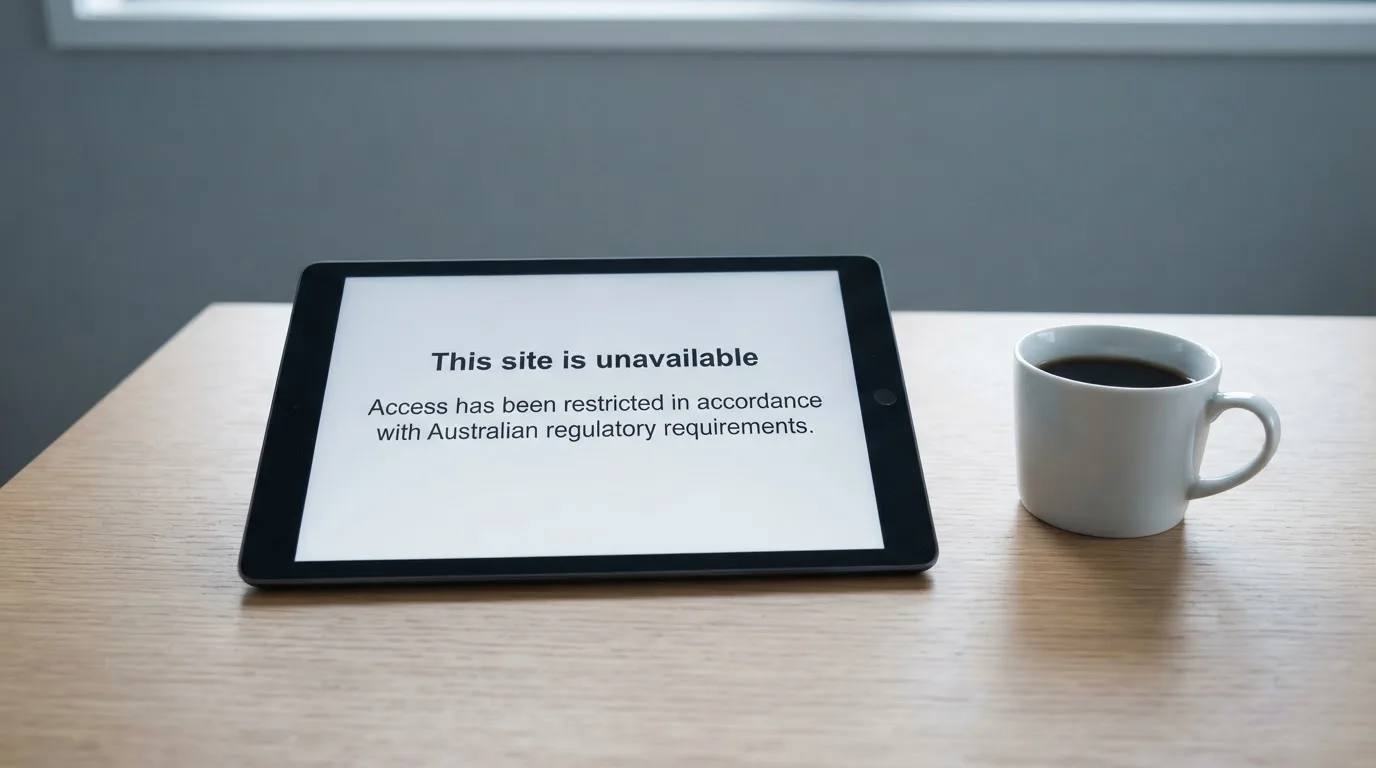
The ACMA is the enforcement body. It investigates complaints, issues formal warnings, and directs Australian internet service providers to block illegal sites. The blocking program — 1,751 sites since November 2019 — runs through the ISPs. A player trying to reach a blocked site sees a redirect to an ACMA information page. The block is at the Australian ISP level; it does not prevent a determined player from reaching the site through a VPN, but it does prevent the site from being reached by the Australian internet population at large.
The ACMA’s enforcement footprint is not uniform across brands. The table above lists 11 brands that have been the subject of formal warnings. A far larger number of offshore operators serving Australians have never received a formal warning — either because the ACMA has not yet investigated them, because they have not crossed the threshold the ACMA uses to issue a warning, or because they sit low enough in the marketing to avoid notice. The presence of a formal warning is not a measure of how serious the offence is; it is a marker that the ACMA has chosen to act.
What the law does not do is prosecute the Australian player. The IGA is targeted at the operator, and the Australian who opens an offshore account, deposits money and plays Plinko does not commit an offence under the IGA itself. That is the limit of the legal protection the player has. The offshore operator is not bound by Australian consumer law, and the player has no Australian complaints body. If a withdrawal is refused, the recourse is to the operator’s own dispute process and, if that fails, to the licensing jurisdiction’s regulator — Curaçao, Cyprus or wherever the licence was issued. None of those regulators are responsive in the way the Australian regulators are, and most offshore disputes take months to resolve, if they resolve at all.
The Interactive Gambling Amendment (Gambling Reform) Bill 2026 passed Parliament on 19 August 2026. Its advertising and inducement measures commence 1 January 2027. The Bill is law with a start date — it is not yet in force on a 2026 page — and the substantive changes to advertising and inducement will not bite until 2026 opens. The offshore Plinko marketing that Australian players see today is governed by the IGA as it stood before the Amendment.
Tax is a separate layer. Gambling winnings of a recreational player are not assessable income under section 6-5 ITAA 1997, and losses are not deductible unless the person carries on a business of gambling. The ATO’s position is straightforward on this and the rule applies whether the gambling happens at a licensed Australian venue or at an offshore Plinko site.
Responsible Gaming: Where to Get Help, and What BetStop Does and Doesn’t Cover
A page that discusses offshore Plinko cannot responsibly stop at the marketing claims and the ACMA warnings without naming the support services that exist for Australians whose gambling has moved from a choice to a problem.
The National Gambling Helpline — 1800 858 858 — is free, 24/7 and confidential. The chat counterpart is Gambling Help Online. Both are funded by the Australian government and operate nationally. State-level services sit underneath the helpline: Relationships Australia in several states, the Victorian Responsible Gambling Foundation, NSW’s GambleAware, and similar bodies in Queensland, Western Australia, South Australia and Tasmania.
BetStop — the National Self-Exclusion Register — went live in August 2023. It binds Australian-licensed online and phone wagering services. A person registered with BetStop cannot open a new account with an Australian-licensed wagering operator and is barred from existing accounts by the operator’s own exclusion machinery. BetStop does not bind offshore casino operators, and it does not block an Australian from opening an offshore Plinko account. Self-exclusion from an offshore site is at the operator’s discretion; some operators offer it, many do not, and none of them are required to.
The framework that does cover all gambling is partial. Self-exclusion at an offshore site is a request, not a ban. A VPN and a fresh email can defeat it. The mechanism works because the player chooses to use it, and that is its limit. For a player whose gambling has reached the point that they want to exclude themselves, the Australian-licensed channels — BetStop, the helpline, the state-level services — are the ones that actually bind.
The reality the responsible-gambling services describe is that offshore casino play sits outside the protective frame Australians expect. A player hitting a problem at an Australian-licensed venue has BetStop, the venue’s own exclusion, the state complaints process, and the operator’s licence at risk. A player hitting a problem at an offshore Plinko site has the operator’s own discretion and, in practice, the option to keep playing by switching brand. The protective frame is materially thinner offshore than it is on the licensed side, and the support services exist in part because that thinner frame is the lived experience of a non-trivial number of Australians.
Frequently Asked Questions
What is the Plinko casino game, and how does the ball-drop mechanic determine a payout?
Plinko is a pegboard game where a ball drops from the top of a pyramid of pegs and lands in one of several slots at the bottom, each carrying a multiplier. The player sets the stake, the risk level (low, normal or high) and the number of lines (commonly 8 to 16), then drops the ball. The payout is the stake multiplied by the slot the ball lands in. The outcome is determined by the physics of the bounce, which the casino’s “provably fair” cryptographic check is meant to verify. There is no skill input after the parameters are set — the player does not choose where to drop the ball, and there is no betting progression that changes the underlying distribution.
Does a crypto version of Plinko pay out any differently to a standard real-money version?
The advertised RTP and paytable are the same in both versions — what differs is the payment rail. Crypto deposits clear in minutes and crypto withdrawals are typically faster than bank wire, but the game’s underlying return is set by the operator and is independent of the deposit currency. Stablecoins on cheaper networks (Tron, Polygon) avoid the gas-fee spike that Bitcoin and Ethereum mainnet can hit on a congested day, which protects the player’s transaction cost but does not change the game’s return. The published RTP — 99% in the case of BGaming’s Plinko — applies to the game itself, not to the rail.
Is playing Plinko for real money at an offshore casino something Australians are legally allowed to do?
The player is not prosecuted under the Interactive Gambling Act 2001 — the offence sits on the operator, not the customer. What the player gives up by playing offshore is the Australian consumer protection frame: no Australian complaints body, no enforceable recourse under Australian consumer law, no connection to BetStop, and the prospect that the site can be blocked by an ACMA request with a balance still on it. The operator commits an offence by offering the game to Australians; the player’s exposure is the absence of protection, not a criminal charge.
What return-to-player rate do offshore sites typically advertise for their Plinko game?
The most consistently advertised figure is 99%, from BGaming’s Plinko. Other studios publish lower numbers, in the 96% to 98% range, and some operators white-label the BGaming version without disclosing the underlying RTP at all. The 99% figure is an average over a very large number of balls and does not describe any individual session. A session of a few hundred drops will almost always sit well above or well below 99%, and the high-risk setting widens the spread further by paying most bets below stake in exchange for occasional large multipliers.
Why do Plinko casino apps get advertised separately from ordinary Plinko casino websites?
The app is a wrapper around the same browser-based game, distributed through the operator’s site as an APK download rather than through Google Play or Apple’s App Store — both stores prohibit real-money casino apps in their content policies. The app form is advertised separately because it offers a fuller-screen experience and, on Android, push notifications for promotions. It does not offer a different game. The app sits on the device outside the store’s content review and is not subject to the same consumer protections as an app distributed through Google Play or Apple’s App Store.
How does a Plinko game’s payout table differ from a pokies reel in terms of the odds involved?
A Plinko game’s RTP is set by the slot multipliers and their probabilities; a pokie’s RTP is set by the symbol weights and paylines. The structural difference is variance. A pokie with a 96% RTP and high volatility returns less on average than a Plinko game at 99%, but the pokie’s per-spin variance is bounded by the pokie’s top payout and the distribution of its symbols. Plinko’s variance is determined by the player’s settings — high risk / 16 lines produces a fat-tailed distribution where most bets return less than stake and a small fraction return the headline multipliers. A reader comparing the two should look at the variance setting first and the RTP second.