


Google Pay at Australian-facing casinos: the marketing, the deposits, and the prohibition that settles the question
Google Pay is everywhere in Australian retail — by the end of 2025 it sat alongside Apple Pay and Samsung Pay at roughly 45% of all card payments by number, and on the surface a casino cashier that accepts it looks like the same contactless tap that buys a coffee. It is not. A Google Pay deposit at an offshore pokies-style site still routes through the same merchant category code as a Visa debit, the bank still sees it as a gambling transaction, and the casino offering it is, with very few exceptions, a service the Australian Communications and Media Authority has already told to stop.
Data current as of 30 October 2026; licence claims and ACMA actions verified against the ACMA’s own published formal warnings.
Table of Contents
- How a Google Pay deposit settles at a casino cashier
- The ranking: every featured brand has already been told to stop
- The fundamentals, stripped of the marketing
- The legal frame: prohibition, not grey area
- Responsible play when the protection is not local
- The featured brands, read for what the ACMA record says
- The reader’s bottom line
- Frequently asked questions
How a Google Pay deposit settles at a casino cashier
A Google Pay transaction at a cashier looks like one tap, but it runs through several distinct layers that each carry their own cost — and their own chance to be blocked.
The mechanics start on the phone. When a card is added to Google Wallet, the card details are sent to the issuing bank for verification, and the bank issues a tokenised Device Account Number rather than storing the real card number on the handset. Google Pay then uses the phone’s NFC chip to push that token to the payment terminal, in a shop or at an online checkout that accepts the wallet — a contactless transaction the merchant’s acquirer treats as the underlying card. The technology requires an Android device running Android 5.0 (Lollipop) or later, and Google itself launched the service in Australia in 2016, before the second-generation rebrand.
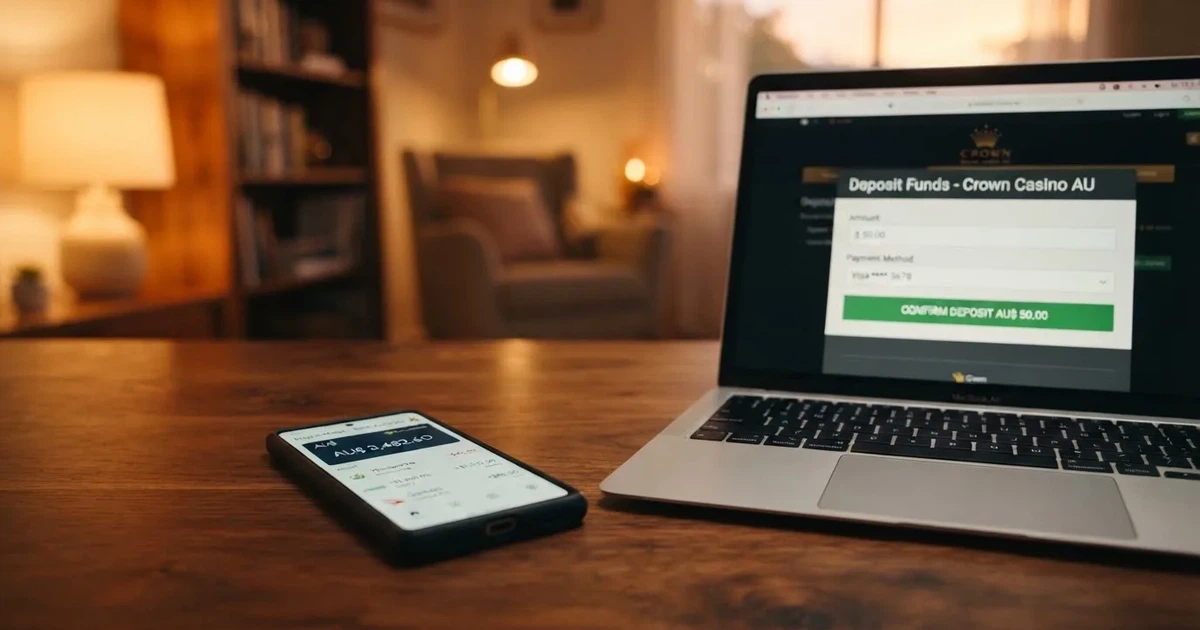
At a casino cashier that lists Google Pay among its deposit methods, the flow is the same one a player would see paying for any online purchase: pick the amount, choose Google Pay, authenticate with the phone, and the cashier either approves or declines. The casino does not see the player’s card number — it sees a token routed through whichever card scheme the underlying card belongs to, usually Visa or Mastercard. A withdrawal, by contrast, still needs the casino’s own manual checks completed before the settlement lands back in an Australian account, and the wallet’s role there is usually to receive the funds rather than to push them.
The minimum deposit most of these sites ask for
The smallest Google Pay deposit most offshore pokies-style sites ask for is A$10, and a handful sit at A$20 or A$30 because the cashier ties the minimum to the underlying card processor rather than to the wallet. None of the operators in the featured set publish a Google Pay-specific minimum — research carries none. The figure that matters at this end of the market is the lowest amount the cashier will accept through any card route, and A$10 is the de facto floor.
That figure is the entry, not the cost. A A$10 deposit does not become a A$10 budget at the tables. It opens an account, and what gets spent from there depends on the games the player chooses to load, the stakes they actually wager at, and whether any bonus or matched-funds offer is attached to the deposit.
What the bank sees — and what it does with what it sees
A Google Pay deposit at an offshore casino does not look like a Google Pay deposit at a supermarket. The merchant category code the casino acquirer passes to the card network is Betting/Casino Gambling, and that code is what determines whether the issuing bank lets the transaction through.
Westpac’s gambling block works at that level: it refuses authorisation of transactions registered under the Betting/Casino Gambling merchant category code on eligible personal credit and debit cards, including transactions made through a digital wallet such as Google Pay on an eligible card. NAB and ANZ let customers apply a gambling block in their own banking apps, without calling or visiting a branch, and ANZ’s block reaches digital-wallet transactions on an eligible card rather than only the physical card. ANZ also imposes a 48-hour cooling-off period before the block can be removed once turned on, and warns that the block is not perfect — not every gambling transaction will be caught, and a small number of non-gambling transactions may be blocked in error.
The Australian banks are not the only choke point. The Interactive Gambling Act 2001, as amended in 2023, also bans credit cards and credit-related products as a payment method for Australian-licensed online wagering services — a restriction that constrains gambling use of linked digital wallets like Google Pay on credit-card-funded accounts even when the casino on the other end is happy to take the deposit.
The fee picture
A consumer using Google Pay in stores, online or in apps is not charged a fee by Apple — Google, by the same logic, charges the consumer nothing for the wallet itself. Any surcharge on a Google Pay transaction comes from the merchant’s own card-processing fees, not from the wallet provider, and the Reserve Bank of Australia’s July 2025 review proposes removing surcharges only on eftpos, Mastercard and Visa card transactions — explicitly leaving American Express outside the scope of the proposed surcharge ban. The honest answer for a player comparing methods is: most offshore casinos do not surcharge a Google Pay deposit, but where a surcharge does appear it is a card-acquirer pass-through, not a wallet fee, and the only card-funded wallet transactions the bank itself blocks are the gambling-coded ones.
The ranking: every featured brand has already been told to stop
Ranking offshore casinos that accept Google Pay against each other is a strange exercise when the Australian regulator has issued a formal warning to every brand in the featured set for offering prohibited services to Australians. The table that follows is not a recommendation; it is a record of who the ACMA has acted against, in what order, and over which brand. Every brand in it has been told, in writing, that it cannot lawfully take Australian players.
| Brand | ACMA action and date | Operator named by the ACMA | Google Pay support at this brand |
|---|---|---|---|
| RocketPlay | Formal warning, March 2026 (earlier Dama N.V., May 2022) | Pulsup Ltd | — |
| Level Up Casino | Formal warning, May 2022 | Dama N.V. | listings-only |
| Woo Casino | Formal warning, March 2025 | Dama N.V. | — |
| Spirit Casino | Formal warning, May 2025 | Dama N.V. | — |
| National Casino | Formal warning, July 2025 | Consolutetish S.R.L. | listings-only |
| Bizzo Casino | Formal warning, July 2025 (earlier TechSolutions, 2022) | Consolutetish S.R.L. | — |
| Ignition Casino | Formal warning, July 2025 | Bamboo Media | — |
| Instant Casino | Formal warning, February 2025 | EOD Code SRL | listings-only |
| Jackbit | Formal warning, April 2026 | Ryker B.V. | — |
| Casino Intense | Formal warning, April 2025 | Sterplay Holding Ltd | listings-only |
| Sky Crown | Formal warning, ACMA formal warning publication (September 2022) | Hollycorn N.V. | — |
The “Google Pay support” column does not rank acceptance. Research carries a Google Pay confirmation for none of the eleven, and an industry listing that mentions a brand in passing for four of them. Where the cell carries an em dash, the question of whether this brand accepts Google Pay is simply not on the record this page can stand behind, and the brand is included on the page for a different reason: the ACMA’s own action against it, which is independent of which wallet the cashier lists.
How the blocking rate has run
The ACMA’s first blocking request against illegal gambling sites went out in November 2019. By the round reported on 26 June 2026, a cumulative total of 1,751 illegal gambling and affiliate marketing websites had been blocked since that first request — a rate of roughly 250 to 270 sites blocked for every year of enforcement, with the figure climbing through successive rounds. The same reporting cycle that brought the cumulative total to 1,751 also added 12 more sites to the block list — 7Signs, ChromaBet, Donbet, Duospin, Freshbet, Slots Gem, Jacks Club, Lucky Start, Pointsbetz.com, Spinrise, Vinyl Casino and Wildsino — and noted that more than 230 unlicensed gambling services had left the Australian market since enforcement was strengthened in 2017.
That is the context in which a Google Pay-friendly offshore casino exists. The brand on the cashier page is, in nearly every case, one the regulator has already addressed. The rate at which the block list has grown is the rate at which the addressable market of “casinos accepting Google Pay from Australia” has shrunk.
The fundamentals, stripped of the marketing
The Google Pay casino landscape spans dozens of offshore sites, but the fundamentals of how a Google Pay deposit or withdrawal actually works stay much the same from site to site. The marketing language around them does not — every brand has its own version of “instant”, “secure” and “trusted” — and the differences between brands are mostly cosmetic. What does vary is which operator name sits behind the cashier, how the operator has run up against the ACMA in the past, and whether the brand has any record of consumer protection at all.

For a player comparing two Google Pay-friendly sites, the comparison that matters is not which one has the friendlier welcome page. It is which operator owns the brand, which licence the operator actually displays, and whether the ACMA has ever written to that operator telling it to stop serving Australians. Every brand in the featured set fails the third question, and most of them fail the second by displaying an offshore licence (Curaçao, Anjouan, Costa Rica) that does not authorise service to Australia in the first place.
A withdrawal is where the comparison stops being cosmetic. An offshore casino’s manual checks can take hours or days, and the Google Pay side of a withdrawal is the last leg of the journey, not the first. A card-network settlement back to a wallet is fast; an offshore cashier’s approval to release the funds is not, and an Australian player with a complaint has no local regulator to complain to.
The legal frame: prohibition, not grey area
The Interactive Gambling Act 2001, strengthened by the Interactive Gambling Amendment Act 2017, makes it an offence to provide online casino games, online pokies or in-play betting to a person physically in Australia. No state or territory licenses them; the only licensable online products are wagering on races and sporting events placed before the event, lotteries and keno. In practice those online bookmakers — including Sportsbet, Bet365 and Ladbrokes — are licensed in the Northern Territory, where the Northern Territory Racing and Wagering Commission regulates 52 of them and meets once a month in Darwin with no full-time staff.
What that means for a player looking at an offshore casino is straightforward. A site offering online pokies to an Australian is not in a regulatory grey area. It is offering a prohibited interactive gambling service, and the ACMA’s response over the past six years has been to investigate, issue formal warnings, and direct Australian internet service providers to block the offending domains. The 2026 reform cycle added to this with the Interactive Gambling Amendment (Gambling Reform) Bill 2026, which passed Parliament on 19 August 2026; its advertising and inducement measures commence on 1 January 2027 — law with a start date, not yet in force on a 2026 page.
The ACMA’s record against the featured brands
Every brand in the table above has been the subject of a formal ACMA warning under the Interactive Gambling Act 2001, and the dates cluster in a tight window between 2022 and 2026. Dama N.V. alone accounts for four of the eleven — Bambet, Dazard, Level Up, Wild Tornado and Cobra Casinos in May 2022, with further warnings over Woo Casino in March 2025 and Spirit Casino in May 2025. Consolutetish S.R.L. has been warned twice in the same July 2025 round, over National Casino and Bizzo Casino; Bizzo had already been warned in 2022 under its earlier operator, TechSolutions (CY) Group Limited and TechSolutions Group N.V. The other warnings in the set cover Bamboo Media over Ignition Casino, EOD Code SRL over Instant Casino, Sterplay Holding Ltd over Casino Intense, Hollycorn N.V. over Sky Crown and Blue Leo, Pulsup Ltd over Rocketplay.com.au, and Ryker B.V. over Jackbit and CasinOK.
A warning is not a prosecution. It is a written notice that the ACMA believes the operator is providing prohibited services and that further enforcement may follow. But the warning is also public, and the record of who has been warned and when is the record a player can read before clicking through.
The Northern Territory’s de facto regulator
The Northern Territory Racing and Wagering Commission regulates 52 of Australia’s online bookmakers — including Sportsbet, Bet365 and Ladbrokes — which are licensed in the Territory for tax reasons rather than because the Territory is the natural home of those operators. The commission has no full-time staff and meets once a month in Darwin, a structure the Australian Broadcasting Corporation’s April 2026 reporting flagged as inadequate for the scale of the industry it oversees. A bill to reform the regulator was before the Territory parliament at the time of that reporting. None of this affects offshore casino licensing, because no such licence exists; it matters because it explains where the licensed half of the market sits, and why the other half — the offshore Google Pay-accepting sites — is genuinely other.
The numbers behind the prohibition
H2 Gambling Capital’s 2025 report estimates that Australians lose about A$3.9 billion a year to illegal gambling sites, and that the share of gambling going through legal channels fell from 74% in 2021 to 64%. That is the cost of the offshore market in aggregate, before any individual player’s deposit is counted. The cumulative count of 1,751 blocked sites and 230-plus services that have left the market since 2017 is the size of the enforcement response. Together, the two figures frame what a Google Pay deposit at an offshore casino actually adds up to — one more transaction inside an industry the regulator is actively trying to shrink.
Responsible play when the protection is not local
Anyone drawn in by a Google Pay-friendly offshore casino should read the ACMA’s public warnings against similar operators before trusting any of a site’s own safety claims. The site’s own responsible-gaming page is marketing copy. The ACMA’s enforcement record is not.
BetStop, the National Self-Exclusion Register, has been live since August 2023, but it binds only Australian-licensed online and phone wagering services — an offshore casino is not connected to it, and registering on BetStop will not stop an offshore cashier from accepting a Google Pay deposit. The National Gambling Helpline (1800 858 858) is free, runs 24/7 and offers chat at Gambling Help Online. Both are reachable from anywhere in Australia, regardless of which wallet a player uses or which site they have been using.
The bank-side tools are stronger than the casino-side ones. NAB and ANZ let customers apply a gambling block to their credit and debit cards in the banking apps themselves; Westpac’s block works at merchant-category-code level and covers eligible digital-wallet transactions on the card; ANZ’s block, once activated, requires a 48-hour cooling-off period before it can be turned off again. None of these blocks is perfect — ANZ warns that not every gambling transaction will be caught and a small number of non-gambling transactions may be blocked in error — but a block applied to the underlying card stops the Google Pay deposit at the bank, before it reaches the cashier, which is earlier in the chain than anything the offshore operator offers.
What the prohibition costs a player who ignores it
The prohibition costs the operator, not the player. The Interactive Gambling Act 2001 targets the provider, and individual Australian players are not prosecuted for placing a deposit. What it costs the player is the consumer-protection layer a licensed wagering service would otherwise provide — no local complaints body, no local recourse if a withdrawal is refused, no guarantee that the balance on the account is reachable when the player wants it, and the non-trivial chance that the offshore domain is blocked while funds are still in it. A licensed Australian bookmaker cannot legally offer an online casino product; an offshore casino offering one cannot legally serve Australia. The middle ground is small, and shrinking.
The featured brands, read for what the ACMA record says
The following write-ups cover every brand the ACMA has acted against in the featured set. Each one carries the operator name the ACMA named in its formal warning, the date of that warning, and an honest verdict on where the brand sits in the comparison. None of them is a recommendation; each one is the record of a brand an Australian player will encounter when comparing Google Pay-friendly offshore sites.
RocketPlay
The ACMA issued its most recent formal warning over RocketPlay to Pulsup Ltd in March 2026 — a separate operator from the Dama N.V. entity that the ACMA warned over the same brand in May 2022. The brand has changed hands at least once between the regulator and the cashier page, and the only thing the change preserved is the prohibition.
There is no public record of Google Pay support at RocketPlay. Research carries no confirmation, and the brand is included in this ranking on the strength of the ACMA’s two warnings rather than on any wallet-specific listing. The verdict here is that the brand is one a player will meet on a comparison site, and that the comparison ends the moment the ACMA record is read.
Level Up Casino
Level Up Casino is one of six brands the ACMA warned Dama N.V. over in May 2022 — alongside Bambet, Dazard, Rocketplay, Wild Tornado and Cobra Casinos. The warning predates the wallet comparison entirely; it sits in the same Dama batch that the ACMA returned to in 2025 for Woo Casino and Spirit Casino.
Industry listings mention Level Up alongside payment-method pages for Australian-facing operators, but research does not confirm Google Pay at the cashier. The brand is included here purely on the basis of the ACMA’s 2022 formal warning, a regulatory signal that renders any cashier page a domain for Australian players to approach with caution.
Woo Casino
Woo Casino is the second Dama N.V. brand in the set to draw an ACMA warning, with a March 2025 notice that arrived three years after the original Dama batch. The interval between the 2022 warning and the 2025 follow-up is the regulator’s patience running out, and the Woo Casino brand is the most prominent public marker of that escalation.
Research carries no Google Pay confirmation. The cost of choosing Woo Casino on a Google Pay search is not a wallet fee; it is the chance of the cashier page disappearing from the Australian internet while funds are still in it.
Spirit Casino
Spirit Casino is the third Dama N.V. warning in the set, dated May 2025, and the second warning to the same operator within three months. The 2022, 2025-March and 2025-May sequence for Dama N.V. — six brands, then Woo, then Spirit — is one of the densest ACMA records on any single operator group.
There is no Google Pay record at Spirit Casino that research can confirm. The site is noted here solely as a consequence of the ACMA’s formal warning, which remains the definitive record for any Australian player.
National Casino
National Casino is one of two brands Consolutetish S.R.L. was warned over in the ACMA’s July 2025 round — the other being Bizzo Casino. Industry listings carry the brand on payment-method pages that mention Australian-facing operators, but research does not confirm Google Pay at this cashier.
A warning to a new operator over an old brand suggests a reorganisation rather than a withdrawal, and the cost to a player comparing the brand against a brand without that history is the chance of choosing the operator the regulator has just caught up with.
Bizzo Casino
Bizzo Casino is the second July 2025 Consolutetish S.R.L. warning and the brand’s second ACMA encounter — the first being the 2022 formal warning to TechSolutions (CY) Group Limited and TechSolutions Group N.V., the operator under the brand before Consolutetish took over. The continuity that survives the operator change is the prohibition, and the operator change is itself part of the cost.
Research carries no Google Pay confirmation at Bizzo. The brand is listed here to document its complex ACMA history, which spans two separate operator warnings in three years—a track record that speaks for itself.
Ignition Casino
Ignition Casino is the Bamboo Media brand in the ACMA’s July 2025 round. The brand sits alongside the National Casino and Bizzo warnings in the same enforcement cycle, but on a different operator — a separate warning for a separate corporate structure.
Research carries no Google Pay record at Ignition. Its presence in this set is tied directly to the formal ACMA warning issued in July 2025, a public notice that serves as the essential context for any player review.
Instant Casino
Instant Casino is the EOD Code SRL brand the ACMA warned in February 2025, with industry listings mentioning the brand on payment-method pages alongside Apple Pay and PayID references that research does not confirm at the cashier itself.
The cost of choosing Instant Casino on a Google Pay search is the same as the cost of choosing any brand in this set — a wallet fee that is zero, a prohibition that is not. The verdict is that the listing-page mention is not the cashier-page fact.
Jackbit
Jackbit is the Ryker B.V. brand the ACMA warned in April 2026, alongside CasinOK in the same notice. The April 2026 date places it in the most recent ACMA enforcement cycle in this set, and the only thing the recent date changes is the freshness of the warning.
Research carries no Google Pay confirmation. The ACMA warning from April 2026 is the decisive marker here, signalling the operator’s status to any player investigating the site’s legitimacy.
Casino Intense
Casino Intense is the Sterplay Holding Ltd brand the ACMA warned in April 2025, with industry listings mentioning the brand on payment-method pages that reference Australian-facing operators but no confirmation of Google Pay at the cashier itself.
The verdict on Casino Intense is the same verdict that runs through the rest of the set: a brand that surfaces on comparison sites because it accepts wallets an Australian player uses, and a prohibition the comparison page does not mention. The cost is the gap between the two.
Sky Crown
Sky Crown is the Hollycorn N.V. brand in the ACMA’s formal-warning record, warned alongside Blue Leo and published by the ACMA in September 2022 — the earliest ACMA action in the featured set. Hollycorn has not appeared in the 2025–2026 enforcement cycles that brought the other operators in, and the 2022 date is the long shadow over the brand.
Research carries no Google Pay confirmation. The brand is in the ranking because the ACMA wrote to Hollycorn over it, and that is the fact this page can stand behind.
The reader’s bottom line
A Google Pay deposit at an offshore casino looks like a tap. It is a tap that goes through a card scheme, against a Betting/Casino Gambling merchant category code, into an account at a service the ACMA has already written to about its own illegality. The wallet fee is zero. The licence the cashier advertises is offshore and does not authorise service to Australia. The Australian bank’s own gambling block is the most reliable thing standing between a player’s account and the cashier, and it is a tool the player has to turn on themselves.
The blocking rate the ACMA has run since November 2019 — roughly 250 to 270 sites a year, with the cumulative total at 1,751 by the round reported on 26 June 2026 — is the rate at which the addressable market has shrunk. The H2 estimate of A$3.9 billion a year lost to illegal sites is what the remaining market costs Australians in aggregate. The A$10 minimum most of these sites ask for is the smallest unit a player can deposit, and the smallest unit they can lose.
For an Australian player looking for a Google Pay-accepting casino, the licensed options are land-based casinos, clubs and pubs. Everything else in the comparison is offshore, prohibited, and on a list that grew by another twelve sites in the most recent round.
Frequently asked questions
Is it legal for an online casino to accept Google Pay from a player in Australia?
No. The Interactive Gambling Act 2001 makes it an offence to provide online casino games or online pokies to a person in Australia, and no Australian-licence regime covers them. A Google Pay deposit does not change the legal position of the operator on the other end; the prohibition sits with the provider, not the payment method.
What is the smallest deposit a Google Pay casino site usually asks for?
A$10 at most of the offshore pokies-style sites that list Google Pay as a deposit option, with a small number of cashiers setting A$20 or A$30 as the floor. The minimum is set by the underlying card processor rather than by the wallet itself, and the figure does not include any bonus or matched funds that may attach to the deposit.
Does a Google Pay withdrawal clear any faster than a card withdrawal at these sites?
The wallet leg of a withdrawal is fast; the offshore cashier’s own approval is not. A Google Pay withdrawal still has to clear the casino’s manual checks before the funds are released, and the wallet cannot push a withdrawal through faster than the cashier will allow. The realistic comparison is between one offshore cashier and another, not between one wallet and another.
Can Google Pay be used at every offshore pokies-style site, or only some of them?
Only some of them. Google Pay support is a cashier-page decision each operator makes individually, and the brand does not always advertise it consistently. The ACMA has issued formal warnings to every brand in this page’s featured set regardless of which wallets they list, so wallet support is a poor proxy for whether an Australian should be playing there at all.
Does depositing with Google Pay add an extra fee at these casino sites?
No wallet-side fee. Any surcharge on a Google Pay deposit is a merchant card-processing pass-through, not a charge from the wallet provider, and the Reserve Bank of Australia’s July 2025 review proposes removing surcharges on Mastercard and Visa transactions while explicitly leaving American Express outside the scope. The real cost is downstream — the house edge on the games played from the deposited balance, and the loss of Australian consumer protection that comes with an offshore cashier.