


First Deposit Bonuses in Australia: The Cost of a Market That Is Not There
Most pages answering this question open with a tidy list of ten brands and a verdict column. The honest answer does not begin that way. Under the Interactive Gambling Act 2001, no operator licensed anywhere in the world may offer online casino games or online pokies to a person physically in Australia, and no Australian jurisdiction issues a licence for them. A first deposit bonus at an online casino is not a deal a reader has to shop around for; it is a product that, on this side of the law, cannot be lawfully supplied. The whole point of a comparison on this subject is to make that gap visible, then to point at what is actually available: licensed pokies venues, land-based casinos and BetStop for self-exclusion.

This page examines how that prohibition is enforced, what money moving into and out of an offshore site looks like from Australia, which “first deposit bonus casinos” have already drawn ACMA action, and the cost the off-ramp choices impose. Comparisons across the eleven operator-level warnings the ACMA has published since 2022 sit in a single table; the wagering math that makes bonus headlines collapse to dust is on the closing pages. Every figure names its source.
Current as of 29 October 2026. Verified against the Australian Communications and Media Authority’s published formal-warning register and block list.
Table of Contents
- How an Australian Bank Account Reaches an Offshore Casino
- Licensed Payment Methods and Status
- The ACMA’s Enforcement Wall, in Eleven Warnings
- What Stays Legal in Australia
- Player Safety Outside the IGA’s Reach
- What Actually Lands at an Offshore “First Deposit Bonus”
- Where to Land
- Frequently Asked Questions
How an Australian Bank Account Reaches an Offshore Casino
The legal ceiling sits above the practical floor. Even before the ACMA acts on a brand, a player funding it from Australia runs into a stack of bank-side and rail-side friction, because each major Australian bank now blocks the merchant category code “Betting/Casino Gambling” at the card level. Westpac’s gambling block refuses authorisation on eligible personal credit and debit cards whose MCC matches. Commonwealth Bank’s CommBank app lets a customer lock gambling transactions onto a specific card, with the same caveat the others give: the bank states it cannot guarantee every gambling-related purchase will be stopped. ANZ’s gambling block works through the card, not just at the point of sale, so an Apple Pay token on that eligible ANZ card is blocked too. Removing the ANZ block requires a 48-hour cooling-off period, a small friction the bank builds in to discourage the toggle being flipped as a reflex.

What still gets through, where it does, comes in on the bank-transfer rails that the Interactive Gambling Act 2001 does not ban outright for the player side: PayID/Osko and BPAY.
PayID and Osko: speed with a sanity check
PayID is the address book on top of Australia’s New Payments Platform. By April 2025 more than 25 million PayID identifiers had been registered, against a base of over 100 Australian financial institutions. It has been live to the public since 13 February 2018, when the New Payments Platform went commercial, and it sits inside Australian Payments Plus (AP+), the merged entity formed in September 2021 from BPAY Group, eftpos and NPP Australia.
The practical effect is twofold. An Osko transfer between participating banks lands in under a minute, 24/7, including weekends, addressed to either a BSB and account number or to a PayID. Paying to a PayID also reveals the registered name of the account holder before the transfer is sent. AP+ itself warns that being asked to send money to a PayID by an illegal gambling site “almost certainly” points at a scam. That is a receipt-time check most players never bother to use; it is also the cheapest sanity check a player can make. The NPP platform contract caps monthly outages at two minutes, which speaks to availability more than security and does not change what a player sees.
BPAY: still a bill-payment rail
BPAY has been around since 1997 and remains available through the online banking of more than 140 institutions, with over 95,000 billers accepting it. Owned equally by ANZ, Commonwealth Bank, National Australia Bank and Westpac via Cardlink Services and run today by AP+, it is the elder of the two rails and behaves the way a generation of Australians remembers it: payer enters Biller Code and Customer Reference Number, the funds land next business day. For deposits at offshore casinos it shares the speed limitation that the legal product is built around bill settlement, not instant transfers.
Apple Pay, Google Pay and the credit-card line
Digital wallets do not pay for themselves. By the end of 2025, Apple Pay, Google Pay and Samsung Pay together accounted for around 45% of all card payments in Australia by number. Apple sets no transaction limit itself; limits and PIN requirements sit with the card issuer or merchant. The interesting bit for gambling is upstream: where the underlying card is a credit card, the Interactive Gambling Act’s 2023 amendment (in force since 11 June 2024) bars licensed Australian wagering services from accepting it, and digital currency is in the same envelope. A digital wallet funding a debit card through a non-bank merchant sits in a greyer spot, and ANZ’s block extends the gambling block through the wallet, not just the plastic.
American Express is the odd network out for a separate reason. The Reserve Bank of Australia’s July 2025 review proposes removing surcharges on eftpos, Mastercard and Visa transactions and explicitly leaves American Express outside the scope of that reform. Most Australian readers will not be paying an Amex surcharge into an offshore casino, but the carve-out is worth knowing: each network has its own economics, and an offer that says “4% surcharge on Visa” is not the same offer on Amex.
AUSTRAC thresholds and ordinary bank transfers
A last bit of folklore worth dropping. AUSTRAC’s threshold-transaction report rule, which requires reporting of transfers of A$10,000 or more, applies only to physical cash. An ordinary electronic bank transfer, regardless of size, is not subject to that per-transaction reporting requirement. The rule does not turn a PayID payment into a flagged transaction; it never sat over electronic transfers in the first place.
See also Best high-roller casino with bonus in Australia.
Licensed Payment Methods and Status
| Method | Status | Availability |
|---|---|---|
| PayID / Osko | Legal / Permitted | 24/7 instant transfer |
| BPAY | Legal / Permitted | Next business day |
| Debit Card | Restricted | Subject to bank block |
| Credit Card | Prohibited | Banned for wagering |
The ACMA’s Enforcement Wall, in Eleven Warnings
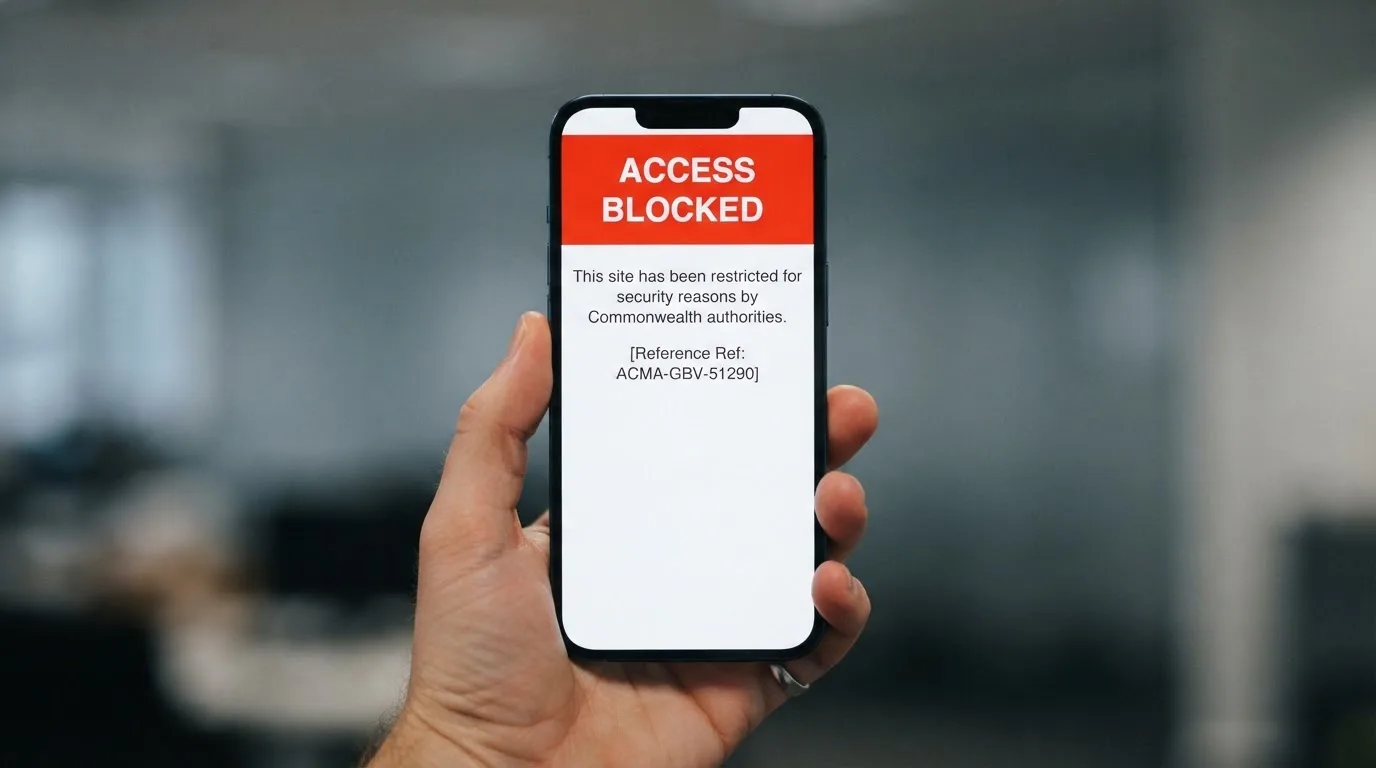
The Australian Communications and Media Authority does not arrest players. It does three things that touch the supply side: it investigates, it issues formal warnings, and it directs Australian internet service providers to block offending websites. By the ACMA’s own running total, 1,751 illegal gambling and affiliate marketing websites had been blocked since the first blocking request in November 2019, and more than 230 unlicensed gambling services have left the Australian market since enforcement was strengthened in 2017. The most recent blocking round, reported on 26 June 2026, took out twelve more names: 7Signs, ChromaBet, Donbet, Duospin, Freshbet, Slots Gem, Jacks Club, Lucky Start, Pointsbetz, Spinrise, Vinyl Casino and Wildsino.
Around that blocking pattern sits a more granular record of formal warnings. These are the ACMA’s published notices to operators it has determined are offering prohibited interactive gambling services to Australians. The eleven brands named below are the ones the page works through: each carries a date the ACMA’s own publication can be cited from, an operator name the warning was issued to, and the legal point that none of it changes the underlying prohibition — online casino games cannot be licensed anywhere in Australia, regardless of what licence a site displays at the bottom of its homepage.
Landscape of ACMA Action
| Brand | ACMA action and date | Operator named by the ACMA | Subject support |
|---|---|---|---|
| RocketPlay | Formal warning, March 2026; earlier Dama N.V., May 2022 | Pulsup Ltd (Rocketplay); Dama N.V. | Listings-only — Gambling Insider |
| Level Up Casino | Formal warning, May 2022 | Dama N.V. | Listings-only — Westpac |
| Woo Casino | Formal warning, March 2025 | Dama N.V. | — |
| Spirit Casino | Formal warning, May 2025 | Dama N.V. | — |
| National Casino | Formal warning, July 2025 | Consolutetish S.R.L. | Listings-only — acma.gov.au, austrac.gov.au, betstop.gov.au |
| Bizzo Casino | Formal warning, July 2025; earlier TechSolutions, 2022 | Consolutetish S.R.L. | Listings-only — Gambling Insider |
| Ignition Casino | Formal warning, July 2025 | Bamboo Media | — |
| Instant Casino | Formal warning, February 2025 | EOD Code SRL | Listings-only — ecoPayz, PayID |
| Jackbit | Formal warning, April 2026 | Ryker B.V. | — |
| Casino Intense | Formal warning, April 2025 | Sterplay Holding Ltd | Listings-only — AUSTRAC, BetStop, Gambling Insider |
| Sky Crown | Formal warning, September 2022 | Hollycorn N.V. | — |
Two patterns show up across that table. The first is operator-name churn. Dama N.V. surfaces four times — RocketPlay, Level Up, Woo Casino and Spirit Casino — between May 2022 and May 2025; the ACMA’s working over of the same corporate group is one of the longer stories in this register. Consolutetish S.R.L. lands twice, in July 2025, for National Casino and Bizzo Casino. The second is that “Subject support” column is sparse on purpose: it lists which third-party sources (gambling trade listing sites, payment processors, regulator pages) name the brand, rather than the operator’s own claims about it. That is the honest way to write the column — a market that cannot be advertised into Australia has little reliable marketing footprint to summarise.
Reading the table for what it costs a player
A formal warning is not the same as a block order, and a block order is not a refund. When the ACMA asks ISPs to block a site, the blocks land at the ISP level; sites can reappear on new domains in weeks, which is partly why the cumulative count of 1,751 has grown so steadily since the first blocking request in November 2019. The cost this carries for a player is not theoretical. A balance held at a blocked site is not automatically paid out. There is no Australian complaints body to escalate a refused withdrawal, because the operator is not licensed here. The cash sits with the operator, the operator sits offshore, and the route that brought it in is a route the law was warning players about from the start.
The blocking-rate tells the same story at a different angle. From the ACMA’s first blocking request in November 2019 to the round reported on 26 June 2026, the total blocks stood at 1,751 sites — a headline figure that hides the width of the funnel underneath. Spread across roughly six and a half years, that is an average of around 270 sites per year pulled off the visible surface of the Australian internet. In the busiest calendar quarters the ACMA has put out blocking requests at a faster clip; in quieter stretches the run-rate has been slower. The point is not to pin a single number on the pace — the published total is a cumulative count, not a quarterly time series. The point is what the curve has not done: it has not bent back toward zero. Enforcement at the ISP level compresses the visible surface; it does not drain the supply. H2 Gambling Capital’s 2025 estimate puts the annual flow of money out to illegal sites at around A$3.9 billion and notes that the legal channel’s share of gambling spend fell from 74% in 2021 to 64% — a market where the compliant portion is shrinking while the blocked-and-replaced portion keeps growing.
What no ACMA warning changes
Repeat, because the marketing copy does not. None of these eleven brands gains standing from holding a Curaçao or Anjouan licence. The Interactive Gambling Act 2001 is a prohibition on supply to persons in Australia; a foreign-issued licence does not lift it, and the ACMA’s formal warnings are the regulator’s confirmation that they consider these operators to be on the wrong side of it. A “licence” footer on a casino homepage is a relationship between that operator and the body that issued the licence. It is not a relationship with Australia. Players funding these accounts are not dealing with an Australian-licensed counterparty.
First Deposit Bonuses in Australia — More on this topic at casino payout.
What Stays Legal in Australia
Three product types are licensable: wagering on races and sport placed before the event, lotteries and keno. In practice sports and race betting comes through operators licensed in the Northern Territory — the NTRWC regulates 52 online bookmakers, including Sportsbet, Bet365 and Ladbrokes. The commission has no full-time staff and meets monthly in Darwin, which is a useful reminder that “Northern Territory licensed” is mostly a tax-driven corporate structure rather than a heavy compliance footprint.
What this means for a player comparing “first deposit bonus” offers
A first deposit bonus can be a real product where wagering is licensable — sports and race bookmakers sign up Australian customers and they do offer deposit-matched bets under marketing names. None of that crosses into the casino or pokies space, because no Australian licence exists for online casino games; the product the comparison question is asking about is the one that does not exist lawfully here. The cross-over that does happen is the marketing claim. Plenty of offshore brands market themselves to Australian readers in English with AUD as the displayed currency, even while the ACMA’s register says they are the subject of a formal warning.
Land-based and club alternatives
In every Australian state and territory, licensed pokies venues operate in clubs and hotels under state-level rules. Crown Melbourne, Crown Perth, The Star Sydney and The Star Gold Coast are the integrated resorts; their casino floors are licensed by state regulators, with minimum age 18. These are physical venues and they do not offer an “online first deposit bonus”. What they do offer is a regulated environment, a complaints body and consumer-protection routes that any offshore site denies. For a player who wants slot-machine play within a framework that is actually regulated, the path is in the venue.
The ad ban coming on 1 January 2027
The Interactive Gambling Amendment (Gambling Reform) Bill 2026 passed Parliament on 19 August 2026; its advertising and inducement measures commence 1 January 2027. This is law with a future start date, not a 2026 rule. The 2026 page reads with the existing rules; the 2027 page will not. Treat the date as the boundary of a regime, not a present-tense prohibition.
Player Safety Outside the IGA’s Reach
The licensing regime protects players in two ways the offshore route cannot match: pre-screening of operators and an accessible complaints path when things go wrong. The Australian off-ramp tools sit with the player side and work whether the site is licensed or not.
BetStop and the self-exclusion register
BetStop, the National Self-Exclusion Register, went live in August 2023. It binds Australian-licensed online and phone wagering services: a person who registers is matched against the customer databases of those licensed operators, and excluded for a minimum period they choose between three months and a lifetime. The constraint in scope matters: it covers licensed Australian wagering services, not offshore casinos. An Australian who excludes themselves through BetStop and then funds an offshore casino account is not stopped by BetStop; the binding does not reach.
Card-level gambling blocks
The card-level blocks at Westpac, Commonwealth Bank and ANZ do reach further, because they apply at the merchant category code level regardless of operator status. A transaction that posts under MCC 7995 (Betting/Casino Gambling) is declined. The banks state they cannot guarantee every gambling-related transaction is stopped, and Westpac’s own materials describe the eligible personal credit and debit card net; what is captured is the bulk of card-based attempts. Combined with the Interactive Gambling Act 2001’s prohibition on credit-funded online wagering, this leaves debit cards (and bank transfers) as the practical funding rails, with bank-side blocks layered on top.
National Gambling Helpline
The National Gambling Helpline is 1800 858 858, free and 24/7, with web chat at Gambling Help Online. For anyone whose reading of this page has tracked towards behaviour rather than curiosity, it is the number to call. Financial Counselling Australia and state-level problem-gambling programs sit alongside it; a player in a particular state can find the locally-funded program through the same referral line.
Tax: what a recreational player takes home
For a recreational player, gambling winnings are not assessable income under section 6-5 of the Income Tax Assessment Act 1997, and losses are not deductible. The exception is professional status — a person who carries on a business of gambling — which gets its own ATO treatment. The “recreational vs professional” line is not the kind of thing a player adjudicates about themselves and gets right; the practical advice is the conservative one. A player with significant winnings should check with the ATO or a tax adviser before treating any of it as untaxed income.
What Actually Lands at an Offshore “First Deposit Bonus”
Worth naming what the comparison the question implies would have looked like, because the mechanics explain why the prohibition is enforced against the supply rather than the player. A first deposit bonus at a casino without an Australian licence has three predictable lines underneath the headline.
The headline number is matched deposit: “100% up to A$500” and so on. The matched amount is locked behind a wagering requirement, expressed as a multiple — a 35x or 40x of bonus, deposit, or bonus plus deposit, depending on the operator. Game weighting cuts the contribution; pokies typically count 100% toward clearing, table games far less. There is a maximum cash-out cap on winnings derived from the bonus, sometimes set against the deposit amount, sometimes against the bonus. There is also a minimum deposit, a deposit-method exclusion (some offers exclude Skrill or Neteller), and an expiry on the bonus funds, after which any unplayed remainder is removed from the account.
None of those terms is in the marketing line. They are what the marketing line spends the rest of the page hiding from a player, and they are what a comparison set would have ranked against each other if the product were licensable here. The blocker is not that the comparison would be hard to do fairly; it is that the product being compared is on the wrong side of the Interactive Gambling Act 2001.
Where to Land
For a reader who arrived from a search for “first deposit bonus casino” or “casino first deposit bonus” and wants a working shortlist of sites to play at, the answer has to be plain.
In Australia, there is no legal online casino first deposit bonus to compare. A non-Australian-licensed casino offering one to a person in Australia is offering a prohibited service; the ACMA’s published register is the regulator’s confirmation of that for each named brand. The H2 Gambling Capital estimate of A$3.9 billion a year leaving the country through illegal channels is the size of the funnel the prohibition is trying to close. Bank-side card blocks and the prohibition on credit-funded wagering do part of the work; the rest is on the player.
For an Australian punter who wants to bet, the licensed route is wagering services operating out of the Northern Territory under the NTRWC, with deposit options that exclude credit cards and digital currency. For slot-style play, the regulated route is the pokies venues and integrated resorts in each state. For self-exclusion, BetStop binds where it reaches, and card-level gambling blocks catch what BetStop cannot. The National Gambling Helpline is 1800 858 858.
The legal first deposit bonus this page set out to compare does not exist, and the page that says so plainly is the more useful one.
Frequently Asked Questions
What is a first deposit bonus, and how does it differ from a no-deposit bonus?
A first deposit bonus matches a percentage of a player’s first deposit, often 100%, up to a stated cap, and the matched amount sits behind wagering requirements. A no-deposit bonus credits bonus funds or free spins on account opening without requiring a deposit, usually at a smaller value with stricter terms. The matched-on-deposit variant typically offers a higher headline figure, with higher clearing requirements to match.
Do first deposit bonuses usually carry wagering requirements?
Yes. Across the offshore market that targets Australian readers, wagering requirements of 30x to 50x the bonus, or of the deposit plus bonus, are typical, with game weighting that counts slots near 100% and table games at lower percentages. Most bonuses also expire if not cleared within a fixed window, often 7 to 30 days, and some carry a maximum-cashout cap.
Is it legal for an online casino to offer Australians a first deposit bonus?
No. The Interactive Gambling Act 2001, as amended in 2017 and 2023, prohibits supplying online casino games and online pokies to a person in Australia; no Australian jurisdiction licenses the activity. The Australian Communications and Media Authority investigates and issues formal warnings against operators offering such services, and has directed Australian ISPs to block offending websites. Players themselves are not prosecuted; the prohibition targets the supplier.
Can a first deposit bonus be withdrawn immediately after it is credited?
No. Bonus funds are subject to wagering requirements and must be cleared within the operator’s stated terms before any associated winnings can be withdrawn. Game weighting, time limits, maximum-bet rules during play and caps on winnings derived from bonus funds all apply. Reading the specific bonus terms before claiming is the only way to know which conditions a particular operator applies.
What should someone read before accepting a first deposit bonus offer?
The bonus terms page, specifically the wagering multiple, the game weighting table, the maximum-bet rule during the bonus period, the time limit for clearing, and any maximum-cashout cap on bonus-derived winnings. Also relevant is the list of excluded deposit methods for the promotion (some offers exclude e-wallets or specific processors) and the bonus-abuse policy. The fine print is where the offer’s real cost sits.
Does a bigger first deposit bonus automatically mean better value?
No. A larger matched percentage or higher cap is only better if the wagering requirement, game weighting, time limit and maximum-cashout cap line up favourably against the deposit being made. A 200% match with a 50x wagering requirement on a small deposit can be worth less to a player than a 100% match with a 30x requirement at a larger deposit, once the time to clear and the eligible games are accounted for. Headline percentage compares advertising lines; it does not compare offers.