

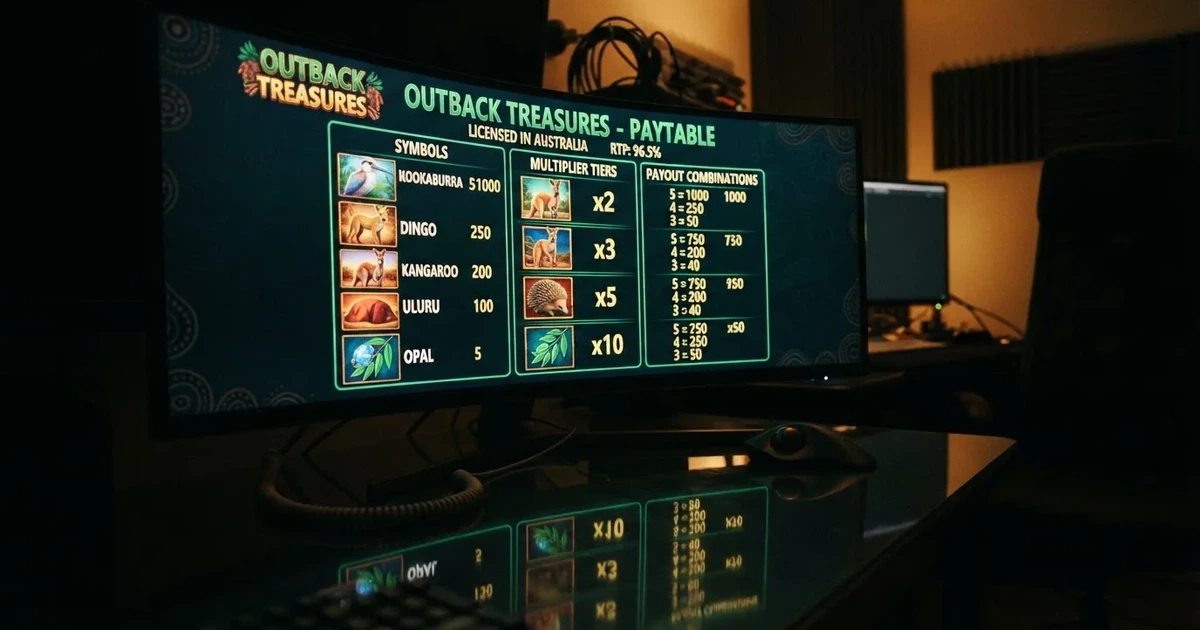
The 100 Free Spins No-Deposit Offer in Australia, and What It Actually Costs
The promise is simple enough to type into a search box and short enough to fit into a banner ad: one hundred free spins on online pokies, no deposit required. In Australia, that promise can only arrive from somewhere outside Australian law. No licensed product exists to hand out a hundred free spins on real-money online pokies the moment you sign up, and the free-spin features inside a pub pokie are a different mechanism entirely. What this page works through is the gap between the offer as advertised and the offer as it stands once you look past the marketing, the offshore operators the Australian Communications and Media Authority has actually moved against, the payments that decide whether a deposit can even leave an Australian bank account, and the arithmetic of how many spins “a hundred” actually is when a wagering requirement sits on top of it.

Current as of 4 November 2026 · Verified against the ACMA’s published list of formal warnings and blocking requests, the Interactive Gambling Act 2001 as amended, and current Westpac, ANZ and Commonwealth Bank gambling-block terms.
Table of Contents
- Payments and payout speed for the offer
- What a hundred free spins actually are, and what they cost
- The eleven operators the ACMA has actually moved against
- The Australian legal frame around the offer
- The responsible-gambling layer around the offer
- How many sites the ACMA has actually blocked
- What the page is for, and what it is not
- Frequently Asked Questions
Payments and payout speed for the offer
The offer is a hundred free spins, but the money side of it decides whether the offer is even reachable. Three pieces of Australian payments plumbing matter for anyone looking at this kind of promotion: the banks’ own gambling blocks, the credit-card ban that has applied to licensed Australian wagering since 2024, and the fact that the licensed deposit routes — debit card, bank transfer, PayID, Osko and BPAY — were built for licensed wagering, not for offshore casinos asking for a credit card or crypto.

Card-level gambling blocks from the major banks
Australian banks give customers a tool that is sharper than anything in the offer itself: a card-level block that refuses to authorise transactions registered under the merchant category code for betting and casino gambling. Westpac’s gambling block works at card level on eligible personal credit and debit cards, refusing authorisation of any transaction flagged with the “Betting/Casino Gambling” code. ANZ’s block, activated in the ANZ app, blocks gambling transactions made through a digital wallet such as Apple Pay on an eligible card, not just the physical card — a useful detail given that Apple Pay, Google Pay and Samsung Pay together carried roughly forty-five per cent of all Australian card payments by number at the end of 2025. Once a customer turns on ANZ’s block, removing it requires a 48-hour cooling-off period, and the bank warns that not all gambling transactions will be blocked and some non-gambling transactions might be blocked in error. Commonwealth Bank offers the same lever via its CommBank app and notes, in the same breath, that it cannot guarantee every gambling-related purchase will be stopped. Three banks, three app switches, three disclaimers. The block is blunt, the disclaimers are honest, and a player who has turned one on has taken the most concrete step the Australian retail-banking system offers to keep the deposit from leaving the account in the first place.
The 2024 credit-card ban and what it leaves open
Under the Interactive Gambling Act 2001 as amended in 2023, Australian-licensed online wagering services cannot accept payment by credit card or any other credit-related product. The change took effect on 11 June 2024, with penalties of up to A$247,500 for operators that breach it. The ban also constrains gambling use of linked digital wallets such as Apple Pay because the underlying funding source still has to clear the same test. Apple itself does not charge consumers for using Apple Pay in stores, online or in apps — any surcharge on a card payment comes from the merchant’s processing fees, not from Apple — and Apple states that transaction limits and PIN requirements for Apple Pay purchases are set by the card issuer or merchant, not by Apple itself. None of that loosens the credit-card ban. What it leaves open, for licensed wagering, is a debit card, a bank transfer, PayID, Osko or BPAY. An offshore site asking an Australian customer for a credit card or a crypto deposit is operating outside the Australian rules entirely — and that fact is the cleanest single indicator a reader has that the offer is not from a licensed product.
PayID, Osko and BPAY
PayID-based instant transfers are available at over a hundred Australian financial institutions. Paying to a PayID shows the name of the account holder before the transfer is sent, and Australian Payments Plus warns that being asked to transfer money to a PayID on an illegal gambling site almost certainly means a scam site. With Osko, a bank transfer between participating Australian banks arrives in under a minute, twenty-four hours a day including weekends, whether addressed to a BSB and account number or to a PayID. More than twenty-five million PayID identifiers had been registered on Australia’s New Payments Platform as of April 2025. BPAY is a bill-payment service in online banking: the payer enters the Biller Code and the Customer Reference Number printed on the bill, the service has operated since 18 November 1997, is available in the online banking of over a hundred and forty banks and financial institutions, and is offered by over ninety-five thousand businesses. These three systems are the spine of legitimate Australian consumer payments. They are also what an offshore casino cannot ask for and what the ACMA blocking regime cannot reach, because the money is leaving the customer’s bank through ordinary rails rather than being taken at the casino’s card-processing front door.
See also $100 no-deposit casino bonus in Australia in 2026.
What a hundred free spins actually are, and what they cost
The number on the banner — one hundred — does the work the offer is sold on. The arithmetic on the back of it does the work the offer is paid on. A wagering requirement is what separates the free-spin headline from the free-spin reality, and the language around it is where an honest reading of the offer has to start.
The shape of the standard offer
The shape, in the offshore market the search lands on, is straightforward: register an account, receive one hundred spins on a named pokie title at a fixed stake per spin, and play through the spins within a stated window. Any winnings from those spins normally land as bonus funds rather than as withdrawable cash, and a wagering requirement — expressed as a multiple of the bonus amount — has to be met before the bonus balance converts. A one-hundred-spin offer can carry a wagering requirement anywhere from modest to punishing; the exact figure, the eligible games, the maximum cashout and the time limit vary brand by brand and are the kind of detail a player should read before claiming. The Australian angle is not that the offer is unusually generous or unusually harsh; it is that the offer is being made from outside Australian law, with no Australian complaints body, no Australian consumer protection and no guarantee the site will still be reachable when the player comes to withdraw.
The arithmetic the offer hides
A wagering requirement is the multiplier that turns a hundred spins into a number a player has to work through. Suppose a player receives the bonus equivalent of A$20 from the spins and the offer carries a forty-times wagering requirement: the required turnover is A$20 multiplied by 40, which is A$800 of bets. At a stake of A$0.10 per spin, that is eight thousand spins. Played at a five-second interval per spin, eight thousand spins takes forty thousand seconds, which is roughly eleven hours of continuous play. Played across sessions with breaks, it is several evenings of pokie work for the chance to convert a bonus into cash. The point is not that any particular number is wrong; the point is that “a hundred free spins” is a front-end figure and the figure that decides whether the bonus is actually worth claiming sits behind it, in the wagering multiple and the stake-per-spin, and most readers never multiply them out. That is the cost the offer carries and the arithmetic the marketing language tends to leave out.
What the no-deposit label does not mean
“No deposit” means the casino does not ask the player to send money to claim the spins. It does not mean the spins are free in any deeper sense: the spins are free of a deposit, the winnings from the spins are not free of a wagering requirement, the maximum cashout is normally capped, and the bonus funds expire if the player does not meet the requirement inside the stated window. “No deposit” is the most legally precise phrase on the offer and also the most misleading — it tells the truth about the front-end transaction and the half-truth about everything that comes after.
The eleven operators the ACMA has actually moved against
This is not a ranking. None of these brands is being recommended as a place to play. Each is on this page because the Australian Communications and Media Authority itself issued a formal warning under the Interactive Gambling Act 2001 over the operator named, for offering prohibited interactive gambling services to people in Australia. Online casino games and online pokies cannot be licensed anywhere in Australia, whatever licence the brand displays in its footer; the brands are offshore by definition and the ACMA action is the public record of that.
RocketPlay
The ACMA issued a formal warning to Pulsup Ltd over RocketPlay in March 2026. An earlier warning had already gone to Dama N.V. in May 2022 covering six casino brands including Rocketplay. Two warnings, four years apart, on the same brand under two different operators: that is the kind of pattern that tells a reader the underlying offer keeps being repackaged under a new corporate wrapper. Public listings carry the brand as a casino operation; the subject-specific details a reader might want — wagering terms, eligible pokie titles, withdrawal times — come from those listings and from the brand’s own pages rather than from any Australian register. The brand fails the page’s own subject on the most basic count: a reader in Australia cannot reach a licensed version of it, because the licensed version does not exist.
Level Up Casino
The ACMA issued a formal warning to Dama N.V. in May 2022, with Level Up Casino named as one of six brands in the same action. A single warning, four years old at the time of writing, and the brand continues to surface in Australian-facing affiliate marketing. Public listings treat it as a standard offshore casino; subject-specific terms are not independently verifiable from any Australian source. A reader who has seen the banner ad and wants to know what the offer looks like in detail will find it described on listings pages, with the usual caveats about who is verifying the description. The ACMA action is the part of the record that is independently verifiable, and the ACMA action is the reason this brand is on a page about the offer rather than a page about the operators.
Woo Casino
The ACMA issued a formal warning to Dama N.V. over Woo Casino in March 2025. That is the second Dama N.V. warning on this page, the first having covered the May 2022 cluster, and it lands on the same operator rather than the same brand. Independent subject-specific detail — the wagering structure, the eligible games, the withdrawal queue — is not carried by any Australian source, so this entry stands on the ACMA record alone. The offer this brand makes, in the form a reader would see it, is not the basis on which it is being listed here; the basis is that an Australian regulator said, formally and on the record, that the brand was providing prohibited services to Australians.
Spirit Casino
The ACMA issued a formal warning to Dama N.V. over Spirit Casino in May 2025. Two months after Woo Casino, same operator, different brand. The pattern is the same as RocketPlay’s: an offshore operator absorbing formal warnings under its corporate name and continuing to run multiple brands across the Australian-facing market. No independent Australian source carries subject-specific terms for this brand, so the ACMA record is again the entire factual basis on which the brand appears here. The reader’s takeaway is not that this brand is uniquely bad; it is that the structure of the offshore market rewards spreading offers across many brand names, and the ACMA can only warn the operator rather than the marketing surface.
National Casino
The ACMA issued a formal warning to Consolutetish S.R.L. over National Casino in July 2025. Public Australian sources — including the ACMA’s own register, AUSTRAC’s threshold-transaction-report guidance and BetStop — reference National Casino as an entity the regulator has acted against, so the brand is verifiable from more than one angle. The subject-specific terms a reader might want are carried by affiliate listings rather than by any independent Australian measurement. The page’s own subject — a hundred free spins with no deposit — runs against this brand’s profile in the obvious way: a no-deposit offer assumes the player will eventually deposit to clear the wagering, and an Australian customer reaching for a credit card or crypto to make that deposit is already outside the 2024 rules.
Bizzo Casino
The ACMA issued a formal warning to Consolutetish S.R.L. over Bizzo Casino in July 2025 — the same action, the same operator, the same month as National Casino. Bizzo had already been the subject of a 2022 formal warning to TechSolutions (CY) Group Limited and TechSolutions Group N.V., so the brand carries two warnings under two different operators across three years. Public listings carry the brand as an offshore casino operation; the subject-specific detail is again the listings’ own. The repetition is the point: the ACMA warns the operator at the corporate level, the operator continues under a new wrapper, the marketing reappears, and the brand a reader types into a search box may have a formal warning attached to it that the marketing surface will not show.
Ignition Casino
The ACMA issued a formal warning to Bamboo Media over Ignition Casino in July 2025. Single warning, single operator, fresh on the record. Independent Australian sources carry no subject-specific terms for this brand. The brand is on this page because the ACMA said it was offering prohibited services to Australians; the offer itself is described in the marketing the regulator warned against, and the offer is not endorsed, rated or summarised here.
Instant Casino
The ACMA issued a formal warning to EOD Code SRL over Instant Casino in February 2025. Public sources including ecoPayz’s own merchant directory and PayID guidance carry this brand as an entity the Australian payments system has had reason to flag, which is a slightly unusual form of verification — the brand surfaces not because an Australian casino reviewer endorsed it but because payment-system participants and the regulator have had cause to name it. The subject-specific terms for any spin offer this brand might extend are not independently verifiable from any Australian source, and they are not asserted here.
Jackbit
The ACMA issued a formal warning to Ryker B.V. over Jackbit and CasinOK in April 2026 — a single warning covering two brands under the same operator. No independent Australian source carries subject-specific terms for Jackbit, and the brand is on this page solely on the basis of the ACMA’s published formal warning. Jackbit’s typical offer structure in the offshore market has tended to emphasise crypto rails, and a crypto-led offer is, in the Australian context, the clearest possible signal that the site is operating outside the rules that bind licensed wagering. The reader does not need to verify the crypto angle: the ACMA record already places the brand offshore, and the offer type confirms it.
Casino Intense
The ACMA issued a formal warning to Sterplay Holding Ltd over Casino Intense in April 2025. Public Australian sources including AUSTRAC’s threshold-transaction-report guidance, BetStop and affiliate listings reference the brand in the same breath as other ACMA-warned operators, which gives the entry a slightly broader evidentiary footprint than some of the others on this page. The subject-specific terms for any hundred-spin offer are not independently verifiable from any Australian source. The brand is here because the regulator named it, and that is enough.
Sky Crown
The ACMA issued a formal warning to Hollycorn N.V. over Sky Crown and Blue Leo casino services, with the formal warning on the record in September 2022. The warning is older than most on this page and the brand has had four years to reshape its presence in the market; the ACMA action, however, is a matter of public record and does not expire. Independent Australian sources carry no subject-specific terms for this brand. The brand appears here on the ACMA record alone, and a reader who sees it advertised today is looking at a brand whose formal warning is still on the regulator’s published list.
What the table makes of the eleven
The eleven brands sit on a single axis: every one of them has had a formal warning issued over it by the ACMA for offering prohibited interactive gambling services to Australians. The dates run from May 2022 to April 2026. The operators behind the brands change names more often than the brands do — Dama N.V. alone accounts for four of the eleven — and the Australian reader’s situation does not change with the rename. A licensed local version of any of these brands does not exist, because no Australian licence exists for the product they sell.
| Brand | ACMA action and date | Operator named by the ACMA | Subject support |
|---|---|---|---|
| RocketPlay | Formal warning, March 2026; earlier May 2022 | Pulsup Ltd (2026); Dama N.V. (2022) | Casino listings only |
| Level Up Casino | Formal warning, May 2022 | Dama N.V. | Casino listings only |
| Woo Casino | Formal warning, March 2025 | Dama N.V. | — |
| Spirit Casino | Formal warning, May 2025 | Dama N.V. | — |
| National Casino | Formal warning, July 2025 | Consolutetish S.R.L. | ACMA register, AUSTRAC, BetStop |
| Bizzo Casino | Formal warning, July 2025; earlier 2022 | Consolutetish S.R.L. (2025); TechSolutions (2022) | Casino listings only |
| Ignition Casino | Formal warning, July 2025 | Bamboo Media | — |
| Instant Casino | Formal warning, February 2025 | EOD Code SRL | ecoPayz directory, PayID guidance |
| Jackbit | Formal warning, April 2026 | Ryker B.V. | — |
| Casino Intense | Formal warning, April 2025 | Sterplay Holding Ltd | AUSTRAC, BetStop, casino listings |
| Sky Crown | Formal warning, September 2022 | Hollycorn N.V. | — |
The Australian legal frame around the offer
The Interactive Gambling Act 2001, strengthened by the Interactive Gambling Amendment Act 2017, makes it an offence to provide online casino games, online pokies or in-play betting to a person physically in Australia. No state or territory issues a licence for those products. What is licensable is wagering on races and sport placed before the event, lotteries and keno — in practice licensed by the Northern Territory. The Northern Territory Racing and Wagering Commission regulates fifty-two of Australia’s online bookmakers, including Sportsbet, Bet365 and Ladbrokes, and the commission has no full-time staff and meets once a month in Darwin. That is the regulator that licences the legal side of Australian online gambling, and it does not licence what this page is about.
How the ACMA enforces it
The ACMA investigates complaints, issues formal warnings and directs Australian internet service providers to block illegal sites. The individual player is not prosecuted — the IGA targets the provider, not the customer — but the customer dealing with an offshore site has no Australian consumer protection, no Australian complaints body and no Australian recourse if a withdrawal is refused. The site can be blocked by an ISP directive while a balance is still on the account. According to the ACMA as reported in June 2026, a total of 1,751 illegal gambling and affiliate marketing websites had been blocked since the first blocking request in November 2019, and more than two hundred and thirty unlicensed gambling services had left the Australian market since enforcement was strengthened in 2017. In a round reported on 26 June 2026 the ACMA asked Australian internet service providers to block twelve more illegal gambling websites: 7Signs, ChromaBet, Donbet, Duospin, Freshbet, Slots Gem, Jacks Club, Lucky Start, Pointsbetz, Spinrise, Vinyl Casino and Wildsino. That is what enforcement looks like in practice: a continuously-growing blocked list, a steadily-growing number of warnings, and the operators who have not yet been blocked still being targeted by name.
What is licensed and what is not
The licensed side of Australian online gambling is wagering, lotteries and keno. The prohibited side is online casino games, online pokies and in-play betting. A no-deposit free-spins offer on real-money online pokies sits squarely on the prohibited side. That is the legal ground the offer is being made from, and it is also why the offer’s terms are not policed by an Australian regulator — there is no Australian regulator for the product to answer to. The customer is, in effect, dealing with an offshore operator on the operator’s own terms, with no Australian backstop if those terms are breached.
The 2026 reform
The Interactive Gambling Amendment (Gambling Reform) Bill 2026 passed Parliament on 19 August 2026, with its advertising and inducement measures commencing on 1 January 2027. That is law with a start date, not yet in force on a 2026 page. The reform’s target is the inducement layer that drives offers like this one into Australian-facing marketing; the inducement itself, on the date this page is read, is being pushed by operators the ACMA has warned but not yet stopped. The reform closes one part of the gap; the ACMA’s blocking regime closes another; the underlying prohibition has been in place since 2001 and was strengthened in 2017. The legal frame around the offer has been narrowing for nearly a decade, and the narrowing has not yet run out of room.
Tax
Gambling winnings of a recreational player are not assessable income under section 6-5 of the ITAA 1997 and losses are not deductible, unless the person carries on a business of gambling. That is the model only, and the ATO is the body to check with. The tax side of an offshore free-spins win, however, is the smaller of the player’s problems: the bigger problem is the absence of an Australian complaints body and the prospect of a withdrawal being refused by an offshore operator that has already been told by the ACMA to stop serving Australian customers.
The 100 Free Spins No-Deposit Offer in Australia, and What It Actually… — More on this topic at casino payout.
The responsible-gambling layer around the offer
The offer sits on a regulated prohibition and on a marketing layer that is about to be further restricted, and it is the kind of offer that benefits from being looked at before it is claimed. Three Australian tools sit between a reader and the offer, and a fourth sits offshore and does not apply.
BetStop and what it does and does not cover
BetStop, the National Self-Exclusion Register, has been live since August 2023. It binds Australian-licensed online and phone wagering services — that is, the licensed bookmakers, not the offshore casinos. A person registered with BetStop is excluded from licensed Australian wagering across every operator connected to the register. An offshore casino is not connected to BetStop. Self-excluding through BetStop does not stop a deposit leaving an Australian bank account for an offshore casino; the bank-level gambling block is the sharper tool for that case, and it is voluntary.
The gambling block at the bank
The bank-level block is sharper than BetStop for an offshore casino because it operates at the point of payment. Westpac refuses authorisation at the merchant-code level, ANZ blocks both card and Apple Pay transactions and requires a 48-hour cooling-off to undo, and Commonwealth Bank’s app lock does the same job with the same disclaimer that not every gambling transaction will be stopped. Three banks, three switches, three honest disclaimers. The block is the most concrete step the Australian retail-banking system offers to keep an offshore casino deposit from leaving an account in the first place.
Help that is actually reachable
The National Gambling Helpline is 1800 858 858, free, twenty-four hours a day, with chat available through Gambling Help Online. If thinking about a no-deposit free-spins offer ever starts to feel compulsive or stressful, the line is there, the chat is there, and the help is confidential. The existence of the offer is not, on its own, a problem; the offer being made from outside Australian law, with no Australian complaints body behind it, makes it the kind of offer a player should look at twice before claiming, and the helpline is one of the places a reader can ask the questions the offer’s marketing is not going to answer.
What the responsible-gambling layer does not do
The responsible-gambling layer around the offer does not turn the offer into a licensed one. BetStop does not connect to offshore casinos, the bank block does not stop every gambling transaction, and the helpline does not negotiate a withdrawal with an offshore operator. What the layer does is give a reader the tools to decide, before claiming, whether the offer is one they want to be in. For a reader who has decided the offer is not one they want to be in, the bank block and the helpline are the next steps. For a reader who has decided it is, the legal frame around the offer is the part of the page to read first.
How many sites the ACMA has actually blocked
The arithmetic the page owes the reader is the scale of the gap the offer is being made into. The inputs are the running total of blocked sites, the date of the first blocking request and the current count as reported by the ACMA. The first blocking request went out in November 2019. By June 2026, the ACMA had asked Australian ISPs to block 1,751 illegal gambling and affiliate marketing websites since that first request. The single round reported on 26 June 2026 added twelve more: 7Signs, ChromaBet, Donbet, Duospin, Freshbet, Slots Gem, Jacks Club, Lucky Start, Pointsbetz, Spinrise, Vinyl Casino and Wildsino. Across more than two hundred and thirty unlicensed gambling services, the market has shed operators since enforcement was strengthened in 2017.

The blocking rate, taken over the roughly six-and-a-half-year window from November 2019 to June 2026, sits in the band of around twenty-five to twenty-eight blocked sites per month on average across the full period — and at a substantially higher monthly pace in the most recent reporting rounds as the ACMA has expanded the list of providers it instructs ISPs to block. The headline number, 1,751, is a cumulative total; the rate that produces it has not been steady. A reader who wants to know whether enforcement is biting should look at the pace of new blocks per reporting round rather than at the running total, and the recent rounds show a pace that is, if anything, accelerating as the ACMA’s list of named operators and named brands grows.
What the page is for, and what it is not
This page works through the gap between the offer as advertised and the offer as it stands once a reader looks past the marketing. The offer is real as a marketing surface; it is not real as a licensed Australian product, because no licensed product exists to make it. The offshore operators who do make it have been warned, by name, by the ACMA, and the warnings are a matter of public record. The payments that decide whether a deposit can leave an Australian account are blunt, and the bluntness is increasing: a card-level block at the major banks, a credit-card ban for licensed wagering since 11 June 2024, and an inducement reform coming into force on 1 January 2027. None of that makes the offer unavailable; all of it makes the offer less reachable than the banner ad suggests.
The arithmetic the page owes the reader is the wagering calculation, the blocking rate and the bank-block mechanic. The arithmetic the page does not owe the reader is any specific operator’s win probability — the ACMA record is the public part of the picture, the marketing is the rest, and the rest is what a player should read before claiming.
Frequently Asked Questions
Can a licensed Australian site legally hand out one hundred free spins with no deposit?
No. The Interactive Gambling Act 2001, as amended, prohibits the supply of online casino games and online pokies to anyone in Australia, and no state or territory issues a licence for those products. What is licensable is wagering on races and sport before the event, lotteries and keno. A no-deposit free-spins offer on real-money online pokies can only come from an offshore operator, and offshore operators fall outside the Australian rules on every other front: no Australian complaints body, no Australian consumer protection, no Australian recourse if a withdrawal is refused.
How would one hundred free spins on an offshore pokies site actually be paid out?
The spins are normally played at a fixed stake on a named pokie title. Any winnings land as bonus funds rather than as withdrawable cash, and a wagering requirement — a multiplier of the bonus amount — has to be met before the balance converts. The exact figure, the eligible games, the maximum cashout and the time limit vary brand by brand. The Australian reader’s situation does not change with the brand: the offshore operator has already been told by the ACMA to stop serving Australian customers, and the deposit route — bank transfer, PayID, Osko, BPAY or debit card — is being monitored at the bank level by a gambling block the customer can switch on.
What wagering requirement usually applies before one hundred free spins can be cashed out?
The standard offshore market runs from modest to punishing. The figure that matters is the multiplier applied to the bonus amount won from the spins, multiplied by the stake per spin, divided into the total number of spins the player is willing to play through. A 40x requirement on a bonus of A$20, at A$0.10 per spin, requires A$800 of bets and roughly eight thousand spins — about eleven hours of continuous play at a five-second interval per spin. The reader who has not multiplied those three figures out has read only the front of the offer.
Is a no-deposit free-spins offer the same thing as the free-spin feature inside a pub pokie?
No. The free-spin feature inside a pub pokie is a bonus round inside the game itself, triggered by in-game symbols, paid out by the machine and governed by the state or territory’s gaming-machine regulations. A no-deposit free-spins offer on an offshore site is a marketing inducement attached to a sign-up, played for bonus funds subject to a wagering requirement, on a site that is providing prohibited services to Australians. The two share a name and nothing else.
Why do so many offshore sites promote one hundred free spins specifically to Australians?
Because Australians are a known and reachable audience for offshore operators, the offer type is the easiest inducement to A/B test in a banner ad, and the inducement layer is the part of the marketing the ACMA can warn against but cannot, in 2026, yet prohibit. The Interactive Gambling Amendment (Gambling Reform) Bill 2026 passed Parliament on 19 August 2026 and its advertising and inducement measures commence on 1 January 2027 — law with a start date, not yet in force on this page. The promotional volume is high because the inducement rules are still being tightened, and the tightening is not yet in force.
Are free-spin no-deposit offers covered by the Interactive Gambling Act 2001?
The Interactive Gambling Act 2001 covers the supply of prohibited interactive gambling services — including online casino games and online pokies — to people in Australia. A free-spin no-deposit offer is a marketing layer on top of a prohibited service; the service itself is what the IGA prohibits, and the inducement to use it is what the 2026 reform is set to restrict further from 1 January 2027. The page’s subject is, in legal terms, a marketing layer on top of a service no Australian is supposed to be supplied with.