

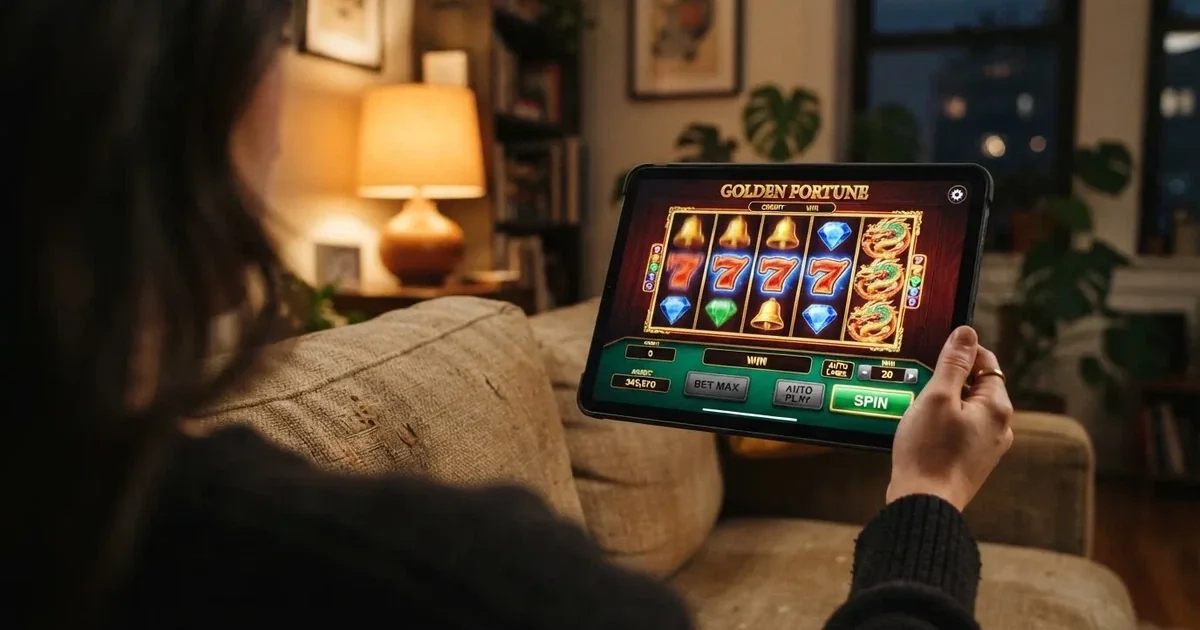
iPad casinos in Australia 2026: what a tablet does not change about the offer
25 September 2026 — operator and licence claims cross-checked against the ACMA register of formal warnings under the Interactive Gambling Act 2001.

The screen on the device is the smallest variable in the equation. A casino that cannot lawfully accept an Australian on a desktop monitor is in the same position with the same player holding an iPad, and the marketing does not say so because the marketing is paid to convert a tap, not to explain a prohibition. This page reads what an iPad casino actually offers a player in Australia in 2026 — the touchscreen mechanics, the no-deposit bonus shape, the bitcoin payment, the Apple Pay workaround, the bank block sitting behind all of it — and sets each one against the law that the offer itself never names. The cost, where there is one, is what the rest of the page is for.
Table of Contents
- The payments shape: cards, wallets and the bank block that runs underneath
- The touchscreen shape: why the casino is almost always a browser tab
- The offers: how a no-deposit bonus actually works on an iPad
- The blocking rate: how fast the ACMA clears the field
- Legality: the part the offer never prints
- The screen and the wallet: responsible play on a tablet
- The market behind the offer: what the ACMA has named
- RocketPlay
- Level Up Casino
- Woo Casino
- Spirit Casino
- National Casino
- Bizzo Casino
- Ignition Casino
- Instant Casino
- Jackbit
- Casino Intense
- Sky Crown
- What the offers actually cost: running the arithmetic on a no-deposit bonus
- The page’s verdict
- Frequently asked questions
The payments shape: cards, wallets and the bank block that runs underneath
A player who tries to fund an offshore casino from an Australian bank runs into the same obstacle whichever device they hold, and the iPad path is just the one with the friendlier on-screen keypad. Three layers determine whether the deposit lands at all, and only one of them is on the casino’s own site.
The first layer is the bank’s gambling block. Westpac refuses authorisation of transactions registered under the merchant category code for betting and casino gambling on eligible personal credit and debit cards, and ANZ’s gambling block, set in the ANZ app, also blocks digital-wallet transactions on an eligible card — Apple Pay included. Commonwealth Bank’s gambling lock sits inside the CommBank app and does the same job, with the same caveat the ANZ page prints in plain type: not every gambling-related purchase is stopped, and the occasional non-gambling one will be. The bank is refusing the transaction at the card network, before the casino ever sees it, so a deposit that fails on an iPad usually fails because of a setting the player applied themselves, not a bug in the casino’s cashier.
The second layer is the card-network ban. Under the Interactive Gambling Act 2001 as amended in 2023, Australian-licensed online wagering services cannot accept payment by credit card or other credit-related products, a restriction that constrains gambling use of linked digital wallets like Apple Pay. Apple does not charge consumers to use Apple Pay — any surcharge that turns up at the cashier is the merchant’s processing fee, not Apple’s, and Apple does not set the transaction limits and PIN requirements on Apple Pay purchases; the card issuer or the merchant does. By the end of 2025 Apple Pay, Google Pay and Samsung Pay collectively accounted for around 45 per cent of all card payments in Australia by number, which means a wallet tap is no longer exotic enough to surprise a card issuer’s fraud system. A credit-funded wallet tap on a gambling merchant is exactly the kind of transaction the ban was written to catch.
The third layer is the bank transfer. With Osko, a bank transfer between participating Australian banks arrives in under a minute, twenty-four hours a day including weekends, whether it is addressed to a BSB and account number or to a PayID, and PayID is live at over one hundred Australian financial institutions. Paying to a PayID shows the name on the receiving account before the transfer is sent, and the operator of PayID warns in plain language that being asked to transfer to a PayID on an illegal gambling site almost certainly means a scam site. More than twenty-five million PayID identifiers had been registered on Australia’s New Payments Platform as of April 2025, and participants must keep the platform’s monthly outages to no more than two minutes — the rail underneath the PayID is engineered to be available precisely when the player is not. BPAY, the older bill-payment service in online banking, runs on the same Australian Payments Plus umbrella and works the way it has since 1997: the payer enters the Biller Code and the Customer Reference Number from the bill. None of this is exotic; the question is what the player is sending money to, and on that the page is not neutral.
The honest reading is that the bank block is doing more enforcement than the regulator alone can. The Australian Communications and Media Authority can ask internet service providers to block a site, and the cumulative count it reported in June 2026 was 1,751 illegal gambling and affiliate marketing websites blocked since the first blocking request in November 2019. The bank block does something different: it refuses the transaction at the moment the player tries to make it, which is the moment marketing is hardest at work. A deposit that fails because of a bank block is a quiet outcome; a site that gets blocked by an ISP is a public one. The same prohibition underwrites both, and neither is going away.
AUSTRAC’s threshold-transaction-report rule, which requires reporting of transfers of A$10,000 or more, applies only to physical cash, so a large electronic bank transfer does not by itself trip a report. That detail belongs to anyone who assumes a single big transfer will draw attention to the destination; the report does not work that way, but the bank block still does.
The touchscreen shape: why the casino is almost always a browser tab
The iPad casino that runs as a downloadable app from the App Store is, in the Australian market, the one that does not exist. Apple restricts real-money casino apps from its store, so the typical iPad casino site is a responsive browser tab dressed up to look like an app: a touch-friendly layout that fills the screen, thumb-reachable menus, portrait and landscape both, with the cashier pinned to the bottom of the viewport because that is where the player’s thumb sits.
That layout choice is doing the conversion work, and it works because the device is doing the persuasion. A casino loaded on a desktop monitor sits on a desk; a casino loaded on an iPad sits in the hand, on the couch, in the queue at the school pickup, in the gap between meetings — in places where the player is not in the posture of having decided to play. The games are the same games the desktop site serves, because the games are served from the same provider back end, but the framing is different. Touchscreen play is faster than mouse play because the gestures are faster, and the absence of a deliberate input device erases the small mechanical pause that a click inserts between the impulse and the wager. None of that is hidden; it is just the format.
A dedicated casino app would in theory load faster and remember a session, and on Android that is exactly what the bigger brands do. On iPad in Australia, the same brand is almost always a web app pinned to the home screen rather than a native binary, and the player should know that the absence of an App Store listing is not the casino’s modesty. It is Apple’s policy.
The offers: how a no-deposit bonus actually works on an iPad
The offers that appear in this market — a no-deposit bonus, a bitcoin-funded welcome, a free-spins pack — share the same arithmetic on a tablet as on a desktop. A no-deposit bonus is a small credit the casino gives the player without a deposit, and the credit is given on the understanding that the player will run it through the wagering requirement a stated multiple of times before any of it can be withdrawn. The “no deposit” in the offer name is a description of the entry condition, not the exit condition; the player deposits nothing and is given the bonus, and the bonus sits in a balance that is not the player’s cash until the wagering is complete.
A no-deposit bonus on an iPad is settled in the same review queue as a no-deposit bonus on a desktop. The casino runs the same anti-fraud checks, the same identity verification when the player finally asks to withdraw, and applies the same maximum-cashout cap that almost every no-deposit bonus carries. The cap is the clause that bites hardest in this market: the bonus might be modest, the wagering might be ordinary, and the maximum that can be withdrawn from bonus play might be a few hundred dollars at the outside. A player who runs the bonus into a larger balance and then tries to withdraw the larger balance is told, at the cashier, that the larger balance is not withdrawable. The casino’s terms state this in the small print, and the small print is the only place the cap appears.
The conditions to read before signing up, on any device, are four. First, the wagering multiple — the number of times the bonus must be wagered before withdrawal. Second, the maximum cashout from bonus play. Third, the list of games that count toward the wagering, because table games and live-dealer games usually count at a reduced rate or not at all. Fourth, the time limit inside which the wagering must be completed, because an unused bonus expires.
The bitcoin-funded iPad casino is the same shape, only paid in bitcoin. Bitcoin is not a special licence from the Australian regulator; it is a payment method on a site that is, in the Australian market, an offshore site. A Bitcoin deposit does not get the player past the Interactive Gambling Act 2001, and the bank block does not apply because the funds are not leaving an Australian account in the first place — they are leaving a wallet. The casino’s own conversion rate applies at the moment of deposit, and again at the moment of withdrawal, and the difference between the two is a fee the player is paying. The volatility is the player’s, not the casino’s: a Bitcoin balance worth A$200 at deposit may be worth A$180 at withdrawal twenty minutes later, with no wagering to explain the gap. None of this is hidden; it is just the medium.
The promise that breaks most often on an iPad no-deposit offer is the implied “free”. The bonus is free to claim and free to play; it is not free to withdraw. The arithmetic the marketing never prints is the one that turns a small bonus into a small payout, and the page below runs it.
The blocking rate: how fast the ACMA clears the field
In June 2026 the Australian Communications and Media Authority asked Australian internet service providers to block a further twelve illegal gambling websites — 7Signs, ChromaBet, Donbet, Duospin, Freshbet, Slots Gem, Jacks Club, Lucky Start, Pointsbetz.com, Spinrise, Vinyl Casino and Wildsino. That round brought the running total of blocked sites to 1,751 since the first blocking request in November 2019, which is the figure the authority itself reports.
A blocking rate is just a count divided by a span of time. The span runs from November 2019 to June 2026, which is roughly seven and a half years, or about ninety months. One thousand seven hundred and fifty-one blocked sites across ninety months works out at roughly nineteen to twenty sites a month on average — and that is the floor of what enforcement has done, not the ceiling. The June round alone removed a further twelve; earlier rounds removed more. The honest reading is that the regulator is clearing the field at a steady clip and the field keeps filling back up.
The same June round carried the cumulative figure for unlicensed services that have left the Australian market since 2017: more than two hundred and thirty. That is a separate count from the blocked sites — a service can be blocked, can leave voluntarily, or can be wound up by the operator after a warning — and the two numbers add up to a market that the regulator has been steadily shrinking for almost a decade. None of this is a guarantee for next month. It is a pattern.
The rate is the regulator’s, not the player’s. A player who waits for the next blocking round is waiting for the regulator’s timing, and the casino’s timing is the cashier’s. The arithmetic is informational: it tells the reader that prohibition is enforced on a cadence, not as a one-off.
Legality: the part the offer never prints
Online casino is prohibited in Australia. The Interactive Gambling Act 2001, strengthened by the Interactive Gambling Amendment Act 2017, makes it an offence to provide online casino games, online pokies or in-play betting to a person in Australia; no state or territory licences them. What is licensable is wagering on races and sport placed before the event, lotteries and keno — in practice licensed by the Northern Territory, where the Racing and Wagering Commission oversees fifty-two of Australia’s online bookmakers, including Sportsbet, Bet365 and Ladbrokes, and meets once a month in Darwin with no full-time staff. The minimum age is eighteen.
The individual player is not prosecuted — the Act targets the provider. What the player gives up by playing offshore is the consumer protection an Australian licence would have carried: a complaints body, a regulator to escalate to, and a withdrawal dispute process that ends somewhere. An offshore site gives none of those. If the cashier refuses a withdrawal, the player has no Australian address to write to, and a site that gets blocked by an internet service provider takes the player’s balance with it.
BetStop, the National Self-Exclusion Register, has been live since August 2023 and binds only Australian-licensed online and phone wagering services. An offshore casino is not connected to it. A player who has registered with BetStop and then opens an offshore account from the same iPad has not self-excluded from that account. The National Gambling Helpline, 1800 858 858, is free and runs twenty-four hours a day, with chat at Gambling Help Online.
A statutory reform is in train. The Interactive Gambling Amendment (Gambling Reform) Bill 2026 passed Parliament on 19 August 2026; its advertising and inducement measures commence on 1 January 2027, which makes the law law with a start date rather than law in force on a 2026 page. A reader acting now is acting under the rule that existed before the amendment, and the amendment is a tightening of that rule, not a softening.
A licence the site displays is not the licence the player needs. Offshore licences from Curaçao, from Malta, from the Isle of Man, from Kahnawake — none of them authorise the site to take an Australian on a casino game. The licence the site shows is a permission to operate in the jurisdiction that issued it; the licence to take an Australian on an online pokie does not exist. The site that quotes a Curaçao number and accepts AUD is not licensed in Australia for the product it is selling.
The screen and the wallet: responsible play on a tablet
A fixed time limit is the cheapest responsible-gaming tool on an iPad, and the one the device is designed to make hardest. The games run in a browser tab with no closing chime, no session counter, no haptic warning when an hour has passed — the player’s wrist does the timing. A session that begins with an intent to play for thirty minutes and ends an hour later is a session the device did not stop, and the device was not asked to.
The same prohibition that makes offshore play unlawful also makes the player-protection machinery inaccessible. BetStop is for licensed Australian wagering; an offshore casino is not on it. A player who has registered with BetStop and is playing on an offshore site has registered for half the market. The other half has no register, no exclusions, no deposit limits a third party will enforce.
A bank block is the closest thing the Australian player has to a hard limit on offshore play from a card account, and the closer the block sits to the moment of deposit, the better it works. ANZ’s block takes forty-eight hours to remove once switched on, which makes it harder to undo in the heat of the moment; the Westpac block works at the merchant category code level and does not need to be set in the same app the deposit is initiated from. A player who has not yet set a block is one setting away from one.
The dollar amount is the more useful limit, on an iPad, because the device’s screen makes the player feel further from the money than a desktop monitor does. A bank statement on a phone shows the loss in dollars; a casino balance on an iPad shows it in chips. The translation is the player’s job, and the page does not pretend otherwise.
The market behind the offer: what the ACMA has named
The brands reviewed below are not a ranking and not a recommendation. Each is on the page because the Australian Communications and Media Authority has issued a formal warning over it under the Interactive Gambling Act 2001 for offering prohibited services to Australians. The licence the site displays is not the licence the player needs, and the only reading of the list that the page endorses is the one a regulator has already published.
The shape of enforcement tells its own story. Dama N.V. was warned in May 2022 over six brands — Bambet, Dazard, Level Up, Rocketplay, Wild Tornado and Cobra Casinos — then warned again in March 2026 over Woo Casino and in May 2026 over Spirit Casino, which is two more rounds of correspondence from the same operator address. Consolutetish S.R.L. was warned in July 2026 over National Casino and Bizzo Casino; Bizzo Casino had already been the subject of a 2022 formal warning to TechSolutions (CY) Group Limited and TechSolutions Group N.V., so the second warning is the second operator name attached to the same brand. Bamboo Media was warned over Ignition Casino in July 2026. EOD Code SRL was warned over Instant Casino in February 2026. Ryker B.V. was warned over Jackbit and CasinOK in April 2026. Sterplay Holding Ltd was warned over Casino Intense in April 2026. Hollycorn N.V. was warned over Sky Crown and Blue Leo in September 2022.
The pattern is the page’s content. A brand that changes hands keeps its name; a name that persists keeps its regulator file; the regulator file keeps the warning that the marketing does not.
| Brand | ACMA action and date | Operator named by the ACMA | Subject support |
|---|---|---|---|
| RocketPlay | Formal warning under the Interactive Gambling Act 2001 | Pulsup Ltd (Rocketplay.com.au), March 2026; earlier Dama N.V., May 2022 | listings-only |
| Level Up Casino | Formal warning under the Interactive Gambling Act 2001 | Dama N.V., May 2022 | listings-only |
| Woo Casino | Formal warning under the Interactive Gambling Act 2001 | Dama N.V., March 2026 | — |
| Spirit Casino | Formal warning under the Interactive Gambling Act 2001 | Dama N.V., May 2026 | — |
| National Casino | Formal warning under the Interactive Gambling Act 2001 | Consolutetish S.R.L., July 2026 | listings-only |
| Bizzo Casino | Formal warning under the Interactive Gambling Act 2001 | Consolutetish S.R.L., July 2026; earlier TechSolutions, 2022 | listings-only |
| Ignition Casino | Formal warning under the Interactive Gambling Act 2001 | Bamboo Media, July 2026 | — |
| Instant Casino | Formal warning under the Interactive Gambling Act 2001 | EOD Code SRL, February 2026 | listings-only |
| Jackbit | Formal warning under the Interactive Gambling Act 2001 | Ryker B.V., April 2026 | — |
| Casino Intense | Formal warning under the Interactive Gambling Act 2001 | Sterplay Holding Ltd, April 2026 | listings-only |
| Sky Crown | Formal warning under the Interactive Gambling Act 2001 | Hollycorn N.V., September 2022 | — |
The “Subject support” column records what public listings report about the operator’s payment or wallet coverage as the listings describe it, not what the operator itself claims. A dash in that column means no such listing was returned; the brand is presented on its ACMA record and on no other strength. A “listings-only” entry means the only sources for the brand’s coverage are third-party listings pages, which the page cites as listings and does not adopt as the operator’s own statement.
RocketPlay
The brand has two formal warnings attached to it from the Australian regulator: the most recent, in March 2026, names Pulsup Ltd as the operator of Rocketplay.com.au; an earlier one in May 2022 named Dama N.V., which means the regulator has corresponded with two different operator entities about the same Australian-facing brand in four years. The site is offshore. The bonus terms that an affiliate page prints are affiliate-page terms; the only source the page relies on is the ACMA’s own publication.
RocketPlay appears here because the ACMA has issued a formal warning against it, not as a recommendation. Our assessment is that a brand with two regulator files attached has faced two rounds of enforcement, and a player checking the ACMA’s record has more reliable information than the operator’s own site.
Level Up Casino
The May 2022 formal warning names Dama N.V. as the operator. Dama N.V. is the operator name that recurs across more than one warning in this set — Woo Casino, Spirit Casino and the six brands warned about in May 2022 — which is the regulator’s way of saying the operator entity has been written to more than once about more than one Australian-facing brand. A warning is not a finding of guilt; it is a regulator telling the operator that the conduct complained of has been identified and that further conduct of the same kind will be acted on.
Level Up is included because the regulator has flagged it. We note that this brand is named in a formal warning under the Interactive Gambling Act 2001, on an operator entity that the regulator has contacted multiple times regarding several Australian-facing brands.
Woo Casino
Woo Casino was the subject of a formal warning to Dama N.V. in March 2026. This is the second time the regulator has written to Dama N.V. about a brand in this set, following the May 2022 warning covering six other brands. The site lacks Australian authorisation, and its stated licence is invalid for the Australian market. Affiliate marketing materials are not a replacement for official ACMA records.
The verdict the page offers on Woo Casino is the same verdict the regulator’s record carries: a brand the regulator has written to the operator about, on a date that is on the regulator’s website. The third-party listings the page consulted returned nothing the page can stand behind, so the brand is presented on the regulator file alone.
Spirit Casino
Spirit Casino was named in a formal warning to Dama N.V. in May 2026, two months after the same operator was warned over Woo Casino. The pair of warnings within a quarter is a regulator working through a single operator entity across the brands that operator runs. None of this is hidden; it is on the ACMA’s website, in the warning the regulator publishes, in the date it carries.
Spirit Casino is on the page for the same reason the others are. The verdict the page offers is the page’s own reading of the regulator file: a brand named in a formal warning in May 2026, on an operator the regulator had already written to that same calendar year. A player who values the regulator’s record over the operator’s marketing will already know what to do with that information.
National Casino
National Casino was the subject of a formal warning to Consolutetish S.R.L. in July 2026. The same operator was warned about Bizzo Casino in the same round, and the warning is published on the ACMA website. The brand does not hold Australian authorisation for its games. Third-party listings refer to this brand, but these mentions do not equate to a recommendation or verified service coverage.
National Casino is included because the ACMA has flagged it. Our view is that a brand named in a July 2026 formal warning is one that the regulator was actively investigating within the last year, and the regulator’s publication is the definitive record we rely on.
Bizzo Casino
Bizzo Casino has two warnings attached to it. The first, in 2022, was issued to TechSolutions (CY) Group Limited and TechSolutions Group N.V. The second, in July 2026, was issued to Consolutetish S.R.L. Two operator names across three years means the brand has changed hands at least once at the operator level, and the regulator has written to both. The page records both because the brand persists through the change.
Bizzo is the cleanest illustration on this page of why the regulator file matters: a player who only knew the brand name would not know which operator entity was running it in 2026, and the regulator’s own publication is the one that says. The verdict the page offers is the same one the regulator’s record carries — a brand with two operator names attached, two formal warnings attached, and no Australian licence for the product on offer.
Ignition Casino
Ignition Casino was named in a formal warning to Bamboo Media in July 2026. Bamboo Media is the operator associated with this brand in the regulator’s publication. This brand does not hold Australian authorisation, and its stated licence is not valid for Australian players. No third-party data on service support could be verified.
Ignition is included because the ACMA has flagged it. Our assessment is based on the single formal warning linked to the operator name in July 2026. Readers seeking further detail can review the warning published directly by the regulator, which is the primary source for this entry.
Instant Casino
Instant Casino was the subject of a formal warning to EOD Code SRL in February 2026. The brand does not hold Australian authorisation for its games. While some payment-method listings mention this brand, these are simply records of where the name appears, not an endorsement of the service by the operator itself.
Instant Casino appears here because the regulator has flagged it; it was named in a February 2026 formal warning as a brand receiving active regulatory attention within the last eighteen months. The site’s own marketing cannot replace the official regulator file, which serves as our primary reference.
Jackbit
Jackbit was named in a formal warning to Ryker B.V. in April 2026, alongside CasinOK. This warning indicates the regulator’s stance on this operator’s Australian-facing activity. The brand does not hold Australian authorisation, and its licence is not valid in this jurisdiction. Our review found no verifiable third-party information regarding service support.
Jackbit appears here due to the regulator’s action. The assessment is based on the April 2026 formal warning, which lists this brand alongside others under the same operator entity contacted that month. A player who already has the regulator’s record available has all the essential information without needing further commentary.
Casino Intense
Casino Intense was named in a formal warning to Sterplay Holding Ltd in April 2026. This brand lacks Australian authorisation, and the licence it cites does not permit it to operate in this country. While external listings include this name, these records do not reflect the operator’s own statements on service coverage.
Casino Intense is included because the regulator has flagged it. Our view is consistent with the regulator’s official record: a brand named in an April 2026 formal warning, on an operator entity the regulator addressed in this set. We distinguish between the operator’s promotional claims and the regulator’s official warning.
Sky Crown
Sky Crown was named in a formal warning to Hollycorn N.V. alongside Blue Leo in September 2022, the earliest warning in this set. This brand lacks Australian authorisation, and its stated licence is not valid for the Australian market. Third-party listings provided no reliable information on service support. The ACMA warning remains publicly available.
Sky Crown is included because the ACMA has flagged it. We note that a brand named in a September 2022 formal warning has been on the regulator’s record for the longest duration in this set, and this official record is what we rely on.
What the offers actually cost: running the arithmetic on a no-deposit bonus
A no-deposit bonus on an iPad casino looks free at the cashier and stops looking free at the withdrawal. The arithmetic is the same on a tablet as on a desktop, because the bonus is the bonus and the wagering is the wagering. The page runs it because the marketing does not, and the only thing the marketing hides with more energy than the wagering multiple is the maximum cashout.
The wagering multiple is the number of times the bonus must be wagered before the bonus balance converts to withdrawable cash. A modest no-deposit bonus of A$10 and a wagering multiple of forty means a required turnover of A$400 before any of it can be withdrawn — and a maximum cashout cap of, say, A$100 means that even after the A$400 has been turned over, the player cannot withdraw more than A$100 from bonus play. The arithmetic the marketing does not print is the one that turns a small bonus into a small payout.
A slot wagered at A$1 a spin with an RTP of 96 per cent loses, on average, four cents per dollar wagered. Over A$400 of required turnover that is an expected loss of A$16, on top of the A$10 bonus the player started with, and the expected cash in the player’s pocket at the end of the wagering is the A$100 cap minus the A$16 expected loss minus the time it took to run the spins. None of that is a guarantee. The expected loss is an average over many spins, not a forecast for any single session, and the player who runs hot will withdraw more than the cap allows only to be told, at the cashier, that the cap is the cap.
The point the arithmetic makes is that the offer is a marketing door, not a profit door. A player who treats the bonus as a way to learn the casino’s cashier rather than as a way to make money has read the offer correctly.
The page’s verdict
The verdict the page offers is the one the law and the regulator’s file jointly support: an iPad casino that accepts an Australian resident for an online casino game is operating outside the Interactive Gambling Act 2001, regardless of the licence the site displays, regardless of the bonus on the landing page, regardless of the bitcoin or the credit card or the Apple Pay tap at the cashier. The screen the player holds is irrelevant; the law applies to the player, not to the device. The bank block sits underneath the cashier to enforce what the regulator’s letter cannot, and the blocking rate of roughly nineteen to twenty sites a month since November 2019 is the regulator working at the pace it works.
The offers the marketing prints — the no-deposit bonus, the bitcoin welcome, the free spins, the touchscreen-friendly layout — are all the same shape, on every brand in this set. The arithmetic above is the one that turns the marketing into the cost. The cost is what the marketing is hiding, and the page has done its job when the reader can see it.
Frequently asked questions
Is it legal to play at an online casino on an iPad in Australia?
No. The Interactive Gambling Act 2001 prohibits providing online casino games, online pokies and in-play betting to a person in Australia, and the device the player holds does not change the rule. The Act targets the provider, not the player, but an offshore site gives no Australian consumer protection and no complaints body if a withdrawal is refused.
Why do most iPad casino sites run through a browser instead of a dedicated app?
Apple restricts real-money casino apps from its App Store, so the typical iPad casino is a responsive web page rather than a native binary. The same games load, the same cashier runs, and the same wagering applies; the difference is the wrapper, and the wrapper is a browser tab.
Does a bitcoin-funded iPad casino work any differently from a card-funded one?
The deposit route is different — the funds leave a wallet, not an Australian bank account, so the bank’s gambling block does not apply — but the casino’s terms are the same, the licence the site displays is not an Australian licence, and the Interactive Gambling Act 2001 still applies. Volatility between deposit and withdrawal is the player’s, not the casino’s.
What conditions usually apply before an iPad casino no-deposit bonus can be withdrawn?
Four clauses: the wagering multiple on the bonus, the maximum cashout cap on bonus winnings, the list of games that count toward the wagering at full or reduced rate, and the time limit inside which the wagering must be completed. The cap is the one that bites hardest; the bonus can grow above it without the growth being withdrawable.
Are the games on an iPad casino site identical to the desktop version?
Yes. The games are served from the same provider back end, so the random-number generator, the RTP and the volatility are the same on a tablet as on a monitor. The framing is different: a touchscreen layout, a thumb-reachable cashier, a portrait orientation — but the game itself is the same game, with the same house edge.