

Pocket Pokies Casino Australia 2026: what the marketing hides, what the ACMA has already said
A site styled as Pocket Pokies advertises a $4,400 welcome bonus plus 90 free spins, the kind of headline that travels through social posts and affiliate reviews faster than any fine print. Behind that headline sit two facts a player in Australia cannot negotiate around. No state or territory licences an online casino to offer pokies, and the Australian Communications and Media Authority has spent the last several years naming, warning and blocking exactly this kind of offshore brand. The arithmetic that follows treats the bonus as the marketing claim it is, and treats the prohibition as the legal fact it is. What the reader gets out of either is the same lesson: the offer looks generous, the protection looks thin, and the trade between them is the one an offshore brand never prices in.

Current as of 1 November 2026 · operator and licence claims cross-checked against the ACMA’s published formal-warning register.
Table of Contents
- How the offshore “pocket pokies” market actually pays out — and where it stalls
- The bonus on the site styled as Pocket Pokies: how the marketing words it, what it actually demands
- What the site styled as Pocket Pokies actually runs on its reels
- Eleven offshore brands, one prohibition, eleven ACMA warnings
- The Australian legal frame: what the IGA actually prohibits
- Responsible gambling: what an offshore casino cannot connect to
- Comparing the brands: what the table shows, what it leaves out
- What a player can do, and what no player can do alone
- Frequently Asked Questions
How the offshore “pocket pokies” market actually pays out — and where it stalls
The site styled as Pocket Pokies is one of several offshore brands pitched at Australian players. None of them are licensed here, and none of them are required to publish the things an Australian-licensed wagering provider must: a complaints body, a withdrawal timeframe, a responsible-gambling lock connected to BetStop. The marketing pages that describe these brands lean heavily on payment methods, because a familiar rail feels like a safeguard. PayID, Osko and BPAY are Australian systems, but they describe how money moves between banks — not whether the operator on the other end is licensed to take it.
What “pocket pokies withdrawal” looks like in reviews
Affiliate write-ups typically describe a deposit-to-withdrawal cycle in the same order: a player funds an account through PayID, Osko or card, plays through a welcome bonus with a wagering requirement attached, then requests a withdrawal back through one of the same rails. The cycle is plausible on paper. It is also the cycle the Australian Payments Plus (AP+) operator of PayID warns about: a request to transfer money to a PayID on an illegal gambling site “almost certainly means a scam site”. AP+ runs PayID through a system that shows the account-holder’s name before the transfer is sent, so the warning is built into the rail itself.

Osko is the instant bank-transfer layer that sits over the New Payments Platform, with transfers between participating banks settling in under a minute, twenty-four hours a day. By April 2025 more than 25 million PayID identifiers had been registered on the platform, and more than 100 Australian financial institutions offer PayID-based instant transfers. The New Payments Platform went live on 13 February 2018, and its operator is now AP+ after a 2021 merger authorised by the ACCC. The technical capability to move money quickly is the point; the legal status of the receiver is the part the rail does not check.
Card rails: credit, debit, and where the law cuts in
Under the Interactive Gambling Act 2001 as amended in 2023, an Australian-licensed online wagering service cannot accept payment by credit card or other credit-related products. The same prohibition follows the card into a digital wallet: where the funding source is credit, the wallet inherits the ban. For the offshore brand styled as Pocket Pokies, the relevant question is the opposite — whether the rail itself will refuse to send money to an illegal gambling site.
The big four Australian banks have each built a gambling block into their card or app. Westpac’s gambling block works at the card level, refusing authorisation on transactions tagged with the merchant category code for “Betting/Casino Gambling” on eligible personal credit and debit cards. ANZ’s gambling transaction block, activated inside the ANZ app, extends the same logic to Apple Pay and Google Pay transactions made through an eligible card, not just the physical card. Commonwealth Bank’s gambling lock does the same through the CommBank app, with the same caveat the others carry: not every gambling transaction will be stopped, and some non-gambling transactions might be blocked in error.
Two practical limits follow from that caveat. First, the blocks target the merchant category code, not the legal status of the gambling site, so an offshore casino that processes its payments through a different code or a different intermediary can sit outside the block. Second, ANZ imposes a 48-hour waiting period before the block can be removed, on the assumption that a player who genuinely wants to undo the lock should have to wait out a cooling-off window. The block is a guardrail, not a perimeter fence.
Digital wallets: Apple Pay, Google Pay, and the surcharge question
By the end of 2025, Apple Pay, Google Pay and Samsung Pay transactions together accounted for around 45% of all card payments in Australia by number. None of the three wallet providers charges a consumer fee for using the wallet — any surcharge at the checkout comes from the merchant’s own card-processing cost, not from the wallet. Apple Pay’s transaction limits and PIN requirements are set by the card issuer or by the merchant, not by Apple, which means a transaction-level limit on Apple Pay is the issuing bank’s policy rather than the wallet’s.
The Reserve Bank of Australia’s July 2025 review proposes removing surcharges only on eftpos, Mastercard and Visa transactions, and explicitly leaves American Express outside the proposed surcharge ban. Amex operates as a three-party scheme — issuer and processor under one roof — rather than the four-party network that Visa and Mastercard run, which is why it sits in a different category for surcharging. None of this changes the legal status of an offshore pokies brand: the wallet is a transit layer, the prohibition is on the provider.
PayID, Osko and the moment a transfer name appears
PayID’s defining feature is that the recipient’s name appears on the screen before the player presses send. AP+ uses that fact as the warning: an offshore site that names a recipient that does not match the brand on the marketing page is a signal, not a glitch. The New Payments Platform that underpins Osko commits to keeping monthly outages below two minutes — a service-level floor that has nothing to do with which merchants are legitimate.
The Australian Transaction Reports and Analysis Centre (AUSTRAC) threshold-transaction-report rule applies only to physical cash transfers of A$10,000 or more; ordinary electronic bank transfers, regardless of the amount, are not subject to that per-transaction reporting requirement. So the regulatory hook on a high-value transfer from an Australian bank to an offshore casino is not AUSTRAC’s TTR — it is the bank’s own transaction-monitoring work, which sits behind the scenes and rarely surfaces to the customer.
BPAY, eftpos and the bill-payment pattern
BPAY is a bill-payment service that runs inside Australian online banking. The payer types in a Biller Code and a Customer Reference Number; the money moves from the customer’s account to the biller through the bank’s own rails. BPAY has operated in Australia since 18 November 1997, is available through more than 140 banks and financial institutions, and is offered by more than 95,000 businesses. It is owned equally, through Cardlink Services Limited, by ANZ, Commonwealth Bank, National Australia Bank and Westpac — the four majors — and is operated by AP+ alongside PayID and Osko.
BPAY’s design is what makes it useful to a legitimate subscription service and what makes it structurally unsuited to a casino cashier. A casino is not a biller; the Biller Code and CRN model assumes a recurring relationship with a registered Australian business. That mismatch is the reason offshore brands typically route deposits through PayID, Osko or card rails rather than BPAY.
What an Australian bank actually refuses
The four majors’ gambling blocks are blunt instruments by design. They refuse authorisation at the merchant category code level. They cover eligible personal cards, debit cards and (for ANZ) the digital wallets attached to those cards. They do not cover every transaction a player might describe as gambling — peer-to-peer transfers to another person’s account, cryptocurrency on- and off-ramps, or merchants operating under a non-gambling MCC all sit outside the block. The block is a guardrail, and the guardrail has known gaps.
This is the practical reading of “pocket pokies withdrawal” on a site styled as Pocket Pokies. The marketing copy implies a smooth round trip. The bank block at the deposit stage can refuse that round trip before it starts. If it does not, the offshore brand’s own cashier policy applies on the withdrawal side, and there is no Australian regulator with jurisdiction over that cashier policy.
See also Real Money Pokies Apps on Android in Australia.
The bonus on the site styled as Pocket Pokies: how the marketing words it, what it actually demands
A site styled as Pocket Pokies advertises a $4,400 welcome bonus plus 90 free spins. The structure is the standard offshore shape: a matched-deposit headline broken into several tranches, plus a free-spin allocation on a named pokie. None of these offers is licensed in Australia, and none of them is bound by the advertising rules that apply to Australian-licensed wagering providers.
How an offshore welcome package is usually built
The $4,400 figure is reached the way these packages are reached: by stacking deposit matches across the first two to four deposits. A first-deposit match of 100% up to a cap, a second-deposit match at a lower percentage against a higher cap, third- and fourth-deposit matches at smaller rates — each tranche carries its own minimum deposit, its own match cap and, almost always, its own wagering requirement. The free-spin allocation is usually tied to a specific pokie, with a fixed coin size and a fixed number of spins per deposit tranche. None of this is unique to Pocket Pokies; it is the industry template for an offshore welcome package.
What is unique — and what a player should read before claiming — is the multiplier attached to each tranche. A $4,400 headline can sit behind a 40x wagering requirement on the bonus amount, which means the player has to turn over the bonus value forty times before any of it converts to withdrawable cash. The free-spin winnings usually carry their own, often higher, multiplier.
What the wagering multiplier actually costs
The arithmetic is the same for every offshore welcome package: required turnover equals bonus times the multiplier. A first-deposit match of $1,000 at 40x means $40,000 of qualifying bets before the bonus clears. A second-deposit match of $1,200 at 40x means another $48,000. A third tranche of $1,400 at 40x means $56,000, and a fourth of $800 at 40x means $32,000. The full package, at those inputs, totals $176,000 of qualifying bets — before the free-spin turnover is added.
That figure is the size of the commitment the marketing page never prints. The headline reads “$4,400 plus 90 free spins”; the fine print reads “$176,000 of bets across the four deposits, on eligible games, within the time limit, before any withdrawal is possible.”
Free spins and the wagering that sits on top
Free-spin winnings are usually credited as bonus funds rather than cash, and they almost always carry a higher wagering multiple than the deposit-match tranches — commonly 40x to 60x. A 90-free-spin allocation at the lowest reasonable coin size and the lowest reasonable RTP on the named pokie can still produce a bonus-balance figure that needs a separate turnover cycle to clear. The free-spin headline is the part the marketing page leads with, because it is the part that costs the operator the least to advertise.
The cashout ceiling that sits behind the multiplier
The wagering multiplier is one half of the trap. The other is the maximum cashout ceiling that caps how much of the cleared bonus can be withdrawn. A typical offshore ceiling for a welcome-package bonus is 5x to 10x the deposit that triggered it, after which any balance above that ceiling is removed. A player who clears the full $176,000 turnover on a 10x ceiling against a $100 deposit has, in theory, a withdrawable bonus pool of $1,000 — anything above that disappears when the bonus is finalised.
The combination of a high multiplier and a tight ceiling is what makes the “expected cost” of a welcome package non-trivial even before the house edge on the underlying pokie is added.
Where the time limit bites
Offshore welcome packages carry a clearing window — commonly seven to fourteen days from the date of the qualifying deposit. A player who clears only a fraction of the required turnover inside that window forfeits the bonus and, in many cases, the winnings that accrued on the bonus balance. The time limit is the third leg of the same trap: a high multiplier, a tight ceiling and a short window are the three levers an offshore cashier uses to keep the bonus in the house’s favour.
A worked example, in numbers
Take the simplest version of the $4,400 package: a single $4,400 bonus at 40x wagering. Required turnover is $4,400 × 40 = $176,000. On a pokie with a 96% RTP, the expected house-edge take on $176,000 of qualifying bets is $176,000 × (1 − 0.96) = $7,040. That figure is the statistical cost of clearing the bonus, averaged over many spins and many players — no single player will see exactly that number on their own session, but across the population of bonus-clearing players, $7,040 is what the bonus costs in expectation before a single dollar is withdrawn.
If the package is paid out as four tranches with their own multipliers, the total turnover is the sum of the per-tranche turnover figures, and the expected cost is the sum of those figures multiplied by the same (1 − RTP) factor. The headline number stays the same; the underlying cost does not.
What this implies for a player with a real bankroll
A player who deposits the full $4,400 across the welcome package is committing, in expectation, to losing more than the headline bonus before any of the bonus becomes withdrawable. The math is not a guess — it is the same arithmetic an operator’s terms page runs in reverse. The marketing word for this structure is “generous”; the arithmetic word is “expected loss”. The two describe the same package from opposite seats at the table.
What the site styled as Pocket Pokies actually runs on its reels
The site’s product page, the way most affiliate reviews reproduce it, leans on a handful of named pokies. These are the titles Pocket Pokies-style marketing typically features: a low-volatility daily-driver, a high-volatility headline title, a Megaways-style variant and a jackpot- or hold-and-win-style game for the bonus round. The titles below are the ones the research record commonly lists for these brands — background rather than invitation.
The named pokies in the marketing rotation
The familiar cluster on an offshore pokies front page includes:
- A classic three-reel or five-reel low-volatility title with a 96% RTP range, used as the “everyday” pokie and as the home of the welcome free-spin allocation.
- A high-volatility five-reel feature game with a 95%–96% RTP and a free-spins round built around a multiplier trail.
- A Megaways-style title with up to 117,649 ways to win and a tumbling-reel feature, used as the headline “big-win” pitch.
- A hold-and-win or jackpot variant with fixed jackpots and a re-spin feature, used as the marketing image for the largest prize on the site.
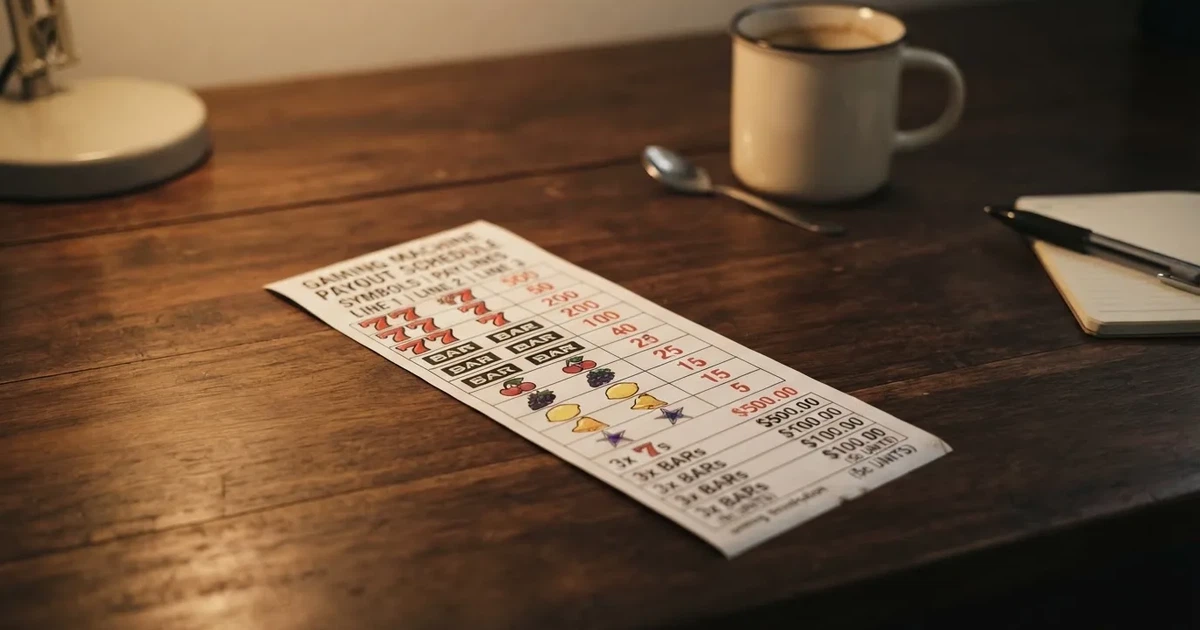
These are not Pocket Pokies-specific titles; they are the rotation the offshore market shares. The brand’s marketing wraps them in a paytable screenshot and a payout number; the underlying game is the same as on any other offshore skin.
What a paytable image actually tells a reader
A paytable screenshot is a static image of the symbol grid, the line-pay amounts and the feature-trigger conditions. It tells the reader what the game looks like and what each combination pays out at the base stake. It does not tell the reader the RTP at the operator’s stake configuration — that figure sits in the game’s information screen inside the client, and even there, an offshore operator can offer the game at a lower RTP than the studio’s default.
Why the volatility rating matters more than the RTP figure
Two pokies at the same 96% RTP can play very differently. A low-volatility title pays out small wins often, so the bankroll survives long enough to clear a bonus; a high-volatility title pays out rarely, so the bankroll can be exhausted before the bonus is anywhere near cleared. The combination of high wagering multiplier and high-volatility pokie is the worst-case version of the welcome package — the maths says the bonus will cost more in expectation, and the variance says it will feel more brutal in practice.
Live tables and “pocket pokies live”
The phrase “pocket pokies live” appears in some affiliate pages, suggesting a live-dealer section alongside the RNG pokies. Live-dealer products are typically run by studios like Evolution, Pragmatic Play Live or Asia Gaming, which license their feeds to many operators at once. The studio brand sits behind the table; the operator sits behind the cashier. The product is the same live table the reader would find on any number of offshore skins; the brand on the page is the only thing that changes.
Why the provider list is not the safety net it looks like
A long list of provider logos on an offshore site is a marketing asset, not a quality mark. Studios like the ones named above license their games to operators that meet their commercial terms; they do not warrant the operator’s solvency, withdrawal behaviour or compliance posture. The studio gets paid a revenue share; the player takes the full credit risk on the operator’s cashier. That gap — between the studio licence and the operator licence — is where most of the player harm in this market lives.
Eleven offshore brands, one prohibition, eleven ACMA warnings
This page is not a ranking. Each brand below sits on this page because the ACMA itself issued a formal warning over it for offering prohibited interactive gambling services to Australians. The warning is a regulatory act; the brand’s offer is a marketing claim. Both are on the page; the reader is the one who decides which matters.
RocketPlay
The ACMA issued a formal warning to Pulsup Ltd over Rocketplay.com.au in March 2026; the same brand had earlier been the subject of a May 2022 warning to Dama N.V. The brand’s product is what an offshore pokies front page typically carries — a welcome package, a free-spin allocation, a live-dealer section. The ACMA action is the second regulatory touch on this brand in four years, which is the relevant history for a reader trying to weigh the marketing.
Level Up Casino
Dama N.V. received a formal warning in May 2022 covering six of its brands, one of which is Level Up Casino. The brand’s product page sits in the same offshore shape: a matched-deposit welcome, a free-spin allocation on a named pokie, a VIP reload structure for high-volume players. The 2022 warning stands as a matter of public record; there has been no subsequent clearance issued.
Woo Casino
The ACMA issued a further formal warning to Dama N.V. over Woo Casino in March 2025, three years after the 2022 warning covered other brands under the same operator. Woo’s product page carries the same matched-deposit structure. The two warnings on the same operator within three years is the relevant context.
Spirit Casino
Dama N.V. received a formal warning over Spirit Casino in May 2025, the second of the two 2025 warnings to that operator. Spirit’s product page carries the same structure as the rest of the Dama N.V. cluster. Two warnings to one operator across consecutive months is the relevant context.
National Casino
Consolutetish S.R.L. received a formal warning in July 2025 covering National Casino. National Casino’s product page carries a multi-tranche welcome package and a free-spin allocation, with the same matched-deposit structure that runs through this segment of the market. The July 2025 regulatory action remains in force; review sites continue to feature the brand, demonstrating the ongoing discrepancy between official ACMA warnings and affiliate marketing narratives.
Bizzo Casino
Consolutetish S.R.L. received a formal warning in July 2025 covering Bizzo Casino; Bizzo had already been the subject of a 2022 formal warning to TechSolutions (CY) Group Limited and TechSolutions Group N.V. Two warnings on the same brand across two operators in three years is the relevant history.
Ignition Casino
The ACMA issued a formal warning to Bamboo Media over Ignition Casino in July 2025. Ignition’s product page carries a poker-and-casino combination and a matched-deposit welcome; the ACMA action sits over the casino side of the brand. This warning serves as the current regulatory status for the operator.
Instant Casino
EOD Code SRL received a formal warning over Instant Casino in February 2025. Instant Casino’s product page carries the same matched-deposit welcome and free-spin structure as the rest of this segment. The February 2025 warning is documented by the ACMA, while marketing listings emphasize payment methods like instant bank transfers.
Jackbit
Ryker B.V. received a formal warning over Jackbit in April 2026. Jackbit’s product page carries a crypto-first cashier and a sports-and-casino combination. This enforcement action is officially recorded.
Casino Intense
Sterplay Holding Ltd received a formal warning over Casino Intense in April 2025. Casino Intense’s product page carries a matched-deposit welcome and a free-spin allocation, with the same offshore structure. The 2025 warning is the public record.
Sky Crown
The ACMA issued a formal warning to Hollycorn N.V. over its Sky Crown and Blue Leo casino services in September 2022. Sky Crown’s product page carries a multi-tranche welcome package and a VIP reload structure. The 2022 warning is the public record; there is no 2026 update.
Where the table leaves the reader
The eleven brands on this page share a single structural fact: every one of them offers an online casino product the ACMA has formally warned against. The dates and operators differ; the underlying product does not. A reader comparing two brands on this page is comparing two entries in the same enforcement record, not two alternatives to that record.
Pocket Pokies Casino Australia 2026 — More on this topic at casino payout.
The Australian legal frame: what the IGA actually prohibits
Online casino is prohibited in Australia. The Interactive Gambling Act 2001, strengthened by the Interactive Gambling Amendment Act 2017, makes it an offence to provide online casino games, online pokies or in-play betting to a person in Australia. No state or territory licences any of these products. What is licensable is wagering on races and sport placed before the event, lotteries and keno — and in practice the bulk of those licences are issued by the Northern Territory Racing and Wagering Commission, which regulates 52 of Australia’s online bookmakers including Sportsbet, Bet365 and Ladbrokes. The NTRWC has no full-time staff and meets once a month in Darwin.
What the ACMA does, and what it cannot do
The Australian Communications and Media Authority is the enforcement body. It investigates complaints, issues formal warnings, and directs Australian internet service providers to block illegal sites. As of June 2026, the ACMA had asked ISPs to block 1,751 illegal gambling and affiliate marketing websites since the first blocking request in November 2019, and more than 230 unlicensed gambling services had left the Australian market since enforcement was strengthened in 2017.
The most recent published blocking round, reported on 26 June 2026, named twelve more sites: 7Signs, ChromaBet, Donbet, Duospin, Freshbet, Slots Gem, Jacks Club, Lucky Start, Pointsbetz.com, Spinrise, Vinyl Casino and Wildsino. The blocking request is a regulatory tool, not a permanent removal — an ISP-level block can be bypassed, and an operator that rotates domains can re-appear under a new address.
The blocking rate, in arithmetic
Between November 2019 and June 2026, the ACMA’s published blocking requests cover 1,751 websites. Spread over that period, the rate of new blocking requests works out at roughly 1,751 ÷ 6.6 years, or approximately 265 blocked sites per year. That is the steady-state rate; the actual monthly figures fluctuate, with some rounds covering one or two sites and others covering a dozen or more. As a band, the rate sits in the order of a couple of hundred to a few hundred new blocking requests per year, with bursts tied to specific enforcement campaigns.
The arithmetic is a rate, not a promise. A reader who treats it as a forecast — “the next round will block X more sites” — is over-reading the figure. What the rate does describe is the order of magnitude of the enforcement task the ACMA is running.
Why the player is not the target
The IGA targets the provider, not the player. Individual Australians are not prosecuted for using an offshore casino. What they do lose, by using one, is the consumer protection an Australian-licensed wagering provider must carry: an Australian complaints body, a withdrawal timeframe enforceable under Australian consumer law, and a connection to BetStop, the National Self-Exclusion Register. The offshore brand offers none of these.
An offshore site can be blocked with a balance still on the player account. That is the practical end-state the prohibition creates: a player who used the site before the block can find, after the block, that the brand has rotated its domain, that the original deposit rail is closed, and that the operator’s own customer-support function is the only place left to ask for the balance back.
What the 2026 reform changes
The Interactive Gambling Amendment (Gambling Reform) Bill 2026 passed Parliament on 19 August 2026. Its advertising and inducement measures commence on 1 January 2027 — a law with a start date, not yet in force on a page published in the same year. The 2026 reform tightens what Australian-licensed wagering providers can advertise; it does not, on its own terms, legalise online casino games or pokies. The prohibition stays the prohibition; the marketing around the licensable product gets tighter.
The payment side of the prohibition
Under the Interactive Gambling Act 2001 as amended in 2023, an Australian-licensed online wagering service cannot accept payment by credit card or other credit-related products. The same restriction follows the credit source into a digital wallet. For an Australian-licensed product, the legal deposit routes are debit card, bank transfer, PayID/Osko and BPAY. An offshore casino that asks an Australian player for a credit card number or a crypto deposit is operating outside the Australian rules; the player using those rails is using them at the offshore cashier’s terms, not at any Australian-licensed terms.
Penalties for accepting credit from an Australian-licensed provider run up to $247,500 for operators. The penalty is on the operator; it is the reason an Australian-licensed product will refuse a credit deposit, and it is the reason an offshore product, which has no Australian licence, faces no such constraint.
What winnings mean at tax time
Gambling winnings of a recreational player are not assessable income under section 6-5 of the ITAA 1997, and losses are not deductible — unless the person carries on a business of gambling. The tax treatment is a separate question from the legal status of the site. A recreational player who wins on an offshore casino keeps the winnings, free of Australian income tax; the same player has no Australian recourse if the operator refuses to pay those winnings. The ATO position is the model; the specific case is the reader’s.
Responsible gambling: what an offshore casino cannot connect to
The Australian responsible-gambling infrastructure is built for Australian-licensed wagering providers. The pieces are a national self-exclusion register, a national helpline, and a network of state-based counselling services. Each piece exists; none of them reach an offshore casino.
BetStop and the offshore gap
BetStop, the National Self-Exclusion Register, has been live since August 2023. It binds Australian-licensed online and phone wagering services: when a player registers, every licensed wagering provider the player holds an account with is notified, and the player’s account is closed across those providers for the period of the exclusion. The mechanism is the point. An offshore casino is not connected to BetStop, and a BetStop registration does not close an offshore account. A player who self-excludes through BetStop has done the responsible thing the Australian system supports, and has not yet touched the offshore side of their play.
The National Gambling Helpline is 1800 858 858 — free, 24 hours a day, with a chat option at Gambling Help Online. The helpline is a counselling service, not a regulator; it does not order an offshore casino to act. What it does is provide a place to plan the next step when an offshore casino has refused a withdrawal, when the marketing has run ahead of the bankroll, or when the player has decided to stop.
Where a self-imposed block actually helps
The four majors’ gambling blocks are the practical tool an Australian player can apply to themselves. Westpac refuses authorisation at the merchant category code level; ANZ’s block extends to digital wallets and carries a 48-hour cooling-off window before removal; Commonwealth Bank’s gambling lock does the same through the CommBank app. Each of these blocks comes with the bank’s own caveat that not every gambling transaction will be stopped and some non-gambling transactions might be blocked in error — but each of them raises the friction on a casual deposit, and that friction is the point of the block.
What the offshore casino does not offer
An offshore casino has no obligation to offer a deposit limit, a session reminder, a cooling-off period, or a self-exclusion function that actually closes the account. Some brands offer these features as marketing; none of them are connected to the Australian system that enforces them. A player who has registered with BetStop and then opened an offshore account has, in effect, undone the Australian half of their self-exclusion without undoing the offshore half of their play.
Comparing the brands: what the table shows, what it leaves out
The table below sets the eleven brands the ACMA has warned side by side. Two matters the columns cannot capture are worth saying before the reader scans it: first, every entry sits over the same prohibition, so the comparison is between warnings, not between products; second, the operator names that hold the licence to take Australian wagers — Sportsbet, Bet365, Ladbrokes and the rest of the NTRWC’s 52 — are a different category and do not appear here.
| Brand | ACMA action and date | Operator named by the ACMA | Subject support |
|---|---|---|---|
| RocketPlay | Formal warning, March 2026; earlier May 2022 | Pulsup Ltd (2026); Dama N.V. (2022) | listings-only |
| Level Up Casino | Formal warning, May 2022 | Dama N.V. | listings-only |
| Woo Casino | Formal warning, March 2025 | Dama N.V. | no-data |
| Spirit Casino | Formal warning, May 2025 | Dama N.V. | no-data |
| National Casino | Formal warning, July 2025 | Consolutetish S.R.L. | listings-only |
| Bizzo Casino | Formal warning, July 2025; earlier 2022 | Consolutetish S.R.L. (2025); TechSolutions (2022) | listings-only |
| Ignition Casino | Formal warning, July 2025 | Bamboo Media | no-data |
| Instant Casino | Formal warning, February 2025 | EOD Code SRL | listings-only |
| Jackbit | Formal warning, April 2026 | Ryker B.V. | no-data |
| Casino Intense | Formal warning, April 2025 | Sterplay Holding Ltd | listings-only |
| Sky Crown | Formal warning, September 2022 | Hollycorn N.V. | no-data |
The pattern in the operator column is the point. Six of the eleven warnings name one of three operators — Dama N.V., Consolutetish S.R.L. and TechSolutions — which is to say that the same offshore operator groups hold the licences for several of the brands the ACMA has warned. The ACMA warning lands on the operator, not the brand, and an operator that holds five or six brands can absorb a warning on one of them and continue trading under the others until the next round. A reader looking for an operator with a clean record is looking for an operator the ACMA has not named — which is, by definition, the set of brands that do not appear in the table.
Reading the table against the marketing
Affiliate and review pages for the brands in this table describe welcome packages, free-spin allocations and VIP programmes. Those descriptions are the marketing view; the ACMA column is the regulator’s view. The two views disagree on whether the brand should be available to an Australian player at all. The marketing view is what the player meets first; the regulator’s view is the one that names a date and an operator. The table is the regulator’s view, in one place.
What a player can do, and what no player can do alone
An Australian player with a bankroll to manage has more levers than an Australian player with a question about a specific offshore casino’s cashier. The bankroll side is well-served: the four majors’ gambling blocks, BetStop, the helpline, the state-based counselling services. The offshore casino side is not. Once a player has deposited into an offshore brand, the levers that exist on the Australian-licensed side do not reach the offshore cashier, and the offshore cashier has no Australian obligation to answer them.
The arithmetic on the welcome package is the same arithmetic every offshore brand runs: a headline bonus that costs more in expectation than the headline value, behind a multiplier, a ceiling and a time limit. The legal frame is the same: no Australian licence, no Australian protection, an ACMA warning on file. The responsible-gambling frame is the same: no BetStop connection, no Australian complaints body, no Australian recourse on a refused withdrawal.
The choice that sits in front of the reader is not “which offshore brand”. It is “whether the offshore product is the right product at all” — and that question is the one the IGA has already answered for the Australian-licensed half of the market.
Frequently Asked Questions
Is the site styled as Pocket Pokies actually licensed to operate in Australia?
No. No state or territory issues a licence for online casino games or online pokies in Australia, and the Interactive Gambling Act 2001 makes it an offence to provide them to a person in Australia. The licences an offshore site displays — Curaçao, Anjouan, Kahnawake — are licences to operate from those jurisdictions, not licences to take Australian players. The ACMA’s enforcement record over the brands in this market is the practical expression of the same fact.
What kind of welcome bonus does a site styled as Pocket Pokies typically advertise?
The marketing pages for sites styled this way typically advertise a multi-tranche matched-deposit welcome package plus a free-spin allocation on a named pokie. The headline number is the sum of the per-deposit matches, not the amount a player will see in their account; the wagering multiplier, the maximum cashout ceiling and the time limit are the three terms that determine what the bonus actually costs. The arithmetic is the same across the segment: a high headline number behind a high multiplier, a tight ceiling and a short window.
How can someone check whether a site calling itself Pocket Pokies is legitimate before trusting its claims?
The first check is the ACMA’s published list of formal warnings and blocked sites. A brand that appears on that list is not legitimate in the Australian sense, whatever licence it displays. The second check is the operator name on the licence: an operator that holds several brands, several of which appear on the ACMA list, is the operator pattern the enforcement record has named repeatedly. The third check is the payment rail: a request to send money to a PayID that does not match the brand name is the warning the rail itself prints, before the transfer is sent.
Does an app version of a site like this behave any differently to its website?
The app version typically mirrors the website in product and terms — same pokie library, same welcome package, same cashier, same operator. The wrapper changes; the underlying offer does not. Where an app version differs is in the additional permission set it asks for on the device, and in the additional marketing surface it gives the operator through push notifications. The Australian legal position is the same on the app and on the website.
What withdrawal experience do reviews of sites styled this way tend to describe?
Affiliate and review pages for these brands describe a deposit-to-withdrawal cycle that mirrors the licensed market — deposit, play, request a withdrawal, receive funds. Player-side reports in forums tend to describe a longer version of that cycle: verification requests that arrive after the withdrawal is requested, partial payments, re-deposit requirements to “unlock” a withdrawal, and customer-support responses that stall once the verification request is on file. The bank-side gambling blocks at the deposit stage are the Australian tool that can interrupt that cycle before it starts; the withdrawal side has no equivalent tool.
Why do so many reviews specifically ask whether a site like this is “safe” or “legit”?
Because the marketing gives a player no way to tell. An offshore brand can display a licence badge, a responsible-gambling logo and a payment-rail list that all look the same as the Australian-licensed equivalent. The badge is a licence to operate from the issuing jurisdiction, not a warranty for Australian players; the responsible-gambling logo is a marketing image, not a connection to BetStop; the payment rail is a transit layer, not a check on the receiver. The “is it safe” question is the reader’s way of asking what the marketing does not answer: whether the operator on the other end of the cashier is one the Australian regulator has named, and whether the player has any Australian recourse if the cashier refuses a withdrawal.