

Pokies in Tasmania in 2026: what is licensed, what is not, and what it costs
Data current as of 22 November 2026, checked against the Australian Communications and Media Authority’s formal-warning register and the Tasmanian Liquor and Gaming Commission’s published decisions.
A search for pokies in Tasmania ends one of two ways. The first is a list of pubs, clubs and two casinos, all licensable on the island, all running electronic gaming machines under the Tasmanian Gaming Control Act. The second is an offshore online casino with a “pokies” tab and a Curaçao or Anjouan footer — unlawful to offer to anyone in Australia, regardless of how Australian the homepage looks. The two are not different versions of the same product. One is a venue you can drive to and the other is a service no Australian operator is allowed to provide, and the ACMA has spent the last seven years telling the second kind of operator to leave the market. This page closes the shelf on the first kind and explains, in detail, what the second kind is and what it has cost the people running it.
The angle here is cost — what each path costs a player in money, time and recourse when something goes wrong, and what an offshore site costs the operator who chooses to ignore the IGA. The arithmetic is the same on both sides: the house takes a cut, the law puts a ceiling on what the house can do, and the only question is which ceiling actually applies to the venue you walked into.
Table of Contents
- Wrest Point and the Country Club: the two casinos Tasmania actually licences
- Pubs and clubs: where the bulk of EGMs actually live
- Payout percentages, maximum bets, and the speed money moves
- The Spirit of Tasmania and other specific games and venues
- What the ACMA has actually blocked, and what that tells a player
- The brands the ACMA has named: a comparison
- What a “pokies venue” looks like against the rest of Australia
- How this ranking was put together
- What it costs to play: the cashless card and the loss ceiling
- Self-exclusion and the help a player can actually use
- What the ACMA’s blocking record actually costs an offshore operator
- The IGA, the 2026 reform, and what changes on 1 January 2027
- Frequently asked questions
Wrest Point and the Country Club: the two casinos Tasmania actually licences
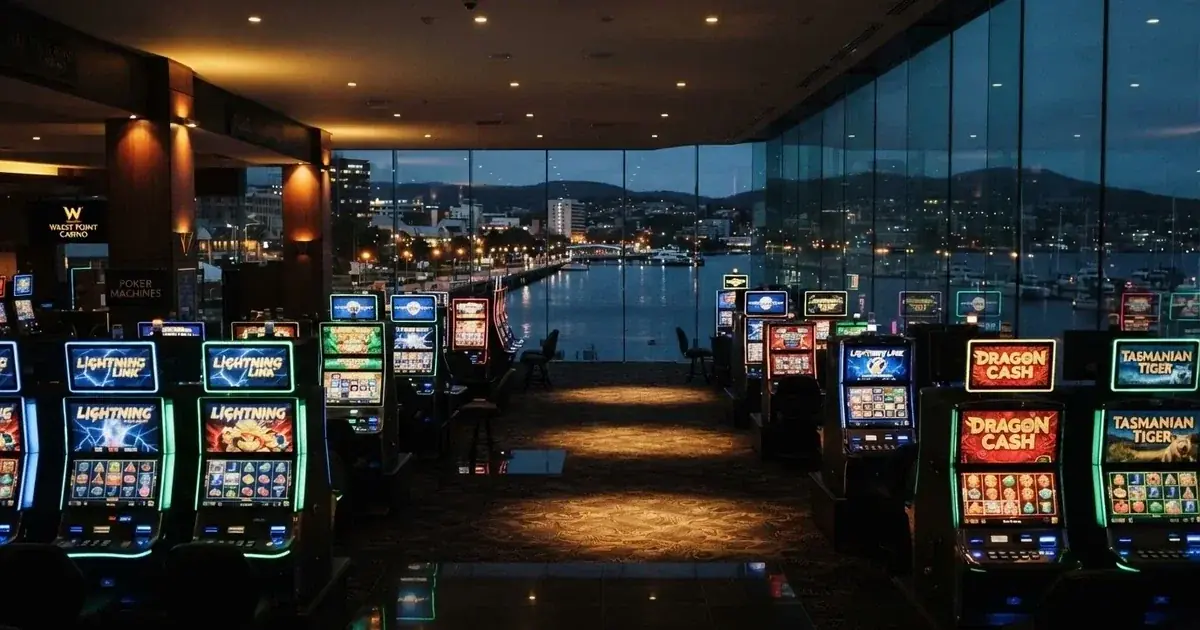
Tasmania runs two casinos, both inside the Federal Group’s stable of Tasmanian gambling licences. There is no third option. Wrest Point in Hobart opened on 10 February 1973, the first legal casino in Australia, and the Country Club Casino and Resort in Launceston opened under the same operator in 1982. The Country Club was built in a Georgian style modelled on the stately homes of the American South, deliberately chosen to suit the rural landscape around Launceston. Both venues are licensed under the same Tasmanian regime, both are full-service resorts, and both carry the floor space and machine count of a regional casino rather than a Sydney or Melbourne megacasino.

Wrest Point sits on the waterfront at Sandy Bay, a short drive from Hobart’s CBD, and remains the larger of the two. The Country Club is in Prospect, on the edge of Launceston, and doubles as a conference venue and resort in addition to its gaming floor. Federal Group’s structure splits the licence interests through Mulawa Holdings, which reported profit jumping from A$13.9 million to A$24.4 million in the year to 30 June 2018 on revenue of A$543 million, with about A$75 million of that going back to the Tasmanian government in gaming taxes and licence fees. The Farrell family acquired majority ownership of the holding company by 1989 and privatised the group in 1990; it is still Tasmanian family-owned.
The monopoly around the casino licence is one piece of Federal Group’s position, but it is not the whole one. Under the Gaming Control Act 1993 the group held the exclusive right to operate electronic gaming machines outside its two casinos for more than two decades. In August 2017 that monopoly ended. Pubs and clubs in Tasmania can now hold their own EGMs under licence, and the gaming floor is no longer a Federal Group monopoly beyond the casino walls. That structural change matters for what a player sees in a pub versus what they see in Wrest Point: the same regulator, the same machine types in many cases, but different limits and different venue-level self-exclusion arrangements.
Federal Group’s own history is older than the casino licence. It started life as the Federal Coffee Palace Company Limited, founded in Melbourne in June 1885, well before the first Tasmanian licence. The group’s transition from a hotel and hospitality business into a casino operator, and then into the holder of an exclusive EGM monopoly, traces the regulatory history of Tasmanian gambling itself: one licence, then a state-granted monopoly on machines outside the casino, then the loosening of that monopoly, and now the cashless card system that has begun to reshape how money moves through every machine on the island.
Pubs and clubs: where the bulk of EGMs actually live
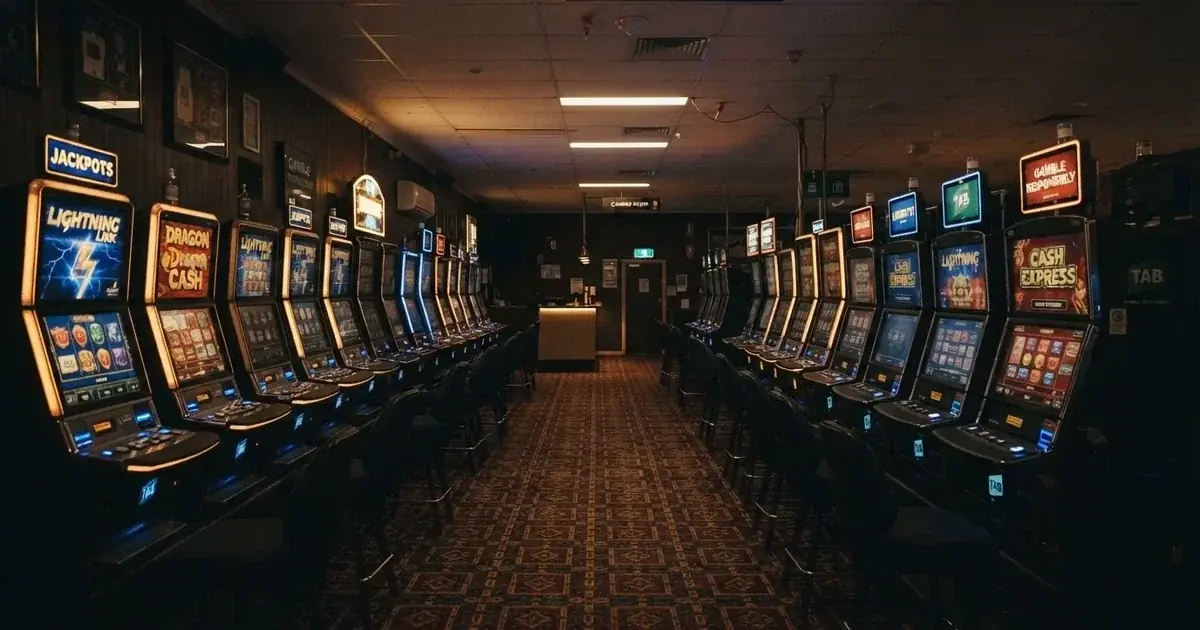
The cluster that matters most for a Tasmanian player is the licensed pub and club network. Tasmania’s hotels and clubs began mandatory cashless carded play on EGMs in December 2025, and that reform changes how the floor feels in practice. A player at a Wrest Point or Country Club machine, and a player at a Hobart pub machine, now moves money through the same kind of system, with the same default loss limits.
The default limits under Tasmania’s cashless gaming card reform are A$100 a day, A$500 a month and A$5,000 a year, and they can be raised only after a minimum 24-hour cooling-off period. The system is overseen by the Tasmanian Liquor and Gaming Commission. As of September 2024 the reform did not have a set date for rolling out to the casino floor, so Wrest Point and the Country Club were still operating under pre-card arrangements for their EGMs while every hotel and club machine on the island moved to mandatory carded play. That asymmetry is temporary, but on a page written in 2026 it is the live picture: pubs and clubs carded, the two casinos not yet.
For a player choosing between a casino floor and a pub floor, the differences run deeper than the cashless card. Casinos carry table games, premium gaming rooms, restaurant and hotel infrastructure, and a different mix of machine denominations. Pubs carry a smaller machine count per venue, lower maximum bets on most machines, and a venue-level self-exclusion arrangement that operates against the specific pub rather than against the operator’s whole portfolio. Both are lawful. Both are regulated. The cashless card sets the same loss ceiling at both kinds of venue, once the casino rollout lands.
Pokies in Tasmania CBD, as a search, sends readers mostly to Hobart’s two clusters: the Wrest Point precinct on the waterfront, and the licensed hotels around the city centre that hold EGM licences. In Launceston, the Country Club handles the casino side, with licensed clubs and pubs carrying the bulk of machine play in the central suburbs. In the north-west, Devonport and Burnie round out the venue pool. The pattern holds across Australia: pubs and clubs carry the machine volume, casinos carry the floor scale, and the regulatory reform of the last few years has moved the two closer together on the player side.
Payout percentages, maximum bets, and the speed money moves
How a Tasmania pokies venue handles money follows the state regime, not the brand on the machine. Tasmania does not publish a venue-by-venue payout table, so any ranking of “best paying pokies in Tasmania” is built on the machine’s own return-to-player setting, not on a venue-level figure. The broader Australian benchmark sits in the mid-90s for club-style EGMs and around the low-90s for casino floors, with state-by-state variation that reflects the regulatory setting rather than the operator’s choice. South Australia, by comparison, sets a minimum gaming-machine return-to-player rate of 87.5% and a general maximum bet of A$5.00 outside the casino; Adelaide Casino itself has no maximum-bet limit. Tasmania’s casino floor carries a higher per-spin ceiling than the pub and club network, and that is the structural reason a “best paying pokies Tasmania” answer tends to point toward denomination and machine choice, not venue choice.
Maximum cash payout at a Tasmania pokies machine is set by the machine, not by the venue. A standard club EGM pays out the smaller wins by ticket or cash, and the larger wins — anything that breaches the venue’s declared payout threshold — by hand pay, which requires a staff member to bring the cash or cheque to the machine. The pattern is the same in every Australian state: small wins are automated, large wins require a person and a process, and the time it takes scales with how busy the floor is and how the venue staffs its payouts. The “maximum cash payout pokies Tasmania” question is really a question about hand-pay thresholds, and those thresholds vary by venue and machine denomination rather than by state.
Deposit and withdrawal speed is a different question, because it does not actually apply to a Tasmania pokies venue in the way it applies to an offshore site. A player at Wrest Point inserts cash or a cashless card, plays, and either walks away with the ticket or redeems it at the cashier. There is no deposit, no withdrawal queue, no payout speed benchmark. The reason “online pokies Tasmania no deposit bonus” appears as a related search is that the offshore sites market aggressively into that vocabulary — “no deposit”, “instant withdrawal”, “Tasmania-friendly” — and they target the same reader who is searching for a land-based venue. The two are not the same product, and the payment speed of one does not translate to the other.
For an offshore site, withdrawal speed is a real and contested variable. Industry listings often quote payout windows measured in hours for e-wallets and days for bank transfers, and those figures vary by site, by method and by verification status. The figures are not from any Australian regulator, because no Australian regulator licenses the sites. They are from the operators themselves, or from affiliate listings that the operators have an interest in populating. A reader using those numbers to compare a Tasmania pub machine to an offshore site is comparing the verifiable behaviour of a Tasmanian venue with the marketing claim of an unlicensed operator.
The Spirit of Tasmania and other specific games and venues
The Spirit of Tasmania, the ferry that runs between Melbourne and Devonport, carries a small gaming room, and “pokies on Spirit of Tasmania” or “Spirit of Tasmania pokies” is a real search. The machines on board operate under the same Tasmanian EGM regime as any licensed pub, and the same cashless card and default loss limits apply. A passenger who steps off the ferry at Devonport and walks into a Burnie or Devonport pub is on the same regulatory floor as the ferry itself.
The 24-hour question is more honest than it sounds. Pokies venues in Tasmania are not all open around the clock, but a few in Hobart and Launceston run late enough to look like a 24-hour operation to a casual reader. The casino floors at Wrest Point and the Country Club are the closest the state comes to a round-the-clock gaming venue, but they are not advertised as 24-hour in the way a Melbourne or Sydney casino floor is. The honest answer to “24 hour pokies Tasmania open now” is: not as a general rule, with casino floors carrying the longest hours and individual pubs carrying whatever hours their liquor licence permits.
Cashless pokies in Tasmania is now the default at every pub and club EGM on the island, with the casino rollout still pending. The card system replaces cash at the machine, ties play to a single registered account per player, and applies the A$100 / A$500 / A$5,000 loss ceiling by default. A player who walks into a Hobart pub in 2026 and feeds a banknote into a machine is using a system designed around a different premise than the one the pub operated under in 2019.
Tasmania clubs pokies is the cluster that picks up most of the volume outside the casinos. Registered clubs, RSL sub-branches and community clubs hold machine licences, and they sit in the same regulatory envelope as the pubs. The cashless card reform applies identically. The venue-level self-exclusion arrangement applies per-venue rather than per-operator, and a player who wants to bar themselves from every club in the state registers separately with each one — a known friction in the system, and the reason BetStop, the National Self-Exclusion Register, exists as a parallel option for the online and phone wagering side.
Tasmania casino online pokies, as a phrase, does not name a licensed product. Online casino games, including online pokies, cannot be licensed anywhere in Australia under the Interactive Gambling Act 2001. A site that uses that phrase is doing so as marketing copy, and the ACMA’s enforcement record over the last three years shows the kind of operator that runs that copy and what happens to it.
What the ACMA has actually blocked, and what that tells a player
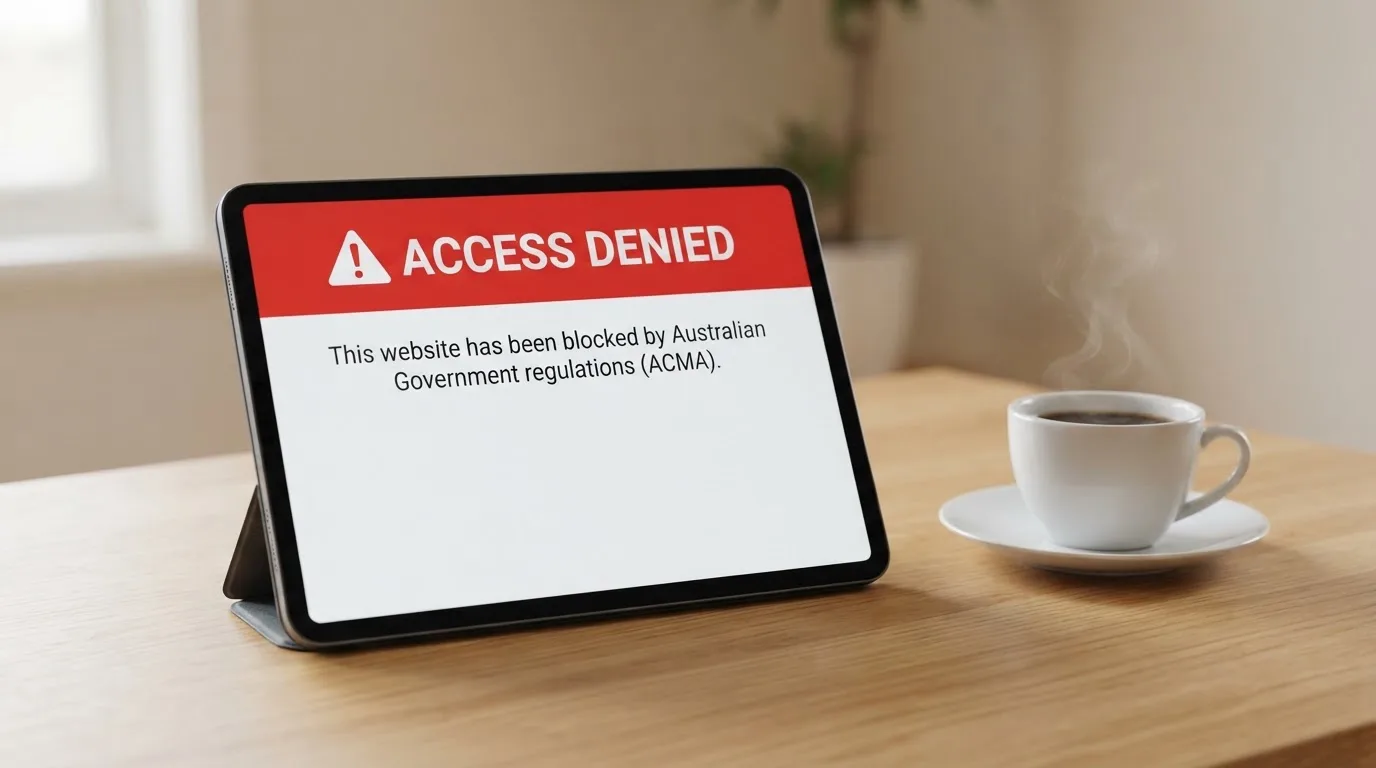
The ACMA’s blocking list is the most concrete piece of evidence a reader can use to tell a licensed Tasmanian venue from an offshore site that is unlawful to offer to Australians. As of the round reported on 26 June 2026, the ACMA had asked Australian internet service providers to block 1,751 illegal gambling and affiliate marketing websites since the first blocking request in November 2019. More than 230 unlicensed gambling services had left the Australian market since enforcement was strengthened in 2017. The June 2026 round alone added 12 more sites: 7Signs, ChromaBet, Donbet, Duospin, Freshbet, Slots Gem, Jacks Club, Lucky Start, Pointsbetz, Spinrise, Vinyl Casino and Wildsino.
That is the running total. The arithmetic for a page written in 2026: 1,751 sites blocked over roughly six and a half years works out to a rate somewhere between four and five blocked sites per working week over the lifetime of the regime. The rate is not constant. The early rounds ran in tens. The later rounds run in larger batches as the ACMA sweeps clusters of operators that share a platform, and a single round can represent months of investigation compressed into one blocking order. The blocking-rate band a reader can read off the public record sits somewhere between “a steady drip” and “a periodic sweep”, and what changes is not the regime but the size of the operator clusters it catches.
H2 Gambling Capital’s 2025 report estimates that Australians lose about A$3.9 billion a year to illegal gambling sites, and that the share of gambling going through legal channels fell from 74% in 2021 to 64%. The drop is consistent with the rise of offshore marketing aimed at Australian players, and with the IGA’s regime being enforced against operators rather than against individual players. The figure is from a commercial dataset, not from the ACMA, and it should be read as a market estimate rather than a regulator’s measurement.
The ACMA’s other enforcement tool is the formal warning. A formal warning does not block a site, but it puts the operator on the public record as having been told, in writing, that its service is prohibited under the IGA. The list below covers every brand that the ACMA has named in a formal warning over the last three years and that was still being marketed to Australian readers as of the ACMA’s most recent publication round.
The brands the ACMA has named: a comparison
The table below lists every brand the ACMA has named in a formal warning over the period covered by the research. The list is a comparison of the regulator’s actions, not a ranking of where to play. There is no licensed Australian online casino, so a “best” answer is not available — what the table shows is what the regulator has done about the offshore sites that market themselves as a substitute.
| Brand | ACMA action and date | Operator named by the ACMA | Listing references |
|---|---|---|---|
| RocketPlay | Formal warning, March 2026; earlier warning to Dama N.V., May 2022 | Pulsup Ltd (Rocketplay.com.au) | — |
| Level Up Casino | Formal warning, May 2022 | Dama N.V. | en.wikipedia.org; vgccc.vic.gov.au |
| Woo Casino | Formal warning, March 2025 | Dama N.V. | en.wikipedia.org |
| Spirit Casino | Formal warning, May 2025 | Dama N.V. | — |
| National Casino | Formal warning, July 2025 | Consolutetish S.R.L. | Abc.net.au; infrastructure.gov.au |
| Bizzo Casino | Formal warning, July 2025; earlier warning, 2022 | Consolutetish S.R.L.; earlier TechSolutions (CY) Group Limited and TechSolutions Group N.V. | — |
| Ignition Casino | Formal warning, July 2025 | Bamboo Media | — |
| Instant Casino | Formal warning, February 2025 | EOD Code SRL | — |
| Jackbit | Formal warning, April 2026 | Ryker B.V. (also named CasinOK) | — |
| Casino Intense | Formal warning, April 2025 | Sterplay Holding Ltd | Abc.net.au; Asgam.com; cbs.sa.gov.au |
| Sky Crown | Formal warning, September 2022 | Hollycorn N.V. (also named Blue Leo) | en.wikipedia.org |
The brands in the table all share one structural feature: the operator named by the ACMA sits outside Australia, holds no Australian licence, and the ACMA’s formal warning is the public record that the service has been told it is offering a prohibited interactive gambling service to people in Australia. Some of the brands are listed by third-party gambling-directory sites; others have no listings at all. The listings column reflects what those directories carry, not what any Australian regulator has verified.
The cumulative picture is one operator cluster appearing across multiple brands. Dama N.V. appears in formal warnings over five different brands across three years, and the same offshore holding company naming pattern shows up across the rest of the table. An operator that ignores one formal warning tends to rebrand under a different domain and continue; the ACMA’s response is the next formal warning, then a blocking request. The full cycle, from first contact to blocking, runs in months for a brand that does not engage, and runs longer for one that does.
What a “pokies venue” looks like against the rest of Australia
The right comparison for Tasmania is not “best online casino Australia” — the IGA forecloses that question. The right comparison is the other small-population states with two or fewer casinos, and how their machine network sits against Tasmania’s. South Australia runs one casino, Adelaide Casino, which sits inside the heritage-listed Adelaide railway station on North Terrace and carries 90 gaming tables and 950 gaming machines, the sole licensed casino in the state under the Casino Act 1997. Outside that single casino, South Australia had 11,672 gaming machines in 471 venues in September 2023. Tasmania, by comparison, runs two casinos and a smaller pub and club network; the comparison is informative on the regulatory side but the population base differs enough that per-capita figures tilt toward South Australia.
Adelaide Casino itself has a different commercial structure: it opened on 12 December 1985 under the state’s Lotteries Commission, was sold to SkyCity Entertainment Group in June 2000, was renamed SkyCity Adelaide in April 2001, then reverted to the Adelaide Casino name in 2009. The 2015-2021 Riverbank precinct redevelopment, worth about A$330 million, added the EOS by SkyCity tower, which opened in 2021 with 120 hotel rooms and expanded gaming space. Adelaide Casino’s table-game monopoly was extended to 30 June 2035 under a licence formalised on 11 October 2013, allowing expansion to up to 200 gaming tables and 1,500 gaming machines subject to redevelopment. South Australia sets a minimum gaming-machine return-to-player rate of 87.5% and a general maximum bet of A$5.00 outside the casino; the casino itself has no maximum-bet limit. The state collected more than A$41 million in taxes and charges from Adelaide Casino in 2007-08 alone. South Australian gaming-machine losses outside Adelaide Casino totalled about A$0.92 billion in 2022-23, equivalent to about A$497 per adult.
Brisbane, on the larger end, offers the contrast with population. Treasury Casino, operated by Star Entertainment Group, closed on 25 August 2024 to make way for the new Star casino at Queen’s Wharf. Treasury had been a three-level gaming emporium of 80 gaming tables and over 1,300 gaming machines, plus a hotel, six restaurants, five bars and a nightclub, sitting inside Brisbane’s historic Treasury Building. The Star Brisbane began a staged opening at the A$3.6 billion Queen’s Wharf Brisbane precinct on 29 August 2024, with the main casino floor and premium gaming rooms opening first. The precinct was developed jointly by Star Entertainment Group and Hong Kong-based Chow Tai Fook Enterprises. Queensland had 21,122 gaming machines operating in 351 venues in October 2023. Queensland’s regulatory picture is its own: in late 2022 the state government, acting on an independent review by former Court of Appeal judge Robert Gotterson, found Star Entertainment unsuitable to hold its Queensland casino licences after concluding it had misled regulators and failed its anti-money-laundering duties; Star was fined A$100 million on 9 December 2022, with a 90-day suspension of the Treasury Brisbane and Star Gold Coast licences deferred to 1 December 2023 to allow remediation.
The takeaway for Tasmania is structural: the state runs fewer casinos, with two physical venues that predate most of Australia’s other casinos by decades, and a regulated machine network that sits in hundreds of licensed pubs and clubs. The cashless card reform that began in December 2025 is the live regulatory change for any player weighing where to spend a session. The rest of the comparison — payout rates, machine counts, per-capita losses — runs through the same Tasmanian framework and is set by the Tasmanian Liquor and Gaming Commission rather than by individual venue choice.
How this ranking was put together
The shortlist in this guide does not rank the offshore brands against each other. There is no lawful Australian online casino, so any ranking of “best pokies site Tasmania” against an offshore operator is a comparison between a regulated Tasmanian venue and a service the ACMA has named in a formal warning. The shelf this page closes is the licensed Tasmanian venues, the regulatory envelope they sit inside, and the offshore operators the ACMA has acted against over the period covered by the research.
The criteria that separate one option from another on the licensed side are: cashless card status (mandatory at pubs and clubs, pending at the two casinos), loss limit defaults, machine denomination mix, venue-level self-exclusion mechanics, and the casino rollout timing. The criteria that separate one offshore brand from another on the regulator’s side are: date of first ACMA contact, whether the operator has rebranded, whether the ACMA has issued a blocking request, and whether the operator’s holding company appears across multiple brand names.
A reader searching “best pokies in Tasmania CBD” should land on a licensed Hobart pub or club, or on Wrest Point itself. A reader searching “best pokies Tasmania” should land on the same answer, with the regulatory envelope around it. A reader searching “pokies in Tasmania airport” lands on the licensed pubs and clubs in Hobart’s airport precinct rather than on any online substitute. A reader searching “24 hour pokies Tasmania open now” lands on the casino floors with the longest hours, and on the licensed pubs running the latest. A reader searching “pokies in Tasmania city” lands on the licensed Hobart and Launceston precincts, and not on any offshore site that uses the same phrase.
A reader searching “online pokies Tasmania no deposit” is being marketed to. The phrase exists because offshore operators buy against it. The page that honestly answers it names the IGA, names the ACMA’s blocking record, and tells the reader why the “no deposit” promise is not a substitute for a venue they could have walked into. That is the test this page applies to its own shelf, and the test that every other page in the pack applies to its own.
What it costs to play: the cashless card and the loss ceiling
The single piece of regulation that has changed the cost of a pokies session in Tasmania more than any other is the cashless gaming card. Under the reform, hotel and club poker machines began mandatory carded play from December 2025, with default loss limits of A$100 per day, A$500 per month and A$5,000 a year, raisable only after a minimum 24-hour wait. The Tasmanian Liquor and Gaming Commission oversees the system. No casino rollout date had been set as of September 2024, so on a page written in 2026 the live picture is carded pubs and clubs, with the casino floor operating under pre-card arrangements.
The arithmetic of the limit is straightforward. A$100 a day, raised only after a 24-hour cooling-off, sets the per-day ceiling that the cashless system enforces for a player who has not actively sought a higher limit. A player who plays the full A$100 at a venue running a typical club EGM with a return-to-player in the mid-90s loses, in expectation, somewhere between A$4 and A$7 of that A$100 to the house. That figure is statistical, not promised: an average over many sessions, not a guaranteed outcome for any one visit. It is the cost the machine’s hold percentage imposes on a player who plays through the entire daily limit, and it is the figure a Tasmanian pub machine takes regardless of denomination or venue.
The annual ceiling, A$5,000, is the figure that matters for a player who plays daily at the default setting. Reached only by sustained play, the limit functions as a circuit breaker rather than as a typical session budget, and the 24-hour cooling-off on any raise is the friction that prevents a player in a losing streak from lifting the ceiling impulsively. The Tasmanian Liquor and Gaming Commission’s role is to operate the system, audit compliance, and approve the venue rollout.
The casino side has not yet rolled out the card system to the gaming floor. Once it does, the same A$100 / A$500 / A$5,000 defaults apply, with the same 24-hour cooling-off on raises. Until that date, a Wrest Point or Country Club player is operating under the previous cash regime, which has no daily loss default and no mandatory cooling-off. The asymmetry between the two casino floors and the rest of the network is temporary, and the cashless card is the regulatory direction the state has chosen.
Self-exclusion and the help a player can actually use
Self-exclusion in Tasmania runs through two layers. The first is venue-level: a player can ask a pub, club or casino to bar them from that specific venue, and the venue records the request and enforces it at the door. Anglicare Tasmania’s Gamblers Help Service runs Gambling Helpline Tasmania on 1800 858 858 — a free 24-hour phone counselling line — and can help arrange venue self-exclusion. In-person counsellors are based in Hobart, Launceston, Devonport and Burnie.
The second is national: BetStop, the National Self-Exclusion Register, has been live since August 2023. BetStop binds Australian-licensed online and phone wagering services, so it covers sports and race betting operators licensed in Australia. It does not cover an offshore casino, because no offshore casino is licensed in Australia. A player who wants to bar themselves from an offshore site has no equivalent register to use; the site is not connected to BetStop and there is no Australian complaints body to take a dispute to. A withdrawal refused, a bonus term altered after acceptance, a payout delayed past the site’s own stated window — there is no Australian recourse for any of these against an unlicensed operator.
The wider safety net runs through the National Gambling Helpline on 1800 858 858, with chat at Gambling Help Online, free and available 24/7. The minimum age for any form of legal gambling in Tasmania is 18, and the Tasmanian Liquor and Gaming Commission enforces the entry policies at licensed venues. A player who feels their play is moving past the cashless card’s daily default, or who has tried to lift the limit and kept being refused, is the player the helpline is set up to reach.
For an offshore site, none of this applies. There is no Australian register, no Australian complaints body, no Australian consumer protection. The site may carry a “responsible gambling” page, but the page is not enforced by an Australian regulator, and the contact details on it are not an Australian service. The enforcement tools against the site are the ACMA’s blocking list and the formal warning register, both of which are aimed at the operator rather than at protecting an individual player’s balance.
What the ACMA’s blocking record actually costs an offshore operator
The arithmetic for an offshore operator is the inverse of the player’s: every blocking request is a market loss in Australia, every formal warning is a public record the operator cannot retract, and every rebrand under a different holding company is a fresh round of compliance risk. The 1,751 blocking requests since November 2019, and the more than 230 unlicensed services that have left the Australian market since 2017, are the cumulative cost the IGA’s regime has imposed on the offshore side.
For the regulator, the cost is a different kind of arithmetic. A blocking request goes to Australian ISPs, who add the domain to their block list, and the ACMA moves to the next operator cluster. The June 2026 round of 12 sites is one batch in a longer sequence; the previous round, the one before, and the round before that all run through the same process. The cost on the regulator’s side is the staffing and the legal review that supports each blocking request, and the bandwidth spent on operators that rebrand rather than leave.
For a player who has deposited with one of the brands in the comparison table, the cost of the site’s eventual blocking is immediate: the site stops loading, any balance still on the account becomes hard to recover, and the dispute resolution options are limited to the operator’s own internal process or to the operator’s home-jurisdiction regulator. Neither is an Australian body, and neither has the legal standing to enforce a payout against an operator that has chosen to ignore a refund request.
That is the cost the comparison table is built to make visible. A reader who sees the table understands that the brands named in it are the ones the ACMA has told, in writing, that they are providing a prohibited service to Australians. Some have rebranded under new holding companies and re-entered the marketing funnel. Some have left. Some are still operating under their original names. The table does not adjudicate between them, because the regulator’s action is the page’s source and the regulator’s action is what the reader needs to see.
The IGA, the 2026 reform, and what changes on 1 January 2027
The Interactive Gambling Act 2001, strengthened by the Interactive Gambling Amendment Act 2017, makes it an offence to provide online casino games, online pokies or in-play betting to a person in Australia. No state or territory licenses these services. What is licensable is wagering on races and sport placed before the event, lotteries and keno — in practice licensed by the Northern Territory through the NTRWC, which regulates 52 of Australia’s online bookmakers including Sportsbet, Bet365 and Ladbrokes. The commission itself has no full-time staff and meets once a month in Darwin.
The Interactive Gambling Amendment (Gambling Reform) Bill 2026 passed Parliament on 19 August 2026. Its advertising and inducement measures commence 1 January 2027, so the law is in place but the start date has not yet arrived on a page written in 2026. The reform tightens the rules around how licensed wagering operators can advertise and run promotions, and it does not legalise online casino. The headline for a reader is that the offshore substitute remains unlawful in 2026 and remains unlawful from 1 January 2027, with the additional change being tighter controls on the licensed wagering side.
The credit card ban on licensed online wagering, in force since 11 June 2024, is the other live regulatory constraint. Credit cards, credit-related products and digital currency are banned as payment for licensed online wagering, with penalties up to A$247,500 for operators. Legal deposit routes for licensed wagering are debit card, bank transfer, PayID/Osko and BPAY. A site that asks an Australian for a credit card or a crypto deposit is operating outside the Australian rules, and that is one of the quickest tells an offshore site gives itself.
On the tax side, gambling winnings of a recreational player are not assessable income (section 6-5 ITAA 1997) and losses are not deductible, unless the person carries on a business of gambling. The “business of gambling” framing is a model only — a recreational player does not need to lodge a return on a pokies win, and the ATO does not treat club or casino payouts as assessable income for an individual.
Frequently asked questions
Which venues in Tasmania are licensed to operate pokies?
Two casinos — Wrest Point in Hobart and the Country Club Casino and Resort in Launceston — plus a network of licensed pubs and clubs holding their own EGM licences since the 2017 end of Federal Group’s monopoly. The Tasmanian Liquor and Gaming Commission regulates every venue on the list, and the cashless gaming card has been mandatory at hotel and club EGMs since December 2025.
Are pokies in Tasmania available around the clock?
Not as a general rule. The casino floors at Wrest Point and the Country Club carry the longest hours in the state, and a small number of licensed pubs and clubs run late, but “24-hour pokies Tasmania” is not a feature Tasmania offers the way a larger state does. Hours at a specific venue are set by the liquor licence.
What identification do venues in Tasmania require before letting someone play pokies?
Every venue requires proof of age (minimum 18) before entry to the gaming floor, and the cashless card ties play to a registered account per player. A player who cannot register a card cannot play a carded EGM. The casino floor carries the same entry policy, with photo identification checked at the door.
Can visitors to Tasmania use self-exclusion schemes at local pokies venues?
Venue-level self-exclusion is available to any player, resident or visitor, through the venue itself or through Anglicare Tasmania’s Gamblers Help Service on 1800 858 858. BetStop, the National Self-Exclusion Register, binds Australian-licensed online and phone wagering services and does not extend to in-person pokies venues, which run on venue-level arrangements.
How does the payout percentage on Tasmania pokies compare with other Australian cities?
Tasmania does not publish a venue-level payout table. The relevant comparison is by machine denomination and by venue type, with the state regime setting the framework rather than the venue setting the rate. South Australia sets a minimum gaming-machine return-to-player rate of 87.5% outside the casino; Tasmania’s casino floor carries a higher per-spin ceiling than its pub and club network.
Is it legal for an online casino to advertise “pokies” in Tasmania the same way a pub or club does?
No. The Interactive Gambling Act 2001 makes it an offence to provide online casino games, including online pokies, to a person in Australia. No state or territory licenses the service. The ACMA’s blocking record and formal-warning register are the public evidence of what the regulator has done about the offshore sites that run that marketing anyway.