

Best pokies in New South Wales, NSW 2026: the venues, the law and the offshore brands the ACMA keeps warning
Anyone researching the best pokies in New South Wales in 2026 is asking a sharp question. They want to know which pubs, clubs and casinos in NSW the state actually licenses to run electronic gaming machines, how the paytables and limits work on the floor, and whether the offshore “pokies” sites that turn up beside the search results are a legal alternative or a regulator’s case file. NSW runs more electronic gaming machines outside its casinos than any other Australian state, spread across more than two thousand venues. The legal product is onshore, the prohibited product is offshore, and the gap between those two facts is what this page is built to close.
Current as of 22 November 2026 and checked against the Australian Communications and Media Authority’s published list of formal warnings and website blocking actions.
Table of Contents
- What “pokies” actually means in New South Wales
- How NSW compares with the rest of Australia
- Paying into and out of a NSW pub or club
- The paytable, the denomination and the hours
- The legal frame: why “online pokies NSW” is not a product
- The offshore “pokies” brands the ACMA has acted against
- How many sites have been blocked, and at what rate
- The cost of the offshore product in real terms
- Responsible gambling on the licensed NSW floor
- Working out what an offer is really worth
- What this page is not trying to do
- Frequently asked questions
What “pokies” actually means in New South Wales
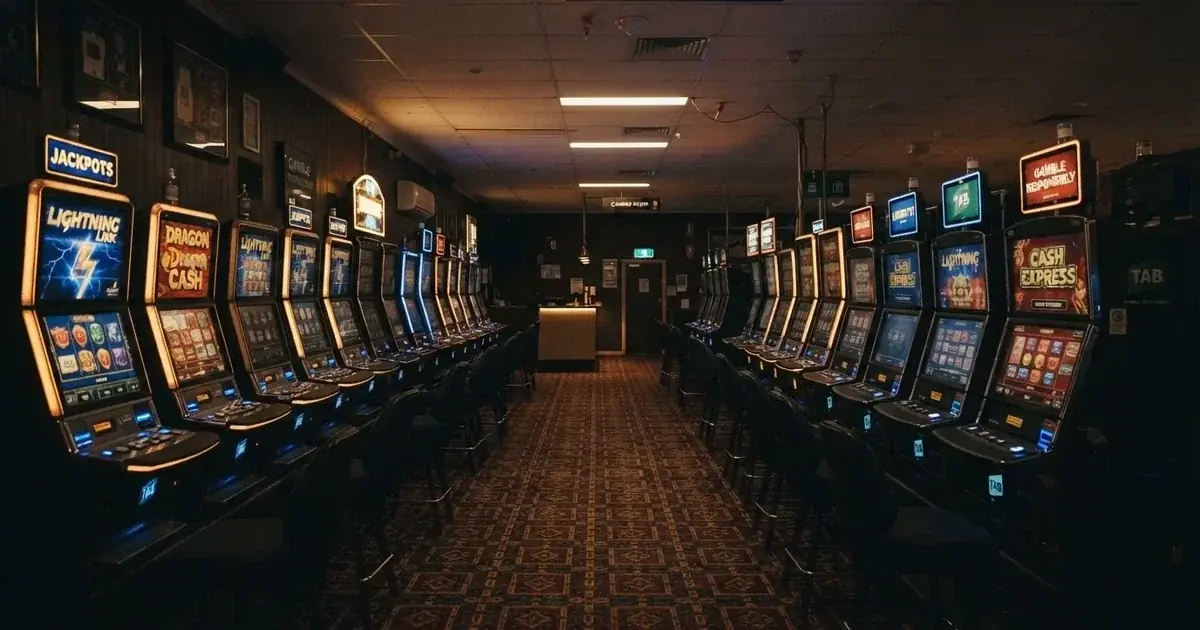
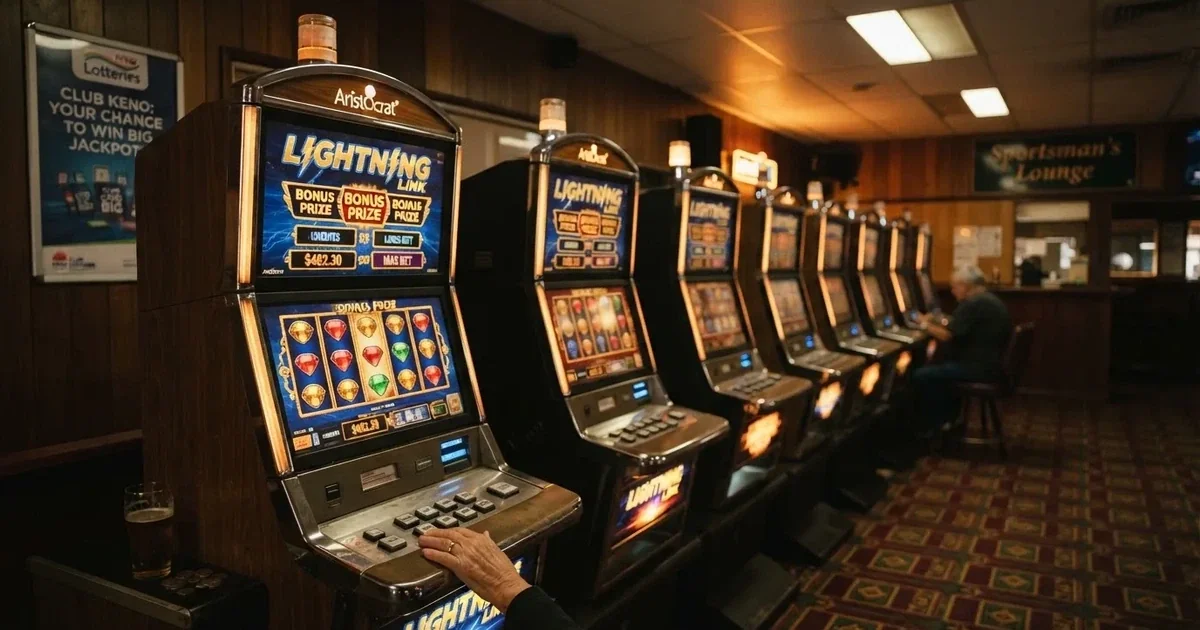
Pokies is the Australian term for electronic gaming machines. In NSW the machines are licensed by Liquor & Gaming NSW, an arm of the NSW Department of Creative Industries, Tourism, Hospitality and Sport, and they sit in licensed pubs, registered clubs and the two Sydney casinos. NSW had 87,298 gaming machines outside casinos, in 2,195 venues, as at June 2023 — a larger base than every other state combined by venue count, with the bulk of those machines running in the clubs that dominate the regional towns. The NSW machine estate outside casinos is, in raw volume, the densest in the country.
In the 2022–23 financial year, NSW gaming-machine players lost A$8.18 billion outside casinos, an average of about A$986 per adult. The turnover figure for 2020–21 was A$85.72 billion, or about A$13,559 per adult — turnover being the total amount staked before wins are paid back. The gap between loss and turnover is the return-to-player rate the state regulates, and the scale of both numbers is what the rest of this page sits beside.
Two licensed casino sites operate inside the state. The Star Sydney has run on Pyrmont since the mid-1990s under the casino licence regime administered by the NSW Independent Casino Commission. Crown Sydney at Barangaroo opened in December 2020 as the second Sydney casino, run by Crown Resorts. Both have come under formal regulatory action over the period this page covers, which is worth its own paragraph further down. Visitors and locals are otherwise looking at the pub and club estate, not at a casino floor, and that estate is what a search for “pokies near me NSW” turns up.
How NSW compares with the rest of Australia
NSW is not the only state with a deep pub and club estate, and a reader weighing a venue in Sydney against one in Adelaide or Brisbane needs to know what the numbers actually look like side by side.
Queensland had 21,122 gaming machines in 351 venues in October 2023, fewer machines and fewer venues than NSW, with a heavier concentration in the southeast corner and a single casino licence held by Star Entertainment Group. Treasury Casino in Brisbane’s historic Treasury Building closed on 25 August 2024 to make way for The Star Brisbane at the new Queen’s Wharf precinct, which began a staged opening on 29 August 2024. That handover sat on top of a December 2022 finding by the Queensland Government, acting on a review by former Court of Appeal judge Robert Gotterson, that Star Entertainment was unsuitable to hold its Queensland casino licences after it misled regulators and failed its anti-money-laundering duties. Star was fined $100 million on 9 December 2022, with a 90-day suspension of the Treasury Brisbane and Star Gold Coast licences deferred to 1 December 2023 to allow remediation. The replacement venue at Queen’s Wharf was developed jointly with Hong Kong-based Chow Tai Fook Enterprises and opened against that background, with the casino floor and premium gaming rooms first through the door.
South Australia runs a different shape. Adelaide Casino sits inside the heritage-listed Adelaide railway station building on North Terrace and is the sole licensed casino in the state under the Casino Act 1997. It opened on 12 December 1985, was sold to SkyCity Entertainment Group in June 2000, was renamed SkyCity Adelaide in April 2001, then reverted to the Adelaide Casino name in 2009. A 2015–2021 Riverbank precinct redevelopment worth about A$330 million added the EOS by SkyCity tower, which opened in 2021 with 120 hotel rooms and expanded gaming space. The licence formalised on 11 October 2013 extended the table-game monopoly to 30 June 2035 and allowed the casino to expand to up to 200 gaming tables and 1,500 gaming machines subject to redevelopment. Outside Adelaide Casino, South Australia had 11,672 gaming machines in 471 venues in September 2023 — a smaller estate than NSW by a wide margin. South Australia also sets the regulatory floor the rest of the country uses as a benchmark: a minimum gaming-machine return-to-player rate of 87.5% and a general maximum bet of A$5.00 outside the casino, while Adelaide Casino itself has no maximum-bet limit. South Australian gaming-machine losses outside Adelaide Casino totalled about A$0.92 billion in 2022–23, equivalent to about A$497 per adult — a much smaller per-adult figure than NSW’s, reflecting both the smaller estate and the lower machine density.
The ACT runs Casino Canberra, in the Canberra CBD, built on land excised from Glebe Park under a 99-year lease and notable for what it does not have: no hotel, no theatres, no retail. It is the first legal casino in the Territory and the only licensed casino venue inside it.
For a punter reading those four markets side by side, the picture is that NSW runs the largest and most diffuse pub and club estate in the country, that the casino floor in Sydney is a different and tighter regime, that Queensland is rebuilding its single casino licence from a regulator-imposed reset, and that South Australia and the ACT offer smaller markets with different rules and a single licensed casino each.
Paying into and out of a NSW pub or club
A NSW pub or club gaming machine takes cash. There is no app to load, no digital wallet to top up, no debit-card tap at the machine. The cashless gaming debate sits in the NSW policy space but has not been rolled into the on-floor product, and the published research for this page does not carry a date by which cashless pokies become mandatory in the state. A punter walks in with notes or coins, converts them to credits on the machine, and walks out with whatever remains as cash at the cashier. That is the whole deposit and withdrawal loop on the regulated side.
The settlement question a reader is really asking — how long until I can spend what I have won — is not the right shape for this market. Winnings are paid out as cash at the venue’s cashier, usually at the bar in a pub or at the cashier’s desk in a club, with no banking intermediary in between. The transaction is the same length as buying a drink. There is no “payout speed” tier to compare against, in the way an offshore casino page would lay one out, because the product is not a wallet the venue holds on the player’s behalf.
What does vary venue to venue is the maximum cash payout a single machine will dispense. Older machines pay out a fixed ceiling per transaction, often a few hundred dollars, and a bigger win requires an attendant call. Newer machines have higher ceilings, and the bigger Sydney casino floors sit on different payout structures entirely. A reader who wants to know the ceiling before they play needs to ask the venue, not search it.
The research behind this page carries no Australia-wide study that gives a like-for-like payout percentage on NSW pub and club machines against Brisbane, Adelaide or Melbourne. The South Australian minimum of 87.5% return-to-player sets the floor in that state, and NSW regulates its own minimum return-to-player rate, but a head-to-head comparison by city was not in the consulted sources.
The paytable, the denomination and the hours
A NSW pub or club machine runs on a regulated paytable — the schedule of symbol combinations, prizes and feature rounds the game presents. The denomination is set by the venue, often one cent, two cents, five cents, twenty cents, a dollar or two dollars per credit, with the prize scale scaling up with the credit value. The maximum bet on a pub or club floor is capped by state regulation in most Australian states; NSW sets its own ceiling on machine wagers in licensed venues, and a player needs to check the screen on the machine or ask staff for the cap the venue runs at.
Opening hours are not uniform. Most NSW pubs run gaming machines during the licensed trading hours of the venue, which usually means from late morning until late evening, and clubs run them through the day and into the night. The “24-hour pokies” idea belongs to the two Sydney casinos — The Star Sydney and Crown Sydney — which run continuous gaming floors as a core part of their licence. A reader looking for 24-hour access on a Tuesday is, in practice, looking at one of those two casino floors, not at a pub or a suburban club.
Casino floors are also the only venues inside NSW where a player walks onto a machine that runs without the state’s pub-and-club stake cap. The casino licence regime sets its own machine limits, and the games on those floors can carry higher maximum bets and different prize structures than a club machine on a Saturday afternoon. The Crown Sydney opening in December 2020 expanded that floor in the harbour city for the first time in a generation.
The legal frame: why “online pokies NSW” is not a product
The Interactive Gambling Act 2001, strengthened by the Interactive Gambling Amendment Act 2017, makes it an offence to provide online casino games, online pokies or in-play betting to a person physically in Australia. No state or territory issues a licence for the prohibited product, which is the reason the marketing pages attached to the offshore brands further down this article can never show an Australian gambling licence. What is licensable is wagering on races and sport placed before the event, lotteries and keno — in practice licensed by the Northern Territory Racing and Wagering Commission, a body that meets once a month in Darwin and regulates 52 of Australia’s online bookmakers, including Sportsbet, Bet365 and Ladbrokes, licensed in the Territory for tax reasons.
The minimum age to play any gaming machine in NSW is 18. Both Sydney casinos were fined by the NSW Independent Casino Commission in a coordinated enforcement action on 19 August 2026 — Crown Sydney $1.75 million and The Star Sydney $500,000 — for allowing a minor to enter each venue, which is what the law looks like when it is broken. Earlier, on 2 June 2026, the NSW Independent Casino Commission issued The Star Sydney a total of $10 million in fines along with an enforceable undertaking, the published reason being governance and operational failures identified by the regulator’s inquiries.
The legal product is the venue floor. The illegal product is anything that asks an Australian customer to spin a casino game from a phone or a laptop.
The offshore “pokies” brands the ACMA has acted against
The Interactive Gambling Act is enforced by the Australian Communications and Media Authority. The ACMA investigates complaints, issues formal warnings to offshore operators, and can direct Australian internet service providers to block illegal sites. The individual player is not prosecuted — the law targets the provider — but a site that is unlawful gives no Australian consumer protection, no complaints body and no recourse if a withdrawal is refused, and it can be blocked with a balance still on it.
What follows is not a ranking and not a recommendation. Each brand is listed because the ACMA itself issued a formal warning over it for offering prohibited services to Australians. No bonus terms are given, because the only sources for those terms are the affiliate marketing pages the regulator has acted against, and a description that leans on those pages would be quoting from a file the ACMA has open. What each entry carries is the warning, the date the ACMA published it, the operator name on the warning, and the subject support a third-party listing source provided.
| Brand | ACMA action and date | Operator named by the ACMA | Subject support |
|---|---|---|---|
| RocketPlay | Formal warning, March 2026; earlier Dama N.V., May 2022 | Pulsup Ltd (Rocketplay.com.au) | No third-party listing data found |
| Level Up Casino | Formal warning, May 2022 | Dama N.V. | Listed by third-party sources, none confirming Australian legality |
| Woo Casino | Formal warning, March 2025 | Dama N.V. | Listed by third-party sources, none confirming Australian legality |
| Spirit Casino | Formal warning, May 2025 | Dama N.V. | No third-party listing data found |
| National Casino | Formal warning, July 2025 | Consolutetish S.R.L. | Listed by third-party sources, none confirming Australian legality |
| Bizzo Casino | Formal warning, July 2025; earlier TechSolutions, 2022 | Consolutetish S.R.L. | No third-party listing data found |
| Ignition Casino | Formal warning, July 2025 | Bamboo Media | No third-party listing data found |
| Instant Casino | Formal warning, February 2025 | EOD Code SRL | No third-party listing data found |
| Jackbit | Formal warning, April 2026 | Ryker B.V. | No third-party listing data found |
| Casino Intense | Formal warning, April 2025 | Sterplay Holding Ltd | Listed by third-party sources, none confirming Australian legality |
| Sky Crown | Formal warning, September 2022 | Hollycorn N.V. | Listed by third-party sources, none confirming Australian legality |
RocketPlay is the most recent of the Dama N.V. cluster to come back on the ACMA’s radar. The March 2026 formal warning named Pulsup Ltd over the Rocketplay.com.au domain; the May 2022 warning had already covered the brand under its earlier operator. A punter who lands on the site today is reading marketing written for a product that does not exist in Australian law, with the operator on a second warning.
Level Up Casino carries a single warning, the May 2022 Dama N.V. action, which covered six brands in the same notice. The subject support in the research is listings-only — third-party sources describe the brand, none of those descriptions amount to an Australian licence.
Woo Casino took its formal warning in March 2025, a separate action from the 2022 round, which means the operator has now appeared on the ACMA’s list more than once.
Spirit Casino took its warning in May 2025, the third Dama N.V. brand in that cluster to surface over twelve months.
National Casino sits under Consolutetish S.R.L. after the July 2025 warning. The operator name is different from the Dama N.V. group, and the warning is a fresh action rather than a re-issue.
Bizzo Casino is the second brand on the same July 2025 Consolutetish S.R.L. notice. The brand had already drawn a 2022 formal warning, this time to TechSolutions (CY) Group Limited and TechSolutions Group N.V., which is the kind of repeated appearance the ACMA’s record surfaces when the operator changes shell.
Ignition Casino arrived in July 2025 under Bamboo Media, a fresh operator name. No third-party listing source carried Australian legality data, which is the standard finding rather than the unusual one.
Instant Casino took its warning in February 2025 under EOD Code SRL. The brand had no third-party listing entries in the consulted set.
Jackbit took its warning in April 2026 under Ryker B.V., alongside CasinOK, which the same notice covered.
Casino Intense took its warning in April 2025 under Sterplay Holding Ltd. The brand was listed across several third-party sources, none of which cleared it under Australian law.
Sky Crown is the oldest entry on this list. The Hollycorn N.V. warning over Sky Crown and Blue Leo is on the ACMA’s record from September 2022, and the brand’s listing profile across third-party sources has not changed the underlying legal status.
What a punter takes from the table is a list of names the ACMA has had to name in print, more than once in some cases. None of them are licensed in Australia. None of them can be. The marketing pages that turn up beside a search for “NSW pokies” are not a substitute for the licensed venue, they are the regulator’s case file.
How many sites have been blocked, and at what rate
The ACMA’s blocking power is the sharpest tool the IGA gives the regulator. As reported in June 2026, a total of 1,751 illegal gambling and affiliate marketing websites had been blocked since the first blocking request in November 2019 — a roughly six-and-a-half-year window. Over the same period, more than 230 unlicensed gambling services had left the Australian market since enforcement was strengthened in 2017.
Put those two figures together and the rate comes out somewhere in the high two hundreds of blocked sites a year on average since 2019, with the number of distinct services leaving the market running alongside. The headline is that the regulator has been blocking sites at a sustained pace for years, not in one-off bursts, and that the offshore brands on the table above are exactly the kind of sites the blocking notices go out against. The H2 Gambling Capital 2025 estimate is that Australians lose about A$3.9 billion a year to illegal gambling sites, and that the share of gambling going through legal channels fell from 74% in 2021 to 64%, which is the size of the funnel the ACMA is trying to close.
The June 2026 blocking round itself asked Australian internet service providers to block 12 more illegal gambling websites in one action: 7Signs, ChromaBet, Donbet, Duospin, Freshbet, Slots Gem, Jacks Club, Lucky Start, Pointsbetz.com, Spinrise, Vinyl Casino and Wildsino. The pace has not slowed.
The cost of the offshore product in real terms
A punter who clicks through to one of the brands in the table is not buying a casino licence they cannot have. They are buying a balance on a site the regulator can block on a Tuesday, with no Australian complaints body if a withdrawal is refused, no recourse if the site disappears overnight, and no connection to BetStop or any other Australian self-exclusion register. The marketing word is “pokies” and the legal word is “prohibited interactive gambling service”. The cost is whatever the player deposits plus whatever the regulator’s next blocking round costs them in access.
The research behind this page does not carry a wagering multiple or a max-cashout figure for any of the eleven brands above, because the only sources for those figures are the affiliate marketing pages the regulator has acted against. A punter who wants to know what a “pokies welcome bonus” actually costs them on one of those sites has to read the site’s terms page, not a search-results summary, and even then the cost is the unregulated withdrawal risk the site carries with it.
Responsible gambling on the licensed NSW floor
A NSW pub, club or casino player who wants to limit their own access has Australian-registered tools to use. BetStop, the National Self-Exclusion Register, has been live since August 2023 and binds every Australian-licensed online and phone wagering service. The constraint is that BetStop binds the licensed wagering industry only — an offshore casino is not connected to it, which is one of the reasons playing on an offshore site is a different kind of decision from playing at a NSW pub. State-level self-exclusion schemes operate through the venues themselves, with the NSW framework running on the registers each venue holds. A punter who self-excludes at one venue is not automatically excluded from another, which is the structural reason the national register exists.
The National Gambling Helpline on 1800 858 858 is free and runs around the clock, with chat available through Gambling Help Online. The service is the first line of support for a punter who has stopped enjoying the sessions, who is chasing losses they cannot afford, or who wants a third party to walk them through the next step. A family member who is worried about someone else’s play can use the same number.
The financial rules around the licensed product are tighter than the offshore one. Credit cards, credit-related products and digital currency are banned as payment for licensed online wagering since 11 June 2024, with penalties up to $247,500 for operators who take them. The legal deposit routes for licensed wagering are debit card, bank transfer, PayID/Osko and BPAY. A site that asks an Australian customer for a credit card or a crypto deposit is operating outside the Australian rules by definition, because no Australian-licensed wagering site would be permitted to take either.
On tax, gambling winnings of a recreational player are not assessable income under section 6-5 of the Income Tax Assessment Act 1997, and losses are not deductible, unless the person carries on a business of gambling. The ATO’s published position is the model, and a punter with anything more than a casual question should check with the ATO or a registered tax agent rather than work it out from the headlines.
The 2026 reform picture: the Interactive Gambling Amendment (Gambling Reform) Bill 2026 passed Parliament on 19 August 2026, with its advertising and inducement measures commencing on 1 January 2027. On a 2026 page the law is law with a start date, not yet in force, which means the substantive restriction in this article is the IGA in its 2001 and 2017 form. The 2026 reform will tighten the inducement rules once it commences.
Working out what an offer is really worth
The marketing pages attached to the offshore brands run a “free spins” or “deposit match” line on every landing page. The arithmetic behind the offer is the same arithmetic that applies to any wagered bonus — the wagering multiple is the number of times the bonus has to be turned over before a withdrawal, the maximum cashout is the ceiling on what can be taken out, and the contribution rate is the share of each game type that counts toward the multiple. The research behind this page does not carry the multiples, ceilings and contribution rates for any of the eleven brands above, because the only sources for those figures are the affiliate marketing pages the regulator has acted against.
A punter who wants a working example of what a wagering multiple costs in real time can take any number on any bonus terms page and divide the required turnover by the stake-per-spin to get the number of spins, then divide the spins by twelve spins a minute to get the play time. A 30x multiple on a A$100 bonus at A$1 a spin is A$3,000 of turnover, 3,000 spins, and about four hours and ten minutes of continuous play at the average spin rate — and that is the floor on the bonus, before the house edge is subtracted on each spin. The same arithmetic on a 50x multiple on a A$200 bonus at A$1 a spin is A$10,000 of turnover, 10,000 spins, and close to fourteen hours of continuous play.
What makes the arithmetic stingier on the offshore product than the math reads is that the house edge is taken on every spin, and the wagering requirement is rarely the only restriction — there is usually a maximum cashout, a game-weighting rule that reduces slot play to a fraction of its real rate, and a deadline on the bonus that turns “four hours of continuous play” into “four hours in the next seventy-two hours, or the bonus is void”. The marketing word is “bonus” and the legal word is “a wagering requirement that has to be cleared before any withdrawal, with the house edge eating the balance along the way”.
What this page is not trying to do
This page is not a comparison of offshore online casino brands, and the table of ACMA warnings is a record of regulatory action rather than a ranking. There is no “best offshore pokies site for NSW” because the product is not legal in NSW, and a recommendation in that direction would be recommending something the regulator has warned against. The page also is not a directory of NSW venues — Liquor & Gaming NSW publishes the licensed venue register, and that register is the authoritative source for the on-floor product.
The reading the page is set up to support is the one a punter actually has to make: where the licensed product sits, what it costs in machine density and per-adult loss, what the offshore “pokies” sites actually are in the eyes of the regulator, and what the responsible-gambling support looks like for the licensed floor. The arithmetic in the bonus section is there to puncture the marketing word, not to encourage a reader toward an offshore site.
Frequently asked questions
Which venues in New South Wales are licensed to operate pokies?
Pubs, clubs and the two Sydney casinos. The pub and club estate is licensed by Liquor & Gaming NSW, and the casino floors — The Star Sydney at Pyrmont and Crown Sydney at Barangaroo — are licensed under the casino regime administered by the NSW Independent Casino Commission. As at June 2023 there were 87,298 gaming machines outside casinos across 2,195 NSW venues.
Are pokies in New South Wales available around the clock?
The two Sydney casinos run continuous gaming floors. Pubs and clubs run machines during the venue’s licensed trading hours, which usually means late morning to late evening, and clubs run longer into the night than most pubs. The “24-hour pokies” frame the search pulls in is, in practice, a casino product.
What identification do venues in New South Wales require before letting someone play pokies?
A NSW pub or club checks identification at the door on a sign-in basis, and the casino floors run a full identity check at entry. The minimum age to play any gaming machine in NSW is 18. Both Sydney casinos have been fined by the NSW Independent Casino Commission for allowing a minor to enter, most recently on 19 August 2026, which is what enforcement of the age rule looks like when it is broken.
Can visitors to New South Wales use self-exclusion schemes at local pokies venues?
The national register BetStop binds Australian-licensed online and phone wagering services and does not extend to venue-based play. Self-exclusion at NSW venues runs through each venue’s own register, and a self-exclusion at one venue does not automatically extend to another. Visitors can use the National Gambling Helpline on 1800 858 858 to find out what state-level support is available during their stay, including chat at Gambling Help Online.
How does the payout percentage on New South Wales pokies compare with other Australian cities?
South Australia sets a published minimum gaming-machine return-to-player rate of 87.5% outside the casino, with a general maximum bet of A$5.00, and Adelaide Casino itself runs no maximum-bet limit. NSW regulates its own minimum return-to-player rate for pub and club machines but the consulted sources do not carry a like-for-like head-to-head figure between NSW, Brisbane, Adelaide and Melbourne venues. A punter who wants the percentage on a specific machine needs to read the help screen on the machine itself.
Is it legal for an online casino to advertise “pokies” in New South Wales the same way a pub or club does?
No. The Interactive Gambling Act 2001, strengthened by the Interactive Gambling Amendment Act 2017, makes it an offence to provide online casino games or online pokies to a person in Australia, and no state or territory licences them. The ACMA enforces the prohibition by issuing formal warnings and directing Australian internet service providers to block illegal sites. As reported in June 2026 a total of 1,751 illegal gambling and affiliate marketing websites had been blocked since November 2019, with more than 230 unlicensed services having left the Australian market since 2017.