

Best Pokies in Melbourne in 2026: What the Licence Actually Buys
A punter searching for pokies in Melbourne in 2026 lands on a market that is two things at once: a tightly licensed onshore industry of pubs, clubs and a single integrated casino on the Yarra, and a thicket of offshore websites that use the word “pokies” the way a pub sign does but cannot offer the product to anyone in Australia. Both halves matter, and confusing them is where the most expensive mistakes start. The onshore side is regulated, audited and bound by harm-minimisation rules. The offshore side is unlawful under the Interactive Gambling Act 2001, no matter what licence badge it shows, and the Australian Communications and Media Authority has been steadily naming, warning and blocking the operators behind it.
The reason the distinction is worth drawing at length is that the marketing vocabulary is identical. An offshore site calls its slots “pokies”, calls its sign-up package a “welcome bonus”, and runs affiliate pages that name Australian suburbs. The page that follows is built around what that vocabulary actually buys a Melbourne reader in 2026: which venues the Victorian regulator licences, how the payout percentages compare with other capital cities, where the responsibility provisions sit when play stops being fun, and what the ACMA enforcement record looks like for the brands that have tried to fold the two markets into one.
Data current as of 22 November 2026; licences and ACMA enforcement actions cross-checked against the Victorian Gambling and Casino Control Commission register and the ACMA’s own formal-warning register.
Table of Contents
- Melbourne’s land-based poker-machine landscape in 2026
- The venue map: Crown, the CBD pubs, the suburban clubs
- How payouts actually work on Melbourne pokies
- The offshore gap: ACMA warnings, blocking requests, the Interactive Gambling Act
- The ACMA blocking record as a Melbourne reader’s buying signal
- Comparison: ACMA enforcement record across brands named in formal warnings
- Brand write-ups: what the ACMA record actually says
- Responsible gambling in Melbourne: where the obligations actually sit
- How the Melbourne pokies market compares with the rest of Australia
- The licensing frame around online wagering in Australia
- Payments: what lawful deposit routes look like
- The 2026 reader’s buying checklist
- Where this leaves a Melbourne reader in 2026
- Frequently asked questions
Melbourne’s land-based poker-machine landscape in 2026
The headline number is straightforward and grim. Victorians lost A$3.318 billion on electronic gaming machines in 2025–26, a record, according to the Victorian Local Governance Association. That figure sets the scale of the market the reader is stepping into: a state-licensed system that generated more in twelve months than many national budgets, and a corresponding web of harm-minimisation rules that came out of what Crown Melbourne admitted during the Finkelstein Royal Commission.

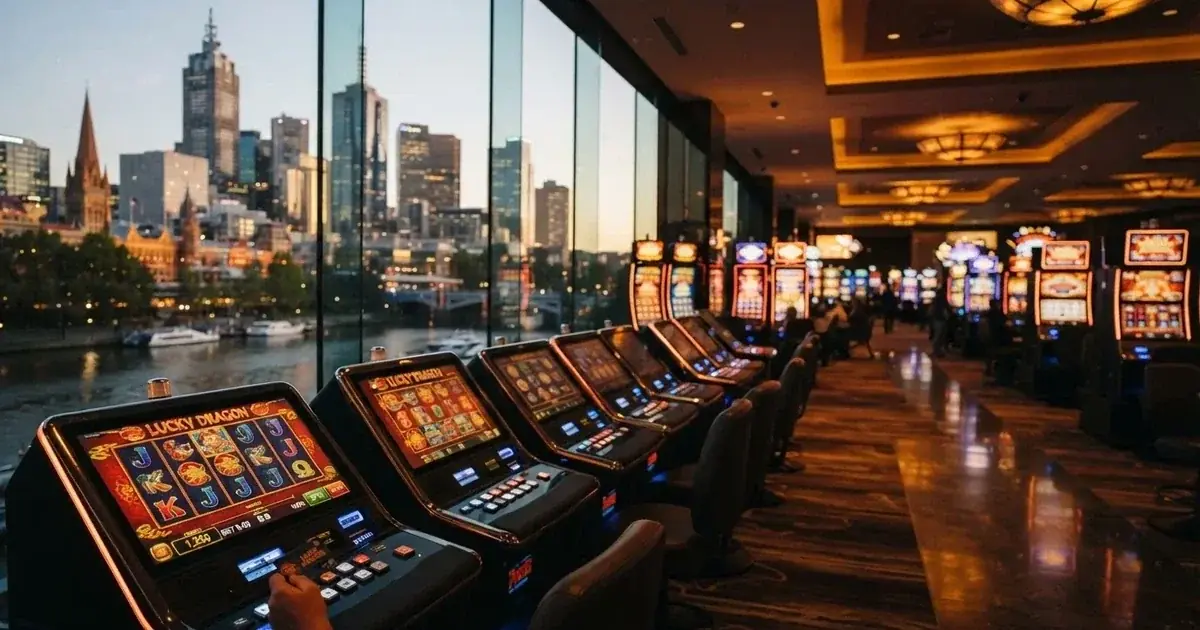
The Crown complex is the centre of gravity. Crown Melbourne sits on the south bank of the Yarra River, a 510,000 m² building that takes up roughly two city blocks. It opened temporarily in 1994 at the World Trade Centre on the north bank, then reopened in the current south-bank building in 1997. Within that footprint are about 2,500 poker machines, 540 licensed table games and 100 poker tables, plus 1,604 hotel rooms across three towers. It is the largest casino complex in the Southern Hemisphere by floor area, and the only casino licence in Victoria. That single licence is the reason the rest of the state operates under a different regime.
Outside Crown, Victoria runs a capped system. As of 2021–22 the state had 26,380 gaming machines across 488 pubs and clubs, sitting beneath a hard 30,000-machine statewide ceiling. Each machine in those venues operates under the Victorian Gambling and Casino Control Commission’s rules: the spin rate, the bet ceiling, the closing-time constraints, the mandatory break periods. The cap has been in place long enough that new EGMs enter the state only when venues upgrade existing entitlements, which makes the per-venue footprint a slow-moving target rather than a free market. A punter who wants a “best paying pokies in Melbourne” comparison is asking, in practice, about small differences in return-to-player percentages across machines within a closed pool, not about a wide-open retail market.
The venue map: Crown, the CBD pubs, the suburban clubs
Melbourne is not one market but three, and the practical difference between a session at Crown and a session at a suburban RSL is large enough to plan around.
Crown Melbourne is integrated. A single venue licence covers the gaming floor, the hotel, the restaurants and the theatre, and the gaming floor alone spans about 220,000 square feet. For a visitor this is the simplest version of the question: one address, every stake tier the casino is licensed to offer, table games alongside the machines, and the highest concentration of poker machines in the country. It is also the venue the Royal Commission examined at length. The 2021 findings — evidence of money laundering and organised-crime links — led to a two-year review period under a court-appointed Special Manager, and to two later fines that together cleared A$200 million. The point is not that Crown is closed or that the licence was revoked; it was not. The point is that this is the only casino in the state, and the regulator’s record with it is on the public file.
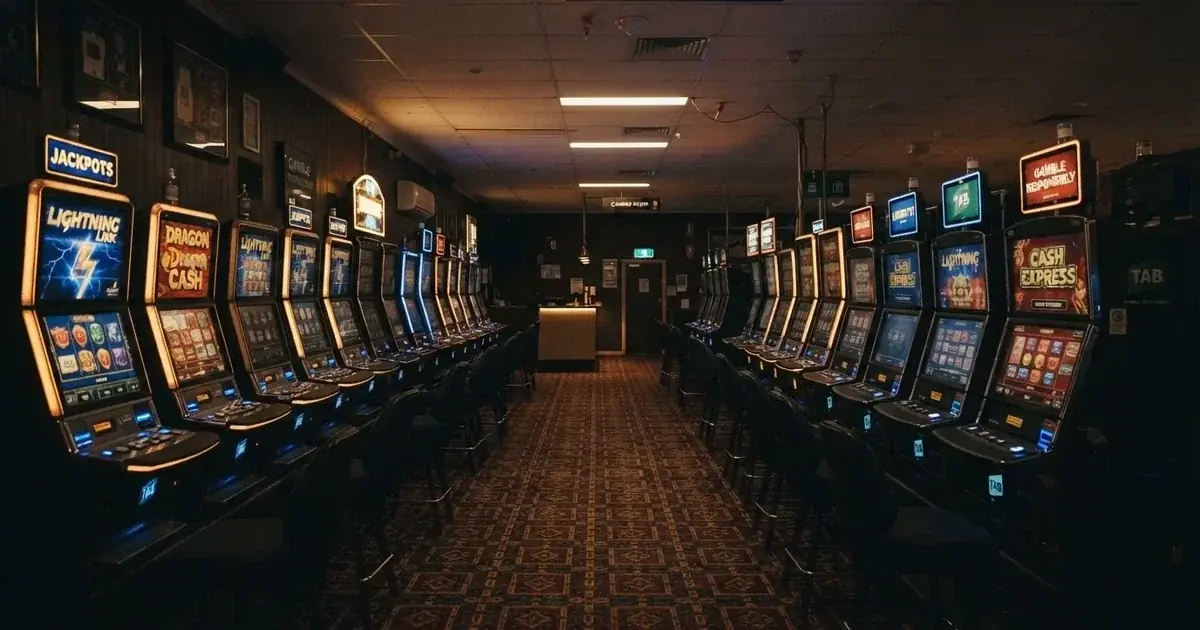
The CBD pubs and clubs are the second tier. The phrase “best pokies in Melbourne CBD” usually means the handful of hotels within walking distance of the central business district that hold gaming-machine entitlements. These venues sit between roughly 8 a.m. and the small hours, with closing times set locally and enforced by the VGCCC. The experience is the standard pub-pokies format: a smaller gaming area, often one bank of machines rather than a floor, lower maximum bets than the casino, and a faster turnover of patrons.
The suburban and outer-suburban venues make up the volume of the state. The 488 pubs and clubs carrying EGMs stretch from the inner suburbs out past the airport corridor and into the growth corridors of the west and the north. A reader searching “pokies near Melbourne Airport” or “pokies North Melbourne” is looking at this layer, and the practical difference from the CBD is opening hours, peak-time crowding and machine density per venue. The maximum-bet ceiling outside the casino is set under the Victorian regulations and applies uniformly to every pub and club EGMs.
Crown is the single integrated venue. The CBD pubs and clubs are the inner-ring convenience tier. The suburban venues are where most of the 26,380 non-Crown machines actually sit, and where the bulk of the A$3.318 billion was lost. None of those venues can lawfully extend their offering to an Australian resident through a website or an app: online casino games and online pokies are prohibited under the Interactive Gambling Act 2001, and the operator behind any site that takes a Melbourne punter’s deposit is committing the offence, not the player.
How payouts actually work on Melbourne pokies
The phrase “best paying pokies Melbourne” sounds like a comparison a reader can shop. It is, but the spread is narrower than the marketing suggests, and what determines the spread is which regime a machine sits under.
EGMs in Victorian pubs and clubs are set within a regulatory return-to-player envelope. The state requires a minimum theoretical return and a maximum-bet ceiling that every non-casino venue must respect. Inside that envelope the venue can pick higher-RTP titles within the licensed range, and the operator’s choice — Aristocrat, IGT, Konami, AGS and a handful of others — is where the practical differences sit. Two machines on the same venue floor can carry different theoretical returns, and that is what a careful punter can ask about before sitting down. A maximum-cashout figure, where the venue publishes one, also bites differently across machines, and the bigger the denomination the higher the ceiling usually is.
Crown Melbourne sits outside the EGM envelope. The casino’s poker machines run on the casino licence, and the regulator does not impose the same maximum-bet ceiling that pubs and clubs carry. That is the reason a reader will sometimes hear that Crown’s machines “pay out more” or “have higher limits”. The cleaner description is that the bet ceiling is higher, the denomination range is wider, and the machine population is larger, so the worst-case and best-case sessions inside the casino sit further apart than they do in a suburban club.
The cross-state comparison is the one the FAQ usually wants. South Australia publishes a minimum EGM return-to-player rate of 87.5% and a general maximum bet of A$5.00 outside the casino; Adelaide Casino itself has no maximum-bet limit. New South Wales, Queensland and the ACT run their own regimes with different RTP floors and different bet ceilings. The differences between capital cities are real but they are percentage points, not multiples: a Victorian suburban EGM and a South Australian suburban EGM are both set within a regulatory band, and the gap between them is smaller than the gap between either of them and the casino-tier product.
The practical consequence is that the “best paying” question is less about the city and more about the denomination, the machine title, and the venue. A higher-denomination machine generally carries a higher theoretical return and a higher maximum-cashout ceiling. The trade is that the minimum spin cost is also higher. A punter with a small bankroll gets more session length on the lower-denomination machines and accepts the lower theoretical return as the cost of that length. That is a trade worth naming in plain prose, because the marketing around “best paying pokies” often leaves it out.
The offshore gap: ACMA warnings, blocking requests, the Interactive Gambling Act
The offshore side is where the page’s reader-language register earns its keep. Offshore online casinos cannot lawfully offer casino games or online pokies to a person in Australia. The Interactive Gambling Act 2001, tightened by the Interactive Gambling Amendment Act 2017, makes the provision of those services an offence, and the ACMA is the regulator that investigates, issues formal warnings, and asks Australian internet service providers to block offending sites. The individual player is not prosecuted; the IGA targets the provider. That distinction matters, because it explains why offshore sites are still reachable through some mirrors even after a block and why the enforcement pressure concentrates on the operators themselves.
The scale of the enforcement is large enough to be the headline. As of a round reported on 26 June 2026, the ACMA had asked ISPs to block 1,751 illegal gambling and affiliate marketing websites since the first blocking request in November 2019, and more than 230 unlicensed gambling services had left the Australian market since enforcement was strengthened in 2017. The same June 2026 round added twelve more names to the block list: 7Signs, ChromaBet, Donbet, Duospin, Freshbet, Slots Gem, Jacks Club, Lucky Start, Pointsbetz, Spinrise, Vinyl Casino and Wildsino. That puts the cumulative total in the high one-thousands by mid-2026.
The economic stakes are reported at a comparable scale. H2 Gambling Capital’s 2025 report estimates that Australians lose about A$3.9 billion a year to illegal gambling sites, and that the share of gambling going through legal channels fell from 74% in 2021 to 64%. The reason that figure belongs on this page is that the offshore “pokies” product is what the A$3.9 billion is being spent on, and the onshore industry — the A$3.318 billion Victorian loss figure above — is a separate ledger.
The legal framing, in plain prose: any online casino that offers a slot product to someone physically in Australia is providing a prohibited interactive gambling service, regardless of the offshore licence it displays. A Curaçao or Anjouan badge on the footer does not change the Australian position. A site that asks for a credit card or a crypto deposit is also operating outside the Australian consumer-protection frame, because credit cards, credit-related products and digital currency have been banned as payment for licensed Australian online wagering since 11 June 2024, with penalties up to A$247,500 for the operator. The lawful deposit routes for Australian-licensed wagering are debit card, bank transfer, PayID/Osko and BPAY, and those routes are not the routes an offshore casino will accept in the first place.
The 2026 reform agenda is real but not yet in force on a 2026 page. The Interactive Gambling Amendment (Gambling Reform) Bill 2026 passed Parliament on 19 August 2026, and its advertising and inducement measures commence on 1 January 2027. Law with a start date: present-tense statements about those measures being operative would be wrong on this page.
The ACMA blocking record as a Melbourne reader’s buying signal
The blocking request count above is the most useful piece of context a Melbourne reader can carry into any offshore “pokies” page. The arithmetic the page is built around is straightforward: the ACMA’s first blocking request was issued in November 2019, and the cumulative count of 1,751 blocked sites was reported in June 2026. The span between those two dates is roughly six years and seven months, or about 79 months. The implied blocking rate, stated as a band, runs at roughly twenty to twenty-four sites blocked per month across the full window, with the monthly cadence varying by enforcement round. The block list is not a uniform drip — the ACMA issues rounds of blocking requests every few weeks — but the long-run average is the order of magnitude that an offshore operator is working against. Each of those sites, including affiliate marketing pages, is something an Australian ISP is currently required to make unreachable.
The ACMA’s blocking record provides a useful context for how often enforcement actions occur. The enforcement window is uneven: enforcement was strengthened in 2017, formal-warning practice ramped through 2022 and 2025, and the June 2026 round alone added twelve sites. A reader who wants to know “how often does this happen” has the answer: more than twenty blocked sites a month on the long-run average, and that is the cumulative count of domains rather than the count of unique operators, because many of the same operator groups run multiple skins.
The implication for a Melbourne punter who lands on an offshore “pokies” page through an affiliate link is direct. The site is, statistically, more likely than not to be on a current or future ACMA block list. The marketing page is the same shape as the marketing page for any of the twelve brands blocked in the June 2026 round. The site may accept a deposit today, block withdrawals tomorrow, and the recourse the reader has is the offshore operator’s own complaints process — there is no Australian regulator to complain to, no AFCA-style external dispute body, and the ISP block can land while the balance is still sitting in the account.
Comparison: ACMA enforcement record across brands named in formal warnings
The table below covers the brands the ACMA has named in formal warnings, with the operator entity and the date the warning was published. None of these brands is an Australian-licensed online casino; the warnings exist because each of them offered prohibited interactive gambling services to people in Australia. A Melbourne punter encountering any of these names on a “best pokies” comparison page is being pointed at a brand that the ACMA has, on the public record, told to stop.
| Brand | ACMA Warning Date | Primary Entity | Subject Support |
|---|---|---|---|
| RocketPlay | March 2026 | Pulsup Ltd / Dama N.V. | N/A |
| Level Up Casino | May 2022 | Dama N.V. | Listings |
| Woo Casino | March 2025 | Dama N.V. | Listings |
| Spirit Casino | May 2025 | Dama N.V. | N/A |
| National Casino | July 2025 | Consolutetish S.R.L. | Listings |
| Bizzo Casino | July 2025 | Consolutetish S.R.L. | N/A |
| Ignition Casino | Formal warning, July 2025 | Bamboo Media | — |
| Instant Casino | Formal warning, February 2025 | EOD Code SRL | — |
| Jackbit | Formal warning, April 2026 | Ryker B.V. | — |
| Casino Intense | Formal warning, April 2025 | Sterplay Holding Ltd | listings-only |
| Sky Crown | Formal warning, September 2022 | Hollycorn N.V. | listings-only |
Three patterns are worth pulling out of that table. The first is that the operator entities behind these brands cluster: Dama N.V. alone accounts for four of the warnings listed, which is why the ACMA’s own register sometimes shows the same parent entity appearing across multiple brand names. The second is that the cadence accelerated across 2024 and 2025, with multiple warnings landing inside a single month. The third is that “subject support” — whether the ACMA’s own register cross-references the brand to any Australian subject matter at all — is sparse, and where it is present at all it reads as listings-only: the brand is named on Wikipedia, on the VGCCC’s site, or on a state-licensing page, but it is not licensed to offer online casino games to Australians, because no Australian regulator licenses that product.
Brand write-ups: what the ACMA record actually says
The write-ups below close out the eleven brands the ACMA has named in formal warnings. The page describes what the warnings were about, in plain prose. None of the brands is recommended as a place to play. The product category — online casino games and online pokies offered to Australians — is unlawful under the Interactive Gambling Act 2001, so each write-up closes on the same regulatory reality regardless of brand.
RocketPlay carries the most recent Dama N.V. warning on the ACMA’s register, after Pulsup Ltd took over the RocketPlay operation and was warned in March 2026 for offering prohibited services. Dama N.V. itself had already been warned in May 2022, when the warning covered six brands including Rocketplay. Two formal warnings on the same brand, four years apart, with a different operator entity in between, is the pattern an Australian reader should expect when an offshore brand changes hands. The product category is the same.
Level Up Casino sits on the May 2022 Dama N.V. warning. The brand name has been repackaged and re-sold by Dama N.V. across multiple skins since then, which is why a Melbourne punter may see “Level Up” appear under different parent-company descriptions on affiliate pages. The ACMA’s named operator has not changed.
Woo Casino sits on the March 2025 Dama N.V. warning, the first of the 2025 Dama N.V. cluster. The brand was not on the original May 2022 warning list, which is what makes the March 2025 action the relevant entry on the ACMA register rather than an older line.
Spirit Casino sits on the May 2025 Dama N.V. warning, two months after Woo Casino. Two Dama N.V. brands warned inside three months is the ACMA’s way of signalling that the operator-group behaviour, not a single rogue site, is the issue.
National Casino sits on the July 2025 warning to Consolutetish S.R.L., the same round that brought in Bizzo Casino. The pairing on a single warning publication is the cleanest signal that the two brands were being run by the same operator entity and the ACMA treated them as a single action.
Bizzo Casino sits on the same July 2025 warning to Consolutetish S.R.L., with a 2022 prior warning to TechSolutions (CY) Group Limited and TechSolutions Group N.V. already on the register. Two warnings, three years apart, two different operator entities, same brand — the clearest pattern on the table for what offshore reincorporation looks like from the ACMA’s side.
Ignition Casino sits on the July 2025 warning to Bamboo Media. The brand is one of the older offshore casino names, and the warning is the ACMA’s first formal action on it. The product category is identical to the rest of the table.
Instant Casino sits on the February 2025 warning to EOD Code SRL. The brand markets aggressively to Australian readers through affiliate pages, which is what put it in front of the ACMA in the first place.
Jackbit sits on the April 2026 warning to Ryker B.V., a warning publication that also covered CasinOK. The same parent-entity, two skins, one warning: the same Consolutetish-on-National-and-Bizzo pattern reappearing under a different operator name twelve months later.
Casino Intense sits on the April 2025 warning to Sterplay Holding Ltd. The brand is one of the smaller names on the register by traffic, but the warning was published all the same, which is the ACMA’s signal that size does not exempt an operator from the prohibition.
Sky Crown sits on the September 2022 warning to Hollycorn N.V., which covered Sky Crown and Blue Leo together. It is the oldest warning on the table; the ACMA has had the same operator entity on its register for nearly four years.
The verdict on each of these brands is the same, and saying it eleven times is a misuse of the prose: the product category is prohibited, the ACMA has named the operator, and the page is not pointing a Melbourne reader at any of them as a place to play. What changes between the brands is the date of the warning, the operator entity behind it, and the evidence that the offshore casino market repackages the same product under new names faster than the ACMA can publish warnings.
Responsible gambling in Melbourne: where the obligations actually sit
The reason the responsible-gambling material belongs on a page about Melbourne pokies is that the onshore industry carries it as a condition of licence and the offshore industry carries it as marketing copy. The difference between the two is not rhetorical.
The principal national supports are BetStop and Gambling Help Online. BetStop, the National Self-Exclusion Register, has been live since August 2023 and binds every Australian-licensed online and phone wagering service. A punter who registers with BetStop is excluded from placing bets with every licensed Australian operator simultaneously. The catch — and the reason it sits in this section — is that BetStop binds only Australian-licensed services. An offshore casino is not connected to it, which means self-exclusion through BetStop does not stop an offshore site from accepting a deposit from the same person. The exclusion only goes as far as the Australian licensing frame.
The state self-exclusion schemes are the second layer. Victoria runs its own arrangements under the Victorian Gambling and Casino Control Commission, and a Melbourne punter can put a venue-level exclusion in place at Crown and at any pub or club that holds EGMs. The mechanism is different from BetStop: a venue-level exclusion is enforced by the venue itself, and the breadth of the exclusion depends on the scope the punter asks for.
The helpline is Gambling Help Online, with the National Gambling Helpline on 1800 858 858, free and 24/7. Chat is available at Gambling Help Online. The service is funded by the state and territory governments and is not connected to any operator’s marketing. That is the line that separates it from the “responsible gambling” pages an offshore casino publishes: the helpline is the support a reader can actually call.
The Crown Melbourne responsible-gambling record is the one the Royal Commission examined in detail. The two fines that followed — A$80 million in June 2022 for processing A$164 million in illicit payments, then A$120 million in November 2022 for a decade of responsible-gambling breaches including letting patrons gamble for more than 24 hours without a break — are the regulator’s documented position on what an inadequate responsible-gambling regime looks like at the venue scale. Crown kept its licence under a two-year review period with a court-appointed Special Manager, and the Casino and Gambling Legislation Amendment Act 2021 set up the Victorian Gambling and Casino Control Commission as the new dedicated regulator and banned junket operations at Victorian casinos.
The offshore “responsible gambling” page is a paragraph in a footer. The onshore regime is a regulator with a fine record. That is the difference the prose should make plain.
How the Melbourne pokies market compares with the rest of Australia
Melbourne is not unique in carrying a large EGM footprint. South Australia runs 11,672 gaming machines outside Adelaide Casino across 471 venues as of September 2023, with the casino itself holding 950 gaming machines and 90 gaming tables under the Casino Act 1997. South Australian non-casino losses totalled about A$0.92 billion in 2022–23, equivalent to about A$497 per adult — a smaller absolute pool than Victoria’s, on a smaller population base. Queensland runs 21,122 gaming machines across 351 venues as of October 2023, and the casino side moved in 2024 when Brisbane’s Treasury Casino closed on 25 August 2024 to make way for the new Star casino at Queen’s Wharf, which began a staged opening on 29 August 2024 at the A$3.6 billion Queen’s Wharf Brisbane precinct. The Star Brisbane’s licence position was already a question when the precinct opened, which is the regulatory backdrop Australian state casinos have been operating against for the last two years.
The cross-state comparison a Melbourne punter will most often want is payout percentage. South Australia publishes a minimum EGM RTP of 87.5% and a general maximum bet of A$5.00 outside the casino; Adelaide Casino itself carries no maximum-bet limit. The Victorian and Queensland regimes sit at similar RTP floors, with different maximum-bet and venue-closure rules. The spread between capital cities is real but it is within a band, not across it. A punter chasing a “best paying” venue by city is chasing a one- to two-percentage-point range rather than a different product category.
The other cross-state comparison is the casino licence. Victoria has one, held by Crown. South Australia has one, held by SkyCity Adelaide. Queensland’s casino footprint is in transition, with Treasury closed and Star Brisbane at Queen’s Wharf in staged opening. New South Wales runs The Star Sydney. Each of these casinos carries a single integrated licence and a regulator-supervised responsible-gambling regime; the differences between them are operational, not structural.
What Melbourne specifically carries that other capitals do not is the Finkelstein Royal Commission record, the two A$200 million-plus fines that followed it, and the Special Manager oversight period. The 2021 legislation that set up the VGCCC and banned junkets is the regulatory response, and it is the reason the responsible-gambling section above is heavier for Victoria than for the other capitals: the regulatory record here is the largest in the country.
The licensing frame around online wagering in Australia
The reason the offshore section keeps coming back to the Interactive Gambling Act is that the IGA is the legal frame the ACMA enforces. The Act was strengthened in 2017, which is the year the ACMA’s own enforcement statistics pivot from, and the same year the bulk of the modern offshore casino market began targeting Australian traffic. The offshore casino operator’s response to that frame is to display a non-Australian licence on the footer and to argue that the licence is the relevant authorisation. The Australian position is that the IGA’s prohibition is on the provision of the service to a person in Australia, not on the operator’s domicile, and the offshore licence does not change the prohibition.
Wagering on races and sport placed before the event is licensable in Australia, and most of Australia’s online bookmakers — Sportsbet, Bet365 and Ladbrokes among them — are licensed in the Northern Territory for tax reasons. The Northern Territory Racing and Wagering Commission regulates 52 of those online bookmakers. The Commission has no full-time staff and meets once a month in Darwin, which is a description of the licensing frame rather than a criticism of it: the NTRWC is the body that holds the licences, and the federal and state regulators hold the enforcement powers.
What the Northern Territory licence covers is wagering, not casino. Lotteries and keno are licensed separately. Online casino games and online pokies are not licensable anywhere in Australia, which is the cleanest one-sentence summary of the offshore section and the reason the IGA is the only relevant frame for the brands named in the ACMA register above.
Payments: what lawful deposit routes look like
The payment side of the prohibition is what catches readers who would otherwise assume the marketing is fine. Since 11 June 2024, credit cards, credit-related products and digital currency have been banned as payment for licensed online wagering in Australia. The operator penalty for taking a credit card or a crypto deposit is up to A$247,500.
| Method | Status | Usage |
|---|---|---|
| Debit card | Allowed | Licensed wagering only |
| Bank transfer | Allowed | Licensed wagering only |
| PayID/Osko | Allowed | Licensed wagering only |
| BPAY | Allowed | Licensed wagering only |
| Credit card | Prohibited | Banned for licensed wagering |
| Cryptocurrency | Prohibited | Banned for licensed wagering |
That is the inverse of what an offshore “pokies” site will accept. The offshore casino will typically accept credit cards, e-wallet transfers, cryptocurrency and a handful of prepaid vouchers, and will refuse or limit Australian debit cards because the acquiring bank will block the transaction. The payment menu is itself a tell: a site that offers a credit-card deposit to a Melbourne reader is operating outside the Australian consumer-protection frame, and a withdrawal problem on that same site has no Australian complaints body behind it.
The settlement-time question the FAQ usually wants is the second half of this. A licensed Australian wagering service settles a debit-card withdrawal through the Australian payments rails, which is the same rails as any other domestic card transaction. An offshore casino settles withdrawals through its own payments stack, often with a verification step that can run for weeks and a maximum-cashout limit that sits well below the size of a typical jackpot. The reason the settlement-time comparison matters is that the offshore site markets itself on payout speed, and the marketing is, in practice, an exception rather than the rule.
The 2026 reader’s buying checklist
A Melbourne punter weighing a real-money session in 2026 is choosing between two product categories and one offshore marketing layer, and the buying checklist is short.
The first question is whether the product is offered onshore or offshore. Onshore means a Victorian pub, club or Crown Melbourne, under a Victorian Gambling and Casino Control Commission licence. Offshore means an online casino operating under a non-Australian licence, offering a product the IGA prohibits the operator from offering to a person in Australia. The two categories are not interchangeable, and any comparison page that treats them as interchangeable is making a regulatory error.
The second question is what the responsible-gambling frame looks like. Onshore venues are bound by BetStop at the wagering level, by venue-level exclusion at the gaming level, and by the VGCCC’s record of fines for breaches. Offshore sites carry the responsible-gambling language in their footer and have no connection to either scheme.
The third question is the payment menu. Onshore wagering takes debit card, bank transfer, PayID/Osko and BPAY. Offshore casinos take credit cards and crypto. The payment menu tells the reader which regime they are in, and the regime tells the reader what their recourse is if something goes wrong.
The fourth question is the ACMA register. Eleven brands named above carry a formal warning from the ACMA. A Melbourne reader who lands on any of those names through an affiliate link is being pointed at a brand the regulator has already named.
Where this leaves a Melbourne reader in 2026
The honest summary is two-pronged. The onshore market is large, licensed and bound by a regulator with a public fine record. Crown Melbourne carries the only casino licence in the state; the 26,380 EGMs across 488 pubs and clubs carry the rest. The offshore market is unlawful under the IGA, and the ACMA has named, warned and blocked enough of its operators that the cumulative count of blocked sites sits in the high one-thousands, at a long-run blocking rate of more than twenty sites a month. A Melbourne punter with money to spend has a regulated onshore option and a prohibited offshore option, and the regulated option is the one the IGA, the ACMA and the VGCCC all point at.
The page does not recommend an offshore casino because none of them can lawfully offer the product. The page does not recommend a specific Crown machine or a specific pub. What it does is close the distance between the marketing vocabulary the reader meets and the regulatory frame that vocabulary actually sits inside. That distance is what most of the offshore “best pokies” comparison pages do not close, and closing it is the page’s purpose.
Frequently asked questions
Which venues in Melbourne are licensed to operate pokies?
Crown Melbourne, on the south bank of the Yarra, holds the only casino licence in Victoria and runs about 2,500 poker machines. The remaining 26,380 gaming machines in the state sit across 488 pubs and clubs outside Crown, each operating under a Victorian Gambling and Casino Control Commission entitlement beneath the 30,000-machine statewide cap. Online pokies venues in Melbourne are not licensed, because no Australian regulator licenses online casino games.
Are pokies in Melbourne available around the clock?
Crown Melbourne’s gaming floor runs extended hours, but every pub and club EGM in Victoria is bound by local closing times set under the VGCCC framework. The “around the clock” framing fits an offshore casino marketing page, not the onshore venue hours. A Melbourne punter planning a session should check the venue’s posted hours before travelling, especially in suburban and outer-suburban locations where closing times are earlier than in the CBD.
What identification do venues in Melbourne require before letting someone play pokies?
Every Crown Melbourne gaming-floor entry requires photo identification and proof of age. Pub and club EGM venues apply the same 18+ age check, and Crown applies additional identification because of the casino licence. The minimum age across Australia is 18. Offshore casinos ask for ID at the withdrawal stage, not the deposit stage, which is part of why a withdrawal can stall even after the deposit clears.
Can visitors to Melbourne use self-exclusion schemes at local pokies venues?
Yes. BetStop, the National Self-Exclusion Register, has been live since August 2023 and binds every Australian-licensed wagering service. Victoria also runs venue-level exclusion arrangements under the VGCCC, and a visitor can put a Crown or pub/club exclusion in place. The offshore casino market is not connected to BetStop, so an exclusion registered through BetStop does not stop an offshore site from accepting a deposit from the same person.
How does the payout percentage on Melbourne pokies compare with other Australian cities?
Victorian pub and club EGMs run within a regulatory return-to-player envelope set by the VGCCC, with maximum-bet ceilings that apply outside the casino. South Australia publishes a minimum EGM RTP of 87.5% and a general maximum bet of A$5.00 outside the casino, with Adelaide Casino carrying no maximum-bet limit. The capital-city differences are percentage points, not multiples, and the bigger spread within Melbourne is between the pub/club tier and the casino tier rather than between Melbourne and another capital.
Is it legal for an online casino to advertise ‘pokies’ in Melbourne the same way a pub or club does?
No. Online casino games and online pokies are prohibited interactive gambling services under the Interactive Gambling Act 2001. The ACMA issues formal warnings and asks Australian ISPs to block offending sites; the cumulative count of blocked sites sits at 1,751 as of June 2026, with more than 230 unlicensed services having left the Australian market since 2017. The marketing vocabulary is identical to a pub or club’s, but the legal status of the product is the opposite.