


The real cost of the ‘safe’ casino claim in Australia
The phrase “safe online casino” does a job in advertising that it does not do at an Australian bank. An Australian who wants to put a real-money spin on an online pokie, a hand of blackjack or a game of roulette has no Australian licence to walk up to. The Interactive Gambling Act 2001 closes that door, and the ACMA keeps knocking on the operators that ignore it. The phrase this article is built around — “safe online casino Australia 2026” — names a product the law does not offer. The whole page sits in that gap.

Current as of 22 November 2026 · Verified against the ACMA register and the IGA 2001 as currently published.
The way offshore sites answer the absence of a real licence is to print one they hold somewhere else, then wrap the page in words like “secure”, “regulated” and “responsible gaming”. The reader who arrives with “safe” in mind is being sold an impression, not a right. What follows is the cost of that impression — what the safety claim actually delivers, what it actually does not, and which of the safeguards Australians already have at the bank end carry more weight than any banner on the homepage.
Table of Contents
- Cluster 4 — The ranking that is not a ranking
- Cluster 1 — Fundamentals: what “safe” actually names on an offshore site
- Cluster 2 — Legality: the prohibition Australians actually face
- Cluster 3 — Responsible gaming: the safeguards that actually exist
- Bringing the three shelves together
- Frequently asked questions
Cluster 4 — The ranking that is not a ranking
The eleven names below carry no endorsement from this page. Each is listed because the ACMA itself has, at some point, issued a formal warning about it for offering prohibited interactive gambling services to people in Australia. The same entry under the ACMA’s own register could carry any other operator from the same parent company. The frame is enforcement, not preference.
RocketPlay — the freshest formal warning on file
The ACMA published a formal warning to Pulsup Ltd over Rocketplay.com.au in March 2026. That makes RocketPlay the most recently named operator in this group. The earlier Dama N.V. warning from May 2022 sits behind it for the same brand family, so the ACMA has come back to this corner of the market twice. Australian-licensed online casino games do not exist, regardless of the licence the homepage displays. Subject support: Gamblinginsider.com lists the brand only as marketing presence.
For a reader who took the safety claim at face value, the cost here is the cost of any offshore slot — the house edge, run over enough spins, on a platform that can disappear the morning after a fresh blocking round. The verdict on RocketPlay is the verdict on the entire shelf: a fresh formal warning does not tell you the brand is worse than its neighbours; it tells you the ACMA has reached this part of the list more recently than others.
Level Up Casino — a warning that has had time to age
The ACMA issued a formal warning to Dama N.V. in May 2022 covering six brands; Level Up is one of them. A warning from 2022 is now years old, and offshore operators routinely rotate brand names, licensees and shell companies under the same parent. The presence on the warning list does not date out: it stays on the record, and the ACMA still keeps the page public. The product itself — online casino games — is still prohibited to Australians.
For the reader, the four-year-old warning is the more dangerous one because it has had time to feel routine. The verdict: an old formal warning does not stop being a formal warning just because the calendar moved on.
Woo Casino — Dama N.V. back on the ACMA’s list in 2025
Dama N.V. received a fresh formal warning over Woo Casino in March 2025, three years after the original batch. The pattern repeats. Subject support carries no source listings. Operators of such sites face enforcement action under local law.
What Woo Casino shows is that warning, then rebranding, then a new warning is itself the business model of the offshore end of this market. The verdict: Woo Casino sits inside that pattern, not outside it.
Spirit Casino — the second 2025 warning to Dama N.V.
Spirit Casino drew a separate ACMA formal warning to Dama N.V. in May 2025. Two warnings, two months apart, to the same parent operator over two different brands. Subject support carries no source listings. This activity is restricted under local law.
For a reader weighing two Dama N.V. brands, the cost of choosing between them is the cost of choosing between two labels printed by the same company on the same shelf. Spirit Casino closes that comparison on the same line Woo Casino did.
National Casino — Consolutetish S.R.L. on the ACMA record
The ACMA issued a formal warning to Consolutetish S.R.L. over National Casino in July 2025. Subject support: the ACMA register, AUSTRAC and BetStop each carry a reference to this brand in their respective lists — the only operator on this page where the regulatory ecosystem itself names the name. This activity is restricted under local law.
The verdict on National Casino is that the regulatory ecosystem itself recognises the brand — not as a recommendation, but as a name with a row in three registers a reader can check.
Bizzo Casino — warned twice under two different owners
Bizzo Casino drew an ACMA formal warning in July 2025 to Consolutetish S.R.L., and a separate earlier one to TechSolutions (CY) Group Limited and TechSolutions Group N.V. in 2022. Two operators, two warnings, the same Australian-facing product. Subject support: Gamblinginsider.com carries a listing reference for the brand. This activity is restricted under local law.
The verdict on Bizzo Casino is that the brand itself has survived the parent-operator churn that takes other names with it. The shelf it sits on does not get safer because the name persists.
Ignition Casino — Bamboo Media named in 2025
The ACMA issued a formal warning to Bamboo Media over Ignition Casino in July 2025. Subject support carries no source listings. Such sites fall outside the legal framework of the country.
For a reader who reached Ignition Casino through its poker marketing rather than its casino marketing, the verdict is that the ACMA formal warning covers the operator, not the lobby — the same brand, the same prohibition.
Instant Casino — EOD Code SRL named in early 2025
The ACMA issued a formal warning to EOD Code SRL over Instant Casino in February 2025, the earliest entry on this 2025 portion of the list. Subject support: Ecopayz.com and Payid.com.au both carry listing references for the brand. This activity is restricted under local law.
The verdict: Instant Casino was already on the regulator’s list before half of 2025 had passed, and it was named there for offering the same product the rest of this shelf offers.
Jackbit — Ryker B.V. in the same 2026 reporting period as RocketPlay
The ACMA issued a formal warning to Ryker B.V. over Jackbit in April 2026, alongside a parallel warning for CasinOK. Subject support carries no source listings. The regulator views these services as operating in contravention of local mandates.
Jackbit and RocketPlay are the two 2026 entries on this shelf and they sit roughly a month apart on the ACMA register. The verdict on Jackbit is that a new formal warning does not move the product inside the law — the prohibition sits on the activity, not on the operator’s calendar.
Casino Intense — Sterplay Holding Ltd in 2025
The ACMA issued a formal warning to Sterplay Holding Ltd over Casino Intense in April 2025. Subject support: AUSTRAC, BetStop and Gamblinginsider.com each carry a listing reference. Australian law prohibits such games entirely, regardless of any licence the site claims.
The verdict on Casino Intense is the same one National Casino closes on — the regulatory ecosystem itself names the brand, not as a recommendation, but as an entry with a row a reader can check.
Sky Crown — Hollycorn N.V. on the formal-warning page
The ACMA issued a formal warning to Hollycorn N.V. over its Sky Crown and Blue Leo casino services. Subject support carries no source listings. Online casino games cannot be licensed anywhere in Australia, whatever the displayed licence says.
Sky Crown closes the shelf where Sky Crown opened it — on the same prohibition, with the same enforcement, no matter which of the eleven names sits at the top of the page. Australian law prohibits such games entirely, regardless of any licence the site claims.
What the shelf looks like together
The eleven entries do not form a ranking. They form a register entry, traced from the ACMA’s own warnings page rather than from any preference. The table below sets the operators in the order research carries them, with the ACMA action, the operator the ACMA named, and whether any third-party listing service carries a reference for the brand.
| Brand | ACMA action and date | Operator named by the ACMA | Subject support |
|---|---|---|---|
| RocketPlay | Formal warning, March 2026 | Pulsup Ltd | listings-only |
| Level Up | Formal warning, May 2022 | Dama N.V. | listings-only |
| Woo Casino | Formal warning, March 2025 | Dama N.V. | no-data |
| Spirit Casino | Formal warning, May 2025 | Dama N.V. | no-data |
| National Casino | Formal warning, July 2025 | Consolutetish S.R.L. | listings-only |
| Bizzo Casino | Formal warning, July 2025 | Consolutetish S.R.L. | listings-only |
| Ignition Casino | Formal warning, July 2025 | Bamboo Media | no-data |
| Instant Casino | Formal warning, February 2025 | EOD Code SRL | listings-only |
| Jackbit | Formal warning, April 2026 | Ryker B.V. | no-data |
| Casino Intense | Formal warning, April 2025 | Sterplay Holding Ltd | listings-only |
| Sky Crown | Formal warning, September 2022 | Hollycorn N.V. | no-data |
| Blue Leo | Formal warning, September 2022 | Hollycorn N.V. | no-data |
The “subject support” column is the article-language no-data marker for the rows where no source listings were located. The rest of the column reads as the listings-only line the rulebook allows: “as listed by Gamblinginsider.com” and similar — never as the operator’s own claim.
The blocking-rate calculation: how fast the ACMA is closing the gap
The calculation the page is built around is the rate at which the ACMA’s blocking requests have eaten into the offshore market, set against the date the first request went out. The plan asks for the result as a band with its condition, not as one tidy figure, and that is the shape the answer takes.
Running totals from the ACMA register: 1,751 illegal gambling and affiliate marketing websites had been blocked since the first blocking request in November 2019. From November 2019 to June 2026 is 79 months. The straight-line rate from those two endpoints is roughly 22 blocked sites per month, with the actual monthly rate varying as enforcement rounds land in clusters and quiet months pass between them. The condition on the band: the rate above counts each individual website the ACMA named, not each operator behind it — a single parent company can account for several entries in the 1,751 total, so the operator-level rate is lower than the site-level rate. The reader-facing translation: roughly two dozen new blocks a month, averaged across the period since the first round, with the ACMA still adding rounds in 2026.
The blocking-rate band is the arithmetic behind the shelf above. Every name on it is one of the sites that, when the warning round did not work, the ACMA took to the ISP blocking list.
Cluster 1 — Fundamentals: what “safe” actually names on an offshore site
The claim a reader meets first is the claim the homepage is built to make. Stripped of the language, it has three parts: a licence from somewhere, a payments stack, and a page of responsible-gaming tools. Each part has a cost the marketing rarely prints.

The licence from somewhere
A licence held by an offshore operator is real. Curacao, Anjouan, the Kahnawake Gaming Commission, the Tobique First Nation — each is a jurisdiction with rules, fees and an enforcement mechanism. None of those jurisdictions regulates an Australian player. The cost to a reader who treats the badge as a guarantee is the entire absence of Australian consumer law on the other side of a withdrawal dispute. The Interactive Gambling Act targets the operator, not the punter; the punter is left with whatever the offshore operator’s own complaints process chooses to offer, and that process is run by the same entity whose decision is being disputed.
The payments stack
A payment method is not a safety certificate. A PayID deposit to an offshore casino gets the punter a real-time bank transfer with a recipient name attached; that name shows who actually receives the money, and AP+ warns that being asked to send a PayID to a site on the illegal-gambling list is close to a scam signal. A debit card deposit gets the punter a transaction the bank can decline if a gambling block is on, and that block works at the merchant category code level rather than the brand level. A credit card deposit at an Australian-licensed wagering operator is illegal under the Interactive Gambling Act 2001 as amended in 2023 — but the offshore site is, by definition, not the Australian-licensed operator the credit-card ban binds. The cost to the punter is doing the prohibition work themselves at the checkout.
Licensed payment routes
The following table summarises the legal deposit methods available for Australian-licensed wagering.
| Payment Method | Status in Australia |
|---|---|
| Debit Card | Legal |
| Bank Transfer | Legal |
| PayID / Osko | Legal |
| BPAY | Legal |
| Credit Card | Prohibited for licensed wagering |
The mechanics behind the impression
The marketing on the page is designed to last the duration of a user’s visit. Underlying it are slower processes: blocking requests, formal warnings, parent-company rebrandings and ISP-level enforcement that work over months and years. The reader who arrives with the topic in mind is meeting the promotional half of the story first. The other half — the ACMA register, the bank-side gambling block, BetStop, the National Gambling Helpline — is the focus of the remainder of this page.
Cluster 2 — Legality: the prohibition Australians actually face
The Interactive Gambling Act 2001 makes it an offence to provide online casino games, online pokies or in-play betting to a person in Australia. The Interactive Gambling Amendment Act 2017 strengthened that. No state or territory licenses them. The 2026 reform bill — the Interactive Gambling Amendment (Gambling Reform) Bill 2026 — passed Parliament on 19 August 2026 and its advertising and inducement measures commence on 1 January 2027, a law with a start date that is not yet in force on a page written in 2026.
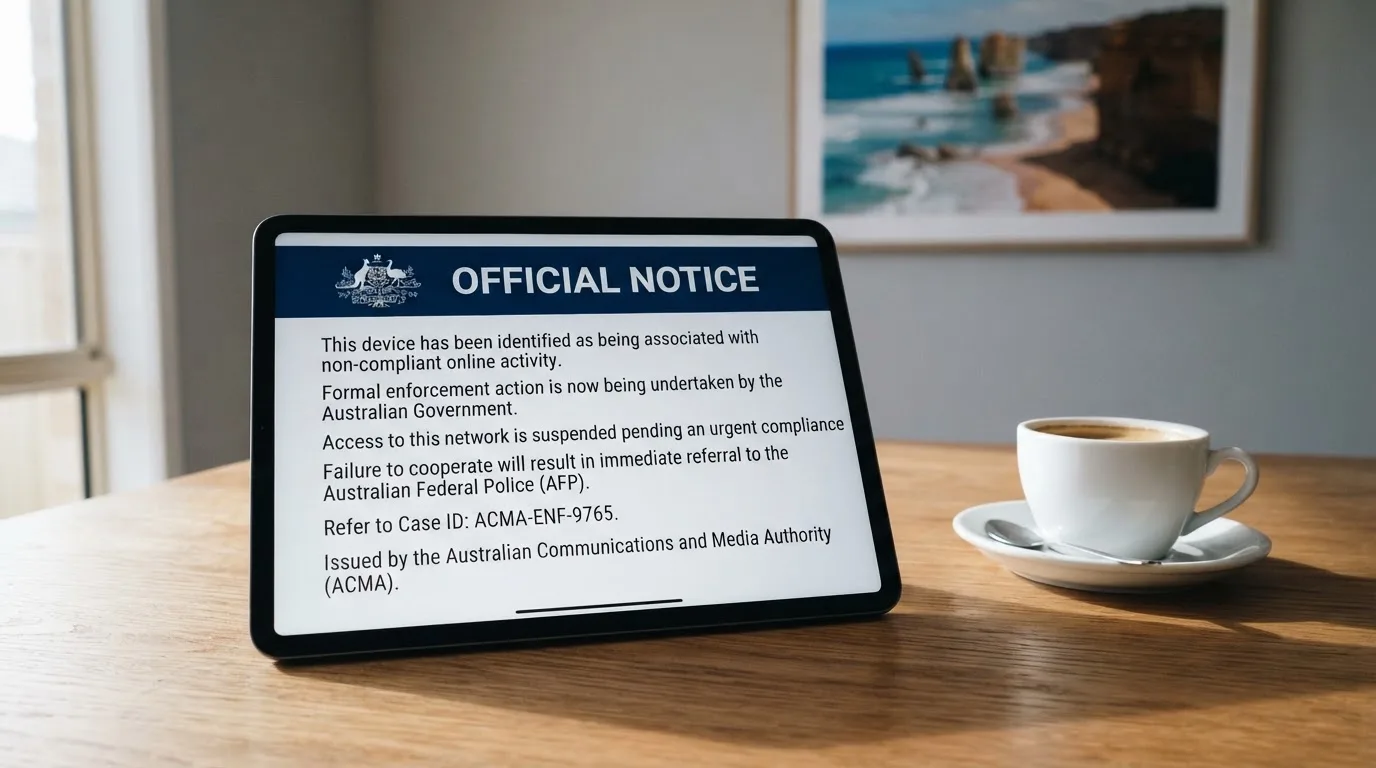
What is licensed, and what is not
Wagering on races and sport placed before the event, lotteries and keno are the four product lines a state or territory will license. Online casino games and online pokies are not among them. The Northern Territory Racing and Wagering Commission regulates 52 of Australia’s online bookmakers — Sportsbet, Bet365 and Ladbrokes among them — licensed in the Territory for tax reasons; the commission has no full-time staff and meets once a month in Darwin. The minimum age across licensed Australian wagering is 18.
The cost of the distinction is the cost of the word “licensed” on a homepage. A reader who sees the badge cannot tell, from the badge alone, whether the badge covers the activity the reader is about to undertake. The activity is what the law reaches, not the badge.
How the ACMA enforces
The ACMA investigates, issues formal warnings and directs internet service providers to block illegal sites. The figure on the table by mid-2026: 1,751 illegal gambling and affiliate marketing websites blocked since the first blocking request in November 2019, with more than 230 unlicensed gambling services having left the Australian market since enforcement was strengthened in 2017. The June 2026 round alone asked Australian ISPs to block a further twelve: 7Signs, ChromaBet, Donbet, Duospin, Freshbet, Slots Gem, Jacks Club, Lucky Start, Pointsbetz.com, Spinrise, Vinyl Casino and Wildsino.
What enforcement costs the punter
The IGA targets the provider, not the punter. No Australian reader has been prosecuted for placing a bet through an offshore site. What the punter pays for is the absence of Australian consumer protection — no Australian complaints body, no Australian recourse on a refused withdrawal, and no guarantee that a balance held on an offshore site survives the morning after the site joins a fresh blocking round. The cost is the entire backstop an Australian-licensed wagering operator is required by law to provide, traded for whatever the offshore operator’s own terms page happens to say.
Tax, briefly
Gambling winnings of a recreational player are not assessable income under section 6-5 ITAA 1997, and losses are not deductible. The carve-out is the person who carries on a business of gambling — model only, the ATO is the body a reader checks with. The point the licence does not advertise is that the absence of an Australian tax bill is not the same thing as the presence of an Australian right.
The 2026 reform bill
The Interactive Gambling Amendment (Gambling Reform) Bill 2026 passed Parliament on 19 August 2026. Its advertising and inducement measures commence on 1 January 2027. A page written in 2026 names the bill as law with a start date, not as a rule already running. The cost to a reader reading in 2026 is that the new advertising measures are not yet in force, and the shape of the offshore market is the one they see today.
Cluster 3 — Responsible gaming: the safeguards that actually exist
The safeguards an Australian reader has at the bank end of the transaction are stronger than anything the offshore homepage publishes. They are also narrower in scope — they work because the bank or the wallet sits between the punter and the site, not because the site itself does anything. The list below is what actually runs.
BetStop, the National Self-Exclusion Register
BetStop went live in August 2023 and binds Australian-licensed online and phone wagering services. A punter registered with BetStop is excluded by every Australian-licensed wagering operator that falls under the regime. The same exclusion does not extend to an offshore casino: BetStop is the Australian register, and the offshore site is not connected to it. The cost a reader pays for treating the offshore self-exclusion checkbox as equivalent to BetStop is the difference between a national registry and a single-brand checkbox.
Bank-side gambling blocks
Westpac’s gambling block works at card level. It refuses authorisation of transactions registered under the merchant category code “Betting/Casino Gambling” on eligible personal credit and debit cards. ANZ runs the same kind of block, and ANZ’s block, once activated in the ANZ app, also blocks gambling transactions routed through a digital wallet such as Apple Pay on an eligible card — the block is at the underlying card, not at the wallet surface.
Commonwealth Bank lets a customer apply a gambling lock to eligible cards via the CommBank app. The lock automatically blocks most gambling transactions; the bank states it cannot guarantee that every gambling-related purchase will be stopped. The qualifier matters — “most” is the bank’s word, not a guarantee of every transaction.
ANZ’s block has a 48-hour waiting period once a customer decides to remove it, and ANZ warns that not all gambling transactions will be blocked and that some non-gambling transactions might be blocked in error. The reader-facing translation: a gambling block is a barrier, not a wall; it raises the friction at the checkout rather than closing the door.
Apple Pay, Google Pay and the credit-card ban
By the end of 2025, Apple Pay, Google Pay and Samsung Pay transactions accounted for around 45 per cent of all card payments in Australia by number. Apple states that any surcharge on an Apple Pay transaction comes from the merchant’s own card-processing fees, not from Apple itself, and that transaction limits and PIN requirements are set by the card issuer or the merchant, not by Apple. Under the Interactive Gambling Act 2001 as amended in 2023, Australian-licensed online wagering services cannot accept payment by credit card or other credit-related products, and that restriction also constrains gambling use of linked digital wallets like Apple Pay. The offshore site, again, is not the Australian-licensed operator that ban binds — the prohibition reaches the activity the punter is about to undertake, not the badge on the page.
PayID and Osko
A PayID-based instant transfer is available at over 100 Australian financial institutions. With Osko, a bank transfer between participating Australian banks arrives in under a minute, 24/7, whether it is addressed to a BSB and account number or to a PayID. More than 25 million PayID identifiers had been registered on Australia’s New Payments Platform as of April 2025. Paying to a PayID shows the name of the account holder before the transfer is sent; AP+ warns that being asked to transfer money to a PayID on an illegal gambling site is almost certainly a scam site.
The reader-facing translation: PayID makes the recipient visible before the money moves. On a legitimate Australian-licensed wagering operator that is a security feature; on an offshore site it is a signal of who actually receives the money, and the signal points at the same answer regardless of which offshore brand the punter is dealing with.
BPAY
BPAY has operated in Australia since 1997 and is available in the online banking of over 140 banks and financial institutions, offered by over 95,000 businesses. The payer enters the Biller Code and the Customer Reference Number printed on the bill. BPAY was launched on 18 November 1997 and is owned equally, via parent company Cardlink Services Limited, by Australia’s four major banks — ANZ, Commonwealth Bank, National Australia Bank and Westpac. It is run by Australian Payments Plus, the same operator that runs PayID and Osko.
The September 2021 ACCC decision authorised the merger of BPAY Group, eftpos and NPP Australia under a new holding entity, Australian Payments Plus. Participants in Australia’s New Payments Platform must keep the platform’s monthly outages to no more than two minutes. The cost a reader pays is not a cost BPAY charges — it is the cost of using a bill-payment rail for a use case its design does not cover.
The credit-card ban and what it leaves on the table
The Interactive Gambling Act 2001 as amended in 2023 bans credit cards and credit-related products as payment for licensed online wagering, with penalties of up to A$247,500 for operators. The legal deposit routes for licensed wagering are debit card, bank transfer, PayID/Osko and BPAY. A site asking an Australian for a credit card or a crypto deposit is operating outside the Australian rules. The reader who pays the credit-card surcharge on an offshore site pays it to a merchant the credit-card ban was written to keep at arm’s length — and the bank that declines the transaction under the gambling block is the bank the rest of the IGA assumes will be present.
American Express and the surcharge review
The Reserve Bank of Australia’s July 2025 review proposes removing surcharges only on eftpos, Mastercard and Visa card transactions. American Express sits explicitly outside the scope of the proposed surcharge ban. Amex was established in 1850 as a freight-forwarding company, launched its first charge card on 1 October 1958 and runs a three-party scheme that issues cards and processes transactions itself, unlike Visa and Mastercard’s four-party network. The reader-facing translation: the surcharge ban does not reach Amex, and any “no surcharge” claim on an Amex transaction on an offshore site is the merchant’s own offer, not the regulator’s.
AUSTRAC’s threshold-transaction rule
AUSTRAC’s threshold-transaction-report rule, which requires reporting of transfers of A$10,000 or more, applies only to physical cash. Ordinary electronic bank transfers are not subject to that per-transaction reporting requirement, regardless of the amount sent. The cost of reading the threshold as a safety check on offshore gambling transfers is the gap between “the regulator must be told” and “no per-transaction rule applies” — the reader pays that gap with their own assumption.
Free support services
The National Gambling Helpline is 1800 858 858, free, 24/7, with chat at Gambling Help Online. The services are independent of the offshore site, and they exist for a reader who has decided the bank-side block is no longer enough. The cost of a call to the helpline is the cost of the call itself; the alternative is the cost of continuing to play on a product the law does not license.
What the safeguards collectively cost
The safeguards an Australian reader has — BetStop, the bank-side gambling block, PayID’s recipient visibility, the helpline — are real, and they are stronger than any banner on an offshore homepage. They cost nothing to set up at the bank end. They cost the reader only the discipline of using them before the offshore site is reached, because none of them is connected to the offshore site once the deposit has gone through.
Bringing the three shelves together
The following sections examine the gap from four angles. The enforcement record is the ACMA’s own, not a recommendation. The site analysis names the three pieces the offshore “safe” claim is built from and what each one does not deliver. The legality overview names the prohibition the offshore market sits outside. The responsible gaming section names the safeguards an Australian reader already has, and which of those safeguards still work once the offshore site has taken the deposit.
The single sentence that holds the four shelves together is this: the offshore “safe online casino” is a product the Australian law does not license, sold with claims the offshore licence does not back, on a site the ACMA can block at any ISP-level round, while the safeguards an Australian reader actually has sit at the bank and at the wallet rather than on the homepage. A reader who treats the offshore homepage as the safety check has paid for a marketing impression with no Australian backstop behind it. A reader who treats the bank and the wallet as the safety check has, at most, paid the friction the gambling block adds at the checkout.
Frequently asked questions
What are the clearest signs that an online casino claiming to be “safe” is not actually licensed anywhere reputable?
The clearest signs are the ones an Australian reader can check without an account. The site offers online casino games or online pokies — prohibited in Australia under the Interactive Gambling Act 2001. The licence displayed is held by a jurisdiction Australia does not regulate Australian players through. The site asks for a credit card or a crypto deposit, both of which sit outside the deposit routes an Australian-licensed wagering operator is permitted to accept. The site is on the ACMA’s list of formal warnings, or has been added to an ISP blocking round.
Is a PayID deposit any safer than a card deposit at an offshore online casino?
A PayID deposit at an offshore casino shows the recipient name before the transfer is sent, and AP+ warns that being asked to transfer money to a PayID on an illegal gambling site is almost certainly a scam site. A card deposit goes through a bank that may have a gambling block turned on. Neither makes the offshore site licensed in Australia. The PayID surface makes the recipient visible; the card surface can be blocked at the merchant category code. Both are stronger than the offshore homepage’s safety claim and weaker than an Australian-licensed wagering operator.
Is it legal for an Australian to use an offshore online casino even if that site markets itself as “safe”?
The Interactive Gambling Act 2001 targets the provider, not the individual player. No Australian has been prosecuted for placing a bet through an offshore site. The prohibition sits on the provider, and the offshore operator sits outside the Australian regulatory perimeter. An Australian reader using an offshore site gives up the Australian consumer protections, complaints body and recourse on a refused withdrawal that an Australian-licensed wagering operator is required by law to provide.
What should someone do if they realise they’ve been playing at an offshore casino and want to stop?
The first step is the bank-side gambling block — Westpac, ANZ and Commonwealth Bank each run one, and ANZ’s also blocks gambling transactions routed through a digital wallet such as Apple Pay on an eligible card. The second is BetStop, the National Self-Exclusion Register, which binds Australian-licensed online and phone wagering services from August 2023 onward. The third is the National Gambling Helpline on 1800 858 858, free and 24/7, with chat at Gambling Help Online.
How does a genuinely regulated gambling operator’s safety record differ from an offshore casino’s own marketing claims?
A genuinely regulated Australian wagering operator sits inside the Interactive Gambling Act 2001 regime, is bound by the credit-card ban, is connected to BetStop, is subject to the responsible-gaming publishing requirements, and answers to an Australian complaints body. An offshore casino answers to the regulator in whichever jurisdiction issued its badge, and that regulator does not regulate Australian players. The marketing on an offshore page is what the operator chose to write, not what an Australian rule required it to write.
What free support services exist in Australia for someone concerned about their own online casino use?
The National Gambling Helpline is 1800 858 858, free and 24/7, with chat at Gambling Help Online. Gambling Help Online also runs online counselling sessions. State-based Gambler’s Help services run face-to-face and telephone counselling in each state and territory. The services are independent of the offshore site, and the cost of using them is the cost of the call itself.