

Best Aussie Pokies Online Australia in 2026: The Offshore Market the ACMA Keeps Warning
Current as of 1 November 2026, against the ACMA’s register of blocking requests and formal warnings.
Anyone searching for “best aussie pokies online” lands in a legal vacuum. The phrase sounds like a category — Australian-branded online pokies, ranked and reviewed — but the category does not exist under Australian law. What exists is a prohibition, a list of offshore operators the ACMA has warned, and a set of licensed land-based machines in pubs, clubs and casinos that the law actually recognises. This page sets out what that means for someone in Australia typing the phrase in 2026, what an honest comparison of those offshore offers looks like, and what the IGA costs a player who treats the prohibition as optional.
Table of Contents
- How the ACMA Has Tried to Clear Offshore Pokies Off Australian Shelves
- The Bonus and Free Spins Picture: What “Aussie” Branding Buys
- PayID, Deposits and How Settlement Timing Works on a Prohibited Product
- The Catalogue and the Paytable: What an “Aussie Pokies” Library Usually Shows
- The Brands the ACMA Has Named — and the Comparison They Allow
- What a Fair Comparison of These Offers Looks Like
- What “Licensed” Means When the Product Is Prohibited
- What the Law Costs the Reader
- What “Responsible Gaming” Means on a Prohibited Product
- What an Aussie Reader Can Actually Access
- The Comparison the Market Is Failing to Make
- Frequently Asked Questions
How the ACMA Has Tried to Clear Offshore Pokies Off Australian Shelves
The first thing a comparison needs is the list. A ranked review that skips it hands the reader the marketing without the regulator. The ACMA, the body that enforces the Interactive Gambling Act 2001, has issued a steady run of formal warnings over offshore operators offering prohibited online casino games and online pokies to Australians. The same names come back across multiple actions, and the pattern is worth reading.

The full blocking round reported on 26 June 2026 brought the running total of blocked sites to 1,751 since the ACMA’s first blocking request in November 2019. The same round directed Australian ISPs to block twelve more names: 7Signs, ChromaBet, Donbet, Duospin, Freshbet, Slots Gem, Jacks Club, Lucky Start, Pointsbetz, Spinrise, Vinyl Casino and Wildsino. None of these is licensed to take an Australian deposit on a pokie spin. The blocking numbers are arithmetic the ACMA itself does — and the gap between “first request” and “current total” is the closest thing the market has to an enforcement score.
At an average run-rate of roughly 1,751 sites blocked over the time from November 2019 to June 2026, the ACMA’s pace lands in the band of about 260 blocking actions per year — call it a quarter-thousand offshore sites a year told to ISPs that they cannot be served to Australian customers. That is the condition behind the band: a ban list that grows by hundreds of entries annually, and that gets refreshed every reporting cycle. The figure is a long-run average, not a per-year guarantee, and it assumes the underlying monthly counts are evenly spread — which they are not, since rounds cluster around enforcement pushes.
The H2 Gambling Capital 2025 estimate puts Australians’ losses to illegal gambling sites at about A$3.9 billion a year, and the share of gambling going through legal channels has fallen from 74% in 2021 to 64%. A market shrinking by ten percentage points in four years is a market the prohibition is failing to push back into the legal channels, and that is the picture a reader needs before any operator review.
The Bonus and Free Spins Picture: What “Aussie” Branding Buys
The phrase “aussie pokies bonuses” suggests a category of offers tuned for Australian players. There is no such licensed category. The Interactive Gambling Act 2001, strengthened by the Interactive Gambling Amendment Act 2017, makes it an offence to provide online casino games, online pokies or in-play betting to a person physically in Australia. The provider is the target, not the player — but the practical effect is that no Australian-licensed body issues a free-spin credit, a deposit match or a no-deposit bonus tied to an online pokie.
What does exist is the offshore version. An offshore site will show a welcome package with bonus credits and free spins, will often mark the offer in Australian dollars, and will brand itself “Aussie” in the URL or the marketing. The branding is a marketing claim, not a regulatory fact. The ACMA’s enforcement record makes that plain: in March 2026 a formal warning went to Pulsup Ltd over RocketPlay; in July 2025 formal warnings went to Bamboo Media over Ignition Casino, and to Consolutetish S.R.L. over National Casino and Bizzo Casino; in February 2025 the ACMA warned EOD Code SRL over Instant Casino. Each of these is a bonus issuer in the colloquial sense; each is also a warning recipient. The offer and the enforcement action sit on the same brand.
A bonus on a prohibited product carries one additional cost a normal bonus does not: the offer can be withdrawn — the site itself can be blocked — with a bonus balance still attached. A$50 in bonus credit on a blocked site is A$50 the reader cannot redeem. The Interactive Gambling Amendment (Gambling Reform) Bill 2026, passed by Parliament on 19 August 2026, tightens the advertising and inducement side of this picture; its measures commence on 1 January 2027, so a 2026 page is reading the existing regime and naming a future start date rather than a present rule.
PayID, Deposits and How Settlement Timing Works on a Prohibited Product
PayID is the Australian fast-settlement rail built on the New Payments Platform, and Osko sits beside it for instant transfers between participating banks. For licensed Australian wagering — the kind licensed through the Northern Territory Racing and Wagering Commission, which regulates 52 online bookmakers including Sportsbet, Bet365 and Ladbrokes — PayID and Osko are an approved deposit route. A bookmaker in that cohort will accept a PayID deposit, settle it in seconds, and refund by the same rail on withdrawal.
None of that applies to an online pokies site. The Interactive Gambling Act 2001 prohibits the service. Credit cards, credit-related products and digital currency have been banned as payment for licensed online wagering since 11 June 2024, with penalties of up to A$247,500 for operators that breach. The prohibition stops at licensed wagering. An offshore pokies site asking for a credit card or a crypto deposit is not asking within the Australian rules at all; it is operating outside them. The reader who pays that way has no Australian consumer protection, no complaints body and no BetStop cover, because BetStop — the National Self-Exclusion Register, live since August 2023 — binds only Australian-licensed online and phone wagering services. The offshore site is not connected to it.
Settlement timing on an offshore pokies deposit is therefore not a comparison metric in the usual sense. It is a property of an unregulated product. A PayID transfer to an offshore site settles in seconds at the bank end, and from there the offshore operator controls whether the funds are credited, when withdrawals are processed, and what currency conversion costs apply. A withdrawal that the operator decides to delay is a delay the player has no Australian avenue to challenge. The fastest rail does not save a route the regulator cannot enforce.
The Catalogue and the Paytable: What an “Aussie Pokies” Library Usually Shows
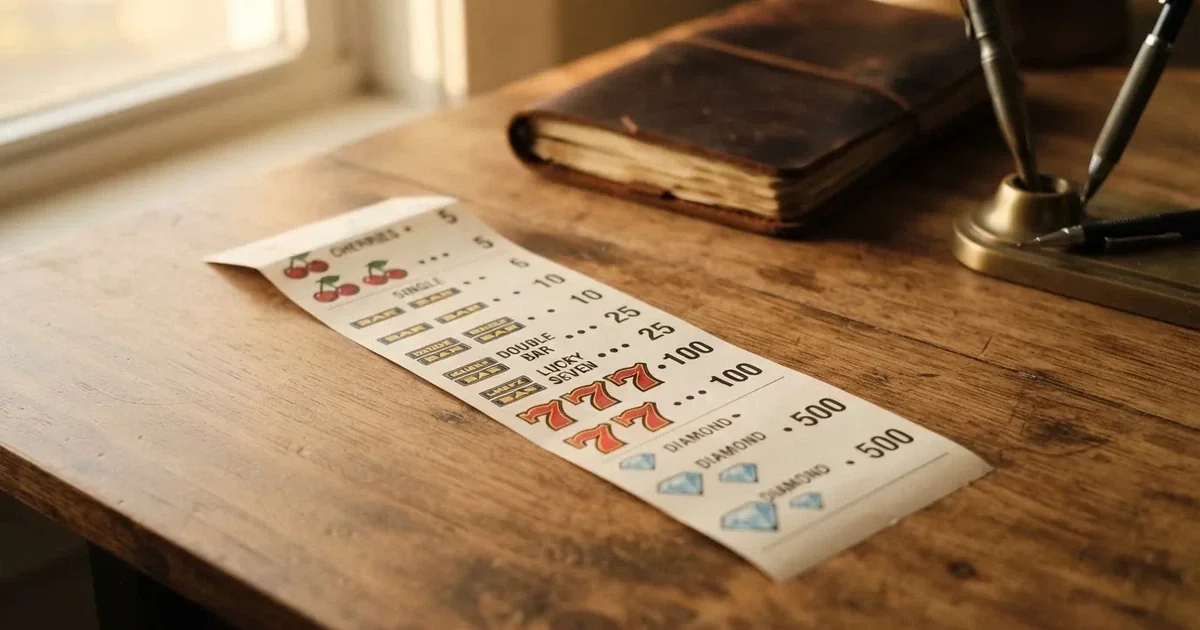
A paytable is the printed sheet on a slot machine that lists every symbol, the lines or ways each combination pays, and the bonus features. The numbers on it — the return-to-player percentage, the volatility band, the maximum multiplier on a single line — are the closest thing the game has to a specification. For Australian licensed land-based pokies the minimum RTP is set state by state: 85% in New South Wales, the Northern Territory and Queensland, generally 87% at Crown Melbourne, 87% in the ACT and Tasmania, 87.5% in South Australia, and 90% in Western Australia. Those figures are statutory floors, not averages — they are the worst the machine may legally return.
An offshore “aussie pokies” catalogue does not sit on that floor. The site publishes its own RTP, often in the mid-nineties for video slots and lower for jackpot-style products, and the figure is audited or not according to the site. The reader has no Australian register to verify against. New South Wales alone had 87,298 gaming machines outside casinos across 2,195 venues as of June 2023, with player losses of A$8.18 billion in 2022–23. Queensland had 21,122 gaming machines in 351 venues in October 2023; Victoria, 26,380 outside Crown Casino across 488 venues, under a 30,000-machine statewide cap. The size of the licensed estate is its own argument for why offshore libraries feel thin in comparison: they have no statutory floor to clear, no state-by-state approval process, and no venue to anchor them.
A pokie catalogue in the offshore sense is also typically organised by provider — the studio that built the underlying maths and the art — rather than by theme. Big-publisher names recur across multiple brands because the operators licence the same games from the same suppliers. A reader who recognises a title across two offshore sites is looking at the same game, not two different products. The catalogue looks varied; the underlying mechanics are not.
The Brands the ACMA Has Named — and the Comparison They Allow
The honest ranking of offshore pokies sites is not a ranking of which is best. It is a comparison of which the regulator has named, and on what date, and under which operator. The table below sets out the eleven brands the ACMA has issued formal warnings over for offering prohibited online casino services to Australians, with the action and the named operator as the ACMA published them. Every one of these is a prohibited interactive gambling service under the IGA. No licence on the site changes that.
| Brand | ACMA action and date | Operator named by the ACMA | Subject support |
|---|---|---|---|
| RocketPlay | Formal warning, March 2026 | Pulsup Ltd (RocketPlay) | No data |
| Level Up Casino | Formal warning, May 2022 | Dama N.V. | Listed as carrying BGaming content in supplier listings |
| Woo Casino | Formal warning, March 2025 | Dama N.V. | No data |
| Spirit Casino | Formal warning, May 2025 | Dama N.V. | No data |
| National Casino | Formal warning, July 2025 | Consolutetish S.R.L. | Listed in general gambling reference material |
| Bizzo Casino | Formal warning, July 2025; earlier 2022 | Consolutetish S.R.L. / TechSolutions | No data |
| Ignition Casino | Formal warning, July 2025 | Bamboo Media | No data |
| Instant Casino | Formal warning, February 2025 | EOD Code SRL | No data |
| Jackbit | Formal warning, April 2026 | Ryker B.V. | No data |
| Casino Intense | Formal warning, April 2025 | Sterplay Holding Ltd | Listed in Australian reporting on offshore casino activity |
| Sky Crown | Formal warning, September 2022 | Hollycorn N.V. | No data |
Dama N.V. sits on three of the eleven rows, which is the kind of pattern the table makes visible only because it lays the operator column beside the brand column. The reader who treats each offshore brand as an independent choice is missing the underlying concentration. The earlier 2022 warning to Dama covered six casino brands — Bambet, Dazard, Level Up, Rocketplay, Wild Tornado and Cobra Casinos — and the 2025 follow-up warnings to Woo Casino and Spirit Casino reused the same corporate owner. The ACMA’s enforcement hits the operator behind the brand.
Subject support is the column where some industry listings — game-provider catalogues, general reference pages — name the brand. Where research carries no such listing, the cell is empty, and the brand is presented on its other fields. The empty cells are not a judgement on the brand’s quality; they are the limit of what Australian-accessible sources record.
RocketPlay
Pulsup Ltd drew a formal warning in March 2026 for operating RocketPlay. The ACMA names the operator and the URL together, which is unusual; the corporate entity and the brand are published as one. The Dama N.V. shell had previously drawn a 2022 warning that listed Rocketplay among six brands. Two warnings over the same brand, four years apart, by two different operators, is the pattern offshore sites leave behind when they re-paper the same product.
For the reader, the consequence is that an offer on RocketPlay today is an offer on a service the ACMA has asked ISPs to block, on a brand the ACMA has named twice. A PayID deposit clears in seconds; a withdrawal is processed by the same operator that has already been warned, on a product the IGA prohibits. The site’s own terms are the only terms in force, because there are no Australian ones.
Level Up Casino
Level Up Casino carries a May 2022 formal warning to Dama N.V. as one of six brands in a single enforcement action. The BGaming catalogue lists Level Up as a publishing partner, which is the one place the brand surfaces outside its own marketing. A studio relationship is a catalogue detail, not a regulatory clearance.
The brand sits in the same 2022 Dama cohort as Rocketplay, Bambet, Dazard, Wild Tornado and Cobra Casinos. The warning was a single coordinated action against a portfolio, not six independent reviews of six independent operators. A reader choosing between these six is choosing between six windows on the same shelf.
Woo Casino
Woo Casino drew a formal warning in March 2025, again to Dama N.V. That is the third Dama-named brand on this page. The corporate concentration is the point: a comparison of Woo, Spirit, Rocketplay and Level Up that treats them as four separate offers is comparing four skins over one operator.
The practical consequence is identical to the Rocketplay case. A bonus on Woo Casino is a bonus on a Dama N.V. product the ACMA has warned; a withdrawal is at the operator’s discretion; an Australian consumer has no recourse if it stalls. The brand is the marketing, not the licence.
Spirit Casino
Spirit Casino carries the same May 2025 warning to Dama N.V. as Woo Casino. The two warnings, two months apart, name the same operator and two different brands — the same pattern the 2022 cohort set. The ACMA’s enforcement hits the corporate layer; the brands are the surface it hits them through.
The reader-facing picture is the same. No data on subject support reflects what the industry listings carry — for these brands, almost nothing verifiable outside the ACMA’s own register. The brand is a name on a server; the offer is an offer on a prohibited service.
National Casino
National Casino was named in a July 2025 formal warning to Consolutetish S.R.L. The brand surfaces in general gambling reference material, the only entry in the subject support column for this row. That is a level of third-party mention, not a regulatory fact.
Consolutetish S.R.L. drew the same warning for Bizzo Casino in the same July 2025 round. Two brands, one operator, one enforcement action. The comparison between National Casino and Bizzo Casino is the comparison between two products on one shelf.
Bizzo Casino
Bizzo Casino carries two warnings: a 2022 warning to TechSolutions (CY) Group Limited and TechSolutions Group N.V., and a 2025 warning to Consolutetish S.R.L. Two operators, two corporate owners, one brand, three years apart. The brand has moved through two offshore holding structures in the period between the two warnings, and the ACMA has tracked the brand through both.
That is the kind of corporate history a comparison based only on the current brand would not surface. A 2026 reader looking at Bizzo is looking at a brand the regulator has warned twice, under two different operator names, on a prohibited product. The operator layer is where the enforcement lands, and the brand has already cycled through it once.
Ignition Casino
Ignition Casino drew a July 2025 formal warning to Bamboo Media. The brand has no entries in the subject support column. The warning is the only Australian record.
Bamboo Media is a single-operator action. The reader sees a brand and a corporate owner in the warning; the rest of the comparison is the same as for the other rows. A bonus on Ignition is an offer on a Bamboo Media product the ACMA has named, and the operator is the entity that handles any deposit the reader makes.
Instant Casino
Instant Casino drew a February 2025 formal warning to EOD Code SRL. The EOD Code SRL action is one of the earlier single-operator warnings in the current enforcement cycle. The brand has no entries in the subject support column.
The product is the same: an offshore pokie offer the ACMA has warned over, operating outside the IGA, with no Australian consumer protection on a withdrawal that goes wrong. The February 2025 date is earlier than most of the row; it sets the start of the recent enforcement wave in this comparison.
Jackbit
Jackbit carries an April 2026 formal warning to Ryker B.V., alongside CasinOK in the same action. Two brands, one operator, one warning. The Ryker B.V. corporate owner is the level at which the ACMA’s enforcement landed.
For the reader, the relevant fact is that an offer on Jackbit in 2026 is an offer on a service warned over in April 2026 — within the current enforcement year. The subject support column carries no listing for the brand; the ACMA record is the only verifiable Australian-side data point.
Casino Intense
Casino Intense carries an April 2025 formal warning to Sterplay Holding Ltd. The brand surfaces in Australian reporting on offshore casino activity, alongside ABC News and ACMA references in the research, which is what gives the brand its single entry in the subject support column.
That is a level of third-party mention the other rows do not carry. It is still not a licence, and the warning is still the only Australian regulatory fact on the brand. The reader should treat the Australian reporting as news coverage of the warning itself, not as independent validation of the casino.
Sky Crown
Sky Crown carries a September 2022 formal warning to Hollycorn N.V., alongside Blue Leo in the same action. Two brands, one operator, one warning. The Hollycorn N.V. action is the oldest in the table.
The brand has no entries in the subject support column. The 2022 date makes Sky Crown and Blue Leo the earliest pair on this page; the ACMA’s enforcement cycle has widened since then. The pattern the table sets out — repeated warnings to the same operator across multiple brand names — is visible here first.
What a Fair Comparison of These Offers Looks Like
A comparison that ranks these offers by bonus size or by free-spin count is comparing prohibited products on the marketing axis. The honest comparison axis is regulatory: which operator has been warned, how often, and how recently. The table above orders the brands by ACMA action and date, which puts the most recent enforcement at the top and lets the reader see the operator concentration that the brand-only view hides.
A second axis is the corporate layer. Dama N.V. appears three times. Consolutetish S.R.L. appears twice. Hollycorn N.V. appears once but across two brands. TechSolutions appears once. Each operator row is a different cost profile: a Dama N.V. brand is a brand the ACMA has warned three times over the past four years; a Hollycorn N.V. brand is a brand the ACMA warned once, in 2022, and has not returned to. A reader comparing brands within the same operator row is choosing between products on a single shelf; a reader comparing across operators is comparing across different shelves with different enforcement histories.
A third axis is the age of the warning. A 2022 warning is a warning the ACMA has not refreshed; a 2026 warning is current. The pace at which warnings are issued — and at which blocks follow — is the operational risk a reader takes on by depositing. A brand warned over in April 2026 may be on a block list before the reader’s bonus clears.
What “Licensed” Means When the Product Is Prohibited
Offshore pokies sites commonly display a licence badge — Curaçao, Anjouan, the Philippines — and a regulator name. None of these licences covers the offer of prohibited online casino games to a person in Australia. The Interactive Gambling Act 2001 is the controlling law on the Australian side. A licence from another jurisdiction authorises the operator to take bets from customers in that jurisdiction under that jurisdiction’s rules; it does not authorise the operator to break Australian law.
The reader who sees a licence badge and concludes the site is therefore legitimate in Australia has imported a category that does not apply. The Australian category is prohibited or not prohibited. The brand’s licence badge is a piece of offshore regulatory housekeeping. The NSW Casino Control Act 1992 sets out what approval looks like for a land-based casino offering baccarat or blackjack under NSW rules — section 66 requires the operator to make approved rules available on request — but no Australian regime has an equivalent process for an offshore pokie.
The Northern Territory Racing and Wagering Commission regulates 52 of Australia’s online bookmakers, including Sportsbet, Bet365 and Ladbrokes, for tax reasons; it has no full-time staff and meets once a month in Darwin. That body exists because wagering on races and sport before the event is a licensable activity. Online casino games and online pokies are not. The NT’s role is on the wagering side, not the casino side.
What the Law Costs the Reader
The IGA does not prosecute the individual player. The provider is the target. The reader is not personally at risk for spinning a reel offshore. The reader is at risk in three other ways.
First, the balance. A blocked site can be blocked with a real-money balance on it, and the ACMA’s enforcement record shows that blocking is the routine outcome, not the exceptional one. The 1,751 blocked sites since November 2019 are the precedent.
Second, the complaint. There is no Australian complaints body that can order an offshore operator to pay a disputed withdrawal. The provider is in another jurisdiction, under another regulator, and the dispute resolution process is the operator’s own. A PayID deposit cleared in seconds at the bank end can sit in “pending withdrawal” for weeks at the operator end with no Australian avenue to escalate.
Third, the consumer protection floor. BetStop, the National Self-Exclusion Register, binds only Australian-licensed online and phone wagering services. The National Gambling Helpline is 1800 858 858, free, 24/7, with chat at Gambling Help Online — that service is available to anyone in Australia, licensed product or not, but it is a help line, not a financial protection.
The cumulative cost is the comparison the page is making: the product is prohibited, the offer is marketed as if it were not, the enforcement record shows the marketing is wrong, and the consumer protection floor is below what a licensed Australian wagering customer has. The reader pays that gap with whatever sits on the blocked side of the balance.
What “Responsible Gaming” Means on a Prohibited Product
Responsible gambling tools — deposit limits, time-outs, self-exclusion — are built into Australian-licensed wagering. BetStop, the National Self-Exclusion Register, went live in August 2023 and binds every Australian-licensed online and phone wagering service. A player who registers with BetStop cannot open a new account with any of them, and the existing accounts close. The coverage is comprehensive within the licensed perimeter.
An offshore pokie site is outside that perimeter. The site may offer its own deposit limit and its own self-exclusion, but those tools bind only the player’s account on that one site. A player who self-excludes from one offshore site can move to another in minutes, and the ACMA’s blocking record shows there are 1,751 names to choose from, with new ones added every enforcement round. The Australian perimeter does not follow the player offshore.
If a reader in Australia finds that thinking about play is affecting their wellbeing, free confidential help is available at any time through Gambling Help Online, with the National Gambling Helpline at 1800 858 858. The service is not gated by which product the reader has been playing, licensed or not. Tasmania planned nation-leading mandatory pre-commitment cards for its poker machines, with implementation delayed until late 2025 — that reform sits on the licensed side of the perimeter, not the offshore side.
What an Aussie Reader Can Actually Access
The licensed Australian pokie product is the land-based machine in a pub, club or casino, regulated state by state. New South Wales had 87,298 gaming machines outside casinos across 2,195 venues as of June 2023. Queensland had 21,122 gaming machines in 351 venues in October 2023. Victoria had 26,380 machines outside Crown Casino across 488 venues, under a 30,000-machine statewide cap. Western Australia banned poker machines in pubs and clubs when Crown Perth opened in 1985; Crown Perth has since grown its own machine count from about 200 in 1985 to roughly 2,500, all approved by the state’s Gaming and Wagering Commission. Tasmania’s monopoly over poker machines was held by the Federal Group from 1968, until legislation passed in November 2021 ended the monopoly and moved oversight to the Tasmanian Liquor and Gaming Commission.
These are the legal pokies. They sit under state regulation, with the minimum RTP floors that vary from 85% to 90% by jurisdiction, with venue-level harm-minimisation measures and with BetStop available for self-exclusion across the licensed wagering perimeter. They are not the same product as an offshore pokie spin, and they are not marketed the same way. The page’s job is to keep the two separate, because the comparison that mixes them misleads on both sides.
The Comparison the Market Is Failing to Make
What the H2 Gambling Capital 2025 figure shows is that Australians lose about A$3.9 billion a year to illegal gambling sites, and that the share of gambling going through legal channels fell from 74% in 2021 to 64%. The legal share is shrinking while the illegal share grows. The comparison the market should be making — between the licensed Australian product and the offshore product the ACMA is blocking — is the comparison the consumer is being asked to skip.
A reader who treats the offshore product as a category is reading a market that does not exist under Australian law. The category exists in the marketing. It does not exist in the register. The ACMA’s warnings, the blocking totals and the corporate-operator patterns in the table above are the comparison the register has already made; the reader’s job is to read it.
Frequently Asked Questions
Does calling an online pokies site “Aussie” change where it is actually licensed?
No. The “Aussie” label is branding; the licence is what the regulator behind the badge has issued. No Australian state or territory licenses an online pokie. The Interactive Gambling Act 2001 prohibits the offer. An offshore licence from Curaçao, Anjouan or elsewhere does not cover the offer to a person in Australia.
Are the bonus credits and free spins on an “Aussie pokies” site legal to advertise here?
The Interactive Gambling Amendment (Gambling Reform) Bill 2026, passed on 19 August 2026, tightens the advertising and inducement rules; its measures commence on 1 January 2027. Until that date, the offer sits on a service that is itself prohibited. The inducement rules and the underlying prohibition are different layers, and both apply.
Is there a dedicated app for Aussie-branded online pokies that is legal to install locally?
No Australian app store carries a legal online pokie product, because there is no Australian-licensed online pokie product to distribute. An “Aussie-branded” app from an offshore operator is the same product as the offshore site, on the same prohibited-service basis. The legal Australian pokie product is the licensed land-based machine.
Do state gaming regulators recognise any “Aussie online pokies” brand as licensed?
No. State and territory regulators license the land-based machines in pubs, clubs and casinos. They do not license online pokies. The Northern Territory Racing and Wagering Commission licenses online bookmakers for wagering, not for casino games. The category of “Aussie online pokies licensed by an Australian regulator” does not exist.
How does an Aussie-branded online pokies catalogue differ from a licensed pub’s machines?
A licensed pub pokie sits under a state-set minimum RTP — 85% in NSW, the NT and Queensland, 87% in the ACT and Tasmania and at Crown Melbourne, 87.5% in South Australia, 90% in Western Australia — with venue-level harm-minimisation requirements. An offshore pokie has no Australian RTP floor, no Australian venue oversight, and no Australian complaints body for a disputed spin.
Can an Aussie-branded online pokies site accept a PayID deposit and still be unlicensed?
PayID is a payment rail; it does not license the receiver. A PayID transfer to an offshore pokie site settles in seconds at the bank end, and from there the offshore operator controls the credit. The deposit route being instant does not put the offer inside Australian rules. The product remains a prohibited interactive gambling service.