


PayID at Australian casinos in 2026: what an honest reader walks away with
Walk into a search for a casino that takes PayID and three things collide inside the first page of results. There are dozens of offshore brands ready to accept a bank transfer. PayID is built into the online banking of more than 100 Australian financial institutions, which makes the deposit feel as ordinary as paying a tradesperson. And every one of those offshore brands sits on the wrong side of the Interactive Gambling Act 2001, which makes the deposit — by the letter of the law that the Australian Communications and Media Authority enforces — an offer from a service that has no licence to sell to an Australian at all.
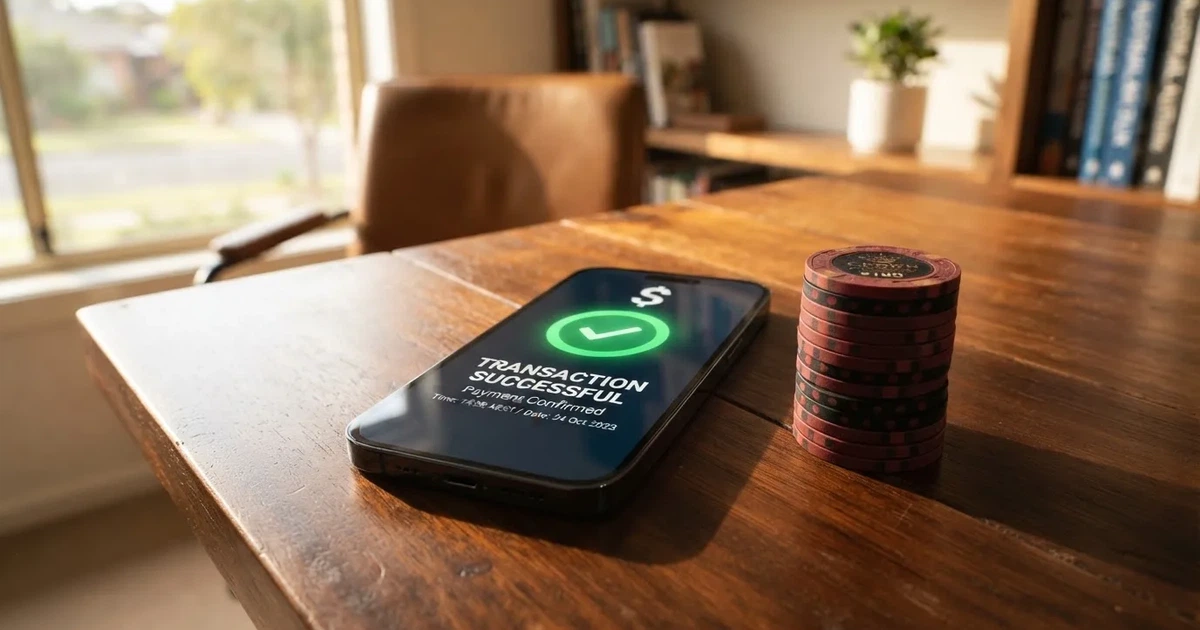
That is the page in full. Everything underneath works through the consequences.
Currency, licence claims and ACMA actions verified as of 31 October 2026 against the ACMA register and the Reserve Bank of Australia’s published payments materials.
Table of Contents
- How PayID actually works when it lands at one of these sites
- The PayID deposit at a glance
- The legal frame that the offshore shelf sits inside
- What the page’s blocking-rate calculation actually shows
- The named operators, in the order the ACMA put them on the record
- What the comparison underneath the comparison is doing
- Responsible play, the offshore gap, and the realistic limits of a self-exclusion
- The Australian payments picture PayID sits inside
- What a reader actually does with all of this
- Frequently asked questions
How PayID actually works when it lands at one of these sites
PayID is the easy-to-remember address layer that sits on top of Australia’s New Payments Platform. Instead of a BSB and account number, the payer sends to a mobile number, an email address, an ABN or an Organisation Identifier; the receiving bank looks up the linked account and credits it through Osko, the instant-transfer service that AP+ runs. The transfer is meant to clear in under a minute, twenty-four hours a day, weekends included. As of April 2025, more than 25 million PayIDs were registered in Australia, and the system was already built into the online banking of more than 100 financial institutions — that is the layer of trust any reader is leaning on when they type a phone number into a casino’s deposit screen.

The mechanism that protects ordinary use of PayID is the recipient-name check. The payer’s banking app shows the name registered against the PayID before the money is sent, and the user can stop the payment if the name does not match who they thought they were paying. Australian Payments Plus itself warns that being asked to transfer funds to a PayID on an illegal gambling site is almost certainly a “scambling” site — their word for an illegal online gambling platform advertised on social media and messaging apps that pulls a punter onto a scam website. The name check is the design feature that makes PayID safe for paying a tradie; it is also the first thing to misfire at a casino that has dressed an offshore operation in the look of an Australian brand.
That mismatch is not a corner case. The ACMA’s register of formal warnings is the list of operators who have already been told, in writing, that they are offering prohibited interactive gambling services to Australians. Every brand on the comparison shelf further down this page sits on that register. The way PayID actually works in this market is therefore not the how of the deposit alone — it is the deposit, then the regulator’s action, then what an Australian player can realistically do if a withdrawal never lands.
What a deposit looks like end to end
The mechanics on the casino side are unremarkable. The player opens the cashier, picks PayID (sometimes labelled “Instant Bank Transfer” or “Osko” through PayID), enters an amount — minimums at most of these sites sit in the A$10 to A$30 range — and is shown the casino’s PayID, with a name attached. The player confirms in their own banking app, sees the recipient name, approves the transfer, and the Osko leg settles in seconds inside their bank. The casino credits the balance when its own ledger picks up the receipt; that leg is the part the player cannot see, and it is the part that decides whether the deposit ever shows up at all.

The credit-card ban matters even though PayID is a debit-style transfer. The Interactive Gambling Act 2001 as amended in 2023 prevents Australian-licensed online wagering services from accepting credit cards or other credit-related products, and the same logic constrains gambling use of linked digital wallets. PayID reaches the casino through a normal bank account, so it falls outside the card ban on its face — but it is also the route most exposed to a bank’s own gambling block. ANZ lets a customer turn on a gambling transaction block in the app that blocks Gambling Transactions made through a digital wallet such as Apple Pay on an eligible card, not just the physical card, and removing the block again takes a 48-hour cooling-off period, during which the bank warns that not all gambling transactions will be blocked and some non-gambling transactions might be blocked in error. Westpac’s gambling block refuses authorisation on transactions registered under the merchant category code “Betting/Casino Gambling” on eligible personal credit and debit cards. The blocks target the merchant code, not the rail; a PayID transfer routed to a merchant that has been correctly coded will be refused at authorisation, and a transfer to one that has not will go through.
What a withdrawal actually requires
The deposit story is the simple half. PayID handles the money leg; the casino handles the acceptance leg. The withdrawal story reverses that order, and that is where the time-cost sits.
A PayID withdrawal request still has to clear the casino’s own internal checks before the settlement lands back in the Australian account. The standard sequence is a pending period — typically one to three working days during which the casino reviews identity, bonus play-through if any bonus was claimed, source-of-funds documents for larger withdrawals, and any anti-money-laundering flags. Only after that internal sign-off does the casino push the payment back to the player’s bank; once it does, the Osko leg completes in under a minute, twenty-four hours a day. From the player’s perspective, the speed of PayID matters at the end of the chain, not at the start. The variable the player controls is which casino’s internal queue they are sitting in, and the variable they do not control is whether the operator still has a withdrawal channel open on the day they ask.
AP+ does not intervene on the casino side, because AP+ is the payments rail operator, not a gambling regulator. The casino side of the chain is overseen by whichever Curaçao or Kahnawake or Anjouan licence the operator displays in its footer, and those regimes do not give an Australian player an Australian complaints route. A withdrawal that stalls is, in practical terms, a complaint that has nowhere to land.
The PayID deposit at a glance
| Brand | ACMA action and date | Operator named by the ACMA | PayID support |
|---|---|---|---|
| RocketPlay | Formal warning, March 2026 | Pulsup Ltd | — |
| Level Up Casino | Formal warning, May 2022 | Dama N.V. | listings report PayID at Westpac |
| Woo Casino | Formal warning, March 2025 | Dama N.V. | — |
| Spirit Casino | Formal warning, May 2025 | Dama N.V. | — |
| National Casino | Formal warning, July 2025 | Consolutetish S.R.L. | listings reference PayID |
| Bizzo Casino | Formal warning, July 2025; earlier 2022 | Consolutetish S.R.L.; earlier TechSolutions | — |
| Ignition Casino | Formal warning, July 2025 | Bamboo Media | — |
| Instant Casino | Formal warning, February 2025 | EOD Code SRL | listings reference PayID |
| Jackbit | Formal warning, April 2026 | Ryker B.V. | — |
| Casino Intense | Formal warning, April 2025 | Sterplay Holding Ltd | listings reference PayID |
| Sky Crown | — | Hollycorn N.V. (warning on file) | — |
Every brand on this shelf carries a formal ACMA warning. The reason it sits in a comparison at all is that a reader looking for this information is going to meet these names anyway, in the order they appear; the comparison is a way of showing, side by side, what the ACMA has already said about each one. Where the listings column is empty, no listing we could verify states that PayID is or is not supported at that brand; the gap is the listing, not the brand.
The legal frame that the offshore shelf sits inside
The Interactive Gambling Act 2001 — strengthened by the Interactive Gambling Amendment Act 2017 — makes it an offence to provide online casino games, online pokies or in-play betting to a person in Australia. No state or territory licences any of them. What can be licensed is wagering on races and sport placed before the event, lotteries and keno — products licensed in practice by the Northern Territory Racing and Wagering Commission, which regulates 52 of Australia’s online bookmakers including Sportsbet, Bet365 and Ladbrokes, and which, as reported in April 2026, runs without full-time staff and meets once a month in Darwin. The licensed product looks like a sportsbook, not a pokies lobby.
The Interactive Gambling Amendment (Gambling Reform) Bill 2026 passed Parliament on 19 August 2026. Its advertising and inducement measures commence on 1 January 2027 — law with a start date, not yet in force on a 2026 page. What that means for a reader now is that the IGA’s prohibition on supply is unchanged; what changes in 2027 is the perimeter around marketing and inducements. Neither change legalises what is currently prohibited.
The age floor is 18. Credit cards, credit-related products and digital currency are banned as payment for licensed online wagering since 11 June 2024 — the operator-side penalty runs up to A$247,500. Legal deposit routes for a licensed wagering service are debit card, bank transfer, PayID or Osko, and BPAY. A site asking an Australian for a credit card or a crypto deposit is, by that test, operating outside the Australian rules.
What the ACMA has actually done
The Australian Communications and Media Authority investigates, issues formal warnings, and directs Australian internet service providers to block illegal sites. As reported in June 2026, a cumulative 1,751 illegal gambling and affiliate marketing websites have been blocked since the first blocking request in November 2019, and more than 230 unlicensed gambling services have left the Australian market since enforcement was strengthened in 2017. The round reported on 26 June 2026 added 12 more sites to the block list: 7Signs, ChromaBet, Donbet, Duospin, Freshbet, Slots Gem, Jacks Club, Lucky Start, Pointsbetz, Spinrise, Vinyl Casino and Wildsino. None of those is on this page’s shelf; the ACMA’s blocking list is wider than any single comparison can cover.
The formal-warning register is the closer fit for what a reader comparing brands actually needs to see. Each warning is a public, dated statement that the named operator offered prohibited services to Australians. The eleven on this shelf are:
- March 2026 — Pulsup Ltd, over Rocketplay.com.au.
- March 2025 — Dama N.V., over Woo Casino; May 2025 — Dama N.V., over Spirit Casino.
- May 2022 — Dama N.V., covering six brands: Bambet, Dazard, Level Up, Rocketplay, Wild Tornado and Cobra Casinos.
- July 2025 — Bamboo Media, over Ignition Casino; July 2025 — Consolutetish S.R.L., over National Casino and Bizzo Casino. Bizzo Casino had already been the subject of a 2022 formal warning to TechSolutions (CY) Group Limited and TechSolutions Group N.V.
- February 2025 — EOD Code SRL, over Instant Casino.
- April 2026 — Ryker B.V., over Jackbit and CasinOK.
- April 2025 — Sterplay Holding Ltd, over Casino Intense.
- A formal warning to Hollycorn N.V. over its Sky Crown and Blue Leo casino services, on the ACMA’s record.
What “no Australian consumer protection” means in practice
The IGA targets the provider, not the individual player. An Australian punter is not prosecuted for depositing. What the player loses, by using an offshore service, is the set of protections an Australian-licensed product would otherwise give them: a local complaints route, an Australian-licenced dispute mechanism, and the binding effect of BetStop, the National Self-Exclusion Register that has been live since August 2023. BetStop binds Australian-licensed online and phone wagering services; an offshore casino is not connected to it. A self-excluded Australian can still sign up and deposit at any of the eleven brands above, because those brands are not on the register’s network.
The financial loss attached to that gap is not small. H2 Gambling Capital’s 2025 report estimates that Australians lose about A$3.9 billion a year to illegal gambling sites, and that the share of gambling going through legal channels fell from 74% in 2021 to 64%. The drop is the market the offshore shelf is built on.
A withdrawal refused at an offshore brand is a complaint that has no Australian destination. A blocked site — and ACMA blocks routinely reach domains that still hold player balances — leaves the balance in the operator’s hands. The only realistic Australian destinations for help in either case are the National Gambling Helpline on 1800 858 858, free and 24/7, with chat at Gambling Help Online, and the ATO for any tax question a recreational gambler may have (gambling winnings are not assessable income and losses are not deductible unless the person carries on a business of gambling — model only, “check with the ATO”).
What the page’s blocking-rate calculation actually shows
The arithmetic the ACMA’s enforcement record supports is a single number that the page can quote, with the condition that holds it together.
The blocking register carries 1,751 illegal gambling and affiliate marketing websites blocked since the first blocking request in November 2019. The June 2026 cumulative figure, set against the November 2019 starting line, gives a running total that an analyst can divide by the months on the clock. The arithmetic is not the regulator’s arithmetic; it is the reader’s, and it is the only way to turn “1,751 in roughly six and a half years” into a sense of how steady the pace has been.
Spelled out: 1,751 blocked sites across 80 reporting months, from November 2019 to June 2026, gives a band centred on roughly 22 blocked sites per month on average. The condition that holds the band together is that “blocked” is a cumulative count of distinct domains and re-branded affiliate pages, not a count of unique operators; the same operator can sit behind several blocked domains across the period, and the ACMA’s June 2026 round added 12 more in a single day. Read as a long-run average, the rate is steady; read as a forecast for next month, it tells the reader very little, because enforcement rounds are batched rather than continuous, and the next round can be a single page of twelve names or several months of zero.
The honest reading for a reader is the band, not the point: somewhere around 22 sites per month on average, with the same operator sometimes occupying several of the slots, and a round-based cadence that means a single quiet month proves nothing. The rate is the pace at which the ACMA’s block list is growing. It is not the pace at which new illegal sites appear.
The named operators, in the order the ACMA put them on the record
Every brand below has had a formal warning issued over it by the ACMA. The shelf is presented in the order the regulator’s own publications list them, not the order a casino review site would. The reader who came in from a search for “casinos that accept PayID” is going to meet these names anyway; the page makes the meeting explicit.
RocketPlay
A formal warning to Pulsup Ltd over Rocketplay.com.au in March 2026 is the most recent action the ACMA’s record carries on this brand; an earlier warning to Dama N.V. in May 2022 covered six casino brands including Rocketplay. That two-operator history is worth a moment on its own. The brand has shifted hands and kept the same deposit rails; the licence displayed in the footer has changed without the player being asked to re-accept anything at the cashier. A withdrawal request submitted at the time of writing is a request to whichever entity now owns the brand, sitting behind whichever licence that entity currently advertises. The Australian player has no Australian destination to take a complaint to if that withdrawal stalls.
Level Up Casino
The May 2022 warning to Dama N.V. named Level Up among six brands. The listings column carries the only PayID-specific reference for this brand, a Westpac-aware listing that mentions PayID as a payment option. That reference is the kind of detail an Australian reader will find useful only because the Westpac gambling block refuses authorisation on transactions coded as “Betting/Casino Gambling”; a transfer to a PayID that the casino’s merchant category code marks as gambling is the very transaction the block is built to stop.
Woo Casino
The March 2025 ACMA warning to Dama N.V. named Woo Casino specifically; an earlier May 2022 warning covered a wider Dama N.V. portfolio. The interval between the two is the story on this brand: the operator continued to accept Australian customers for three years after the first warning, and the ACMA came back with a second. The reader who is deciding whether to deposit here is making that decision against a record that includes a second regulator action, not a first.
Spirit Casino
The May 2025 ACMA warning to Dama N.V. over Spirit Casino sits on the same operator as the Woo Casino warning two months earlier. The cadence matters: Dama N.V. was told twice in 2025 alone, and the brand list in between includes names that have appeared on this page. For a reader, the practical reading is that the operator behind two of the brands on this shelf has continued to launch new skins in Australia after warnings.
National Casino
The July 2025 ACMA warning named Consolutetish S.R.L. as the operator. The listings column for this brand carries references that mention PayID through AUSTRAC and Wikipedia entries — the listings are saying that the option appears, not that the operator has been verified to process it through a particular Australian financial institution. A PayID transfer to an unknown overseas-recipient name will go through Osko; whether the casino credits the balance is the question the listings column cannot answer.
Bizzo Casino
The July 2025 warning to Consolutetish S.R.L. over Bizzo Casino is the second formal warning tied to this brand, after a 2022 warning to TechSolutions (CY) Group Limited and TechSolutions Group N.V. Two operators, one brand, ten years of regulator action; the brand has changed hands, and the deposits have continued to land. The Australian player has no Australian recourse if a balance is stranded through a brand transition of this kind.
Ignition Casino
The July 2025 warning named Bamboo Media as the operator. The brand is one of the better-known poker-and-casino names offshore; the ACMA action covers the casino offering, not the poker product. For an Australian reader, the IGA’s prohibition on supply is unchanged by which vertical the deposit page links to.
Instant Casino
The February 2025 warning named EOD Code SRL as the operator. The listings column carries references through Payid.com.au itself and ecopayz — references that mention PayID rather than confirm it as a settled rail for this brand. A reader who has read the AP+ scam page knows what that distinction is worth.
Jackbit
The April 2026 ACMA warning to Ryker B.V. covered both Jackbit and CasinOK. Two brands, one operator, one warning; the deposit rail is the same on both, and the regulator’s record is the same on both.
Casino Intense
The April 2025 warning named Sterplay Holding Ltd as the operator. The listings column carries references that mention PayID through AUSTRAC, itnews and NAB — three listings from three different angles, none of them the casino’s own payment page.
Sky Crown
The ACMA’s formal warning to Hollycorn N.V. over its Sky Crown and Blue Leo casino services is on the regulator’s record; the date carried by the published PDF is September 2022. The brand has had the longest gap on this shelf between action and 2026, and the listings column carries no PayID-specific reference.
What the comparison underneath the comparison is doing
Eleven brands, eleven formal warnings, one legal frame. That is the shape of the shelf, and the comparison’s job is to keep the regulator’s record visible at the point where a reader is choosing whether to deposit.
The columns do three pieces of work at once. The brand column keeps the player’s search context in view; the ACMA action and date column keeps the regulator’s record adjacent to the brand; the operator named by the ACMA column exposes the licensing chain that the casino’s footer typically obscures; and the subject support column marks where the listings we could verify actually say PayID is offered, and where they do not. A column missing because no listing backs it is itself a finding.
What the table does not do is recommend. A reader who treats it as a ranking will see the brands with the freshest warnings at the top of the regulator’s record, and the brands with two-operator histories further down; that is the regulator’s ordering, not the editor’s.
Responsible play, the offshore gap, and the realistic limits of a self-exclusion
The responsible-play frame an Australian punter would meet at a licensed wagering service is missing, by design, from the offshore shelf.
BetStop, the National Self-Exclusion Register, has been live since August 2023. It binds Australian-licensed online and phone wagering services, and it is the mechanism by which a punter who wants to be excluded from wagering can be excluded across every licensed brand at once. The mechanism has no effect on an offshore casino, because no offshore casino is connected to the register. A self-excluded Australian can still open an account at any of the brands above, deposit by PayID, and play. The block does not extend offshore.
The financial blocks a bank offers are partial. ANZ’s gambling transaction block stops Gambling Transactions made through a digital wallet such as Apple Pay on an eligible card once the customer has turned it on in the app, and the 48-hour cooling-off period for removal exists because the bank itself warns that not all gambling transactions will be blocked and some non-gambling transactions might be blocked in error. Westpac’s gambling block works at card level against the “Betting/Casino Gambling” merchant category code. PayID is not a card transaction, so the card-level blocks do not stop a PayID transfer; the block fires on the merchant code, not the rail. A transfer to a merchant code that has been correctly classified is the transaction the block is built to refuse.
The RBA’s July 2025 review of merchant card payment costs and surcharging proposes removing surcharges only on eftpos, Mastercard and Visa card transactions, explicitly leaving American Express outside the scope of the proposed surcharge ban — a detail that matters less on a PayID page than on a card page, and that is named here only because the Reserve Bank is also the regulator and overseer of the New Payments Platform PayID runs on. The reader who wants a clean read on surcharging at the rails they actually use should know that Apple does not charge fees to consumers for using Apple Pay in stores, online or in apps, and that any surcharge comes from the merchant’s own card-processing fees, not from Apple; transaction limits and PIN requirements for Apple Pay purchases are set by the card issuer or merchant, not by Apple. By the end of 2025, Apple Pay, Google Pay and Samsung Pay transactions collectively accounted for around 45% of all card payments in Australia by number — a figure that puts the wallet layer at the centre of Australian retail payments, and well outside the card-level gambling block.
For someone reading this page because they are looking for help with their own play or someone else’s, the practical destinations are:
- National Gambling Helpline, 1800 858 858, free, 24/7.
- Gambling Help Online, with chat.
- BetStop, for self-exclusion from Australian-licensed wagering services.
- The ATO, for the tax treatment of recreational gambling winnings.
The Australian payments picture PayID sits inside
The PayID layer is one part of a wider Australian payments stack, and the offshore casino shelf depends on several of the others.
The New Payments Platform launched in February 2018, with the Reserve Bank of Australia as regulator and overseer and AP+ as operator, to let households, businesses and government agencies make simply-addressed, near real-time payments 24/7. Osko is the instant-transfer service AP+ runs on top of the NPP; a bank transfer between participating Australian banks arrives in under a minute, 24/7 including weekends, whether it is addressed to a BSB and account number or to a PayID. The Reserve Bank owns and operates the Fast Settlement Service that settles NPP transactions individually in close to real time, 24 hours a day.
The American Express layer is the part of the picture that is not on this page’s rail. Amex was established in 1850 as a freight-forwarding company and later became a card issuer, launching its first charge card on 1 October 1958; unlike Visa or Mastercard’s four-party network, Amex traditionally issues cards and processes transactions itself as a three-party scheme. The Reserve Bank’s July 2025 review proposes removing surcharges only on eftpos, Mastercard and Visa card transactions, explicitly leaving American Express outside the scope of the proposed surcharge ban. Amex does not affect the PayID deposit at an offshore casino, because the casino’s cashier is not asking for an Amex card. It does affect what an Australian punter pays when they reach for the wallet they usually reach for, which is why the Reserve Bank’s scoping decision is worth a sentence even on a PayID page.
The picture that emerges is that PayID is the rail on which an offshore casino can most plausibly look like an Australian deposit; the recipient-name check is the design feature that protects ordinary use of that rail; the ACMA register is the regulator’s record of who on the other end of that rail has already been told to stop; and the player protection layer — BetStop, the bank-level gambling blocks, the Helpline — covers Australian-licensed services and stops at the border the IGA draws.
What a reader actually does with all of this
The honest reader response is not “find the safest offshore brand”. There is no such brand, because every brand on the comparison shelf has been formally warned by the ACMA, and the IGA prohibits the supply they are offering.
For a reader who has already decided to deposit at one of these brands anyway, the practical steps reduce to a few:
- Confirm the bank has a gambling block on the card that the wallet is funding, and understand that the block targets the merchant category code rather than the PayID rail.
- Expect the deposit to land in seconds through Osko; expect the withdrawal to wait on the casino’s own queue first and the rail second.
- Read the ACMA record for the brand before depositing, because the regulator’s record is the public version of what the operator’s footer is not.
- Keep the National Gambling Helpline number in a place that does not depend on the casino’s own help page being reachable.
For a reader interested in playing online pokies in Australia who has not yet understood the legal frame, the practical answer is that the licensed options for pokies in Australia are the land-based casinos and the state-regulated club and pub pokies; there is no Australian-licensed online pokies site, and there cannot be one under the current IGA. PayID is the rail that makes the deposit feel local; the legal frame is what makes the offer not.
For a reader whose question is whether the IGA’s prohibition will be relaxed, the only honest answer is that the Interactive Gambling Amendment (Gambling Reform) Bill 2026 passed Parliament on 19 August 2026 and that its advertising and inducement measures commence on 1 January 2027; the IGA’s prohibition on supply is unchanged by that bill, and any change to it would require a separate act. The 2026 page does not know what a future parliament will pass.
Frequently asked questions
Is it legal for an online casino to accept PayID from a player in Australia?
No. Under the Interactive Gambling Act 2001, no online casino may lawfully take Australian players at all, regardless of which payment method the cashier lists. PayID changes the rail, not the law; an offshore operator accepting PayID is still offering a prohibited interactive gambling service, which is why every brand on this page’s shelf carries an ACMA formal warning.
What is the smallest deposit a PayID casino site usually asks for?
The minimum at most of these offshore sites sits in the A$10 to A$30 range, which is why search traffic clusters around the “A$10 deposit PayID casino” phrasing. PayID itself does not impose a minimum — AP+ runs the rail — so the floor is the casino’s own cashier setting, and the player’s bank may impose its own minimum on instant transfers.
Does a PayID withdrawal clear any faster than a card withdrawal at these sites?
Once the casino pushes the payment, yes — the Osko leg completes in under a minute, 24/7. The variable is the casino’s own internal review, which typically takes one to three working days. The total time is set by whichever queue the casino runs, not by the rail.
Can PayID be used at every offshore pokies-style site, or only some of them?
Only some of them. PayID appears in the cashier of brands that have chosen to expose it; for the brands where our listings show no PayID reference, the column on the table above is marked accordingly, and the reader should treat the absence as the listing, not as a verified outcome.
Does depositing with PayID add an extra fee at these casino sites?
PayID itself carries no consumer fee at the rail — AP+ does not charge the payer for using the address layer — and the Osko leg is free at the receiving end for transfers between participating Australian banks. Any fee the player meets is the casino’s own deposit fee or the bank’s own transaction fee, not a PayID fee. Where a merchant surcharge is added at the casino’s cashier, it is the casino’s policy, not the rail’s.
What should a player do if a PayID deposit does not appear in a casino account?
The first step is to keep the banking-app receipt, which carries the recipient name, the Osko reference and the timestamp. The second is to contact the casino’s support with that receipt, because the credit leg is the casino’s ledger, not the rail. The third, if the casino does not respond or refuses to credit, is to contact the player’s bank to raise a disputed transaction, and the fourth is the National Gambling Helpline on 1800 858 858, which is the realistic Australian destination for help where a regulator-led complaint is not available.