


Apple Pay deposits and withdrawals at casino sites Australians encounter
Apple Pay feels frictionless at a café terminal, and that is precisely the impression a casino cashier tries to borrow. The mechanics on the casino side, however, are not what the wallet shows. The money still moves through a card network, the merchant is still classified under a code that banks recognise, and the site is still the same operator the Australian Communications and Media Authority has, in many cases, already told to stop. What follows is a close look at how an Apple Pay deposit and withdrawal actually work at the offshore casino sites that list it, and what the legal and banking frame around them costs the player.
Data current as of 7 November 2026 and verified against the ACMA’s published list of formal warnings and the Reserve Bank of Australia’s card-payments data.
Table of Contents
- How Apple Pay moves money at a casino cashier
- Deposit floors, fees and how the wallet reads on a bank statement
- Withdrawals: why Apple Pay is rarely the payout rail
- The legal frame: the Interactive Gambling Act 2001 in plain language
- Enforcement: what the ACMA has actually done
- Player protection: what an offshore site does not connect to
- Responsible play at offshore sites — what the player actually has
- Landsca
- RocketPlay
- Level Up Casino
- Woo Casino
- Spirit Casino
- National Casino
- Bizzo Casino
- Ignition Casino
- Instant Casino
- Jackbit
- Casino Intense
- Sky Crown
- The frame that holds across every brand
- Frequently asked questions
How Apple Pay moves money at a casino cashier
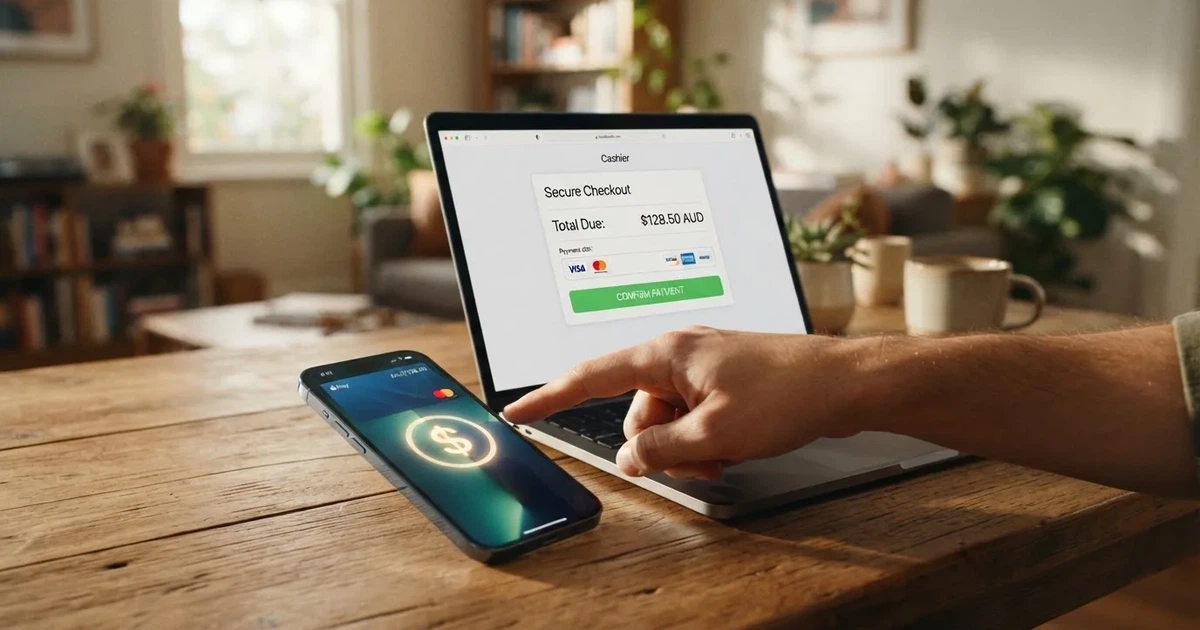
Apple Pay is a wallet, not a bank account. When a player taps or confirms a deposit, the wallet hands the transaction off to the underlying card — a Visa, Mastercard or, in fewer cases, an American Express — and that card is what the casino’s processor actually sees. The wallet adds two layers in front: a device check, and a tokenised card number that replaces the real one at the merchant. The casino never holds the real card details. Apple does not charge consumers for any of it; any surcharge at the cashier is the merchant’s own card-processing fee, not an Apple levy.
That architecture has three consequences the marketing line does not advertise. First, the casino’s deposit floor sits wherever the underlying card scheme and the merchant’s own minimum sit — the wallet does not lower it. Second, the bank issuing the underlying card still sees the transaction, and the merchant category code attached to the casino is “Betting/Casino Gambling” — the code Westpac, ANZ and Commonwealth Bank all use to decide whether to honour the payment. Third, a withdrawal works in reverse only if the casino is willing to push funds back to a card; many push back to a bank account instead, with its own delay.
Apple Pay captured around 45% of Australian card payments by number at the close of 2025, sitting alongside Google Pay and Samsung Pay. That share explains why every cashier page lists the wallet; the share does not explain what sits behind it. The cashier button is identical across dozens of operators. What is not identical is everything else.
Deposit floors, fees and how the wallet reads on a bank statement
The deposit minimums at these sites are typically A$10 to A$30 when a card route is offered. Research did not carry a confirmed figure for every operator in this set, so the exact floor is given only where a source backed it; the rest is described as ordinary for this market. Apple Pay itself imposes no minimum — that is set by either the card issuer or the merchant.
On fees, Apple Pay sits on the same footing as the underlying card. The Reserve Bank of Australia’s July 2025 review proposes removing surcharges only on eftpos, Mastercard and Visa transactions, and explicitly leaves American Express outside the proposed ban. For a player this means the casino’s own surcharge policy, not the wallet, decides whether a deposit costs the player anything on top. Surcharges, where they apply, tend to mirror the card-present equivalent rather than the wallet.
The bank statement is the line that surprises players most. The merchant descriptor is the casino’s name, not “Apple Pay” or the wallet’s brand. Westpac’s gambling block refuses authorisation of transactions carrying the “Betting/Casino Gambling” merchant category code at the card level, which means an Apple Pay tap will be declined on an eligible Westpac card for the same reason a physical card tap is. ANZ’s gambling block, set in the ANZ app, behaves the same way and explicitly blocks gambling transactions through a digital wallet such as Apple Pay on an eligible card, not just the plastic. The Commonwealth Bank app lets customers apply a gambling lock to eligible cards with the same intent. Three of the four major issuers have built the block at the merchant code rather than at the wallet, and the wallet offers no way past it.
Transaction limits and PIN requirements for Apple Pay purchases are set by the card issuer or merchant, not by Apple. The wallet does not raise a card’s limit; it cannot lower a casino’s deposit ceiling either.
Withdrawals: why Apple Pay is rarely the payout rail
Apple Pay is built for push payments in, not push payments out. The casino cannot return funds to a tokenised card number the way a bank returns funds to an account number. Most operators that list Apple Pay as a deposit method route withdrawals to a bank transfer instead — typically a PayID/Osko transfer or a standard BSB-and-account transfer. Osko, the New Payments Platform’s instant transfer service, settles between participating Australian banks in under a minute, twenty-four hours a day, including weekends, whether addressed to a BSB and account number or to a PayID. PayID-based transfers are available at more than 100 Australian financial institutions; more than 25 million PayIDs had been registered on the platform by April 2025.
The casino’s own manual checks still have to clear before the transfer is initiated. PayID itself shows the name of the account holder before the transfer is sent, and Australian Payments Plus warns that being asked to transfer to a PayID on an illegal gambling site is, in practical terms, a marker of a scam site. That warning cuts across this entire page: an offshore casino is, in the regulator’s terms, prohibited from serving Australian customers in the first place, which means any PayID transfer to one is an outlier the network itself flags.
Where a casino does push funds back to a card, the timing matches the underlying scheme’s settlement cycle rather than anything the wallet does. The marketing phrase “instant Apple Pay withdrawal” usually describes the time between casino approval and card-network acknowledgement, not the time until the funds are spendable.
The legal frame: the Interactive Gambling Act 2001 in plain language
The Interactive Gambling Act 2001, strengthened by the Interactive Gambling Amendment Act 2017, makes it an offence to provide online casino games, online pokies or in-play betting to a person physically in Australia. No state or territory licences any of them. What is licensable is wagering on races and sport placed before the event, lotteries and keno — wagering in practice licensed by the Northern Territory Racing and Wagering Commission, which regulates 52 of Australia’s online bookmakers, including Sportsbet, Bet365 and Ladbrokes, and has no full-time staff and meets once a month in Darwin.
The IGA targets the provider, not the player. The individual player is not prosecuted. The cost of the prohibition lands on the player in a different way: an offshore site gives no Australian consumer protection, no recognised complaints body, and no recourse if a withdrawal is refused — and the ACMA can have the site blocked while a balance is still on it.
The Interactive Gambling Amendment (Gambling Reform) Bill 2026 passed Parliament on 19 August 2026. Its advertising and inducement measures commence 1 January 2027 — law with a start date, not yet in force on a 2026 page. The deposit and credit-card rules, separately, have been in force for some time.
The credit-card ban for licensed online wagering services took effect on 11 June 2024, with penalties up to A$247,500 for operators. Because Apple Pay is a front end for a card, the same restriction constrains gambling use of a linked wallet at Australian-licensed sites. An offshore casino that accepts a credit card or a crypto deposit is operating outside the Australian rules entirely.
Enforcement: what the ACMA has actually done
The ACMA investigates, issues formal warnings and directs Australian internet service providers to block illegal sites. By June 2026, the ACMA’s running total stood at 1,751 illegal gambling and affiliate marketing websites blocked since the first blocking request in November 2019, with more than 230 unlicensed gambling services having left the Australian market since enforcement was strengthened in 2017. In the round reported on 26 June 2026 alone, twelve more sites were referred for blocking: 7Signs, ChromaBet, Donbet, Duospin, Freshbet, Slots Gem, Jacks Club, Lucky Start, Pointsbetz, Spinrise, Vinyl Casino and Wildsino.
H2 Gambling Capital’s 2025 report estimates that Australians lose about A$3.9 billion a year to illegal gambling sites, and that the share of gambling going through legal channels fell from 74% in 2021 to 64%. The lost share is the gap the ACMA’s blocking action has not closed.
The blocking-rate calculation below puts the enforcement picture into numbers.
Deposit methods at a glance
| Payment method | Availability | Notes |
|---|---|---|
| Debit card | High | Accepted by all major licensed services |
| Bank transfer | High | Instant via Osko |
| PayID / Osko | High | Instant; available at 100+ institutions |
| BPAY | High | Standard bill-pay service; available at 140+ institutions |
| Credit card | Prohibited | Banned for gambling in Australia since 11 June 2024 |
| Crypto | Prohibited | Not accepted by Australian-licensed wagering services |
The table above summarises standard deposit methods for Australian-licensed wagering services. Offshore sites may list other methods, but these are the compliant standard for legal operators.
Between November 2019 and June 2026 is 79 months of ACMA enforcement. Across those months the authority referred 1,751 sites for blocking, an average pace of roughly 22 sites per month across the whole period. The first year was light — the 2020 calendar year contributed only a small share of the total, and most of the monthly run-rate was earned in the years after the 2017 enforcement reforms began to bite. Recent months have been heavier than the long-run average: the June 2026 round alone referred 12 sites, and the 230-odd operators that have left the market voluntarily since 2017 sit on top of the blocked count.
The honest framing is a band, not a single figure: monthly referrals have run somewhere between low single digits in the early years and around 22 across the whole period, with the most recent rounds sitting at or above that average. The condition that drives the variance is enforcement capacity and the number of complaints received, neither of which the published total exposes. What the total does expose is that the rate is not zero, and is not slowing.
What the blocking record means for the cashier
A blocked site is not a closed site — the operator simply reappears under a new domain. For a player, the practical consequence is that the casino account and the balance on it can disappear overnight if the site the player is on is the next one referred. The ACMA’s formal warnings, separately, do not carry the same immediate effect but they sit on the operator’s record and are the basis for any later blocking request.
Player protection: what an offshore site does not connect to
BetStop, the National Self-Exclusion Register, has been live since August 2023. It binds Australian-licensed online and phone wagering services. An offshore casino is not connected to it. A player who has registered with BetStop and then opens an account at an offshore casino has not, in the BetStop sense, self-excluded from it.
The National Gambling Helpline on 1800 858 858 is free and runs twenty-four hours a day, with chat available through Gambling Help Online. Those services are for any player, at any operator, including the offshore ones on this page.
The bank-side gambling blocks are the only protection that follows a player across operators. ANZ’s block, once turned on, requires a 48-hour waiting period before it can be removed, and the bank itself warns that not all gambling transactions will be blocked and some non-gambling transactions might be blocked in error. Westpac’s block works at card level, refusing authorisation on the merchant code; Commonwealth Bank’s lock works the same way and the bank states it cannot guarantee all gambling-related purchases will be stopped. The honest framing is that the bank block is the closest thing to a working tripwire that operates at the cashier regardless of which site the player is on.
Responsible play at offshore sites — what the player actually has
The combination is unforgiving. The casino gives no Australian consumer protection. The bank block is the player’s only tripwire and even then does not catch every transaction. The self-exclusion register does not bind the offshore site. The helpline is always reachable but is upstream of the cashier, not downstream of it.
The most useful single habit, given all of that, is to set the bank block before the first deposit rather than after. ANZ’s 48-hour cooldown on removing the block is a feature, not a bug, for anyone tempted to undo it during a session. Westpac’s and Commonwealth Bank’s blocks can be applied in-app in minutes.
The legal frame does not change with the wallet. Apple Pay does not legalise a transaction that the underlying arrangement makes prohibited. The merchant code is the same regardless of whether the card is tapped, dipped or pushed through a wallet.
Landsca
The table below covers the brands featured in this review. Each row is on this page because the ACMA itself issued a formal warning over it for offering prohibited online casino services to Australians. Online casino games cannot be licensed anywhere in Australia, whatever offshore licence a site displays on its footer. The table’s last column reflects what the named sources say about Apple Pay support for that subject — confirmed where multiple independent sources carry it, listings-only where only the operator’s own affiliate pages mention it, and not attached where research turned up nothing verifiable.
| Brand | ACMA action and date | Operator named by the ACMA | Apple Pay support |
|---|---|---|---|
| RocketPlay | Formal warning, March 2026 (earlier Dama N.V., May 2022) | Pulsup Ltd | — |
| Level Up Casino | Formal warning, May 2022 | Dama N.V. | listings-only |
| Woo Casino | Formal warning, March 2025 | Dama N.V. | — |
| Spirit Casino | Formal warning, May 2025 | Dama N.V. | — |
| National Casino | Formal warning, July 2025 | Consolutetish S.R.L. | listings-only |
| Bizzo Casino | Formal warning, July 2025 (earlier TechSolutions, 2022) | Consolutetish S.R.L. | — |
| Ignition Casino | Formal warning, July 2025 | Bamboo Media | — |
| Instant Casino | Formal warning, February 2025 | EOD Code SRL | listings-only |
| Jackbit | Formal warning, April 2026 | Ryker B.V. | — |
| Casino Intense | Formal warning, April 2025 | Sterplay Holding Ltd | listings-only |
| Sky Crown | Formal warning, September 2022 | Hollycorn N.V. | — |
The “listings-only” tag carries a specific meaning. Those brands have Apple Pay mentioned on affiliate aggregator pages, not on the ACMA’s own record or on the named regulator pages. The aggregator pages are marketing material; the ACMA’s record is enforcement record. The two do not carry the same weight, and the table keeps them apart.
RocketPlay
RocketPlay carries the freshest ACMA action in this set: a formal warning to Pulsup Ltd in March 2026, on top of an earlier May 2022 warning to Dama N.V. covering six brands that included Rocketplay. Two formal warnings over the same brand, four years apart, is the regulator’s pattern when a brand has not changed its behaviour at the warning. Research did not return a verifiable Apple Pay figure specific to RocketPlay, so the column above shows no data on that field. The judgement is that RocketPlay is one of the most recently and repeatedly warned operators in the set, and is therefore the row on this page where the bank-block habit matters most.
Level Up Casino
Level Up Casino sits on the May 2022 Dama N.V. warning. Affiliate aggregator pages list Apple Pay among Level Up’s deposit methods; the ACMA’s own record makes no statement on the payment side, and the merchant-code exposure is the same regardless of which wallet fronts the card. The level-up-as-a-brand pattern is that Dama N.V. has accumulated warnings across most of its roster — Bambet, Dazard, Level Up, Rocketplay, Wild Tornado and Cobra Casinos on the 2022 list, with Woo Casino and Spirit Casino added in 2025. The honest summary is that the operator, not the wallet, is what the warnings are about.
Woo Casino
Woo Casino was the subject of a Dama N.V. warning in March 2025, four years after the earlier 2022 round. Two warnings over the same operator is what an enforcement record looks like when the first one did not move the operator offside. The cashier side carries no separate ACMA comment; the brand sits in the same Dama N.V. cluster as Level Up, Rocketplay and Spirit Casino. The page’s verdict on Woo Casino is that it is one of the brands a player should not be surprised to see appear on a future blocking round.
Spirit Casino
Spirit Casino is the May 2025 entry in the Dama N.V. sequence. The pattern across Dama N.V. — 2022, then 2025 in two instalments — is what an enforcement record accumulates into when an operator’s portfolio keeps offering prohibited services to Australian customers. The judgment sits with the operator. The wallet and the merchant code do not change.
National Casino
National Casino was the subject of a Consolutetish S.R.L. warning in July 2025, in the same batch as Bizzo Casino. Apple Pay is mentioned on affiliate aggregator pages for National Casino; the ACMA’s own record does not address the payment method. The July 2025 warning came on top of an earlier Bizzo Casino warning to TechSolutions in 2022, making Consolutetish S.R.L. the second operator in this set to draw a second-round warning after 2022. National Casino’s exposure to an Australian player is the same as any other operator in the table.
Bizzo Casino
Bizzo Casino carries the most warnings of any brand in this set: the July 2025 Consolutetish S.R.L. warning and the earlier 2022 TechSolutions warning, two distinct operators over four years. A second formal warning tied to the same brand since 2022 is the regulator’s clearest signal of a brand that has not changed its posture. Research did not return a verifiable Apple Pay figure specific to Bizzo. The page’s verdict is that Bizzo is the brand in this set where the bank-block habit is the difference between a controlled session and a balance that disappears with the next blocking round.
Ignition Casino
Ignition Casino was the subject of a Bamboo Media warning in July 2025. The July 2025 round covered both Bamboo Media over Ignition Casino and Consolutetish S.R.L. over National Casino and Bizzo Casino, two operators in one batch. Apple Pay support for Ignition is not on the ACMA’s record. The verdict is that Ignition is the freshest warning on a smaller operator in the set, and the merchant-code exposure is unchanged from any other row.
Instant Casino
Instant Casino was the subject of an EOD Code SRL warning in February 2025. Affiliate aggregator pages list Apple Pay among Instant Casino’s deposit methods, and PayID-based transfers are part of the same payment discussion. EOD Code SRL’s entry on the ACMA list is a single warning rather than a repeat, which is the operator’s better record in this set — though “better” against a baseline of zero is not the same as licensed. The page’s verdict is that Instant Casino is the row where the aggregator mentions the wallet most confidently, and the warning record is one warning rather than two.
Jackbit
Jackbit was the subject of a Ryker B.V. warning in April 2026, alongside CasinOK. The April 2026 entry is the second-newest formal warning in this set after RocketPlay. Research did not return a verifiable Apple Pay figure specific to Jackbit. The verdict is that Jackbit is the row where the warning is so fresh that the bank block is more likely than not to matter before the next ACMA round.
Casino Intense
Casino Intense was the subject of a Sterplay Holding Ltd warning in April 2025. Apple Pay support for Casino Intense is mentioned on affiliate aggregator pages; the ACMA’s own record is the enforcement record. The bank block behaves the same way regardless of which wallet fronts the card. The verdict is that Casino Intense is the row where the warning sits mid-2025, fresh enough to be on the regulator’s active list but not as fresh as RocketPlay or Jackbit.
Sky Crown
Sky Crown was the subject of a Hollycorn N.V. warning in September 2022, alongside Blue Leo. The Hollycorn warning is the oldest in this set. Information on Apple Pay support for Sky Crown was not available in our research. The verdict is that Sky Crown is the row where the warning is older than the others, which does not mean the operator has changed its posture — only that the ACMA has not yet escalated it to a second round.
The frame that holds across every brand
The cashier is the same on every page: Apple Pay on top, card on the bottom, merchant code in the middle. The legal status is the same on every page: online casino games are prohibited in Australia, and the site is operating outside the regime regardless of what its footer says. The bank block behaves the same way: Westpac, ANZ and Commonwealth Bank all read the merchant code, and the wallet does not get the transaction past the block. The withdrawal rail is the same on every page where research did not find a special arrangement: a PayID or a bank transfer, with Osko settling in under a minute once the casino’s own checks have cleared.
What changes between brands is the ACMA’s enforcement record. The 2022 cluster (Bambet, Dazard, Level Up, Rocketplay, Wild Tornado, Cobra, Sky Crown, Blue Leo) and the 2024-2026 cluster (Woo, Spirit, National, Bizzo, Ignition, Instant, Jackbit, Casino Intense, Rocketplay again) describe a pattern rather than a list. An operator warned in 2022 and not heard from since is not necessarily safer than an operator warned in March 2026. The honest reading is that the warning record is what it is, the legal frame has not changed, and the wallet at the cashier does not change either of those.
Frequently asked questions
Is it legal for an online casino to accept Apple Pay from a player in Australia?
No. The Interactive Gambling Act 2001 makes it an offence for an operator to provide online casino games to a person in Australia, regardless of the payment method. Apple Pay moves the money through a card under the merchant category code for gambling, so the wallet does not put the transaction outside the law — it routes it through the same legal regime the underlying card sits in.
What is the smallest deposit an Apple Pay casino site usually asks for?
Most operators in this market set deposit floors between A$10 and A$30 when a card route is offered. Apple Pay itself imposes no minimum, and the merchant sets the figure. Research did not carry a confirmed floor for every brand in this set, so the exact figure is given only where a source backed it.
Does an Apple Pay withdrawal clear any faster than a card withdrawal at these sites?
Apple Pay does not support a direct payout. The casino returns funds to a bank transfer instead, usually PayID/Osko or a standard BSB-and-account transfer, and the casino’s own manual checks have to clear before the transfer is initiated. Osko settles in under a minute once initiated, but the bottleneck is the casino’s checks rather than the wallet.
Can Apple Pay be used at every offshore pokies-style site, or only some of them?
Apple Pay is listed at most offshore casino sites but is confirmed for only a small share by independent sources. Affiliate aggregator pages carry the wallet for several brands in this set, and the ACMA’s own record does not address the payment method for any of them. The honest reading is that listing and confirming are different acts, and the page keeps them apart.
Does depositing with Apple Pay add an extra fee at these casino sites?
Apple does not charge consumers for using the wallet. Any surcharge at the cashier is the merchant’s own card-processing fee, not an Apple levy. The Reserve Bank of Australia’s July 2025 review proposes removing surcharges only on eftpos, Mastercard and Visa transactions and leaves American Express outside the proposed ban, so the casino’s own surcharge policy decides whether a deposit costs the player anything on top of the wallet.
What should a player do if an Apple Pay deposit does not appear in a casino account?
The first move is to check the bank statement, not the casino’s pending-deposits page. The merchant code attached to the transaction is what the bank sees, and a gambling block at Westpac, ANZ or Commonwealth Bank will decline the authorisation before the casino sees it. The transaction will appear as a decline with the merchant’s name. If the bank statement shows the transaction as settled, the casino’s own pending-deposits queue is the next place to look; offshore operators sometimes batch deposits overnight rather than in real time.