

Pokies open near me in Australia: the legal way to find machines running right now
A search for “pokies open near me” is a search for a building — a pub, a club, sometimes a casino floor — whose gaming room is unlocked at this hour. It is not a search for a website, even though plenty of marketing pages want it to be. In Australia, the legal place to sit down at a poker machine is on licensed premises, under state and territory rules that govern everything from how late the machines run to the minimum return they must pay back. Anything offshore, no matter what licence badge it carries on its homepage, sits outside that system, and the Australian Communications and Media Authority has spent the last several years telling offshore operators exactly that in writing.

Current as of 22 November 2026; verified against ACMA enforcement actions and state gaming authority figures.
Table of Contents
- What “pokies” means in Australia, and why the term matters
- How “near me” actually works when you’re looking for a machine
- The hours that pubs and clubs actually keep
- What the law actually says about online pokies
- How the ACMA enforces it, and what that means on the ground
- Minimum returns and what they cost the player
- ID checks, sign-in cards and what a venue actually asks for
- Payments, credit cards and what licensed wagering actually accepts
- The 2026 reform package and what it changes
- Offshore brands the ACMA has formally warned
- ACMA formal warnings at a glance
- Keeping the search in perspective
- Tax treatment for recreational players
- Frequently asked questions
What “pokies” means in Australia, and why the term matters
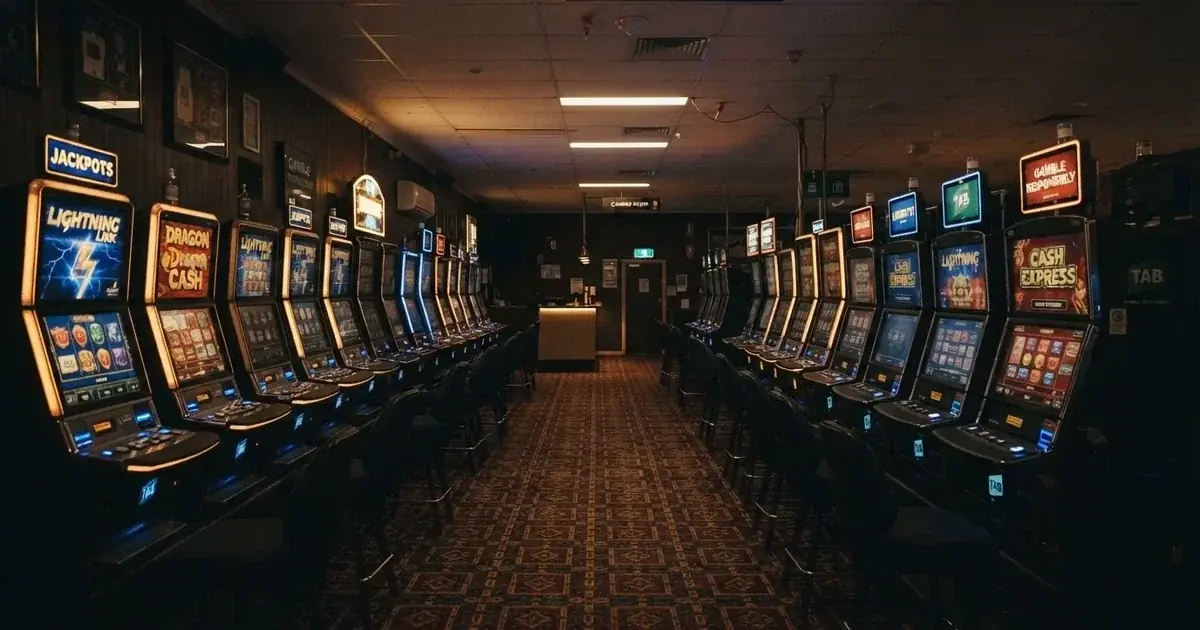
Pokies is the local name for electronic gaming machines — slot-style terminals, the kind that sit in rows along a pub wall or a club’s gaming lounge. They have operated legally in Australian venues since New South Wales registered clubs first installed them in 1956, and they now sit in every state and territory under rules each jurisdiction writes for itself. The design, the maximum bet, the hours of operation, the minimum return-to-player and the harm-minimisation settings all vary by state, which is why a single national answer to “where can I play pokies right now?” does not exist.
Australia runs a striking share of the world’s pub and club machines. As of 2020–21, Australians wagered close to A$150 billion through gaming machines in a single year and lost A$12.18 billion on them, against roughly 0.3% of the global population and around 3% of the world’s pub and club poker machines. New South Wales alone had 87,298 machines outside casinos across 2,195 venues as of June 2023, with player losses of A$8.18 billion the following financial year. Queensland operated 21,122 machines across 351 venues in October 2023. Victoria ran 26,380 machines outside Crown Casino in 488 venues in 2021–22, held under a statewide cap of 30,000. These are not rare machines in a hard-to-find venue; they are the dominant legal gambling product in the country.
The phrase also gets stretched, sometimes deliberately, to cover the online version of the same game. That stretch is what the law treats as a different product entirely. Online pokies — internet-delivered slot games — are prohibited interactive gambling services for anyone in Australia. The machines in front of you in a venue are legal; the same game on an offshore website is not. Conflating the two is how an Australian ends up on a site the ACMA has already written to about offering exactly that.
How “near me” actually works when you’re looking for a machine
Search engines treat “pokies open near me” as a location query. The results that come back are drawn from business listings tied to a postcode or a device location, so the practical answer to “what’s open right now?” depends on three things working in sequence: the venue has to be licensed, the gaming room has to be open at this hour, and the listing has to carry accurate trading hours.
Pubs and clubs are the default. They hold the bulk of the machine count outside the casino sector, and their opening hours are governed by ordinary liquor licensing — the gaming room usually trades at least as long as the bar, sometimes longer. Casinos run separately. Crown Melbourne and Crown Perth are full-license casinos with extended gaming floors; state-specific rules determine how late the tables and machines stay open. Regional and suburban clubs can hold anywhere from a handful to several hundred machines, and the bigger ones often run gaming rooms that close well after midnight.
The honest constraint is that no national database publishes “this machine is on right now.” The trading hours belong to each venue, and they shift for public holidays, race meetings, and seasonal demand. The quickest way to confirm is the venue’s own page or a phone call.
The hours that pubs and clubs actually keep
There is no single national answer. State regulations cap the latest hour a gaming room can stay open, and individual venues set their own hours inside that ceiling. Most suburban pubs shut their gaming room somewhere between midnight and 2 a.m. on weeknights, with later close on Friday and Saturday. Clubs with a stronger focus on gaming — RSLs, leagues clubs, bowling clubs in some states — frequently run to 4 a.m. or later on weekends. The casino floors run later still, with Crown Melbourne’s main gaming floor typically trading into the early hours.
The headline point is that “24 hours” is rare for an Australian pub or club gaming room. A small number of casinos and a handful of large-format clubs in some states hold approval for round-the-clock gaming, but the majority of venues do not. The way to find out is to check the specific venue rather than assume a national rule.
Some states have tightened these hours in recent years. Western Australia is the outlier: pubs and clubs there cannot run poker machines at all. The ban was put in place when Crown Perth opened in 1985, and it has held since. Western Australians wanting pokies travel to Crown Perth, where the machine count has grown from roughly 200 in 1985 to around 2,500 today, every one of them approved by the state’s Gaming and Wagering Commission.
What the law actually says about online pokies
The Interactive Gambling Act 2001, strengthened by the Interactive Gambling Amendment Act 2017, makes it an offence to provide online casino games, online pokies or in-play betting to a person physically in Australia. No state or territory licenses these products. What is licensable is wagering on races and sport placed before the event, lotteries, and keno — in practice licensed by the Northern Territory Racing and Wagering Commission, which oversees 52 of the country’s online bookmakers, including Sportsbet, Bet365 and Ladbrokes, for tax reasons.
The IGA targets the provider, not the individual player. An Australian who opens an offshore site is not personally prosecuted. What they do lose is the consumer protection that comes with an Australian licence: no complaints body, no recourse if a withdrawal is refused, no guarantee that the offshore operator won’t disappear overnight with a balance attached to the account. The site can also be blocked by Australian internet service providers on the ACMA’s direction while money is still sitting on it.
H2 Gambling Capital’s 2025 estimate puts losses to illegal offshore gambling sites at around A$3.9 billion a year, and reports that the share of gambling going through legal Australian channels fell from 74% in 2021 to 64%. The slide tracks the marketing spend of offshore operators targeting Australian players, not any change in the legal status of what they sell.
How the ACMA enforces it, and what that means on the ground
The ACMA investigates complaints, issues formal warnings to offshore operators, and directs Australian internet service providers to block illegal sites at the domain level. As of June 2026, a running total of 1,751 illegal gambling and affiliate marketing websites had been blocked since the first blocking request in November 2019, and more than 230 unlicensed gambling services had left the Australian market since enforcement was strengthened in 2017. A round reported the same week added 12 more domains to the block list — 7Signs, ChromaBet, Donbet, Duospin, Freshbet, Slots Gem, Jacks Club, Lucky Start, Pointsbetz, Spinrise, Vinyl Casino and Wildsino.
The formal warning letters are the visible edge of that process. Each one names a specific company and a specific brand, gives the legal basis under the IGA, and warns that further action — including civil penalties or referral to the Australian Federal Police — will follow if the operator continues serving Australians. The ACMA publishes the warnings on its website, and they make the regulatory position concrete in a way the statute alone does not. A warning to EOD Code SRL over Instant Casino in February 2025, for instance, names the operator, the brand, and the prohibited service, and is on the public record.
The blocking rate, measured
The arithmetic the ACMA’s enforcement record supports is a blocking rate, not a count. From the first blocking request in November 2019 through to the round reported on 26 June 2026, the cumulative total sat at 1,751 blocked illegal gambling and affiliate marketing websites. Across roughly 79 months of active blocking, that works out to an average of around 22 blocked domains per month, with the monthly pace picking up noticeably after the 2017 amendments gave the regulator firmer ground and again after each subsequent enforcement round.
The right way to read that figure is as a band rather than a fixed point. The early months of the program, after November 2019, ran at a slower tempo as the ACMA built its case files and ISPs set up the technical means to honour the directions. The rounds since 2022 have clustered into batches — sometimes four or five in a single week, then quiet stretches while investigators prepare the next batch. A reader should take “around twenty per month” as the long-run average, not as a steady-state. The blocking tempo accelerates when the ACMA has built a portfolio of complaints against a particular operator’s network of brands, and slows when the next round is still being prepared.
What the band hides is the affiliate side of the same operation. The 1,751 figure counts affiliate marketing pages as well as the gambling sites themselves, and those pages are the infrastructure offshore operators rely on to reach Australian searchers. A search result that lands on a blocked affiliate page looks, to the reader, like a dead link. To the operator, it is a customer-acquisition channel that has gone dark. The enforcement record shows that the regulator treats both ends of the chain as part of the same prohibited service.
Minimum returns and what they cost the player
Every Australian jurisdiction sets a legal minimum return-to-player for its poker machines. The figure is the share of money wagered that the machine must, over its full cycle, return to players. New South Wales, the Northern Territory, Queensland and (generally) Victoria sit at 85%; the Australian Capital Territory and Tasmania at 87%; South Australia at 87.5%; Western Australia at 90% — though Western Australia’s figure applies only to the machines at Crown Perth, since pubs and clubs in that state do not host them. Crown Melbourne’s machines run at 87%, slightly above the general Victorian floor.
The implicit house edge sits between 10% and 15% across the country, depending on jurisdiction. On a machine returning 85%, A$100 wagered returns A$85 in the long run, costing the player A$15. On a 90% machine in Western Australia, that same A$100 returns A$90, costing A$10. The variation is small at the level of any single session and enormous at the level of A$150 billion a year.
It is worth holding those numbers alongside the losses reported above. Australia’s machine count produces A$12.18 billion in player losses for 2020–21, against roughly A$150 billion wagered. The implied return across the national fleet sits at about 91.9%, dragged upward by Western Australia’s 90%-minimum machines and by individual venues whose machines exceed the statutory floor. The headline number is closer to 90% than to the 85% floor that several states set — the industry clears the minimum by a margin, because returning 87% or 88% keeps players at the machine longer than returning exactly 85%.
ID checks, sign-in cards and what a venue actually asks for
Identification rules vary by state and by venue, but the practical position is that an Australian pub or club is not required to scan a driver’s licence before letting a patron sit down at a poker machine. Age verification happens at the door for the venue itself, since entry to a gaming room is tied to the same liquor licensing that governs the bar. The card-check is the licence check at the front of the building, not a per-machine identity verification.
What is changing is pre-commitment. Tasmania legislated nation-leading mandatory pre-commitment cards for its poker machines, with the reform originally planned for earlier rollout but delayed until late 2025 under updated implementation timelines. A pre-commitment card is a player’s record of how much they intend to spend over a given period, and the machine enforces the limit. Tasmania’s rollout is the first mandatory version in the country; other states have voluntary pre-commitment schemes that run alongside the machines but do not bind the player the same way.
BetStop, the National Self-Exclusion Register, has been live since August 2023. It binds Australian-licensed online and phone wagering services — bookmakers, not casinos, and not the offshore operators. A punter who has registered with BetStop cannot open an account with a licensed Australian wagering provider; they can still, in principle, sit down at a venue machine and play, because BetStop does not reach into the venue floor. The National Gambling Helpline is 1800 858 858, free, 24/7, with chat at Gambling Help Online.
Payments, credit cards and what licensed wagering actually accepts
Since 11 June 2024, credit cards, credit-related products and digital currency have been banned as payment methods for licensed online wagering in Australia, with penalties of up to A$247,500 for operators that accept them. The legal deposit routes for licensed wagering are debit card, bank transfer, PayID/Osko and BPAY. The rule applies to licensed Australian operators, which means it is a useful diagnostic when looking at an offshore site: any site asking an Australian for a credit card or a crypto deposit is operating outside the Australian rules, whatever licence it displays.
For the land-based experience, none of this applies. The machine takes cash, sometimes a ticket-in-ticket-out voucher from a previous session, and that is the transaction. The credit card ban governs online wagering, not the venue floor.
The 2026 reform package and what it changes
The Interactive Gambling Amendment (Gambling Reform) Bill 2026 passed Parliament on 19 August 2026. Its advertising and inducement measures commence on 1 January 2027. The bill tightens the rules around how licensed wagering operators can promote their products to Australians, particularly around inducements to open new accounts or to keep playing. It does not change the prohibition on online casino games or online pokies; that has been settled since the 2017 amendments.
The shape of the change is law with a start date, not law already in force on a 2026 page. The advertising and inducement rules become enforceable from 1 January 2027, and the enforcement actions that follow will belong to the next year.
Offshore brands the ACMA has formally warned
This section is not a ranking and not a recommendation. The brands below appear because the ACMA itself issued a formal warning over each one for offering prohibited interactive gambling services to Australians. No bonus terms are given; the only sources for bonus claims are affiliate marketing pages, and affiliate pages are exactly the kind of infrastructure the ACMA blocks. A reader comparing options needs to see which brands the regulator has publicly named, the operator behind each brand, and the date of the warning. What a brand does after a warning is a matter for the regulator.
Each operator below holds a marketing licence offshore — Curaçao, Anjouan, elsewhere — and displays it on its homepage. The relevant question is not which offshore licence a brand has, but whether any offshore licence allows it to offer online casino games to a person in Australia. The answer, under the Interactive Gambling Act 2001, is no. A licence displayed on the site is a licence to operate in the jurisdiction that issued it, not a licence to target Australians.
RocketPlay
The ACMA issued a formal warning to Pulsup Ltd over RocketPlay in March 2026. An earlier warning over the brand went to Dama N.V. in May 2022. The 2026 action names a different operator entity for the same brand, which is a familiar pattern — operators rotate the corporate shell around the brand when one entity attracts regulator attention, while the underlying service continues.
RocketPlay is a brand that has cycled through the ACMA’s enforcement record twice. A warning in 2022 over Dama N.V., a second warning in 2026 over a different operator. The pattern speaks for itself: the brand kept running for Australians, the regulator kept writing letters, and the operator structure changed between rounds.
Level Up Casino
The ACMA issued a formal warning to Dama N.V. over Level Up Casino in May 2022, as part of a six-brand batch that also covered Bambet, Dazard, Rocketplay, Wild Tornado and Cobra Casinos. Level Up Casino is one of six brands attached to the same operator in that warning, which means the enforcement action addressed the operator as well as the individual brand.
Woo Casino
The ACMA issued a formal warning to Dama N.V. over Woo Casino in March 2025. The operator is the same Dama N.V. that received the May 2022 batch warning, so the formal record shows a pattern: warning in 2022, then a fresh warning for a specific brand within the same operator’s portfolio in 2025.
Spirit Casino
The ACMA issued a formal warning to Dama N.V. over Spirit Casino in May 2025, two months after the Woo Casino warning to the same operator. Two warnings to the same operator in successive months is unusual in the ACMA’s published record; the regulator appears to have addressed the operator’s brand portfolio systematically.
National Casino
The ACMA issued a formal warning to Consolutetish S.R.L. over National Casino in July 2025. The same operator also received a warning over Bizzo Casino at the same time, indicating the regulator batched the two brands together.
Bizzo Casino
The ACMA issued a formal warning to Consolutetish S.R.L. over Bizzo Casino in July 2025. Bizzo had already been the subject of a 2022 formal warning to TechSolutions (CY) Group Limited and TechSolutions Group N.V. — meaning the brand has cycled through two different operators and two separate ACMA actions.
Ignition Casino
The ACMA issued a formal warning to Bamboo Media over Ignition Casino in July 2025. The action addresses a different operator from the Dama N.V. and Consolutetish S.R.L. cases above, which illustrates how widely the offshore operator ecosystem is distributed: a single brand is often one node in a much larger network of services run by many different companies.
Instant Casino
The ACMA issued a formal warning to EOD Code SRL over Instant Casino in February 2025. Instant Casino is one of the brands marketed aggressively to Australian searchers, and the ACMA’s published warning puts the operator on the public record.
Jackbit
The ACMA issued a formal warning to Ryker B.V. over Jackbit and CasinOK in April 2026. Two brands from the same operator in a single warning letter, which the regulator occasionally does when the operator runs a small portfolio of services under one corporate structure.
Casino Intense
The ACMA issued a formal warning to Sterplay Holding Ltd over Casino Intense in April 2025. The brand has appeared in mainstream Australian coverage alongside the ACMA’s own enforcement actions.
Sky Crown
The ACMA issued a formal warning to Hollycorn N.V. over Sky Crown and Blue Leo casino services. The Hollycorn warning is one of the longer-running cases on the ACMA’s published record, with the original action dated to September 2022.
ACMA formal warnings at a glance
The table below summarises the brands the ACMA has publicly named. The columns are: brand; the ACMA action and date; the operator named by the ACMA in the formal warning; and the subject support marker from research, indicating whether the brand’s connection to the subject of this page (pokies open nearby) is confirmed, sourced only to listings, or unsupported. No row adds a fact research does not carry.
| Brand | ACMA action and date | Operator named by the ACMA | Subject support |
|---|---|---|---|
| RocketPlay | Formal warning, March 2026 | Pulsup Ltd | — |
| Level Up Casino | Formal warning, May 2022 | Dama N.V. | listings-only |
| Woo Casino | Formal warning, March 2025 | Dama N.V. | — |
| Spirit Casino | Formal warning, May 2025 | Dama N.V. | — |
| National Casino | Formal warning, July 2025 | Consolutetish S.R.L. | listings-only |
| Bizzo Casino | Formal warning, July 2025 (and 2022) | Consolutetish S.R.L. / TechSolutions | — |
| Ignition Casino | Formal warning, July 2025 | Bamboo Media | — |
| Instant Casino | Formal warning, February 2025 | EOD Code SRL | — |
| Jackbit | Formal warning, April 2026 | Ryker B.V. | — |
| Casino Intense | Formal warning, April 2025 | Sterplay Holding Ltd | listings-only |
| Sky Crown | Formal warning, September 2022 | Hollycorn N.V. | — |
The spread of dates is the point. Two warnings to the same operator, fresh warnings years after the original, and warnings spread across operators from Curaçao and other jurisdictions: the table shows an enforcement landscape that is active, sustained, and not slowing. Where the subject-support column shows listings-only, it means research could only trace the brand’s presence in the subject area through directory or affiliate listings rather than the operator’s own primary statement; where it is blank, research carried no statement either way, and the brand is presented on its other fields.
Keeping the search in perspective
A search for pokies open nearby is, at heart, a search for entertainment on licensed premises within driving distance. The legal answer is straightforward: pubs, clubs and casinos are the venues; trading hours are venue-specific; identification is at the door rather than at the machine; and minimum returns run between 85% and 90% depending on the state.
The offshore answer is what the rest of this page is about. The Interactive Gambling Act 2001 prohibits the offering of online casino games to people in Australia, the ACMA enforces it through formal warnings and ISP-level blocking, and the cumulative blocking figure now sits at 1,751 domains since November 2019. The brands listed above are the names the regulator has put on the public record in that effort. None of them offers a legal route to playing pokies in Australia; the only such routes are the venue floors the law was written around.
A reader who is concerned about their own play, or someone else’s, can reach the National Gambling Helpline on 1800 858 858, free and 24/7, with chat at Gambling Help Online. BetStop, the National Self-Exclusion Register, covers licensed wagering services but does not bind venue floors. Pre-commitment is mandatory in Tasmania from late 2025 and voluntary elsewhere. The protective layer exists; it sits inside the Australian-licensed system rather than around it.
Tax treatment for recreational players
Gambling winnings of a recreational player are not assessable income under section 6-5 of the Income Tax Assessment Act 1997, and losses are not deductible. The position changes only when a person carries on a business of gambling, which is a much higher bar than regular play and involves a different tax treatment. For the standard case — the occasional session at the local club — the winnings are tax-free and the losses are a personal cost. The Australian Taxation Office’s published guidance should be consulted for any situation that strays outside the recreational case.
Frequently asked questions
What hours do most Australian pubs and clubs typically keep their poker machines open?
Most suburban pubs close their gaming room between midnight and 2 a.m. on weeknights, with later close on Friday and Saturday. Larger clubs — RSLs, leagues clubs, some bowling clubs — frequently run to 4 a.m. or later on weekends. State regulation caps the latest permitted hour, and each venue sets its own hours inside that ceiling. Round-the-clock gaming is rare outside casinos and a small number of large-format clubs.
Is there a way to check which nearby venue currently has poker machines open right now?
No national database publishes live gaming-room status. The practical check is the venue’s own listing — website, Google Maps trading hours, or a phone call — against state rules on the latest permitted hour. Casino floors trade longer than pubs and clubs, and Crown Melbourne and Crown Perth are full-license venues with extended hours.
Are poker machines in a licensed pub or club the same thing as an online pokies game?
The mechanical product is similar, but the legal status is different. A poker machine in a licensed pub or club is regulated under state law, with a minimum return-to-player between 85% and 90% depending on jurisdiction, venue-based harm-minimisation settings, and a venue licence that can be inspected or revoked. An online pokies game on an offshore website is a prohibited interactive gambling service under the Interactive Gambling Act 2001, and no state or territory licenses it for Australian players.
Do all pubs and clubs run pokies for 24 hours, or only some venues?
Only a small number. The majority of Australian pubs and clubs shut their gaming room well before 24-hour trading, often by 2 a.m. on weeknights. Casinos and a handful of large clubs in some states hold approval for round-the-clock gaming, but the typical pub or club does not. Western Australia is the extreme case: pubs and clubs there cannot run poker machines at all under the 1985 ban, with the machines confined to Crown Perth.
What identification, if any, does a venue ask for before letting someone play the machines?
Identification is at the door for the venue itself, since entry to a gaming room is governed by the same liquor licensing that governs the bar. The machines themselves do not require per-player sign-in. Tasmania’s mandatory pre-commitment cards, which came into effect in late 2025, change that position in that state specifically: the card is the player’s record of intended spend and the machine enforces the limit. Other states rely on voluntary pre-commitment and venue-level harm-minimisation settings rather than mandatory player identification at the machine.
How does the number of poker machines in Australian venues compare with the rest of the world?
Australia runs about 3% of the world’s pub and club poker machines against roughly 0.3% of the global population. New South Wales alone — 87,298 machines outside casinos across 2,195 venues as of June 2023 — has more poker machines than many countries combined. The national fleet wagered close to A$150 billion in 2020–21, with player losses of A$12.18 billion the same year, a per-capita intensity no other country matches.