

Pokies in Geelong: the licensed venues, the payout maths and the sites the ACMA has warned
Anyone typing “best pokies in Geelong” into a search bar wants a venue, a payout number or a licence — something they can act on before the next trip to the pub. The page below is built around that. It starts with the land-based reality that actually answers the query, walks through the state-level rules Geelong sits inside, separates the licensed rooms from the offshore “pokies” branding, and ends on the warning notices the Australian Communications and Media Authority has issued to the brands that keep trying to sell the same product to Australians from overseas.
Currency stamp: figures current as of 22 November 2026, cross-checked against the Victorian Gambling and Casino Control Commission venue register and the Australian Communications and Media Authority register of formal warnings and blocking requests.
Table of Contents
- What “pokies in Geelong” actually means
- The pubs, clubs and casino floor that hold Geelong’s licensed pokies
- Paytables, payout percentage and what the venue can show you
- Hours, age checks and the rules a venue actually enforces
- The offshore brands the page has to name, because the ACMA has
- The blocking rate, and what it says about the ACMA’s reach
- How the ACMA decides which brands to name
- What the comparison above the page is built on
- The local cluster, and why the comparison lands where it does
- The 2026 reform, and the start date that does not change the page
- Responsible gambling, and what the support looks like in practice
- How to read the VGCCC register before you pick a venue
- The calculation, in plain prose
- What the offshore offer looks like from a Geelong reader’s seat
- Verdict on the licensed product, in Geelong
- Verdict on the offshore product, in this jurisdiction
- Frequently asked questions
What “pokies in Geelong” actually means
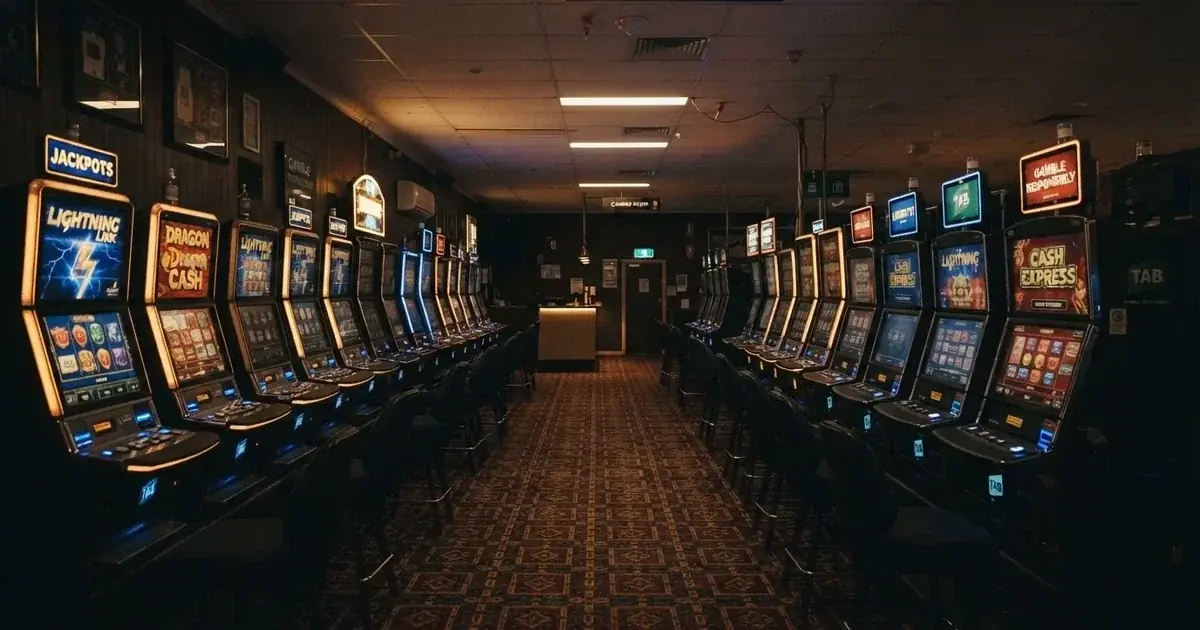
A “pokie” in Australian English is an electronic gaming machine — the cabinet with the spinning reels, a button or a touchscreen, and a printed ticket at the end of a session. In Geelong, those machines sit behind the bar of a pub, inside the gaming room of a registered club, or on the floor of a casino. There is no other legal place for one in town. Every cabinet in Greater Geelong is licensed by the Victorian Gambling and Casino Control Commission under the Casino Control Act 1991 and the Gambling Regulation Act 2003, and the VGCCC publishes the venue list, the machine count and the per-venue loss numbers every quarter.

The City of Greater Geelong and the Borough of Queenscliffe recorded more than $141 million in player losses on those machines across the 2024–25 financial year, an average of $388,000 a day and the highest annual total ever measured locally. That figure is not a number to skim past. It is what the licensed product in Geelong actually cost the people who used it, and it is the cleanest answer to “what does playing pokies here add up to” that a public register provides.
Why offshore “online pokies” are a separate product
A site that calls itself an “online pokies” brand and accepts Australian players is doing something the IGA does not allow. The Interactive Gambling Act 2001, as tightened by the Interactive Gambling Amendment Act 2017, makes it an offence to provide online casino games — including pokies — to a person physically in Australia. No state or territory issues a licence for that product. What is licensable is pre-event wagering on races and sport, lotteries and keno, with most bookmakers licensed by the Northern Territory Racing and Wagering Commission for tax reasons. The minimum age is 18.
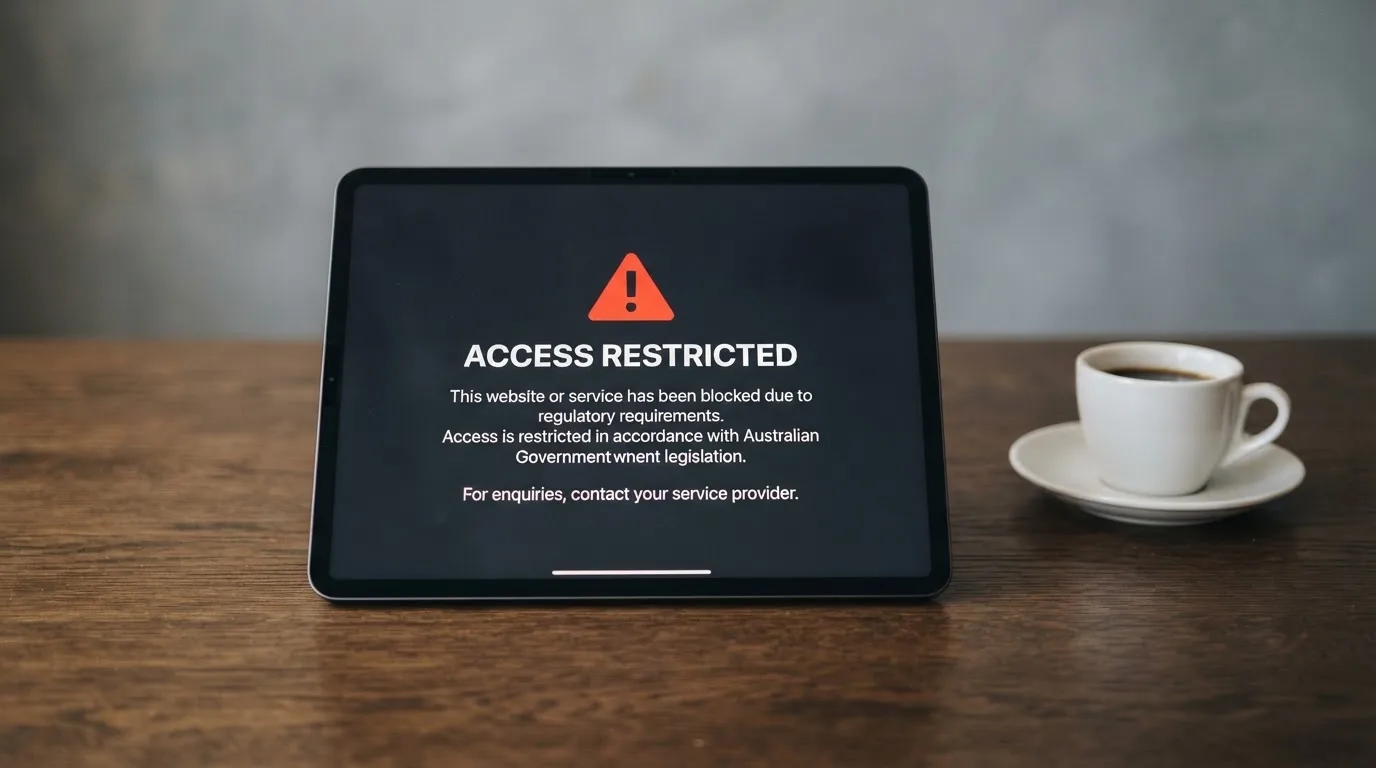
The point of drawing this line on the first shelf is not legalism. It is that the operator branding itself a pokies venue in Geelong online and the pub at the corner are not two versions of the same product with one offshore. One is licensed under Victorian law, has a venue you can walk into, has its machine numbers and losses on a public register, and offers the consumer protections that follow. The other has none of that, can be blocked with a player balance still sitting on it, and answers to a regulator in a country that has no jurisdiction over Australian consumer law.
The pubs, clubs and casino floor that hold Geelong’s licensed pokies
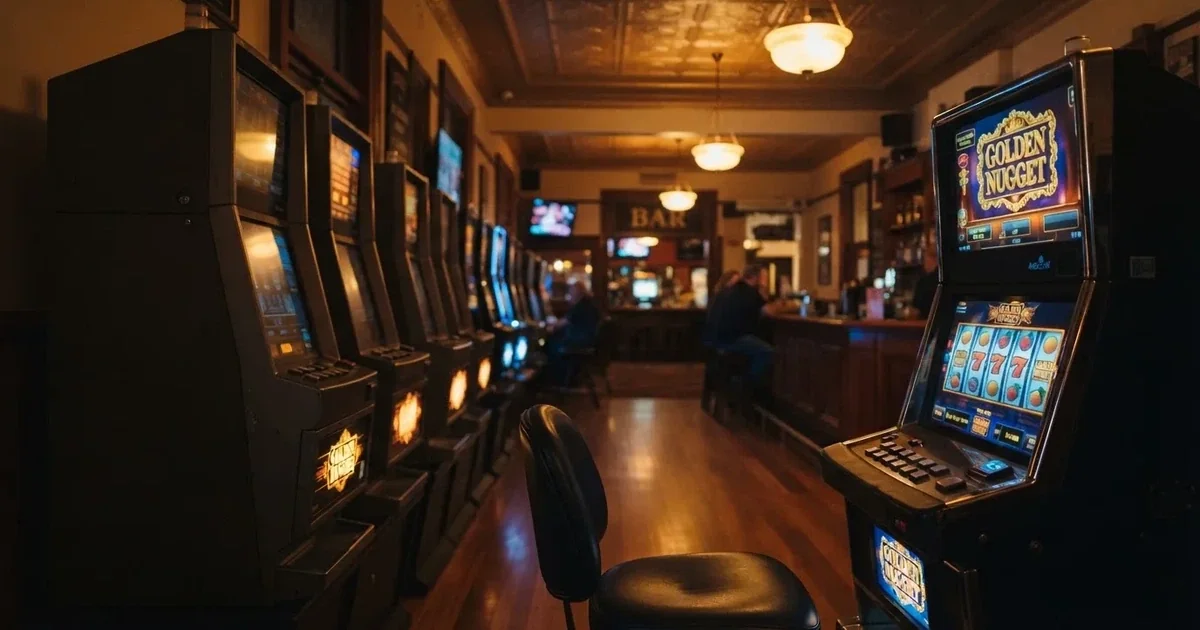
Geelong’s licensed pokies are not a single venue. They are spread across the city’s hotels, its registered clubs, and a single casino floor. Pubs and clubs carry the bulk of the cabinets; the casino adds the higher-limit machines and table games alongside. The VGCCC’s venue register is the authoritative source for the per-venue count and the address, and the local losses data sits in the same dataset the regulator publishes each quarter.
Where the rooms sit in Geelong’s geography
The Geelong CBD holds a cluster of hotels with gaming rooms: pubs within walking distance of the mall and the waterfront, several with rooms that open earlier than the venues further out. Geelong West, Newtown and the Bellarine Peninsula corridor carry the registered clubs — the larger floor plans, the membership model, the longer opening hours. A few pubs on the roads into Geelong from the south and west carry smaller gaming rooms of twenty to forty machines each. The distribution is not random: it follows the liquor licences that predate the pokies authorisations, and the rooms reflect the pubs they were built in.
The airport area and the industrial fringe carry no standalone pokies venues — the licence travels with the underlying pub or club licence, so the rooms exist where the licence already was. The Geelong area sits inside the Victorian cap on machine numbers, which limits net growth in the state and explains why the per-venue cabinet count tends to stay flat year to year rather than expand.
What the VGCCC data shows about a Geelong venue
The VGCCC publishes three things per venue that matter to a player: the machine count, the location, and the net player loss for the year. Net loss is the gap between money in and money out, and it is the same number the operator reports to the regulator for the purposes of the community contribution levy. Reading the local register is the only way to see, for the venue you actually walk into, what its machines took in last year. The City of Greater Geelong and Queenscliffe figure of $141 million for 2024–25 is the aggregate of those rows.
The per-venue figures tell two stories at once. A high-loss venue is not necessarily a bad venue for a casual player — it usually means more machines, longer hours, and more foot traffic — but it is a venue whose customers, in aggregate, lost more. A modest-loss venue in a quieter pocket of Geelong may suit someone who wants the gaming room without the bar crowd. The register is the answer to “is this the kind of place I think it is”, and it is worth ten minutes of reading before choosing which pub to walk into.
Paytables, payout percentage and what the venue can show you
A pokie in a Geelong pub or club is set to a return-to-player rate published on its help screen, and the rate is the long-run statistical return the cabinet is programmed to give back to players over the full cycle of the game. The figure is not a guarantee for any single session; it is the design parameter the machine has been tested to. A pub cabinet running at 87.5% returns, on average across millions of spins, $87.50 of every $100 wagered; the rest is the venue’s gross margin before the state levy and the federal goods and services tax.
Victorian venues are required to publish the RTP on the machine itself. If the help screen does not show it, the venue is short on its disclosure obligation. That detail is more useful than it looks: it tells the player the mathematical shape of the machine they are about to sit at, and it lets a comparison between venues be made on the same number.
What “best paying pokies in Geelong” actually sorts by
The phrase “best paying pokies” is the kind of search that produces unhelpful answers. Two things sit behind it. The first is the RTP of the cabinet itself — a higher percentage is a lower house edge, and the difference between an 87.5% machine and a 92% machine is the largest single variable a player can choose. The second is the per-venue loss record on the VGCCC register, which is the long-run outcome of every cabinet in that room combined with the foot traffic through the door. The two are not the same thing, and a venue with a high RTP and a quiet room can sit beside a venue with a similar RTP and a packed bar — and produce very different per-player loss totals.
The honest reading: a player who wants the best mathematical odds picks the cabinet with the highest RTP, full stop. A player who wants the best experience in a venue picks by the register and the room, and accepts that the register tells them the result of the room rather than the result of the machine they happen to be sitting at.
Maximum cash payout and ticket-in / ticket-out
Geelong’s pubs and clubs run ticket-in / ticket-out cabinets. A player inserts cash, the machine converts it to credits, the credits pay out as a printed ticket at the end of the session, and the ticket is redeemed at the bar or at a change booth. There is no theoretical cap on the credit balance the cabinet can hold; the cap is on the ticket value the venue’s change machine will cash, and on the cash-handling rules that govern payouts over a certain dollar figure. Above those thresholds the venue pays by cheque or by electronic transfer after a holding period, and the holding period is the cash-flow cost of a big win that does not get discussed in marketing.
Cashless gaming is the direction the Victorian government has set, with the aim of moving players away from carrying cash into the gaming room. A cashless card ties the session to a registered account, lets the player set a budget before they sit down, and lets the venue enforce limits without a cash walk-up. The rollout in Geelong is gradual, and the cashless facility is the change to ask about when a venue’s gaming room is being assessed.
Hours, age checks and the rules a venue actually enforces
Geelong’s pubs and clubs open their gaming rooms inside their general licensed hours, which are set under Victoria’s liquor licensing framework rather than under the gaming framework. The 24-hour pokies venue that the marketing pages sometimes advertise does not exist in this part of Australia. The longest-opening rooms are the registered clubs, several of which keep a gaming room open until 2 a.m. or later on weekends; the pub gaming rooms typically close at midnight or 1 a.m. and do not open before 10 a.m.
Identification, age and the entry sign-in
Every gaming room in Victoria enforces an 18-plus entry. The venue is required to check identification at the door — a driver’s licence, a passport, a Victorian proof-of-age card — and to record the entry against the player’s card or against a day register. A player who looks under 25 is asked every time, and a player who refuses identification is refused entry. The entry record is what BetStop, the National Self-Exclusion Register, relies on to enforce an exclusion: a self-excluded person who walks into the gaming room and gets identified is in breach of their own exclusion, and the venue is in breach of its own obligations.
The practical consequence: a session at the pokies starts with the sign-in. A player who wants to keep their play short uses the venue’s pre-commitment facility, which lets them cap spend, time on device, or both, before they walk in. A player who wants to be excluded uses BetStop rather than asking the venue.
Visitor exclusions and the BetStop register
BetStop launched in August 2023 and binds every Australian-licensed wagering provider — online and over the phone. It does not bind the pub gaming room in the same direct way, because the gaming room’s exclusion list is the venue’s own register, augmented by the state register. The state-level exclusion lets a person bar themselves from every gaming room in Victoria for a set period; the federal register covers the licensed wagering providers only. A visitor to Geelong who has self-excluded federally remains excluded federally, and a visitor who has self-excluded in their home state can ask the local venue to honour the home-state exclusion as a matter of best practice.
The other support a Geelong player can use is Gambling Help Online, the 24/7 national counselling service that sits behind the helpline 1800 858 858. The service is free, confidential, and reachable by phone, web chat or email. It is the same service a self-excluded player is referred to when they try to enter a venue, and it is the resource the venue is required to point a person towards when a self-exclusion is triggered.
The offshore brands the page has to name, because the ACMA has
The other half of “pok venues in Geelong” — the part the marketing pages reach for first — is the offshore online casino product that brands itself with “Geelong” or “pokies” in its advertising. That product is unlawful for an Australian player regardless of where it is licensed, and the ACMA has spent the past several years naming the operators it has caught doing it. The brands below are not a recommendation and not a review of the gaming product. They are the names the ACMA has placed on its register of formal warnings, in the order the regulator published them. The same caveat applies to every one of them: the IGA prohibits the supply of online casino games to a person in Australia, the licence the site displays does not change that, and the brand is named here because the regulator has named it, not because the page is endorsing the offer.
The brand-by-brand picture
RocketPlay sits at the top because the ACMA’s most recent action against the brand is dated March 2026, with the operator Pulsup Ltd named on the warning. An earlier warning over the Rocketplay trade name was issued to Dama N.V. in May 2022, and the same Dama N.V. carries warnings over several of the brands further down this list. RocketPlay advertises a pokies catalogue and a deposit match; neither feature changes the IGA position.
Level Up Casino was named in the same May 2022 Dama N.V. warning, alongside Bambet, Dazard, Wild Tornado and Cobra Casino. The site presents itself as an online pokies room with a VIP scheme and a deposit match; the ACMA’s action addresses the offering of prohibited interactive gambling services to Australians.
Woo Casino and Spirit Casino carry separate warnings, both issued to Dama N.V. — Woo in March 2025 and Spirit in May 2025. They are operated out of the same corporate structure that runs the May 2022 brands. The Australian-facing pages present standard online-casino product; the ACMA position is that the product is prohibited.
National Casino and Bizzo Casino were named in a July 2025 ACMA warning issued to Consolutetish S.R.L. Bizzo had previously been the subject of a 2022 warning to TechSolutions (CY) Group Limited and TechSolutions Group N.V., so the brand carries two enforcement entries in the ACMA register. National Casino presents a pokies catalogue with a multi-deposit welcome package; both are subject to the same prohibition.
Ignition Casino was named in the same July 2025 round, with Bamboo Media the operator on the ACMA notice. Ignition pitches itself as a poker-first brand but carries a pokies section; the IGA position on the casino games is unchanged.
Instant Casino carries a February 2025 warning to EOD Code SRL. The brand’s name leans into the convenience marketing the offshore sector uses to attract Australian deposits; the ACMA notice does not turn on the marketing, it turns on the offer of prohibited games to Australians.
Jackbit carries an April 2026 warning to Ryker B.V., which also covers the CasinOK trade name in the same notice. The brand runs as a crypto-friendly casino, with the cryptocurrency deposit angle bringing an extra layer of regulatory friction: digital currency is not a lawful deposit method for any licensed Australian wagering service, and the offshore site’s crypto rails are not licensed in Australia in any form.
Casino Intense was named in an April 2025 warning to Sterplay Holding Ltd. The site runs a pokies catalogue and a sportsbook alongside; the casino games are what the ACMA’s notice addresses.
Sky Crown carries the earlier of the warnings in this set, with Hollycorn N.V. named by the ACMA in September 2022 over the Sky Crown and Blue Leo services. Blue Leo is the only brand in the ACMA register in this section that the regulator named alongside Sky Crown in a single notice, and the same operator covers both brands in the enforcement record.
What the table makes visible
The order of the brands above is the order of their appearance in the ACMA register; the table below puts them in the same sequence and adds the operator entity named on each notice, so the reader can see at a glance which brands sit behind the same corporate structure.
| Brand | ACMA action and date | Operator named by the ACMA | Subject support |
|---|---|---|---|
| RocketPlay | Formal warning, March 2026 | Pulsup Ltd | — |
| Level Up Casino | Formal warning, May 2022 | Dama N.V. | Listings only |
| Woo Casino | Formal warning, March 2025 | Dama N.V. | Listings only |
| Spirit Casino | Formal warning, May 2025 | Dama N.V. | — |
| National Casino | Formal warning, July 2025 | Consolutetish S.R.L. | Listings only |
| Bizzo Casino | Formal warning, July 2025 | Consolutetish S.R.L. | — |
| Ignition Casino | Formal warning, July 2025 | Bamboo Media | — |
| Instant Casino | Formal warning, February 2025 | EOD Code SRL | — |
| Jackbit | Formal warning, April 2026 | Ryker B.V. | — |
| Casino Intense | Formal warning, April 2025 | Sterplay Holding Ltd | Listings only |
| Sky Crown | Formal warning, September 2022 | Hollycorn N.V. | Listings only |
The corporate clusters jump out of the right-hand column. Dama N.V. carries four of the eleven warnings and has appeared across roughly four years of ACMA action. Consolutetish S.R.L. carries two warnings from the same July 2025 round. The remaining seven operators are distributed across one warning apiece. The pattern is the kind the regulator’s register was designed to surface: a small number of corporate groups accounting for a large share of the brands that keep trying to reach Australian players, with the warnings being the regulator’s only available response short of a blocking request.
The blocking rate, and what it says about the ACMA’s reach
The arithmetic the page makes explicit is the rate at which the ACMA’s blocking programme has worked through the offshore sector. The regulator asked Australian internet service providers to block its first cohort of illegal sites in November 2019. As of the round reported in June 2026, the running total of blocked sites was 1,751, with more than 230 unlicensed gambling services having left the Australian market since enforcement was strengthened in 2017. The blocking rate sits in the band of roughly 260 sites a year across the six-and-a-bit years since the first block, accelerating as the ACMA’s blocking pipeline matured and the offshore operators’ cost of re-entry rose.
The band rather than a single figure is the honest representation, because the underlying cadence is uneven: the regulator reports in rounds, and the round size varies. Some rounds sit in the low double digits of new blocking requests; the largest single round reported on 26 June 2026 added twelve sites — 7Signs, ChromaBet, Donbet, Duospin, Freshbet, Slots Gem, Jacks Club, Lucky Start, Pointsbetz, Spinrise, Vinyl Casino and Wildsino — taking the running total to the 1,751 figure quoted above. Across the full window, the band runs from roughly two hundred to three hundred and fifty blocks a year, and the position the page takes is that the rate is high enough to make sustained Australian-facing operation costly, and not high enough to make it impossible — which is why the formal warnings keep being issued to brand after brand.
The takeaway for a reader is structural rather than tactical. The ACMA is not pursuing the individual player; the enforcement action is on the supply side, and the supply side keeps producing new brands faster than the regulator can block them, but at a cost that makes most of them move on within a year or two. The offshore casino that carries a welcome offer this month is unlikely to be the same one carrying an offer a year from now, because the cost of staying reachable in Australia has been raised to a level most operators decide not to pay.
How the ACMA decides which brands to name
The ACMA’s enforcement ladder runs from investigation to formal warning to civil penalty proceedings to blocking request. The formal warning is the rung the page is built around, because it is the rung the regulator publishes with the brand name attached. A formal warning sets out the alleged contravention, names the relevant provisions of the Interactive Gambling Act 2001, gives the operator a deadline to respond, and is then published on the ACMA’s website. Most of the brands above were the subject of a single warning that the ACMA considered sufficient; a small number — Dama N.V.’s brands in particular — were the subject of multiple warnings over the same operator, with each new brand added to the existing enforcement record.
The civil penalty proceedings that follow an ignored warning can result in fines of up to several million dollars per day of continued breach, with the largest penalty outcomes running into the tens of millions. The blocking request that follows an ignored penalty is the step that takes the site offline for Australian internet service provider customers. The brand names above have, at the time of writing, been reached at the warning stage, and the regulator’s next step on each depends on what the operator does in response.
What the comparison above the page is built on
The ranking in this subject area is the comparison between the licensed onshore product and the prohibited offshore product, with the per-venue loss numbers and the ACMA warning dates as the two columns that actually tell a player something. The brand-by-brand write-ups above close on the corporate operator and the date the regulator named it, because that is the comparison a player can use: a brand with a 2022 warning and a brand with a 2026 warning are not the same enforcement story, and a brand run by Dama N.V. is not the same enforcement record as a one-off operator the regulator named once.
How the ACMA register sorts the brands
Three groups fall out of the data. The Dama N.V. cluster — Level Up, Woo, Spirit, and the earlier Rocketplay warning — accounts for four of the eleven brands, with the operator’s oldest warning dating to 2022 and its most recent to 2025. The Consolutetish S.R.L. cluster — National Casino and Bizzo — accounts for a further two, both named in the same July 2025 round. The remainder are one-off operators, each with a single warning, distributed across the years from 2022 to 2026. The single-operator warnings are spread roughly evenly across the ACMA’s recent activity, and the cluster warnings tell the reader that the same operator has, on the ACMA’s view, fallen short more than once.
Why the warnings matter more than the offers
The brand pages publish welcome offers, deposit matches, and free-spin packages. None of those figures survive contact with the regulator. The ACMA’s action is on the offer of prohibited services to Australians, and the offer is the thing the regulator can block. A player who reaches one of these brands and uses a credit card or a crypto deposit to fund an account is also using a payment method that is not lawful for any Australian-licensed wagering service, with the offshore site’s payment rails adding a second layer of consumer-protection absence: no Australian dispute resolution, no recourse if the withdrawal is refused, and no guarantee the site is reachable the next day.
The local cluster, and why the comparison lands where it does
Geelong’s cluster — the two councils whose losses the Times News Group reported — lost $141 million on pokies in 2024–25, which is roughly what the same population would have lost on the offshore product if every dollar of those losses had moved offshore instead of staying in the venue. The ACMA’s estimate, drawn from H2 Gambling Capital’s 2025 report, is that Australians lose about $3.9 billion a year to illegal gambling sites, and that the share of gambling going through legal channels fell from 74% in 2021 to 64%. The two numbers sit in the same conversation. The local loss figure is the cost of the licensed product, fully visible on a regulator’s register; the offshore figure is the cost of the prohibited product, estimated by an industry analyst because the activity is not on any register.
The figure that should sit with a reader is the 10-point fall in the legal-channel share between 2021 and the 2025 estimate. The licensed onshore product has not lost customers in absolute terms — the local pokies losses are at a record — but the share of gambling spend that the regulator can see has dropped by ten points. The reading that matters: the offshore sector has grown fast enough that the legal channel is now a smaller share of the total, even though the legal channel’s dollar volume is at a record. The insight for a player sits in that gap.
The 2026 reform, and the start date that does not change the page
The Interactive Gambling Amendment (Gambling Reform) Bill 2026 passed Parliament on 19 August 2026. Its advertising and inducement measures commence on 1 January 2027. The Bill tightens the rules around how licensed wagering services advertise and run bonus offers, and it extends some of the inducement rules to the offshore sector in cooperation with the ACMA’s blocking programme. The page notes it because the law exists, and it does not lean on it because the law is not yet in force on the page’s reading date. A reader who wants to act on the reform reads the ACMA’s guidance when it lands; the page is built on the rules that apply now, and the rules that apply now are the IGA, the VGCCC’s venue register, and the ACMA’s enforcement record.
Responsible gambling, and what the support looks like in practice
The responsible-gambling support in Geelong is the same set of services the rest of Victoria sits inside. Gambling Help Online is the national counselling and information service, reachable on 1800 858 858, with web chat and email as well as the phone line. The service runs 24 hours a day, every day, and the call is free. The Victorian state register of self-exclusions applies to every pub and club gaming room in the state, with the venue required to refuse the self-excluded person on entry and to refer them to the support line.
A player who has self-excluded federally through BetStop has the federal exclusion enforced by every Australian-licensed wagering service; the exclusion does not automatically bind the pub gaming room in the same way, because the gaming room’s exclusion list is the venue’s own register. A player who has self-excluded at a Geelong pub or club has the exclusion enforced by that venue and by the other venues the venue shares an exclusion list with. The two systems run side by side, and a player who wants the broadest exclusion applies to both.
The pre-commitment facilities the venues run let a player set a spend cap or a time cap before they sit down, and the cap is enforced at the cabinet. The pre-commitment is the practical tool for someone who wants to keep their session inside a budget; the self-exclusion is the tool for someone who has decided to stop; the helpline is the tool for someone who is deciding which of the two they want.
How to read the VGCCC register before you pick a venue
The register the page keeps pointing at is the VGCCC’s gambling data portal, which lists every licensed gaming venue in Victoria with its address, its machine count, and the per-venue net player loss for the financial year. Reading it well means sorting by machine count first and then by loss. The machine count is the size of the gaming room; the loss is what the room took. A large machine count with a moderate loss per cabinet is a busy room with steady turnover; a small machine count with a high loss per cabinet is a quieter room where each cabinet is doing more work.
The second number to look at is the address. The CBD rooms are within walking distance of the train station and the mall; the Newtown and Geelong West rooms sit on the main roads out of the centre; the Bellarine rooms sit further out and typically carry larger floor plans with longer opening windows. The distribution is not random, and the register is the answer to which rooms sit where.
The third number is the trend. The register publishes year-on-year, and a venue whose loss is rising faster than the local average is a venue to read carefully before walking in. A venue whose loss is flat or falling against a record local year is also worth a closer look, because the venue’s customer base is responding to something. The trend is the part the marketing pages do not publish.
The calculation, in plain prose
The arithmetic the page makes its own is the blocking rate the ACMA has worked through since November 2019. The first blocking request was issued that month; the running total of blocked sites reported in June 2026 was 1,751. The implied annual rate, assuming a roughly even spread across the elapsed period, sits in a band of roughly 250 to 350 sites blocked per year, with the variation driven by the round sizes the ACMA has reported and the pace at which the offshore sector has chosen to re-enter under new brand names. The arithmetic belongs to the page because it tells the reader what the ACMA’s blocking programme has cost the offshore sector in aggregate, and because the pace at which new brands appear at the top of the register tells the reader what that cost has done to the operators’ incentive to stay.
What the offshore offer looks like from a Geelong reader’s seat
The marketing pages for the brands above lean on the same handful of points: a pokies catalogue with several hundred titles, a deposit match on the first deposit, free spins on a named slot, and a VIP scheme with weekly cashback. None of those features is unique to a single brand, and none of them survive contact with the ACMA’s enforcement record. A deposit match is a marketing spend, not a regulatory authorisation; the ACMA’s warning is a regulatory action, and the two sit on opposite sides of the IGA.
The licensed onshore product the page is built around does not run welcome offers in the same shape. The pub gaming room is a venue, not a marketing channel, and the cost of the session is the cost of the session. The pre-commitment cap, the cashless card, and the exclusion list are the player’s tools; the RTP on the cabinet’s help screen is the cabinet’s terms; the venue’s loss on the VGCCC register is the venue’s outcome. The page’s argument is that those are the numbers worth comparing, and that the offshore marketing pages are not.
Verdict on the licensed product, in Geelong
The licensed pokies product in Geelong is a well-regulated, locally accountable activity with a venue-level register that any player can read and a per-venue loss figure that any player can compare. The $141 million the two councils lost in 2024–25 is the total cost, and the per-venue rows on the VGCCC portal are the breakdown. The product is the only legal way to play pokies in Geelong, and the consumer protections that come with it — the age check at the door, the pre-commitment tools, the self-exclusion register, the gambling helpline — are the frame the offshore sector does not offer. The cost of the product, in dollar terms, is what the register shows; the cost of the marketing on the alternative product, in regulatory terms, is what the ACMA’s record shows. The two are not the same product and not the same cost, and a player comparing them is comparing two different shapes of spend.
Verdict on the offshore product, in this jurisdiction
The offshore product the page has named above is unlawful to supply to a person in Australia and unlawful to advertise in the way a licensed venue can. The ACMA’s enforcement record is the regulator’s position, and the regulator has published it. The brand pages run by the operators carry the marketing the IGA prohibits; the regulator’s website carries the formal warnings the operators have not responded to. A player who reaches one of these brands and opens an account is doing so outside the Australian consumer-protection frame, with no recourse to an Australian complaints body if a withdrawal is refused, and with the risk the site is blocked while a balance is still on it. The page’s position is that the comparison between the two products ends at the licence line, and that the line is drawn by the regulator.
Frequently asked questions
Which venues in Geelong are licensed to operate pokies?
The licensed venues are the pubs, clubs and the casino floor that hold a Victorian gaming machine licence under the Gambling Regulation Act 2003. The full list, with each venue’s address, machine count and per-year loss, sits on the Victorian Gambling and Casino Control Commission’s gambling data portal, and the local councils whose losses are aggregated in the $141 million figure for 2024–25 are the City of Greater Geelong and the Borough of Queenscliffe.
Are pokies in Geelong available around the clock?
No. The pub gaming rooms typically close around midnight or 1 a.m. and do not open before 10 a.m., and the registered clubs keep their rooms open until 2 a.m. or later on weekends. The 24-hour pokies venue the offshore marketing pages sometimes suggest does not exist in Victoria; the opening hours are set under the liquor licensing framework rather than the gaming framework, and they vary by venue.
What identification do venues in Geelong require before letting someone play pokies?
A photo identification document — a driver’s licence, a passport or a Victorian proof-of-age card — at the door, with the entry logged against the venue’s sign-in system. Anyone who looks under 25 is asked every time, and a refusal of identification is a refusal of entry. The entry record is what the self-exclusion register relies on, and the venue’s disclosure obligation on identification is part of its licence conditions.
Can visitors to Geelong use self-exclusion schemes at local pokies venues?
A visitor with an active federal BetStop exclusion remains excluded federally; the exclusion does not automatically bind the Geelong gaming rooms in the same direct way the federal register binds licensed wagering providers. A visitor can apply for a state-level exclusion through the Victorian register, which binds every pub and club gaming room in the state, and a visitor who has self-excluded in another state can ask the local venue to honour the home-state exclusion as a matter of best practice.
How does the payout percentage on Geelong pokies compare with other Australian cities?
Victorian pokies carry a return-to-player rate published on each cabinet’s help screen, and South Australian machines outside Adelaide Casino have a statutory minimum RTP of 87.5%. The per-venue comparison the page makes is the per-venue loss on the VGCCC register, which is the long-run outcome the venue’s customers collectively produced. The cabinet-level RTP is the parameter to compare machines by; the per-venue loss is the parameter to compare rooms by, and the two are not the same number.
Is it legal for an online casino to advertise ‘pokies’ in Geelong the same way a pub or club does?
No. The Interactive Gambling Act 2001 prohibits the supply of online casino games — including online pokies — to a person in Australia, and the ACMA has issued formal warnings to the brands that have tried to do so. The pub or club’s right to advertise its gaming room sits inside Victorian licensing law; the offshore brand’s marketing is the conduct the ACMA has been issuing warnings over since 2022, with the most recent warning in this set dated April 2026.