


Best Novomatic online casinos Australia 2026
A reader searching for the best Novomatic online casinos in Australia expects a ranked shortlist. In most countries that is a page another site could write well: a slot catalogue, a payout table, a verdict at the top. The Australian version starts in a different place — at the fact that no operator can lawfully offer online casino games, online pokies or live-dealer tables to a person in this country, and that the Australian Communications and Media Authority has spent the better part of a decade acting on that fact. Everything that follows works from that position, including the comparison block further down, which is a record of who has been warned, not a recommendation of who to play with.

Data current as of 4 November 2026, verified against the ACMA’s published list of formal warnings and blocking requests.
Table of Contents
- Payment methods at Novomatic-facing casino sites
- Bonus terms and what a “free spins” offer actually costs
- Mobile play and what an in-browser casino actually delivers
- Paytable mechanics: how a Novomatic slot actually runs
- The current landscape: eleven brands the ACMA has warned
- Fundamentals of Novomatic gaming for Australian readers
- The prohibition: how the Interactive Gambling Act 2001 actually applies
- Player protection: BetStop and the safeguards that do apply
- Frequently asked questions
Payment methods at Novomatic-facing casino sites
The following table summarises the availability of payment methods for licensed Australian wagering services versus offshore casino sites.
| Payment Method | Licensed Australian Wagering | Offshore Casino Site |
|---|---|---|
| Debit card | Accepted | Accepted |
| Credit card | Banned | Often accepted |
| Digital currency | Banned | Often accepted |
| Bank transfer | Accepted | Limited |
| PayID / Osko | Accepted | Not available |
For an Australian reader, the payment question is the most concrete consequence of the prohibition. The Interactive Gambling Act 2001 makes it an offence to offer online casino games to anyone in Australia, and the credit-card and digital-currency ban that took effect on 11 June 2024 sharpens that picture: any site asking an Australian customer for a credit card or a crypto deposit is, by definition, operating outside the Australian rules, because those instruments are not lawful funding routes for any gambling service that targets this country. An operator asking for either is not licensed under Australian consumer law and is not connected to the Australian ePayments Code. The card issuer’s chargeback rights are theoretical at best.
What that means for the act of paying is plain. A licensed Australian wagering service — the kind that takes bets on horse races or sporting events before they start — accepts debit cards, bank transfer, PayID and Osko, and BPAY. The choices are narrow on purpose and they are tracked. A site offering online pokies is not in that system. It runs on its own rails. Visa, Mastercard, a handful of e-wallets such as Skrill and Neteller, occasionally a crypto on-ramp in Bitcoin or Ethereum. The customer funds the account in whatever currency the cashier accepts, and the casino settles in the same currency; there is no Australian intermediary holding the funds in trust, no Australian dispute resolution body if a withdrawal stalls, and no regulator to appeal to if a bonus term is read in a way the player did not expect.
The payout side is where the cost shows. Offshore operators publish their own timelines: instant for crypto, a day or two for e-wallets, three to seven business days for cards. None of those timelines are tested by an Australian regulator, and there is no public record of how often an Australian customer actually sees the funds land. Several of the operators further down this page have had exactly that trajectory — a balance held on a domain the ISP is now refusing to resolve is, in practice, a balance the player does not reach. The ACMA’s blocking record shows how often sites vanish mid-payout.
A further cost sits in the conversion itself. Every deposit to an offshore casino is an AUD conversion done at the casino’s spread, plus whatever the payment processor charges on top. A player depositing A$200 rarely moves exactly A$200 onto the site; the rate the cashier shows is rarely the rate the bank statement records. The difference is small per transaction but it compounds over a session, and it sits outside any advertised payout percentage. Some operators also carry a maximum-cashout rule on bonus-funded play — a cap of two or three times the deposit, or a flat ceiling on winnings, that turns a winning spin into a smaller-than-expected withdrawal regardless of how the reels landed.
The instruments themselves carry different risk profiles. A Visa or Mastercard debit card offers a chargeback right under the card scheme’s rules, but the issuing bank will weigh whether the transaction was for a service that is illegal in the cardholder’s jurisdiction; for a service the ACMA has actively warned about, that defence cuts both ways. E-wallets are faster but opaque to the player’s bank, which removes one audit trail without adding another. Crypto is irreversible by design — the ACMA’s ban on digital currency for licensed wagering was about consumer protection, and the offshore casino that accepts it is offering the same instrument the Australian regime specifically disallowed.
Withdrawal limits are the other quiet cost. Most offshore operators cap withdrawals at a weekly or monthly amount, often €2,000 to €5,000 a week for new accounts, rising with VIP status. A player who hits a meaningful win on a Novomatic progressive or a feature buy can find the payout spread across two or three months, with the operator’s KYC checks re-triggered at each tranche. The casino holds the money. The player does not.
There is also the question of who actually has the money while the player is playing. Australian licensed wagering uses segregated customer funds; offshore operators generally do not. If the operator goes into administration, the player becomes an unsecured creditor — a slot spin that returned A$4,200 yesterday is a claim against an empty shell tomorrow. Several Curaçao-licensed operators named on this page have been through exactly that kind of corporate restructuring, with player balances disputed in the process. That is the load-bearing fact the rest of the page keeps returning to.
Bonus terms and what a “free spins” offer actually costs
A bonus is the single most quoted figure in the marketing copy around any offshore casino, and the single most expensive in real terms. The advertised number is the headline; the wagering requirement, the max-cashout cap, the eligible games and the time window are the cost. The headline is what the player sees first. The cost is what they pay.
The standard structure is a deposit match — “100% up to A$500” or similar — with a wagering multiplier applied to the bonus amount, the deposit, or both. The most common is 35x to 45x the bonus. A A$200 bonus at 40x means A$8,000 in qualifying turnover before the bonus and any winnings from it become withdrawable. That is not a typo; the player needs to place A$8,000 in bets on eligible games before the bonus clears. “Free” spins offers carry the same multiplier structure on the winnings, often at a higher rate than the deposit bonus — 40x or 50x on spin winnings is ordinary. A “no deposit” bonus, where the casino credits a small amount for signing up, carries the highest multiplier of all, often 60x, because the casino is taking on more risk than it appears to be giving away.
The eligible games matter as much as the multiplier. Slots typically contribute 100% of the bet to the wagering requirement; table games and live casino often contribute 10% or 0%. A player using the bonus on a roulette table will clear wagering at one-tenth the speed, or not at all. Most operators also exclude a short list of high-RTP slots from bonus play — Novomatic’s Book of Ra is on more than one such list — which means the games the player actually wants to play are the games the bonus refuses to count toward clearing. The marketing message around the bonus and the structure of the bonus are pointing in opposite directions.
Max-cashout rules are where the bonus becomes an explicit ceiling. A typical structure caps withdrawals from a no-deposit bonus at A$50 to A$100, from free spin winnings at A$200, and from a matched deposit bonus at 5x to 10x the bonus amount. A player who hits a four-figure win on a bonus-funded spin often finds the casino only releases a fraction of it, with the rest removed as “bonus abuse” or simply not appearing in the cashier. The fine print matters more than the headline.
The time window finishes the picture. Most bonuses expire in seven to thirty days. A 40x requirement on a A$200 bonus at minimum stakes means roughly 800 spins if every spin is A$0.25; spread across thirty days that is about 27 spins a day, which is achievable. The same calculation on a A$500 bonus at 40x is 2,000 spins, or about 67 spins a day — heavier, but still in the realm of casual play. The case where it stops working is the combination of a short expiry, a high multiplier, and a max-cashout cap low enough that the player’s stake per spin is bounded by the cap, not by the wagering requirement.
The honest read on bonus value is that the headline figure is closer to a coupon than to a gift. The promo is a way to extend the session and to test a new site; it is not a route to a meaningful withdrawal. Players who treat the bonus as the reason to sign up tend to lose more than the headline number, because the multiplier pulls them into longer sessions than they would otherwise have played. The bonus is the operator’s tool, not the player’s. “Free” is the word the operator uses; the wagering multiplier is the number the operator charges.
Mobile play and what an in-browser casino actually delivers
The mobile experience is one of the few areas where the offshore operators have genuinely invested. A reader on a phone in Australia, opening a casino site for the first time, sees a polished vertical layout, a hamburger menu, a deposit button within two taps of the homepage, and a slot catalogue sorted by “popular” or “new”. The catalogue is HTML5, which means no download is required for the games themselves. The cashier is mobile-responsive. The live-dealer lobby opens inside the same browser window. From the player’s seat, it feels like a finished product.
The feeling does not survive a check on what is actually running. The site is an HTTPS front end to an offshore operation; the game client is HTML5 served from a content delivery network in Europe or Curaçao; the cashier is a payment gateway licensed somewhere other than Australia. None of that is illegal in itself — HTML5 is just a web standard — but the package the player is using is the package the ACMA has been directing ISPs to block, and the CDN endpoints are part of what gets blocked. A session that opens cleanly on Monday can fail on Friday because the site has been added to a blocking request. The site offers no in-app warning when that happens.
App-store distribution is the cleaner signal of an offshore operator’s standing. Apple and Google both restrict real-money gambling apps to operators licensed in the user’s jurisdiction. A genuine Australian-licensed wagering app — Sportsbet, Ladbrokes, bet365, the Northern Territory–licensed bookmakers — appears in the Australian App Store because the operator holds an Australian licence. A Novomatic-facing offshore casino does not. Its players reach it through a mobile browser, with the casino sending push notifications and SMS as workarounds once the player has registered. The “mobile casino app” marketing language is therefore about the responsive website, not a downloadable app.
In-browser performance is acceptable for slots. Greentube’s HTML5 conversion of Novomatic’s catalogue has been live for over a decade, and most flagship titles — Book of Ra, Lucky Lady’s Charm, Sizzling Hot — render well on a modern phone at portrait orientation. The same cannot be said for the live-dealer lobby, which uses WebRTC video and is sensitive to network jitter; a 4G connection is the practical minimum, and home Wi-Fi on a typical Australian NBN plan is more than enough. What is missing is any Australian-specific feature: no BetStop integration, no play-history export to a file format a counsellor can read, no deposit-limit enforcement against the IGA’s later amendments, no real-time spend display in AUD. The offshore operator has no reason to build any of those things, and an Australian reader has no leverage to ask.
Paytable mechanics: how a Novomatic slot actually runs
The paytable is the document a casino is supposed to publish for every slot, listing symbol values, the rules for triggering bonus features, and the return-to-player (RTP) percentage over the long run. For Novomatic-powered games, the paytable is built by Greentube, Novomatic’s online division, and the catalogue is reasonably well documented. A reader who wants to see what a slot actually does before depositing can usually find the paytable inside the game’s help screen, on Greentube’s own game information pages, or on the casino’s game detail page. The information exists; the operator’s incentive to surface it is uneven.
The headline number on a paytable is the RTP. For most Novomatic slots the figure sits between 94% and 96%, depending on the title and the regulatory regime the game has been certified for. The same game can carry different RTPs in different jurisdictions — the German market, where Novomatic has around 520 Admiral arcades through its Löwen Entertainment subsidiary, often sees tighter RTP versions than Malta or the UK, because the German regulator caps stake sizes and the math has to absorb that. A reader comparing RTPs across two casinos may find they are not comparing the same configuration of the same game.
Volatility is the figure the marketing copy tends to skip. A high-volatility slot pays less often, but in larger lumps; a low-volatility slot pays more often, in smaller amounts. For Novomatic’s classic range — Book of Ra, Lucky Lady’s Charm, Sizzling Hot — volatility sits on the higher end, which is part of why the games became popular in European land-based arcades. A player with a A$50 bankroll will see longer dry stretches on these titles than on a low-volatility alternative, and the bankroll can be gone in twenty minutes if the session goes badly. The reverse is that the rare feature spin or expanding-symbol combination can pay 100x to 500x the line stake, and that is the prospect the bonus terms are selling.
The wider catalogue goes beyond the classics. Novomatic’s game library runs into the hundreds, with Greentube adding new HTML5 releases each year; many are rebranded or reskinned versions of older mechanics. Titles like Dolphin Treasure, Faust, Katana, and the Asian-themed range are stable across most operators. A handful of newer releases carry feature-buy options — paying 50x to 100x the line stake to trigger the bonus round directly — which is attractive in theory but disqualifies the spin from bonus wagering on most operators’ terms. The marketing language around “feature buy” is one of the more inflated in the slot industry; the player is paying for a shortcut, not an edge.
It is worth pausing on who actually delivers these games to the player. Novomatic is a gambling company based in Austria, founded by Johann Graf in 1980 and operating roughly 2,000 gaming facilities across around 50 countries. Its online arm, Greentube, holds a Malta Gaming Authority B2C licence and a UK Gambling Commission licence. Greentube licenses games to operators, not to players directly. The operator is the legal entity the player has a relationship with. When that operator has been warned by the ACMA — and several of the brands further down this page have, including Woo Casino in March 2025 and Spirit Casino in May 2025, both under Dama N.V. — the warning is over the operator’s conduct toward Australian customers, not over Greentube’s underlying licence in Malta. Greentube continues to licence games to operators around the world; the Australian block sits with each operator individually.
Other providers sit alongside Novomatic on offshore casino lobbies. Aristocrat Leisure, the Australian slot-machine manufacturer founded in 1953, has its regulated online arm — Aristocrat Interactive, formed in 2024 — under its own licence structure, and its titles (Buffalo, Big Red, the Lightning Link family) appear on a number of offshore sites. 1spin4win, a Curaçao-based studio founded in 2021, lists more than 190 online slots built in HTML5 for low-bandwidth connections and reports more than 1,000 casino partnerships. Betsoft, founded in 2006, runs a catalogue of more than 200 RNG games including slots, table games, video poker and specialty titles; its slot Good Girl Bad Girl 2 carries a published RTP of 96.22% and a “Very High” volatility rating. None of these providers make their games available to Australians through a domestically licensed route; they reach the Australian reader only through offshore operators, and the operator is where the ACMA enforcement sits.
The mechanism a player is interacting with is straightforward: a certified random number generator, a published RTP, a paytable that the player can read in the help screen. The complication is not in the math; it is in the operator wrapping it. An RTP of 96% is a long-run average across millions of spins; it does not describe the next session. A player who treats the published RTP as a guarantee will be disappointed, and an offshore operator is under no obligation to explain that distinction more clearly than the marketing copy already has.
The current landscape: eleven brands the ACMA has warned
This section is a record, not a recommendation. Each of the eleven brands below has been the subject of a formal warning from the Australian Communications and Media Authority for offering prohibited interactive gambling services to Australians. The ACMA publishes these warnings on its website and the brand and operator named in each warning are reproduced below. None of the brands is licensed to offer online casino games to Australians; the licences they display — Curaçao, Anjouan, occasionally a Malta Gaming Authority reference for the upstream provider — do not extend to the Australian consumer. No bonus terms are listed alongside these brands because the only sources for them are affiliate marketing pages with no independent verification.
The “External aggregator references” column captures what external game-listings and aggregators say about whether each brand carries Novomatic-powered titles. Where the listing is absent, the column is left blank rather than completed with an unverified assumption. The audit the ACMA has carried out is independent of the audit any slots aggregator has carried out; the two do not align, and the column reflects only the aggregator side.
| Brand | ACMA action and date | Operator entity named by the ACMA | Earlier ACMA history | External aggregator references |
|---|---|---|---|---|
| RocketPlay | Formal warning, March 2026 | Pulsup Ltd | Earlier warning, May 2022 (Dama N.V.) | — |
| Level Up Casino | Formal warning, May 2022 | Dama N.V. | — | Wazdan provider listing only |
| Woo Casino | Formal warning, March 2025 | Dama N.V. | — | — |
| Spirit Casino | Formal warning, May 2025 | Dama N.V. | — | — |
| National Casino | Formal warning, July 2025 | Consolutetish S.R.L. | — | Betsoft and Pragmatic Play provider listings only |
| Bizzo Casino | Formal warning, July 2025 | Consolutetish S.R.L. | Earlier warning, 2022 (TechSolutions) | — |
| Ignition Casino | Formal warning, July 2025 | Bamboo Media | — | — |
| Instant Casino | Formal warning, February 2025 | EOD Code SRL | — | — |
| Jackbit | Formal warning, April 2026 | Ryker B.V. | — | — |
| Casino Intense | Formal warning, April 2025 | Sterplay Holding Ltd | — | 1spin4win listing and UK Gambling Commission entry |
| Sky Crown | Formal warning, September 2022 | Hollycorn N.V. | — | — |
RocketPlay
The ACMA issued a formal warning to Pulsup Ltd over Rocketplay.com.au in March 2026, having previously warned Dama N.V. over the same brand in May 2022. The change of operating company at the front of the site did not insulate the brand; the ACMA’s action targets the service being offered to Australians, not the corporate wrapper. RocketPlay operates under a Curaçao licence and accepts players through an offshore payment stack; no Australian consumer protection regime covers its cashier. The brand has been warned twice under two different operating entities, and the same product is still reaching Australian customers through the new corporate wrapper.
Level Up Casino
Dama N.V. was the named operator in a May 2022 formal warning covering six brands, of which Level Up Casino was one. Independent slots-aggregator listings place Level Up alongside Wazdan; whether the Novomatic/Greentube catalogue is also present is not something the operator’s own pages confirm. The brand sits on the same Dama N.V. corporate stack as several other names on this page, which means the ACMA’s enforcement record against the operator is the same across all of them. An aggregator picture is not the same as a confirmed catalogue, and on a brand the ACMA has already warned, that gap is the more useful of the two things the player can know.
Woo Casino
The ACMA issued a formal warning to Dama N.V. over Woo Casino in March 2025, one of two further actions against Dama N.V. brands that year. Woo has operated as a multi-provider offshore casino since the late 2010s; like its sister brands under Dama N.V., it carries a Curaçao-issued licence that does not extend to Australian players. The brand’s slots catalogue is broad enough that aggregator listings are uneven about which providers are actually live on the Australian-facing mirror of the site. An Australian player signing up to Woo has no domestic recourse for any complaint, and the ACMA’s action makes that gap explicit.
Spirit Casino
The ACMA issued a formal warning to Dama N.V. over Spirit Casino in May 2025. Spirit is a more recent brand than Woo and shares the Dama N.V. corporate and payment stack; its marketing leans heavily on bonus offers and slot-tournament promotions. The ACMA action is part of the second wave of formal warnings against Dama N.V. brands in 2025, indicating that the earlier 2022 warning did not end the operator’s Australian-facing activity. Spirit sits on the same Dama N.V. risk profile as every other brand on this page that shares the operator.
National Casino
The ACMA issued a formal warning to Consolutetish S.R.L. over National Casino in July 2025. Independent slots-aggregator listings reference Betsoft and Pragmatic Play titles on the National Casino lobby; whether the Novomatic/Greentube catalogue is also present is not something the operator’s own pages confirm. The brand has been around since the late 2010s and carries a Curaçao-issued licence. The aggregator picture and the operator’s own page do not line up, and on an ACMA-warned brand that mismatch is the safer reading.
Bizzo Casino
Bizzo Casino has been the subject of two ACMA formal warnings: an earlier one to TechSolutions (CY) Group Limited and TechSolutions Group N.V. in 2022, and a later one to Consolutetish S.R.L. in July 2025. The shift in operating company is the same pattern visible with RocketPlay — same brand, different corporate wrapper, and the ACMA’s enforcement continues regardless of which entity sits at the front. Bizzo carries a Curaçao licence and a broad slots catalogue. Two ACMA warnings under two operators, with the second action showing the brand continued Australian-facing activity after the first.
Ignition Casino
The ACMA issued a formal warning to Bamboo Media over Ignition Casino in July 2025. Ignition has historically been positioned as a poker-and-casino brand with a strong US-facing presence, but the ACMA’s action covers its offering to Australian customers. The brand displays an offshore licence and accepts Australian sign-ups through its standard cashier. A US-facing origin is not an exemption from Australian enforcement, and the ACMA’s July 2025 warning puts that beyond doubt.
Instant Casino
The ACMA issued a formal warning to EOD Code SRL over Instant Casino in February 2025. Instant Casino is one of the newer brand names on this page and operates with a broad slot catalogue and a payment stack that includes crypto. The ACMA action is over the offering to Australian customers, which the operator’s own terms acknowledge by excluding certain jurisdictions — but Australia is not on the operator’s excluded list. The crypto-friendly payment stack is the most direct signal on this page that the brand operates outside the Australian digital-currency ban, with the consumer-protection gap that follows from it.
Jackbit
The ACMA issued a formal warning to Ryker B.V. over Jackbit in April 2026, alongside a parallel warning over CasinOK. Jackbit is a crypto-first casino brand; its marketing emphasises the speed of crypto withdrawals and the absence of KYC friction. That same absence is the structural reason an Australian player has no domestic recourse. Jackbit is the brand whose marketing most directly addresses the parts of the Australian regime the licensed side is closing, and the ACMA’s April 2026 action makes the implication plain.
Casino Intense
The ACMA issued a formal warning to Sterplay Holding Ltd over Casino Intense in April 2025. Independent slots-aggregator listings place Casino Intense alongside 1spin4win, with an entry visible on the UK Gambling Commission’s public register; whether the Novomatic/Greentube catalogue is also present is not something the operator’s own pages confirm. The brand carries a Curaçao-issued licence and a smaller lobby than some of the other names on this page. On a brand the ACMA has warned, the mismatch between the aggregator picture and the operator’s own page is itself the safer reading.
Sky Crown
The ACMA issued a formal warning to Hollycorn N.V. over Sky Crown in September 2022, alongside a parallel warning over Blue Leo. Sky Crown has continued to operate through to 2026 under the same Hollycorn corporate stack. Hollycorn is a relatively common operator entity across the offshore market; the ACMA’s action against it is one of several over the years. The September 2022 warning is the earliest ACMA action on this page, and the gap between the warning and the brand’s continued Australian-facing activity is the longest visible record on the list.
Fundamentals of Novomatic gaming for Australian readers
Novomatic is one of the largest gambling companies in Europe. Founded in Austria in 1980 by Johann Graf, the group operates roughly 2,000 gaming facilities across around 50 countries and reported 2021 revenue of €1.84 billion with operating income of €588 million. It employs more than 21,000 people across its land-based arcades, casino operations, manufacturing and online division. The company is privately held; its founder remains the controlling shareholder.

The online business sits inside Greentube, a controlling stake of which Novomatic acquired in 2010. Greentube is the division that builds, ports and licenses the HTML5 versions of Novomatic’s slot library; it holds a Malta Gaming Authority Critical Supply Licence (MGA/CRP/120/2006) and a B2C Gaming Service Licence (MGA/B2C/823/2020), and is also licensed by the UK Gambling Commission. The Malta licences are the reason a Novomatic slot can appear on a European-licensed casino lobby; the UK licence is the reason it can appear on a UK-facing site. Both jurisdictions are explicitly outside the Australian regime.
Novomatic’s land-based footprint is the part of the business that does reach Australians, but not as online play. Through its German subsidiary Löwen Entertainment, Novomatic operates around 520 Admiral Spielhalle arcades in Germany; through its UK subsidiary Luxury Leisure, acquired in 2014, it operates more than 270 gaming venues. Neither of those footprints is an Australian footprint. In Australia, Novomatic does not operate gaming venues and does not hold an Australian licence for online casino games. The Australian gambling-machine market is dominated by Aristocrat Leisure — founded in 1953, listed on the ASX in 1996, and described as Australia’s largest gambling-machine manufacturer and the second-largest slot-maker worldwide — and Novomatic’s catalogue is a parallel European product rather than a competing Australian one.
The acquisitions tell the same story. Novomatic acquired a 52% stake in ASX-listed Ainsworth Game Technology in 2018 for approximately €300 million; that is the closest the group has come to Australian gaming-machine manufacturing. It acquired the Italian gambling business HBG Group in 2022 and 11 French casinos from Vikings Casinos in 2025 — both European, neither Australian. None of these deals place Novomatic in the Australian online casino market, because there is no Australian online casino market to be placed in. The corporate reach runs through European jurisdictions, not Australian ones.
The Novomatic group is a serious counterparty in the jurisdictions where it is licensed. A player in Malta, the UK, Germany or Italy has regulatory cover for their play — dispute resolution through the Malta Gaming Authority or the UK Gambling Commission, segregated customer funds, advertising rules. An Australian player has none of that. The legal entity the Australian player signs up with is an offshore operator — one of the eleven brands in the comparison block, or another brand not on that list — and the regulatory relationship sits in whichever jurisdiction licensed that operator.
That is the foundational mismatch running through the whole record. Novomatic’s catalogue exists, is well-built, and is regulated in jurisdictions that take consumer protection seriously. The operator that brings the catalogue to an Australian player is not regulated in any jurisdiction that takes Australian consumer protection seriously. The two facts are independent; both are true; and they are the reason a reader looking for “the best Novomatic casino in Australia” lands on a page that explains why the question does not have the answer the search suggested.
The prohibition: how the Interactive Gambling Act 2001 actually applies
The Interactive Gambling Act 2001 makes it an offence to provide certain interactive gambling services to a person in Australia. The 2017 amendment tightened the regime, expanding the list of prohibited services and giving the Australian Communications and Media Authority a clearer enforcement toolkit. Online casino games, online pokies and in-play betting on sporting events are all prohibited services. What is licensable — and only licensable — is wagering on racing and sport placed before the event, lotteries, and keno. The Northern Territory Racing and Wagering Commission regulates 52 of Australia’s online bookmakers — including Sportsbet, bet365 and Ladbrokes — under Territory licences taken out largely for tax reasons; the commission has no full-time staff and meets once a month in Darwin, which is part of why federal enforcement through the ACMA has done most of the visible work.
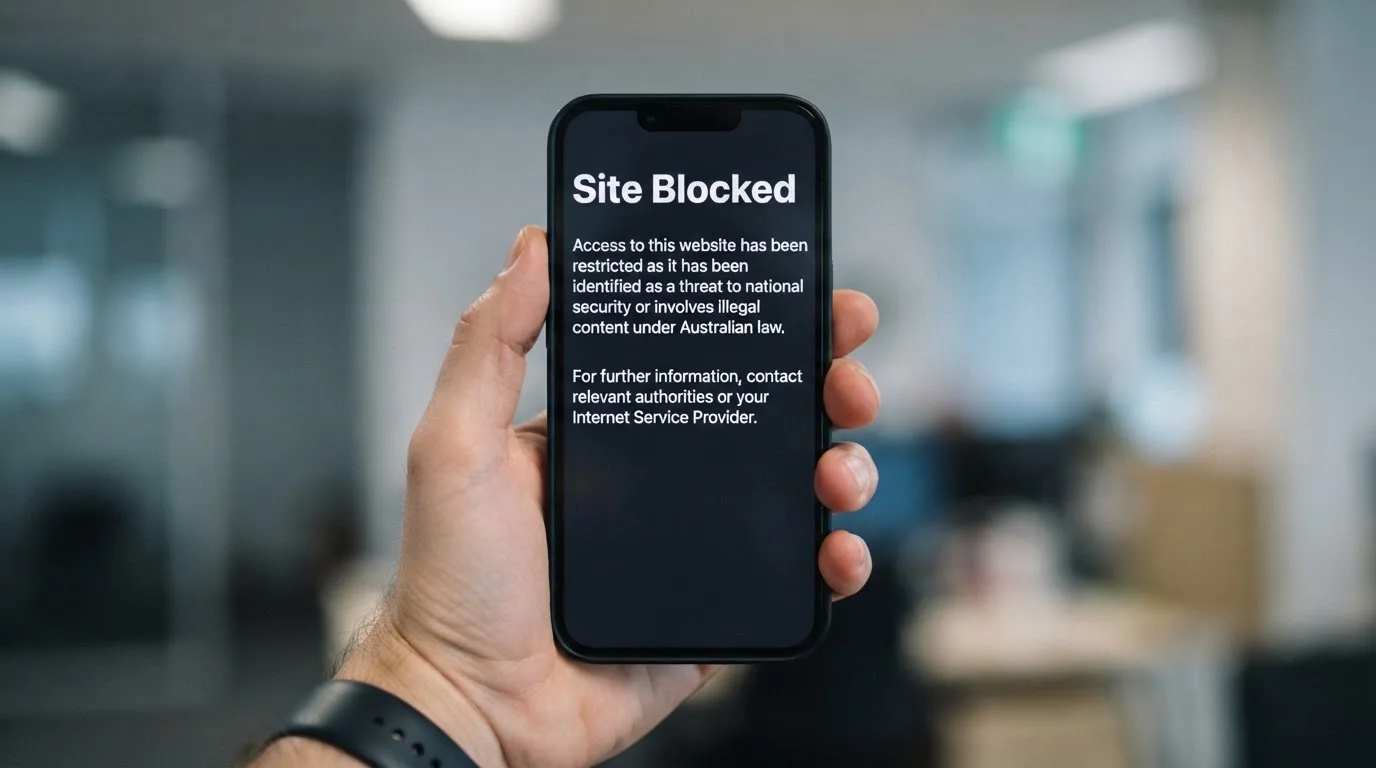
Enforcement has not been theoretical. The ACMA has asked Australian internet service providers to block illegal gambling and affiliate marketing websites since November 2019; by the June 2026 reporting round, the running total reached 1,751 websites blocked across more than seven years. The same reporting round added 12 more names — 7Signs, ChromaBet, Donbet, Duospin, Freshbet, Slots Gem, Jacks Club, Lucky Start, Pointsbetz.com, Spinrise, Vinyl Casino and Wildsino — in a single request. The pace is the figure that matters: across roughly 79 months from November 2019 to the June 2026 round, the average sits around 22 blocking requests a month, or about 265 a year — though the actual cadence has varied sharply with each enforcement round, and the recent rounds have been the heaviest of the series.
Beyond the blocking list, the ACMA issues formal warnings to operators, which is what the eleven brands in the comparison block further up this page are tied to. Each warning is published on the ACMA’s website, names the operator entity and the brand, and gives the operator a period to cease offering prohibited services to Australian customers. Warnings can run into civil penalties; the credit-card and digital-currency ban that took effect on 11 June 2024 carries penalties up to A$247,500 per operator for licensed wagering breaches, though the offshore operators named in this page are by definition outside the licensed-wagering regime.
The scale of the market the prohibition is trying to address is significant. H2 Gambling Capital’s 2025 report estimates Australians lose about A$3.9 billion a year to illegal gambling sites, and the share of gambling going through legal channels fell from 74% in 2021 to 64% — a roughly ten-percentage-point shift over four years, much of it toward offshore casino and sports betting operators that the ACMA’s blocking list targets. The direction of travel is what matters; the absolute loss figure is what gives the direction weight.
It is also important to be clear about who the prohibition targets. The IGA targets the provider — the operator offering prohibited services to Australians — not the individual player. An Australian who plays at an offshore casino is not committing an offence under the IGA. That is a narrow protection. It does not extend to consumer protection, dispute resolution, or recourse if the operator refuses a withdrawal. An Australian player has no ePayments Code right against an offshore operator, no Australian Financial Complaints Authority path, and no Australian court that will hear a complaint about a Malta- or Curaçao-licensed casino under Australian consumer law. The prohibition is doing what it can to push the operators out; it cannot put Australian consumer protection around the players who continue to use them.
The 2026 reform is a partial acknowledgement of the gap. The Interactive Gambling Amendment (Gambling Reform) Bill 2026 passed Parliament on 19 August 2026, with its advertising and inducement measures commencing on 1 January 2027. The bill is law with a start date, not yet in force on a 2026 page. Its effect, once commenced, will be to extend the prohibition’s reach to a wider set of inducements — sign-up bonuses, “free” offers, and the marketing language that surrounds them — and to give the ACMA additional enforcement levers. Whether it changes the offshore operators’ Australian-facing behaviour is a question for the year after next.
The minimum age for any gambling activity in Australia is 18. That applies across the licensed wagering market and is the same age an offshore casino’s terms would impose on an Australian sign-up, even though the operator has no Australian process for verifying it. Tax treatment is the one area where the law is on the player’s side: gambling winnings of a recreational player are not assessable income under section 6-5 of the ITAA 1997, and losses are not deductible. The recreational gambler is in a better tax position than the small-business gambler, who would be carrying on a business of gambling and would need to declare winnings and account for losses differently. The ATO’s website is the model for any specific question; this page does not give tax advice.
Player protection: BetStop and the safeguards that do apply
Australian readers who want to manage their gambling have a set of tools that work, and another set that do not. The most important distinction between the two is which side of the prohibition the operator sits on.
BetStop, the National Self-Exclusion Register, has been live since August 2023 and binds every Australian-licensed online and phone wagering service. A person who registers with BetStop is excluded from opening new accounts, depositing, or placing bets with any licensed Australian operator, and the exclusion period can run from three months to a lifetime. The system is enforced at the operator end — the wagering service checks the register before allowing a sign-in or a deposit — and it is audited by the ACMA. For a player who wants to step back from Australian-licensed wagering, BetStop is the mechanism that works.
For a player who has been using offshore casino sites, BetStop is a partial answer at best. Offshore operators are not connected to BetStop; an exclusion registered with BetStop does not stop a player from signing up to a Curaçao-licensed casino and depositing there. The player is the only enforcement mechanism, which is why BetStop’s value is in preventing accidental return to licensed sites rather than in cutting off the offshore side. A player serious about excluding themselves from gambling entirely needs a self-imposed block on top of BetStop — bank-level gambling blocks, software-based DNS filters, and a written commitment — because the offshore operators have signed up to none of the Australian regimes.
The National Gambling Helpline — 1800 858 858 — is free, available 24/7 and offers counselling, information and referral. The companion service, Gambling Help Online, runs chat-based support. Both services are funded by the Australian government and operate independently of any operator. A reader who is concerned about their own or someone else’s gambling can call the helpline without naming themselves and without committing to anything; the line is staffed by trained counsellors who can talk through the available options and, where appropriate, refer the caller to face-to-face services in their state or territory.
The credit-card and digital-currency ban that took effect on 11 June 2024 is a structural protection that applies to licensed wagering services. A licensed Australian wagering operator cannot accept a credit card or a crypto deposit; the player’s only funding routes are debit card, bank transfer, PayID and Osko, and BPAY. The ban does not apply to offshore operators — by definition, since they are outside the Australian regime — but it gives a player a quick filter: a site asking for a credit card or a crypto deposit is, by its own payment stack, identifying itself as offshore. That is not a verdict on the site, but it is a clear signal.
The player-protection story on the licensed side is reasonably complete: self-exclusion through BetStop, account-level deposit limits enforced by the operator, time-out and cool-off features, mandatory display of odds and house edge, and complaints bodies in each state and territory. The story on the offshore side is the opposite. There is no Australian dispute resolution, no BetStop connection, no enforced deposit limit, and no Australian complaint avenue if a withdrawal stalls. The player is the only safeguard, and the operator is under no obligation to provide any.
The honest read is that a player who is concerned about their gambling should treat any casino offering games to Australian customers — whether the operator has been warned by the ACMA or not — as outside the Australian protection net. The BetStop registration, the helpline, the deposit limits and the self-imposed bank blocks apply to the Australian side; the offshore side requires the player to take responsibility for the entire exclusion themselves. That is a heavier lift than the licensed side demands, and it is the load this analysis keeps returning to.
Frequently asked questions
What does Novomatic actually build?
Novomatic is best known for its land-based slot machines, the Book of Ra and Lucky Lady’s Charm range being the most widely recognised. The online catalogue, delivered through Greentube, includes HTML5 versions of those classics plus several hundred further slot titles, video bingo, table games and a small live-dealer offering. Aristocrat is the Australian equivalent in market position, not a Novomatic subsidiary.
Is there an Australian-licensed online casino offering Novomatic games?
No Australian jurisdiction — state, territory or federal — issues a licence for the online casino games or online pokies that Novomatic produces. The Interactive Gambling Act 2001 prohibits offering those games to Australians, and the ACMA’s enforcement record shows how that prohibition is applied in practice. Novomatic’s Australian footprint is land-based only, through its Ainsworth Game Technology stake.
Is it legal for an Australian to play Novomatic slots at an offshore casino?
The law targets the operator, not the player. An Australian who plays at an offshore casino is not committing an offence under the Interactive Gambling Act. The catch is that offshore operators give no Australian consumer protection — no BetStop connection, no ePayments Code complaint, no Australian dispute body — and the ACMA can block the site with a balance still on it.
Does Novomatic run land-based gaming venues in Australia?
Through its 52% stake in Ainsworth Game Technology, acquired in 2018, Novomatic has a presence in the Australian gaming-machine manufacturing market, but not as the operator of venues. The Australian pub, club and casino floor is dominated by Aristocrat Leisure products. The Admiral and Luxury Leisure venue footprints are European, not Australian.
What should an Australian reader verify before signing up to a site advertising Novomatic titles?
The first check is whether the operator holds an Australian licence — and for online casino games, no jurisdiction issues one. The second is whether the ACMA has issued a formal warning over the brand, which the ACMA publishes on its website. The third is the payment stack — credit card or crypto deposits signal an offshore operator outside Australian rules.