

Best Australian online pokies in 2026: the honest short answer
Current as of 31 October 2026 · Licence and ACMA action verified against the Australian Communications and Media Authority’s published register.
There is no ranked list of the best online pokies sites for Australian players. Not because no one has bothered to write one — the search engine results a person lands on are full of them — but because the underlying product is not licensed in any state or territory. The Interactive Gambling Act 2001, as tightened by its 2017 amendments, makes it an offence to provide online pokies to a person physically in Australia, and no Australian regulator issues a licence for the service. The land-based equivalent sits inside pubs, clubs and casinos under state and territory rules; the offshore offer a search engine surfaces operates outside that frame entirely. The page that follows walks through what is actually licensed, what the offshore sites cost the person who signs up, and what an Australian player has to fall back on if help is ever needed.
Table of Contents
- How money moves at and around these sites
- What a “bonus” on an offshore pokies site actually costs
- Reading a paytable without buying the marketing
- The enforcement record, in the shape the data actually has
- The Australian landscape, in its actual shape
- How the regulator’s blocking programme works
- Where the legal frame sits today
- When the activity stops being entertainment
- What a reader comparing these sites is actually choosing between
- Frequently asked questions
How money moves at and around these sites
The payment routes an Australian sees advertised on offshore pokies sites — PayID, POLi, credit cards, sometimes crypto — are not the same subject as the legal deposit routes for the wagering services Australia does license. PayID is a real thing, and it does sit behind everyday banking through Osko, which is the instant-transfer layer the major Australian banks run. The reason it shows up on offshore casino deposit pages is purely as a faster rail for the deposit itself; the rails a person uses to put money in is a separate question from whether the destination is a licensed Australian wagering service.
For the wagering services Australia does license — bookmakers licensed by the Northern Territory Racing and Wagering Commission, the major lotteries, keno — the legal deposit routes are debit card, bank transfer, PayID/Osko and BPAY. Credit cards, credit-related products and digital currency have been banned as payment for licensed online wagering since 11 June 2024, with penalties of up to A$247,500 for the operator that breaches it. A site asking an Australian for a credit card or for a crypto deposit is therefore not running on the Australian rules at all: the credit-card ban only applies to the licensed set, and the unlicensed set is outside the frame.
The payout side is where the cost shows up. Withdrawing from an offshore site to an Australian bank account means the deposit route is mirrored — PayID in, PayID or direct bank transfer out — but the offshore operator is the only party that decides when the money moves. The Interactive Gambling Act targets the provider, not the player, so an individual Australian is not prosecuted for playing. What that means in practice is that the person holding the balance has no Australian complaints body to escalate to if a withdrawal stalls. The site can be blocked by the ACMA while the balance sits in it. The bank rails do their job; the legal frame around them does not.
What a “bonus” on an offshore pokies site actually costs
The bonus credits and free-spin packages the marketing puts in front of a reader are calibrated for a market where the offer is competing for sign-ups inside a regulated environment. In Australia it is competing for sign-ups outside one. The arithmetic that decides what a bonus really costs the player does not change — turnover requirements, game-weighting tables, maximum-cashout caps and expiry windows operate in the same mechanical way offshore as they do on a licensed site — but the recourse if the offer misbehaves does. If a licensed bookmaker refuses to honour a bonus, the player has an Australian regulator to complain to. If an offshore casino does the same, the player has whatever the operator’s own complaints process chooses to offer.
The mechanism is worth understanding on its own terms. A bonus credit is almost always paired with a wagering multiple: the bonus amount, multiplied by the factor, is the turnover the player has to put through the games before any of the bonus money can be withdrawn. Free spins carry a separate turnover on whatever they win, and most offshore pokies sites apply a maximum-cashout cap on bonus-derived winnings that is much lower than the cap on cash play. The site is selling the headline value, not the value that lands in the player’s account. Reading the headline and reading the small print produce two different numbers, and the small print is the one that holds when the player tries to withdraw.
What that means for an Australian weighing whether to claim: the same arithmetic operates, the same recourses do not. An offer advertised as “100% up to A$500 with 40x wagering” carries a required turnover of A$20,000 before any of the bonus portion becomes withdrawable, on the assumption the player only wagers the bonus itself; if the site weights pokies at 100% of stake and the player uses a A$1 spin, that is 20,000 spins at roughly five seconds a spin — about 28 hours of play against a single bonus. That figure does not change because the site is offshore. What changes is who answers the phone if the player wants to dispute it.
Reading a paytable without buying the marketing
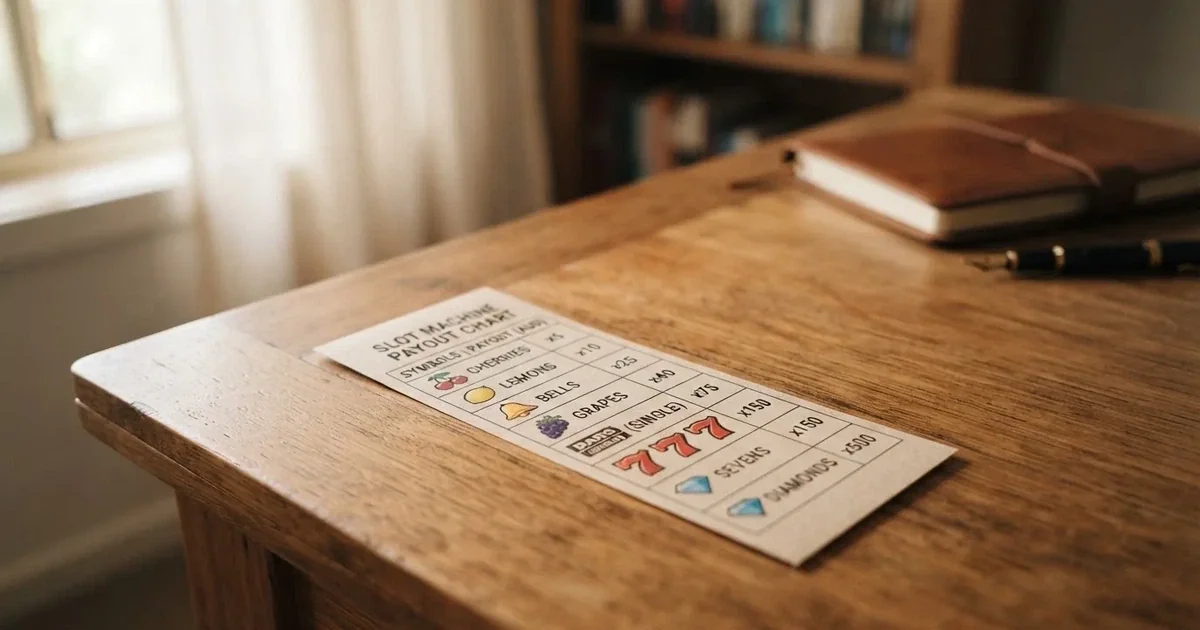
A pokies paytable is the only piece of information the player has about what a game actually does, and the page it sits on is a place the marketing tends to leave alone. What the table shows, before any bonus or feature gets involved, is the symbol-value chart: each symbol’s payout for three, four and five of a kind on an enabled line, and which symbol combinations trigger the feature rounds. The math that drives the whole machine sits behind it — return-to-player, hit frequency, volatility — but those figures are not usually printed on the paytable. They live in the game’s specification sheet, and a licensed Australian pub machine publishes them in a help screen that the player can pull up at any time. An offshore online pokies site is under no such obligation.
That gap matters because the legal minimum return-to-player for poker machines varies materially across Australian jurisdictions, and the licensed venue is the only place that guarantee exists. In New South Wales, the Northern Territory, Queensland and most of Victoria the floor is 85%, climbing to 87% in the Australian Capital Territory and Tasmania, 87.5% in South Australia and 90% in Western Australia — and Western Australia’s figure is a casino-only number, because Crown Perth is the only place in the state where a poker machine can legally operate. Outside those venues, on offshore sites, no minimum applies, and the figure printed in the game’s specification can sit anywhere the operator chooses.
The second layer of paytable information is the volatility class — a description of how a game distributes its wins. A low-volatility game pays out small amounts often; a high-volatility game pays out larger amounts rarely. The shape of the session changes with it: a low-volatility game stretches a bankroll over a longer session, a high-volatility game compresses it. The shape is not a quality judgement; it is a mechanical fact about the game’s mathematics, and it is the difference between an evening’s play and a weekend’s play. The paytable does not always say which class a game sits in. The game’s help screen on a licensed machine usually does. On an offshore site the player is working from what the operator chooses to print.
The enforcement record, in the shape the data actually has
The honest comparison an Australian reader can be offered is not a ranking of offshore pokies sites. The data the page has to work with — a register of ACMA formal warnings — is a list of sites the regulator has acted against, in alphabetical order, not a list the regulator ranks. The shape of the comparison is therefore the shape of the ACMA’s own action: each brand sits in the table because the regulator issued a formal warning over it for offering prohibited services to Australians, with the operator the ACMA named and the date the warning was published. A person choosing between them is choosing between different versions of the same underlying problem, and the page’s job is to lay that out plainly.
| Brand | ACMA action | Operator named by the ACMA | ACMA action and date |
|---|---|---|---|
| RocketPlay | Formal warning under the Interactive Gambling Act 2001 | Pulsup Ltd (March 2026); earlier Dama N.V. (May 2022) | Online casino games cannot be licensed anywhere in Australia |
| Level Up Casino | Formal warning under the Interactive Gambling Act 2001 | Dama N.V. (May 2022) | Online casino games cannot be licensed anywhere in Australia |
| Woo Casino | Formal warning under the Interactive Gambling Act 2001 | Dama N.V. (March 2025) | Online casino games cannot be licensed anywhere in Australia |
| Spirit Casino | Formal warning under the Interactive Gambling Act 2001 | Dama N.V. (May 2025) | Online casino games cannot be licensed anywhere in Australia |
| National Casino | Formal warning under the Interactive Gambling Act 2001 | Consolutetish S.R.L. (July 2025) | Online casino games cannot be licensed anywhere in Australia |
| Bizzo Casino | Formal warning under the Interactive Gambling Act 2001 | Consolutetish S.R.L. (July 2025); earlier TechSolutions (2022) | Online casino games cannot be licensed anywhere in Australia |
| Ignition Casino | Formal warning under the Interactive Gambling Act 2001 | Bamboo Media (July 2025) | Online casino games cannot be licensed anywhere in Australia |
| Instant Casino | Formal warning under the Interactive Gambling Act 2001 | EOD Code SRL (February 2025) | Online casino games cannot be licensed anywhere in Australia |
| Jackbit | Formal warning under the Interactive Gambling Act 2001 | Ryker B.V. (April 2026) | Online casino games cannot be licensed anywhere in Australia |
| Casino Intense | Formal warning under the Interactive Gambling Act 2001 | Sterplay Holding Ltd (April 2025) | Online casino games cannot be licensed anywhere in Australia |
| Sky Crown | Formal warning under the Interactive Gambling Act 2001 | Hollycorn N.V. (September 2022) | Online casino games cannot be licensed anywhere in Australia |
The repeated line — that online casino games cannot be licensed anywhere in Australia — is the only honest verdict the page can attach to each row. The differences between brands are differences in the operator name, the date of the action and whether the operator has been warned before; they are not differences in legal status, recourse, or the protection a player carries into the site. A reader looking for a way to tell these sites apart on quality is looking for a comparison the underlying data does not support.
RocketPlay
Pulsup Ltd received a formal warning over RocketPlay in March 2026, and the same brand had already been named in a May 2022 warning issued to Dama N.V. The brand sits on the ACMA’s published register twice across four years, against two different corporate operators. The reason the operator changed is the mechanism by which offshore brands move between licensees when one is acted against — the warning attaches to a corporate entity, and the brand itself can be re-launched under a new entity. What does not change is the underlying service: online pokies offered to a person in Australia, outside any Australian licence.
For a reader comparing options, the RocketPlay row carries the same single piece of information every row in this table carries: an offshore casino, acted against by the ACMA, with no Australian consumer protection framework behind it. The fact that it has been acted against twice tells the reader the regulator’s view has not softened. It tells the reader nothing about whether the brand itself has changed.
Level Up Casino
Dama N.V. picked up a formal warning over Level Up Casino as part of a May 2022 batch that also named Bambet, Dazard, Rocketplay, Wild Tornado and Cobra Casinos. The 2022 batch is the foundational layer of the ACMA’s enforcement against Dama N.V. — the operator is the connecting thread across half the brands in the table above. The Level Up brand itself has not been the subject of a separate later action, which is a fact about the ACMA’s enforcement calendar rather than about the brand’s conduct.
The same caveat applies as to every other brand on this page: the licence a site displays is not an Australian licence, and an Australian player has no Australian body to escalate to if a withdrawal stalls. The Level Up brand is one of the better-known Dama N.V. labels in the Australian-facing search results, which is the reason the ACMA named it in the first place.
Woo Casino
Dama N.V. received a separate formal warning over Woo Casino in March 2025 — three years after the May 2022 batch. That second action is the ACMA’s response to the same operator continuing to offer prohibited services to Australians under one of its better-known labels, and the timing tells the reader the regulator’s patience ran out in 2022 and has not been extended since. The fact that the second warning came three years after the first is the regulator’s way of saying the 2022 warning did not, on its own, change the operator’s conduct.
Spirit Casino
Dama N.V. picked up another formal warning in May 2025, this time over Spirit Casino. The Dama N.V. footprint in the ACMA’s register is now four separate actions across three years: Bambet, Dazard, Level Up, Rocketplay, Wild Tornado and Cobra Casinos in 2022; Woo Casino in March 2025; Spirit Casino in May 2025. The pattern is the ACMA’s published record of an operator group that did not change course after the first warning.
National Casino
The July 2025 formal warning over National Casino was issued to Consolutetish S.R.L., a different operator name from Dama N.V. The shift in operator name does not mark a change in the underlying service. National Casino is one of several Australian-facing offshore brands that have appeared in the ACMA’s enforcement actions under a sequence of corporate vehicles, and the regulator’s formal warning attaches to the corporate entity currently operating the brand.
Bizzo Casino
The July 2025 action over Bizzo Casino named Consolutetish S.R.L. as the operator. Bizzo had already been the subject of a 2022 warning, that time issued to TechSolutions (CY) Group Limited and TechSolutions Group N.V. The brand has therefore been through the ACMA’s register twice, and twice under different operator names — which is the pattern offshore brands follow when one corporate entity is acted against and the brand is re-launched under another. The 2022 warning did not, on its own, end the brand’s Australian-facing operation.
Ignition Casino
The July 2025 warning over Ignition Casino named Bamboo Media as the operator. Ignition Casino sits on the ACMA’s published register alongside the other Consolutetish S.R.L. warnings in the same month, but with a different operator name. The ACMA’s enforcement actions do not group every Australian-facing offshore brand under one corporate umbrella; the corporate layer is one of the things the regulator has to work through each time.
Instant Casino
EOD Code SRL received a formal warning over Instant Casino in February 2025. Instant Casino is one of the more heavily advertised Australian-facing offshore brands in search results, and the warning is the ACMA’s published response to that advertising.
Jackbit
Ryker B.V. received a formal warning over Jackbit in April 2026, with the same action also covering CasinOK. The April 2026 action is among the more recent entries on the ACMA’s register, and the regulator’s pattern is clear: every six months or so a new batch of brands comes through, each with a different operator name, each offering the same prohibited service.
Casino Intense
Sterplay Holding Ltd received a formal warning over Casino Intense in April 2025. Casino Intense is a quieter brand in the Australian-facing market than some of the others on this list, which is reflected in the fact that it has only appeared in the ACMA’s register once.
Sky Crown
Hollycorn N.V. received a formal warning over Sky Crown and Blue Leo in September 2022. The Sky Crown entry is the oldest on this list and the only one dated to 2022 — the Hollycorn N.V. action predates the 2025 batch that named Dama N.V. and Consolutetish S.R.L. brands. The September 2022 warning is the ACMA’s earliest enforcement action against the Australian-facing offshore market in the form it now takes.
The Australian landscape, in its actual shape
The Australian gambling market a reader is searching within sits in three layers that do not overlap.
The first layer is the licensed wagering services — online and phone bookmakers licensed by the Northern Territory Racing and Wagering Commission, state and territory lotteries, keno. About 52 online bookmakers operate under the Northern Territory licence, including the largest names in the Australian market — Sportsbet, Bet365, Ladbrokes — and the commission that regulates them is a small body with no full-time staff that meets once a month in Darwin. The NTRWC’s thin footprint is one of the reasons the Interactive Gambling Amendment (Gambling Reform) Bill 2026 has reform of the commission on its agenda, with Parliament passing the bill on 19 August 2026. The licensed wagering set covers racing and sport only. It does not cover online pokies.
The second layer is the licensed land-based pokies. New South Wales alone has 87,298 gaming machines outside casinos across 2,195 venues, with player losses of A$8.18 billion in 2022–23. Queensland has 21,122 machines in 351 venues. Victoria has 26,380 machines outside Crown Casino in 488 venues, under a 30,000-machine statewide cap. Tasmania handed its monopoly licence over to a new regulator, the Tasmanian Liquor and Gaming Commission, in November 2021 after decades of Federal Group holding the licence alone, and the same state planned mandatory pre-commitment cards for its machines, with implementation now delayed until late 2025. Western Australia is the outlier — poker machines are banned in pubs and clubs, and the only legal machines in the state are the roughly 2,500 inside Crown Perth, all approved by the state’s Gaming and Wagering Commission.
The third layer is the offshore offer. Online pokies are prohibited for people in Australia under the Interactive Gambling Act 2001, and the only enforcement against the third layer is the ACMA’s blocking programme and formal warnings.
| Brand | ACMA action and date | Operator named by the ACMA | Subject support |
|---|---|---|---|
| RocketPlay | March 2026; May 2022 | Pulsup Ltd; Dama N.V. | no-data |
| Level Up Casino | May 2022 | Dama N.V. | listings-only |
| Woo Casino | March 2025 | Dama N.V. | no-data |
| Spirit Casino | May 2025 | Dama N.V. | no-data |
| National Casino | July 2025 | Consolutetish S.R.L. | listings-only |
As of June 2026 the ACMA’s published register of formal warnings and blockings covered 1,751 illegal gambling and affiliate marketing websites blocked since the first blocking request in November 2019, and more than 230 unlicensed gambling services have left the Australian market since enforcement was strengthened in 2017. H2 Gambling Capital’s 2025 report estimates Australians lose about A$3.9 billion a year to illegal gambling sites, with the share of gambling going through legal channels falling from 74% in 2021 to 64%. The numbers are the regulator’s and the industry’s own estimates; they are the closest thing to a measurement of what the offshore market actually costs Australian players in dollar terms.
How the regulator’s blocking programme works
The ACMA’s enforcement mechanism against offshore pokies sites has two parts: the formal warning and the blocking request.
The formal warning is a published action, attached to the operator name and the brand, and listed on the ACMA’s website. A formal warning does not by itself block the site. It is a public statement that the regulator has investigated, has formed a view, and has put the operator on notice. The operator is given a chance to comply; the regulator’s record shows the warnings it has issued to particular operators have not, on their own, stopped the brand from continuing to be offered to Australians.
The blocking request is the harder tool. The ACMA asks Australian internet service providers to block specific websites at the DNS level, and the ISPs comply. In the round reported on 26 June 2026 the ACMA asked Australian ISPs to block 12 more illegal gambling websites — 7Signs, ChromaBet, Donbet, Duospin, Freshbet, Slots Gem, Jacks Club, Lucky Start, Pointsbetz, Spinrise, Vinyl Casino and Wildsino. A blocked site disappears from Australian internet traffic — the URL resolves to nothing. A blocked site can also still hold a player balance at the moment the block goes in, and the operator can choose to keep servicing withdrawals or can choose not to.
The blocking-rate the ACMA’s published record implies, between the first blocking request in November 2019 and the June 2026 total of 1,751 sites, runs at roughly 260–270 sites per year on average across the period, with the rate varying by round. The June 2026 round alone blocked 12 sites in a single day, and earlier rounds have been smaller and larger. The regulator’s bandwidth has been roughly constant, and the queue of brands the regulator has acted against is long.
Where the legal frame sits today
The Interactive Gambling Act 2001, as tightened by the Interactive Gambling Amendment Act 2017, sets the legal frame. The 2017 amendments strengthened the offences around providing prohibited interactive gambling services to Australians and gave the ACMA its current enforcement toolkit. The Interactive Gambling Amendment (Gambling Reform) Bill 2026, passed by Parliament on 19 August 2026, adds advertising and inducement measures that commence on 1 January 2027 — so as of 2026 the bill is law but the new measures are not yet in force.
What the law prohibits is online casino games, online pokies and in-play betting. What it does not prohibit is wagering on racing and sport placed before the event, lotteries and keno. The distinction sits in the Interactive Gambling Act’s definition of a “prohibited interactive gambling service” and is the line that divides what an Australian-licensed bookmaker can offer from what no Australian licensee can. The credit-card ban for licensed wagering, in force since 11 June 2024, draws the same line on the payment side — the ban applies to the licensed set, not to the offshore set, because the offshore set is outside the regulatory frame in the first place.
The minimum age for any form of Australian wagering is 18. The legal minimum return-to-player for a land-based poker machine varies by jurisdiction as set out in the section on paytables. Tax on recreational gambling winnings is not assessable income, and losses are not deductible — gambling is not a business for the typical punter. A player who carries on a business of gambling is a different matter, and the ATO’s own guidance is the place to look for that edge case.
When the activity stops being entertainment
Gambling Help Online, run by the Australian state and territory health departments in partnership with the federal government, is the free and confidential round-the-clock service for any Australian whose gambling is starting to feel out of control. The National Gambling Helpline is 1800 858 858. The same service has a chat function that runs on the same hours, and the helpline takes calls from mobile phones and landlines without charge.
BetStop, the National Self-Exclusion Register, has been live since August 2023. BetStop binds Australian-licensed online and phone wagering services — a person on the register cannot place a bet with a licensed Australian bookmaker. BetStop does not bind offshore sites, because the offshore sites are not part of the Australian regulatory frame. A self-excluded Australian can still reach an offshore pokies site, which is the practical limit of the register’s reach.
The wider player-protection layer — the responsible-gambling code each licensed Australian wagering operator runs, the state and territory gambling help services, the consumer protection framework that applies to licensed operators — does not extend to offshore sites. An Australian player who has set a deposit limit, taken a cooling-off period, or self-excluded through BetStop has done the right thing on the licensed side. None of it stops the offshore side from accepting the next deposit.
What a reader comparing these sites is actually choosing between
The honest verdict on each brand in the comparison above is the same line repeated, because the data the page has to work with is the data the regulator has published, and the regulator’s verdict on each brand is the same verdict with a different name attached to it. A reader who lands on this page looking for the best offshore pokies site for Australian players is looking for a comparison the underlying data does not support. The reading the page can offer is the reading the ACMA’s register implies: every brand listed has been the subject of a formal warning, every brand offers a prohibited service to Australians, and the difference between brands is the operator name and the date, not the legal status or the player protection.
The closest legal equivalent — the licensed pub, club or casino pokies machine — sits inside the state and territory regulatory frame, with a published return-to-player floor, with a state or territory complaints body behind it, and with the responsible-gambling code the licensed operator runs. The mechanical experience of the machine is the same; the legal frame around it is the difference.
Frequently asked questions
Is there any licensed, ranked list of online pokies sites for Australian players?
No. The Interactive Gambling Act 2001 prohibits online pokies for people in Australia, and no state or territory issues a licence for them. A “ranked list” of licensed sites is a list with zero members; the search results a reader finds instead are rankings of offshore sites, none of which hold an Australian licence.
Does a PayID deposit option make an online pokies site any more Australian or legal?
No. PayID is an Australian real-time payment rail and runs through Osko at the major banks, but the rail the deposit moves on does not determine the legal status of the destination. A PayID deposit into an offshore casino is still a deposit into an unlicensed service, and the legal frame around the destination is unchanged.
What separates a licensed pub or club poker machine from an “online pokies” site?
The licensed machine sits inside a state or territory regulatory frame, with a published return-to-player floor (85% to 90% depending on jurisdiction), a state or territory regulator, and the responsible-gambling code the venue runs. The offshore online pokies site sits outside that frame entirely — no Australian regulator, no Australian complaints body, no return-to-player guarantee, and no connection to BetStop.
Can an offshore online pokies site legally advertise a sign-up bonus credit to Australians?
The Interactive Gambling Act 2001 makes it an offence to provide a prohibited interactive gambling service to a person in Australia, and an offer to a person in Australia is part of providing the service. The bonus credit is a marketing wrapper around an unlicensed offer; the legality of the offer is the legality of the underlying service, and the bonus does not change it. The Interactive Gambling Amendment (Gambling Reform) Bill 2026, in force from 1 January 2027, adds advertising and inducement measures that further restrict how unlicensed offers can be marketed to Australians.
How would payouts on an offshore online pokies site be verified as fair?
They would not be, by any Australian body. The Interactive Gambling Act targets the provider, not the player, so an individual Australian is not prosecuted for playing — but the offshore site gives no Australian consumer protection, no complaints body and no recourse if a withdrawal is refused. The balance can sit on a blocked site. The verification framework the player has on a licensed Australian venue does not reach the offshore site.
Is online pokies play covered by the same ban as online casino table games?
Yes. The Interactive Gambling Act 2001 defines a prohibited interactive gambling service to include online casino games and online pokies as a single class. The ban covers both. The licensed set — wagering on racing and sport placed before the event, lotteries, keno — is the gap, and online pokies sit firmly inside the prohibited class rather than at its edge.